Blog

  • Reality Is Broken

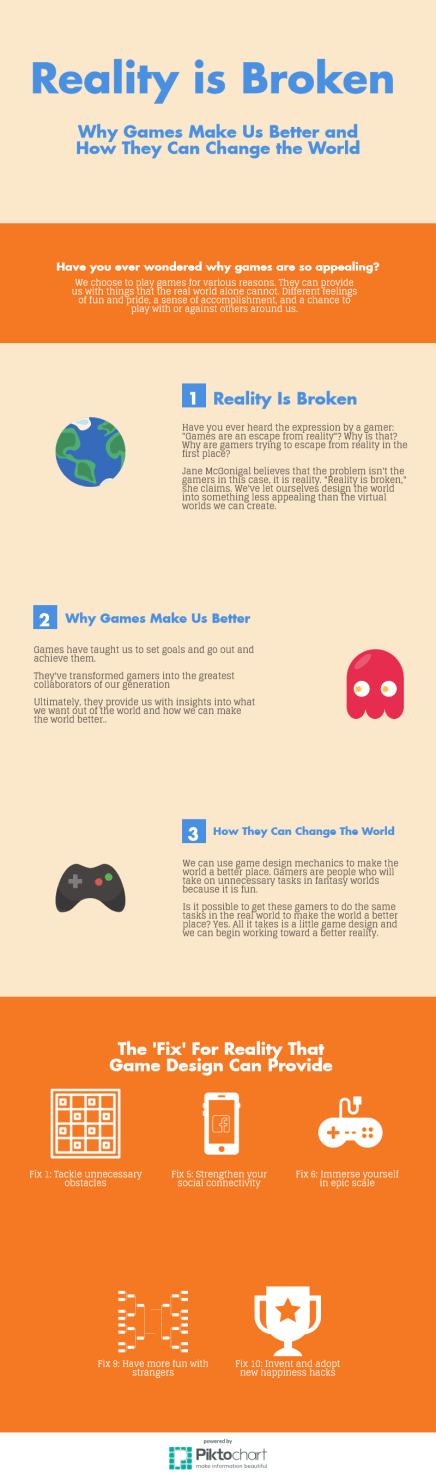
    Tikkun Olam is all about contributing to the repair of the world. What if there was a way to perform Tikkun Olam in a way almost all of us had never thought of before? What if we could help contribute to the repair of the world through video games?

    Jane McGonigal, author of Reality Is Broken and game designer believes that game design can help us make the world a better place. Of course, games already exist and help the world by making a lot of people happier when they play them. But what if we could take the elements that make games fun and apply them to our world to make daily life more fun?

    We can. We can implement game-like mechanics into our own life using what Jane McGonigal calls happiness hacks. Doing this can increase our happiness in the real world just by doing game-like tasks during our daily schedules. She covers some examples of happiness hacks that she has helped design in the later half of her book.

    Games do something else amazing. They convince people to do unnecessary tasks just because it is fun. Those unnecessary tasks, if designed by the right game designer, can actually have value. People could play a game where they design strategies for solving problems like world hunger and military crises. Actually, games like these have already taken place and helped create more informed decisions on situations like those and more. It’s all about getting more people to support games like those.

    If you are interested in the ways that gaming can make the world a better place, read Jane McGonigal’s book Reality Is Broken.

    – Andrew Moody
     

  • So You’ve Been Publicly Shamed

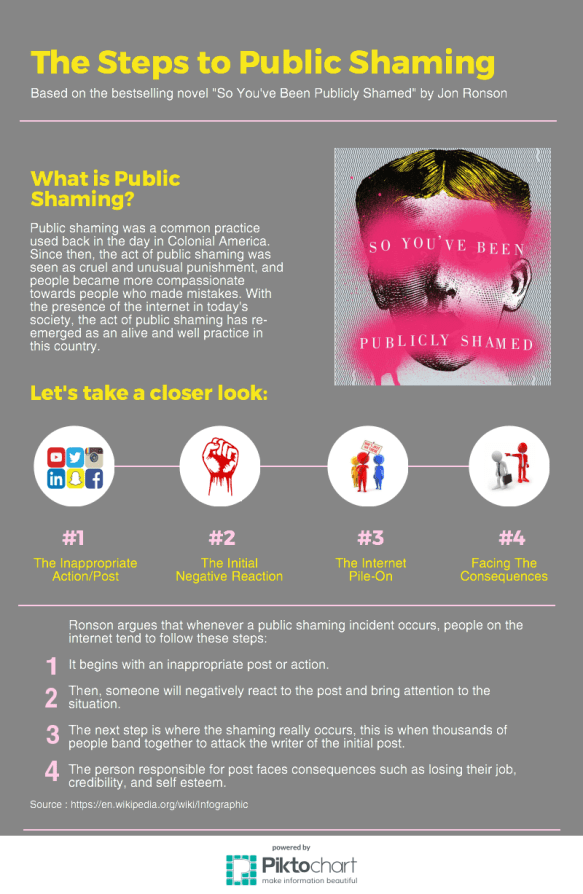
    We have all experienced that moment when you are scrolling through your social media feeds and you come across that cringe-worthy post that is wildly inappropriate and offensive. Jon Ronson’s So You’ve Been Publicly Shamed takes a closer look at what exactly happens when someone is publicly shamed for something that they did or said on the internet.

    block_1


    As shown in the infographic above, Ronson explains the steps that happen whenever there is a public shaming incident.

    Pepsi and Kendall Jenner are currently under fire for their advertisement depicting the supermodel at a protest making peace with the police officers by handing them a can of Pepsi. The advertisement, which was intended to bring the world together, ended up making inappropriate light of the very serious Black Lives Matter protests, Women’s Marches, etc. that have been taken place in recent times.

    Lets take a look at how Ronson’s steps to public shaming apply directly to Pepsi and Kendall Jenner.

    1. The inappropriate action/post06xp-PEPSI-master768.jpgPepsi releases an advertisement featuring Kendall Jenner called “Live For Now Moments Anthem.
    2. The initial negative reaction

    Screen Shot 2017-04-09 at 4.22.34 PM.png

    People begin viewing the advertisement and posting their reactions on social media.

    3. The internet pile-on

    Screen Shot 2017-04-09 at 4.27.07 PM.png

    The advertisement goes viral for all the wrong reasons, and the world reacts on Twitter and Facebook generating a lot of negative attention towards Pepsi and Kendall Jenner.

    4. Facing the consequences

    Pepsi-Ad-Apology.jpg

    Pepsi realizes their mistake and pulls the advertisement immediately. Both Pepsi and Kendall Jenner are left publicly shamed.


  • The Habit Cycle

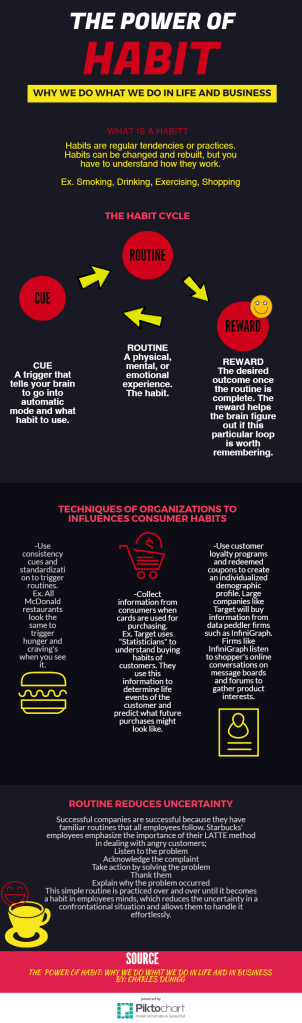
    Every single day a person goes through hundreds of routines. From tying your shoes in the morning, to putting on your pajamas at night, the human brain uses habits to save energy while completing mundane tasks. Habits are the routines your brain has deemed worth remembering. They are suspected to be stored in a place of your brain called the basal ganglia.

    Habits are implanted in your brain, but that does not mean they can’t be changed. Habits can be rewritten and rebuilt. But, it takes a lot of work.

    Breaking a habit is hard, but not impossible. It can be done by taking advantage of the cycle that created it. By keeping the same cue and reward, but changing the routine can rewrite the habit. A person that snacks constantly throughout the day may do so to satisfy the feelings of boredom. By keeping the same cue, being bored, and the reward, of finding something to do, but changing snacking to getting up and walking around, they can change that habit. Changes require consistency and time devotion. A relapse will only damage the process made.

    Advertisers and Marketers use habits to draw in customers and encourage purchases. Large companies like Target will buy consumer demographic information, and then track purchase patterns to predict future buys. Toothpaste companies create a satisfying minty and tingling taste to convince you the toothpaste is working. This is all part of creating a reward worthy of habit.

    The Power of Habit, by Charles Duhigg, introduces these topics and explains the success of changing a habit. Through his book, he illustrates the steps a person needs to take to change a bad habit into something beneficial, and shows that one change can impact other habits in a positive way. We do what we do in life and business because of habits, so read this book.

    -Eva Mewborn

  • The Filter Bubble: How the New Personalized Web is Changing What We Read and How We Think

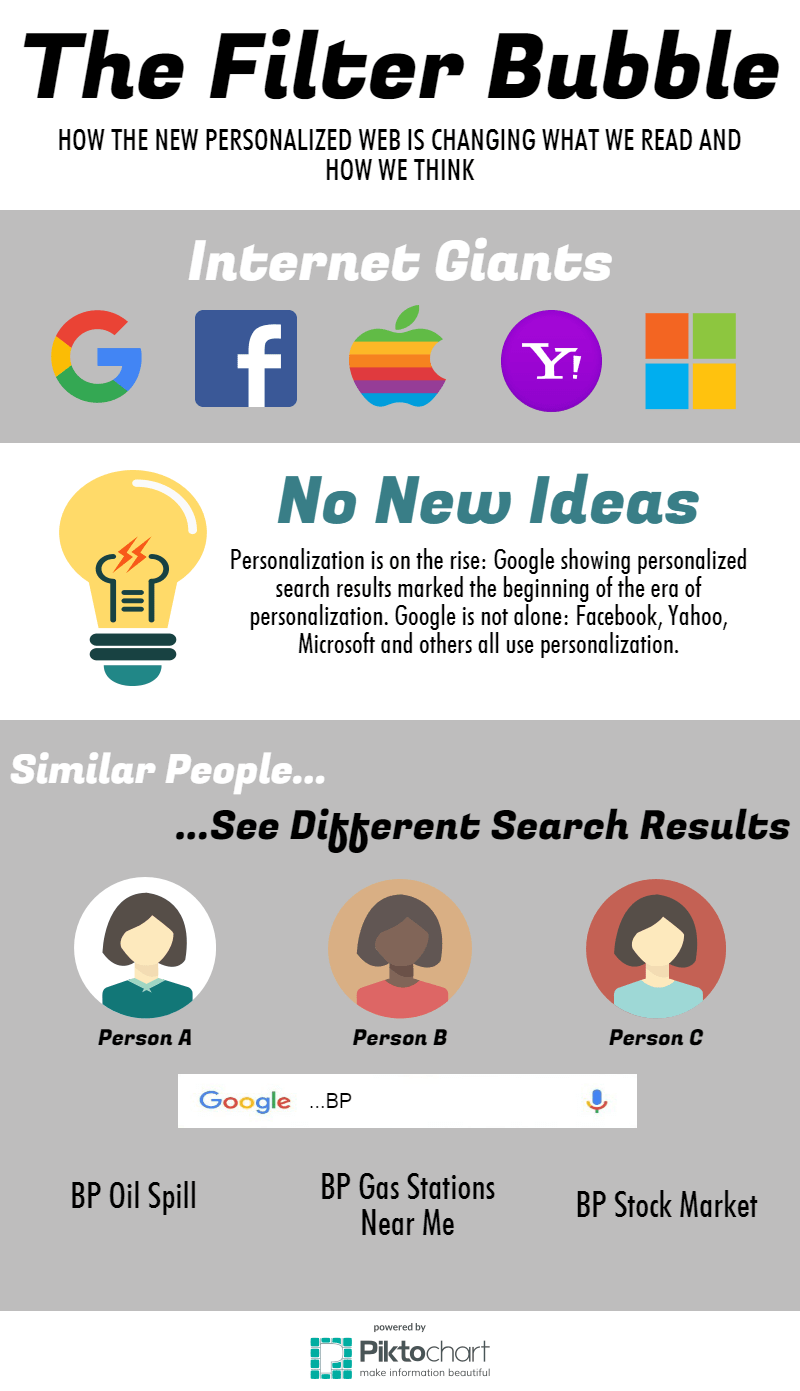
    new-piktochart_21476884_5cd9c89d1740b99959e6c352a004f67605d72cb0Imagine a world where all the news you see is defined by your salary, where you live, and who your friends are. Imagine a world where you never discover new ideas, and where you can’t have secrets.

    This is a world created by personalization, and it’s on the rise: Google showing personalized search results marked the beginning of the era of personalization. However, Google is not alone: Facebook, Yahoo, Microsoft and others all use personalization.

    We’re used to thinking of the Internet like an enormous library, with services like Google providing a universal map. But that’s no longer really the case. Sites from Google and Facebook to Yahoo News and the New York Times are now increasingly personalized – based on your web history, they filter information to show you the stuff they think you want to see. That can be very different from what everyone else sees – or from what we need to see.

    Google looks to your previous queries, and the clicks that follow, and refines its search results accordingly. If you click on gossip blogs like Gawker rather than Netflix after searching for the names of movie stars, links to Gawker may feature more prominently.

    Likewise, if you have hundreds of Facebook friends, you only see relevant updates from your closest friends. Facebook relies on your earlier interactions to predict what, and who is most likely to interest you.

    So, if you’re were following the NCAA tournament, friends who post articles or videos relating to March Madness may feature more prominently than posts from those who couldn’t care less about basketball, even if you are “friends” with them. 


    This is called the filter bubble. The filter bubble is the universe of information individualized for each one of us. It is completely individual, transparent and out of our control. Your filter bubble is this unique, personal universe of information created just for you by an array of personalized filters. It’s invisible and it’s becoming more and more difficult to escape.

    This book, written by Eli Pariser, aims to explore the implications of the filter bubble, mostly focusing on the risks, and to make them, and the bubble itself, visible. This book draws attention to the growing power of information intermediaries.

    This new trend is nothing short of an invisible revolution in how we consume information, one that will shape how we learn, what we know, and even how our democracy works.

    The Filter Bubble reveals how personalization could undermine the internet’s original purpose as an open platform to spread ideas. But it is not too late to change course. Pariser lays out a new vision for the web, one that embraces the benefits of technology without turning a blind eye to its negative consequences, and will ensure that the Internet lives up to its transformative promise.
    So, how are we, as a collective, going to change this? Well, you’ll just have to read the book to find out.

    Kyndall DySard, ’17 

  • Don’t Miss Out On This Event

    Image result for uncw lambda pi eta

    UNCW’s Lambda Pi Eta presents a graduate school panel TODAY Wednesday, March 22nd that features representatives from three communication-related programs in North Carolina. The three panelists include:

    – Elon University’s M.A. in Interactive Media.

    – NC State’s M.S. in Communication.

    – East Carolina University’s M.A. in Communication who also offers a graduate certificate in Health Communication.

    The meet and greet will take place before the panel at 6:00 pm and the panel will begin at 6:30 pm. The panel will be held in the big lecture room on the first floor of Mcneil, room 1051. This will be a great event and we hope to see a big turnout.

    Image result for dont miss out

  • Facing Your Fear Factor!

    This is the 15th annual Professional Dress Fashion Show that we have had at UNCW. This year, the theme of the COM Studies Day Fashion Show is: “Facing Your Fear Factor”.  The theme focuses on the challenges you may face when trying to get a job offer.

    Image result for the handshake gif

    During the show, a prerecorded skit will play that was produced by Com Studies majors. The fashion show gives you different ideas and styles on how to dress either professionally or casually around the workplace. At the show, there will be raffle prizes that you can win that includes a ticket to Jason Derulo at the Azalea Festival.

    Image result for what?! gif

    So come on out this Friday to the Warwick Ballroom at 12:15 to see a fantastic show!

    Image result for zoolander gif

  • What are you standing on?

    If you would like to be intellectually entertained, I have the event for you. Tomorrow, March 21st at 7:00 pm, Dr. Scott has invited Dr. Jade C. Huell to come to UNCW. She is presenting “Becoming a Word Warrior: Performance Studies for a New Personal politics.” Here are three more things you need to know:

    1. It is in Leutze Hall 125 (Studio)

    2. Again, it is tomorrow at 7:00 pm

    3. The event is free and open to the public!

    If that is not enough information to make you want to go then I don’t know what will change your mind. All I know is that it will be a great event so get there a little early to secure a seat.

    Image result for i can't wait gif