Blog

  • The Deepwater Horizon One Year Later: A Brief IMC Analysis

    Today marks the one year anniversary of the BP, Deepwater Horizon disaster that leached millions of barrels of oil into the in the Gulf of Mexico, greatly impacting the Gulf Coast.  In the few days following the Deepwater Horizon incident BP came under tremendous scrutiny for the way they chose to address, or not really address, the media.    The former CEO, Tony Hayward, received the brunt of criticism for comments he made, including telling a photographer to get out during a photo-op on the shores of Louisiana.

    Following the PR nightmare BP created for itself, the oil company had to get to work repairing their image.  How else were they going to keep selling gas to pay for all the damage the oil leak was causing?  The marketing department sprang to action, launching a campaign that touted their commitment to cleaning up the oil spill in the Gulf.  In order to do this they employed tactics and used several channels for delivering their message of being compassionate and concerned about the residents of the Gulf Coast who were affected by the oil spill. Fishermen, hospitality workers, and any others harmed by the Deepwater Horizon accident were going to be reimbursed by BP for the income they were loosing from the impact.  They created jobs in a recession for workers willing to clean up the oil.

    In order to let the public know about all of the things they were doing to combat the oil spill BP aired several television commercials, utilized Facebook, and attempted to use twitter, but were parodied.  They utilized Search Engine Optimization (SEO) and spent millions in advertising on Google and several other search engines each month.  Every time anybody searched for anything remotely connected with oil, a spill, the Deepwater Horizon, BP, the Gulf…you get the picture, BP was pulled up.

    One year after the Deepwater Horizon disaster, BP’s marketing focus has changed.  Yes, they want you to know about their efforts in the Gulf, however they have shifted their efforts to focusing on BP’s efforts to foster sustainability and utilize renewable resources.  Despite the fact that BP’s marketing message has changed they still are employing a synergistic method to get it out there.  This synergistic technique is synonymous with IMC.

    -Eliza Wadson

  • R.E.C.Y.C.L.E. It begins with you and me!

    Are you looking for a fun and easy way to help show support for Earth Day? If you are, there is an all natural rainwater car wash that features music, free food, and children’s activities such as birdhouse painting this Saturday, April 23. The event takes place from 11 a.m. to 3 p.m. at the corner of 16th street and Queen Street. It is hosted by the Wilmington-Cape Fear Home Builders Association, which our very own Allison Day interns for. The event is co-sponsored by the Carolina Green Building. The first ever Earth Day Rainwater Car Wash is completely free of charge and is 100% eco-friendly because the cars will be washed by natural rainwater that has not been contaminated by harmful chemicals.

    How does this relate to IMC? This event has been promoted by the Wilmington- Cape Fear Home Builders Association through non-traditional media with the use of a Facebook event, as well as the traditional media tactic of a press release. The event will also help foster social capital among families within the community by bringing people together to help continue the celebrations on the day after actual Earth Day.

    -Allison Day, Jessica Berinson, Megan Canny, Melissa Gagliardi, & Scott Burgess

  • Branded Nation

    James Twitchell explains in Branded Nation that “a brand becomes not just what we think about an object, but how we think about it.” Branding has become so successful that even institutions we would not think of have fallen into the branded nation.

    In Branded Nation, Twitchell goes deep into the institutions of religion, higher education, and art in our society. Twitchell compares megachurches to shopping malls and how museums have turned into an institution that will do anything such as motorcycle exhibits and have restaurants to increase revenue.

    The most intriguing section in Branded Nation is when Twitchell talks about university and college branding. As students studying in a university, Twitchell makes an important point. Colleges and Universities have accepted branding ever since they have become more alike. It is now a competition and The U.S. News & World Report proves it. Twitchell uses the example of Harvard and how it is all about who has “the best students, the most money, and the deepest faith in the brand.”

    Interestingly enough, Twitchell doesn’t find branding bad. Knowledge and belief will spread if we all become aware of branding and that in it’s self will create a community along with social capital. Branding Nation is a perfect example of why things work the way they do and with Twitchell’s example’s we see how effective/ineffective brands really are.

    -Micaela Fouhy, Brie Golden, Will Cosden, Lindsey Baggett, Andrew Mayer

  • Here Comes Everybody. The Digital Age

    In his book “Here Comes Everybody” Clay Shirky describes the how the new digital age has changed society.  With everyone using smart phones, people now have the ability to film, take pictures, and quickly upload things to the internet before any government or media outlet has the opportunity to catch the story.

    In his book Shirky gives real life examples about how using the power of the internet, the everyday person can create a revolution that hardly anyone can stop. He shows how with everyone having the capability to become their own media outlet, they can quickly gather followers and slowly build a reputation on the web to achieve a large amount of attention.

    In IMC it is critical for us to understand the web as a powerful tool. A negative statement by a client could make its way around the world in no time via the internet and social networking sites. Now and in the future it will be more and more important for people in the IMC field to constantly manage the web to learn what the public is saying about their clients. As the internet continues to grow and be more accessible to everyone, the importance of good IMC will continue to grow as well.

    – Chad Graves, Ryan Kelley, Katlyn Truss, Maxann Keller, Eric Holtzman

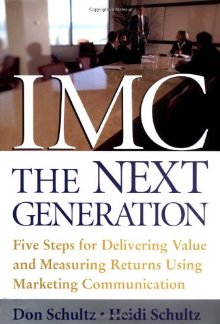
  • IMC, The Next Generation

    IMC is not easy to define.  It is so multi-faceted that it can’t really be summed up in a brief definition.  Even as advanced IMC students who had already taken another class on the subject we had difficulties articulating everything that IMC contains on the first day of class.  Lucky for us we embarked on the first of four reading assignments for the semester, IMC, The Next Generation: 5 Steps for Delivering Value and Measuring Financial Returns.

    This book, written by Don and Heidi Schultz, helps one to understand everything that IMC is and gives the reader a clear understanding of the industry’s practices today.  IMC, the Next Generation is the follow-up to Don Schultz’s 1993 book Integrated Marketing Communication that first introduced the concept to professionals. Although it is not the most thrilling of the books that we have read over the past semester, it certainly provided us with a solid IMC base that we have applied to many different projects and topics.

    IMC, the Next Generation is a quintessential read for anyone in the fields of public relations, marketing, or advertising.  Schultz makes the concepts of IMC understandable and provides readers with great insight into the practice that has revolutionized how brands and campaigns are marketed to publics.

  • The IMC War: Balancing Power and Values

    The aim of college courses is to prepare students for their professional lives.  In our IMC class we have been assigned books that teach us ideas, facts, values, and more.  To teach us more about the importance of values in business we read Niccolo Machiavelli’s The Prince.

    This book is Machiavelli’s guide to holding and seizing power.  The Prince was written in 1513 for Lorenzo de’ Medici, the prince of Florence.  Despite its age, this book remains popular and important for those involved in government, politics, and positions of power.  Machiavelli uses the book as a way to give calculated advice backed up by examples.  Throughout the book, Machiavelli sets morals aside and focuses on how to attain goals of power.  He teaches readers how to use violence, lies, abilities, and luck to force others under your control.

    How does this book teach us values?  After reading The Prince we wrote a memo to our chancellor to either recommend or not recommend Machiavelli as an IMC consultant based off of his ideas within the book.  We had to decide if we were willing to risk our values and beliefs to accomplish our goals as a university. 

    Machiavelli makes decisions based off of research, forms consistent messages, and knows how to accomplish goals in the most direct, efficient way.  This may seem like the way to go if his suggestions fit the company’s mission and vision.  In other cases, this drive to complete a goal without respecting values could ultimately lead to the demise of the company’s image.  We should ask ourselves if the product really is great or if that is just a claim to get more money?  If being great is just a claim the next question is: is it worth it to be dishonest and ignore values to get what we want?  This decision between honesty and power is something many professionals have to face and we were able to learn this lesson with help from Machiavelli’s The Prince.

    – Carissa Niederkorn, Deji Adeleke, Anna Kate Babnik, Tiffany Evans, & Katie Eagle

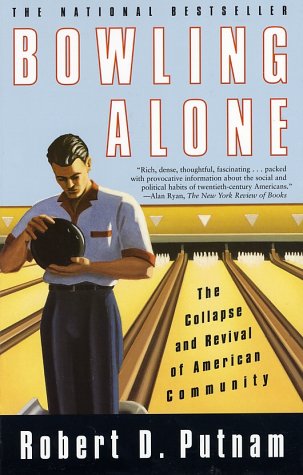
  • Who Wants to Bowl Alone? Not Me?

    One of the books we read this semester was called Bowling Alone, and no it is not about the sport of bowling, much less actually bowling alone. It is about fostering social capital in America. Back in the early to mid 1900s, people were involved in social groups, clubs, and organizations within their community. Everyone was involved, but over the past few decades involvement has dwindled, leading some to believe that social capital in America is non- existent. Before we can explore this book further, we must define social capital. According to Robert D. Putnam, the author of Bowling Alone, “The core idea of social capital theory is that social networks have value.” Basically, being connected with others is beneficial to ones life, and as a member of a group you are able to accomplish more. Life is more meaningful when you have friends, and someone to share happiness and trust with.

    Do you think that social capital is lacking in today’s society?

    Unfortunately, Putnam failed to take into account the age of social media, mainly in part that Bowling Alone was published before such a term existed.  The question now becomes in this day and age, “Does social media foster social capital?” Being connected with hundreds, perhaps even thousands of people, at the click of a mouse does create a network of individuals. On the other hand, can social capital really happen in the digital world? Social capital has always been within ones community, and now since the rise of technology has created a global community, is this still social capital?

    Overall, we think Putnam made valid claims about the diminishing amount of social capital in the United States, mainly in groups and clubs. We think that he should write a newer version of Bowling Alone and comment on the addition of social media to the equation.

    -Allison Day, Jessica Berinson, Megan Canny,  Melissa Gagliardi, Scott Burgess