Blog
-
Kickstarting Your Creativity
Have you ever been lounging around, casually stuffing your face with some nameless artificially flavored snack, when an infomercial blasts on about a product you, your cheese puff eating self, could have created? If only you had the funding for your own inventions and ideas, you could surely top the contribution that the genius wonder that is the Snuggie (a backwards robe) brings to society. Well, back up Shamwow, your creative project can now have a chance at coming to actuality too.Through the Kickstarter program you can potentially obtain funding for your personal creative projects, whether it be a modern picture book of what makes a baby, an art installation of the brain storming process, or even 3D android based playing cards. Whatever your entrepreneurial endeavor may be, Kickstarter is there to help secure your funding. Their slogan is “A new way to fund and follow creativity,” they showcase a project of the day on their homepage and show the percentage of funding the project has already received and how much they still need. Now there are some rules that come along with this free marketing to patrons. The first and most stressed is that no money will exchange hands until the previously stated funding goal has been reached, you can exceed the monetary goal but you must obtain the full amount of estimated project costs. This rule protects both the contributor as well as the project mastermind because the creator will not have to begin making progress on their idea until all of the money is accounted for. There is also a deadline the project creator must set for themselves when they first post their idea on the site. Kickstarter nor the patrons will be allowed to claim ownership over the intellectual property and the money put forth is strictly a donation, not an investment. You also must be 18 or over, sorry mini Wunderkinds.Kickstarter is an interactive platform to display one’s most artistic and ambitious enterprising efforts. This site allows one to broadcast a call for funding of your own great ingenuity. No longer do you have to be a passive bystander on the couch, watching other people’s inventions and ideas succeed, now all you have to do is add a new tab and click away from your Facebook or Twitter long enough to post your brilliant idea on Kickstarter.com. No matter how simple, how complex, how much it costs, or how random it is, Kickstarter will put the word out about your new innovative venture.-Alexis Kapczynski, Kacy Cox, Sara Kaloudis, and Josh Bowman -
Ron Paul, Who?
Over the past eight years, the media coverage regarding Ron Paul has been very lackluster to say the least. Although most of the coverage he has received has been positive, the overall amount is significantly lower than the other candidates running. The messages he supports are often considered the most accurate and truthful by any candidate and many believe him to be the most qualified for the political office. However, the media seems to have its own agenda, and seem to have a different idea on who should be the frontrunner.

Although there are four candidates, CNN seems to believe that only three are relevant. Missing from this photo is Ron Paul, sitting just left of candidate Santorum. Both CNN and Fox News are partially to blame for this so-called “media blackout”, and have not been giving fair coverage to Congressman Paul. When it comes to debates or discussion, Ron Paul seems to mysteriously disappear from the subject and is often overlooked. In a recent interview with Fox News, he states that he has observed that the amount of coverage on himself post-debate has a ratio of about 90:1 in favor of his opponents. This shows a tendency that the media does not believe that Ron Paul has the ability to win the candidacy and therefore neglects to give him adequate coverage.
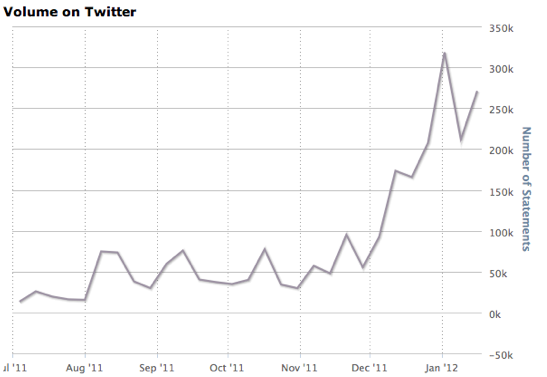
Although the media coverage on Ron Paul is largely absent from television and news broadcasting channels, he receives overwhelming support on major social media networks. Seeing as the majority of his supporters are those of a younger generation, Twitter plays a large part of his support and communication between his fans. During a recent poll, the Washington Post found that from July of 2011 to January of 2012 that the amount of mentions on Twitter significantly increased from about 30,000 to almost 260,000. Compared to Newt Gingrich who had 294,000 mentions, Ron Paul still comes in second. Luckily, thanks to his many loyal supporters there is still a good chance for him to succeed despite the media’s lack of belief.
Leslie Tyler, Leanna Marshall, Bryce Koonts, Julius Roberts
-
Today’s Politics in the Internet Age.
With the Republican Primaries and Caucuses well underway, the candidates are narrowed down to the four main contestants. Mitt Romney, Rick Santorum, Newt Gingrich, and Ron Paul are campaigning across the nation and participating in debates to convince voters that they are what the nation needs in a candidate. How do the general public learn information about the candidates though, if they aren’t campaigning in their state? The answer is found on the candidates’ websites.

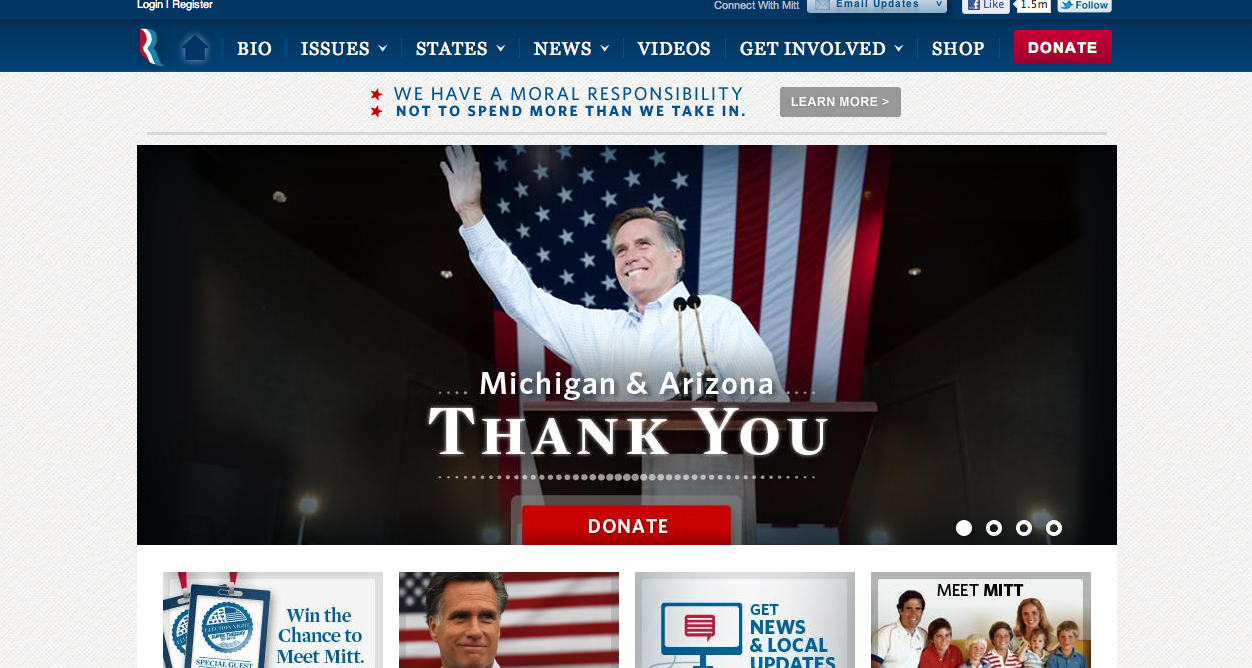
Mitt Romney uses his website to thank the voters in the states in which he was victorious. Each candidate has their own website, run by their political team and volunteers that keep their information (like interviews, media, photographs and messages) up to date. On these sites are direct links to the candidate’s social media outlets, such as Facebook and Twitter, and their Youtube channels to watch ads that have been produced.

Rick Santorum's website has his beliefs and campaign strategy on the main page. Something you will notice on each candidate’s page are donation links, most notable on candidate Ron Paul’s page who needs the money to continue his campaign. For those who want to support their favorite candidates, there is no better way than to go online and donate to their campaign using links found on each site.

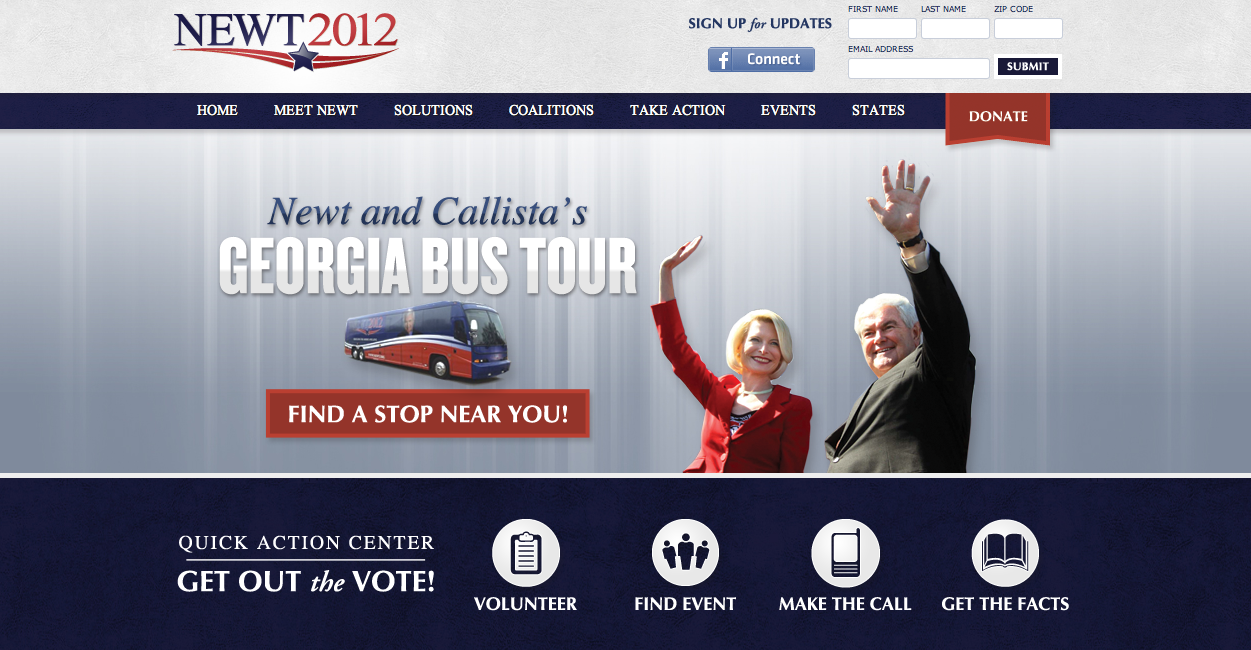
Newt Gingrich uses his homepage to let supporters know where he will be next and how to contact him. These websites are also excellent outlets to connect to mass groups of people at once, without having to pay to run advertisements or receive television or print media coverage. For candidates who don’t receive as much media coverage as they feel they deserve, this can be a vital part of their campaign. Since so much information is traded on the internet now, much of the general population is turning to the internet to learn more about the potential leaders of the United States.

Ron Paul's main page takes you directly to his donation totals to try to get more support for his campaign. –Joshua Vester, Molly Jacques, Ashley Oliver, and Hunter Wilson.
-
Wait, they care about my vote?
Candidates have really been trying to “woo” young people to vote. This demographic can be quite difficult to motivate and actually get them to do something. They all just really need someone who they can relate to before we can make a decision, you know like a celebrity who is endorsing one of the candidates. Remembering back to the last election, this was very successful in Obama’s favor. Many famous people were sporting the always fashionable Obama gear. He even made it on the runway! Who wouldn’t want a president that has made it on the Paris fashion runway?
Of course, not all ploys to get the youth to vote are quite so extreme and over the top. Rock the Vote is one of the biggest organizations trying to get young people to vote. They use pop culture, music, and new technologies to get them to register and have successfully signed up over five million young voters. The Millennial Generation makes up about 1/4 of the voting population which makes them an important demographic for politicians to market themselves to. Just in the last presidential election alone Rock the Vote registered 2.5 million voters. This was by far their highest number they have had yet.
College campuses are another great outlet for getting the younger crowd to register to vote. Statistics show that there is a much higher rate of educated youth voting versus the ones who didn’t attend college. This is the most convenient way to motivate this apathetic age group. Having an on campus presence is a good reminder of how easy it is to register. Since the 2000 presidential election it has been forced by federal law for postsecondary institutions to make a good faith effort to distribute voter registration forms to all of their degree seeking students.
The Presidential candidates now take the Millennial Generation a lot more seriously, then they ever did before. They want their voting numbers to go up and this large demographic can be the boost they need. As a member of this generation, I wonder what tactic they will use next to sway my vote?
– Mollie Berthold, Laura Simmons, Christina Stevenson, Dorothy Conley
-
Need Help Voting? There’s an App for That!
While the pressure is on for candidates in the upcoming 2012 presidential election, social media is not taking a break in helping voters make the best decision either. Twitter accounts and Facebook pages are always the go-to websites with social media. They are effective in getting different views from different people and users have control over who they follow and what information they want to receive. Now with the transition into the use of smart phones, users can not only have instant access to their two favorite networking sites but they also have the possibility of downloading applications (apps) specific to their interests.
With this new technology, the presidential campaign is now open to even greater possibilities and the chance for voters to really connect with the candidates in a new way. Apps like Politifact and Political Fury give voters the opportunity to not only find out specific information on a particular candidate but also to compare them head-to-head in terms of their policies and values. With these new apps you can look into informational editorials and even have the opportunity to voice your own opinion on a specific candidate or policy you have chosen to support. With some you can even take part in polls to give campaign leaders a chance to see what people think of their candidate. On one app, voters can choose to follow specifically Republican or Democratic candidates and tune in to radio stations or watch videos that cover them.
In recent non-political events, such as the Superbowl or the Grammys, marketers have used social media to track how viewers respond to certain ads or particular performances. This use of viewer feedback, in turn, gives marketing teams and event organizers a chance to enhance their next event due to a direct connection with their audiences. The same goes for politicians. Campaign leaders can now review how their candidates are being understood through hashtags on twitter, repeated key words on Facebook, and how voters use the apps on their smart phones. This presidential campaign is taking place largely through social media. One example being the controversy over whether Ron Paul is being represented well through major news stations. This issue has created quite the buzz in social media and in turn is allowing more people to do their own research into his policies. In a way it could be a pretty good tactic for Paul as the campaign develops.
By: Sara Kaloudis, Kacy Cox, Alexis Kapczynski and Josh Bowman