Blog

  • An “Augmented” Look Into the Future of Advertising

    Last week Google unveiled Project Glass, their latest developmental project set out to design and build augmented reality eyeglasses. Google upload a video to YouTube entitled “Project Glass: One day…”, which shows viewers what Project Glass could potentially look like. Project Glass would allow you to communicate with friends, schedule appointments, get directions, take pictures, and even hold video conferences all by using the augmented reality interface and voice commands. While this technology is in the earliest stages of development, Project Glass has the potential to be a realistic and marketable product in the future.

    While the announcement of Project Glass is only a week old, there is already concern about user privacy and advertisements. Google already uses search terms to customize advertisements, and are even beginning to push ads based on your location, so just how far would Project Glass go? Would advertisements pop-up in front of you if you are close enough to a store? Could marketers use where you go and what you look at throughout the day to better understand what type of consumer you are? The parody video below shows how pop-up ads with Project Glass might look if they were implemented:

    While this idea of “forced advertising” seems a bit extreme, it’s already happening with several other projects. Twitter now adds Promoted Tweets to your timeline, which are sponsored announcements from businesses that merge together with the other tweets from people you follow. Pop-up ads are common with free Android and iPhone apps, and some applications even send ads as a notification. Amazon sells discounted Kindle e-Readers with “special offer” advertisements that appear on your screen. It seems that with every new piece of technology, the first idea that is addressed is how to advertise on it. With Project Glass, the possibilities for customized advertising are much more personal. How will marketers adapt to changing technology? Will consumers be willing to sacrifice their privacy and accept interruptive advertisements in order to use Project Glass? Only the future will tell.

    -Hunter Wilson, Joshua Vester, Ashley Oliver, Molly Jacques

  • Praising the Purple Cow

    Technology is the medium of choice for the young adults in today’s society.  They have Ipods, Androids, Macs, PCs, Bamboo pads, and many more cool things. Until now, no one has thought of combining all of these favorite gadgets into one device.
    Fujitsu has come up with a laptop concept that incorporates a tablet, phone and camera called the Lifebook 2013. You can detach its digital camera and use it separately, detach the tablet and use it as such or leave it attached to use as the laptop’s keyboard or touch drawing area. It also comes with a phone that is housed in the side. All of the pieces are synced when inserted into the laptop. This concept is one that is going to bring technology to the next level and will open up a new niche for companies like Dell and Apple to compete with.
    This is a perfect example of how, just like technology, advertising is continually changing. Seth Godin, in his article “In Praise of the Purple Cow”, tells us that we always have to be looking for something that stands out, and if we don’t find it, create it. That is exactly what Fujitsu did; they saw that we have so many technological gadgets that we like to carry around and from that, they made a purple cow. This general idea is something people have been doing for years and we all enjoy the inventions that have come from it. So don’t forget, from time to time, to praise the purple cow.
    -Dorothy Conley, Christina Stevenson, Laura Simmons, Mollie Berthold
  • TechKNOWLEDGEy

    Changes in time catalyze changes not only in society but in the tools we use to connect with one another. From the telegraph to instant messaging our advancements in technology are so rapidly developing that some struggle to stay up to date. It has been a little over a century since the telephone was invented, and in that time we have managed to transform what we used to call a telephone into a device called a smartphone. We’re looking at you, iPhone. Not only have we managed to globalize communication in the last century but we have wrangled the use of the internet to help businesses communicate with their customers and allow friends to stay in touch. It is no wonder that with everything changing and developing so quickly that companies are turning to IMC consultants to help them keep up with the new technologies.

    As mentioned before, changes in time demands a change in tools. If a company can not manage their image there are people in public relations and integrated marketing communications that are fluent in the tools of social media and gauging the power of search engines. A smaller, local company may weaken if their consumers can’t access them as easily as others. Almost every business needs a website to maintain credibility and to inform the consumer of their services and locations. If it weren’t for technology, jobs for IMC and PR consultants wouldn’t have evolved into what they have become today. The more outlets for customer interaction the more roles that are needed to ensure a coherent brand message is being sent out and maintained through all possible points of contact. We are in constant change and with technology on the move it is imperative for a company to be able to communicate with its consumers by utilizing  the appropriate medium. Seriously, when was the last time you thumbed through the yellow pages to find a business? If you need to find something, you get on Google, enter your desired search and click on the best match that Google provides.

    For companies, staying relevant with modern technology is essential to creating a presence for your brand and technology today is allowing them to do so by employing multiple media outlets so that people can communicate with their brand. As the semester begins to draw to a close, a new crop of graduates will be entering into the job market, it’s imperative to keep in mind the true impact of the role of modernity. A company’s mastery of technology and multimedia tends to correlate with their success, in a time where “that was so five seconds ago” actually holds some truth. It is vital that businesses continue to make exponential progress, but unfortunately, this also means that like your now ancient VHS player and WalkMan, your brand new iPhone will soon be considered passe. Siri will be a thing of the past, something that the next generation will mock at throwback parties while rocking a Snuggie and some skinny jeans, poking fun at what lies in the past while riding the technological wave towards the future.

    By: Kacy Cox, Alexis Kapczynski, Sara Kaloudis, and Josh Bowman

  • Are you Getting What you are Playing for?

    Call of Duty is one of the top leading video game brands of all time.  Video gamers line up for hours on end prior to the release of the newest edition to Call of Duty.  Regardless of how much gamers complain about the issues that are attributed to the newest game, people still buy the game.  Why are gamers throwing so much money at a franchise that does not deliver like it used to?  Activision and Infinity Ward have developed something super successful.  Not the video game itself, but the brand behind the game.

    Anymore, the video games that are next in line with the Call of Duty series are sold before they even hit the stores.  Last year alone, with the release of Call of Duty Modern Warfare 3, Activision and Infinity Ward recorded a record $1.7 billion in sales before the actual release date.  What makes a brand sell so well before it is actually played?  The hype.  The promise of delivering one of the greatest games ever brought to a video game console.  That’s what sells.  In a world that is completely run by electronics, video games are the king.  Players line up around the corner to await their turn to buy the newest game and get home to play.

    Some fads in video games never fade away. For example, classics like Mario Kart, Donkey Kong and Super Mario Brothers all have evolved with each new gaming system and never died out.  What makes games like those stick around?  I mean, no one plays duck hunter from the original super Nintendo anymore.  Playing games we played during our childhood take our imagination back to when we were a kid.  Video game developers market specific games to specific generations in order to maintain the life-long bond we share with our favorite characters and bring up conversations like “is it really cheating if you play as Odd Job in 007 Golden Eye and have the golden gun?” or who stole your star in Mario Party.  It’s all about creating a brand identity and associating it with a generation who will have an emotional bond with the game.

    Julius Roberts, Leanna Marshall, Leslie Tyler, Bryce Koonts

  • The trend of helping others

    With everything that is happening in the world today, it is nice to see that others are using their products to direct consumers’ attention to things other than America’s economy. Some companies have created a brand based on helping those in need. This trend has been one that can actually make a difference in the world we live in. These companies are using their consumers’ ethos to make them feel as though they are doing the right thing by buying certain products. This marketing tactic has proven to be a successful one because two brands especially have become increasingly popular throughout their mission to help those who truly need it.  

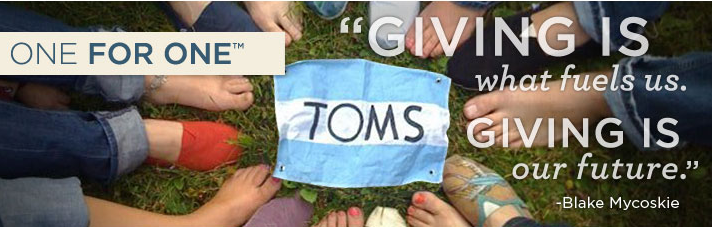
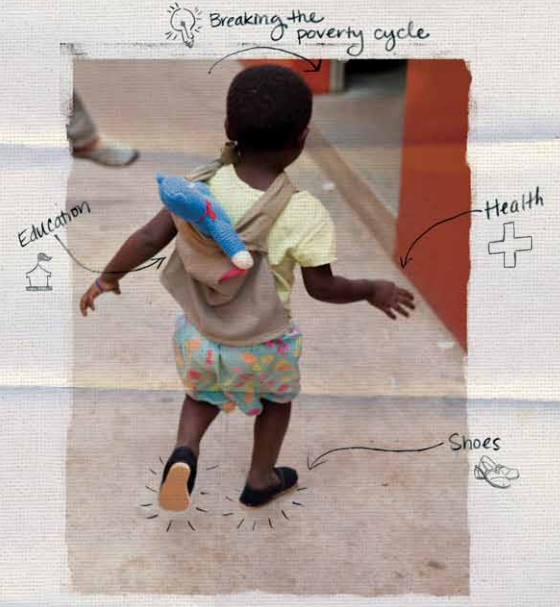
    If you haven’t heard of TOMS, you aren’t in with the latest trends.  Here on the campus of UNCW especially, TOMS are almost as big of a hit as Rainbows.  Not only do they look amazing and feel great, the TOMS brand is all about giving back.  For every pair of TOMS sold, the company donates a pair of their shoes to people in need.  The TOMS brand started back in 2006 with the creator’s trip to Argentina, where he saw first hand how many children had no shoes to protect their feet.  This is not only true in Argentina, but in many other developing countries where children grow up barefoot.  The TOMS brand slogan is ONE FOR ONE and is making a major impact on the trend of helping those in need.

    Chegg is a resource that hundreds of thousands of students utilize around the world to rent or buy textbooks to save money. One of Chegg’s incentives for students to rent or buy textbooks from their company is their philanthropic marketing strategy.  Chegg markets to their consumers that with their support, Chegg can plant trees around the world. Today, Chegg has planted over five million trees with their partnership with American Forest Global ReLeaf Foundation.  As stated on Chegg’s website these trees are planted worldwide to, “help regenerate areas damaged by wildfire, strengthen River Bounds, and restore wildlife habitats.”  In 2011, 175,000 trees were planted in Pondicherry, India, 40,500 trees were planted in Colorado and 700,000 trees were planted in Florida, just to name a few.  Chegg inspires students to be a catalyst for change around the world.  When their consumers purchase their textbooks through Chegg they can make a difference in the world by improving the environment.

    -Kelsey Bendig, Andrea Blanton, Brooke Keller, Brian Burch

  • So is it not hip to be hip anymore?

    “Hipster”. By now, I’m sure everyone reading has probably heard this word thrown around to describe someone. It has a great deal of meanings now, some more relatable than others. Urbandictionary.com defines a hipster as ” a subculture of men and women typically in their 20’s and 30’s that value independent thinking, counter-culture, progressive politics, an appreciation of art and indie-rock, creativity, intelligence, and witty banter”. What sounds like a common description for a large group of people has been boiled down now into an image, one which companies and a select group of consumers have been embracing recently.

    So what makes a “hipster”? Some people believe it’s the type of music you listen to, or the clothes you choose to wear. Other people think it’s the attitude about the music and clothes you have also chosen to wear. “Skinny jeans, cardigan sweater, and listening to Neutral Milk Hotel…yeah, that guy’s a hipster”. Ironic sayings on t-shirts, listening to obscure music on their vinyl records, and drinking home-brewed fair trade blend coffee. These seem to be the most common conceptions of what classifies a person as a “hipster”. With such a large trend being developed, of course fashion companies are going to developing products appealing to the trend.

    Like many fads from the past, "hipsters" are just an evolution from the previous popular trends.

    Urban Outfitters and American Apparel are both companies that cater to a more “hip” lifestyle. Carrying a large variety of plaids, cardigan sweaters, and tight jeans, both companies have been considered a “hipster haven”. Both companies know this, have accepted it and are now running away with it. Urban Outfitters now sells 35mm cameras and Holga copies, because there is a common interest in those who some would call a “hipster” and their interest in photography. Also on their site, you can make your own screen prints, and even build your own fixed gear bicycle, both things targeting directly to those who are attempting to follow the “hipster” trend.

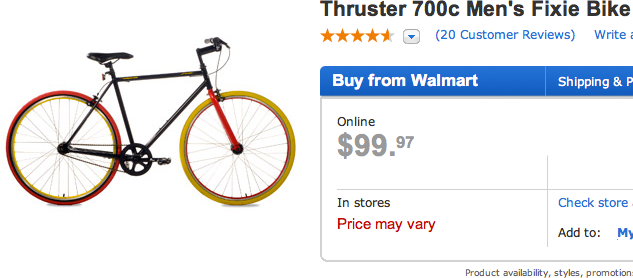
    Walmart attempts to capitalize on the fixed-gear craze by offering a low-priced bike called "The Fixie".

    Companies today are smart. They realize that the trend of “hipsters” including their fashion sense and their interests have been on the rise, and are adjusting to the demand in order to deliver what sells best. They also are targeting this demographic through their advertisements via email and internet ads featuring models who roughly resemble “hipster fashion”. The trend does not seem to be dying out any time soon, as more and more people are starting to embrace it for themselves, so we can expect to see more and more companies reaching out to these consumers in an attempt to show how “hip” they can be in order to sway them into buying from them. What it simply boils down to is another label for another trend that is ripe for the capitalization on, and it seems like many companies are doing just that.


    -Joshua Vester, Hunter Wilson, Ashley Oliver, Molly Jacques

  • Never Say Never

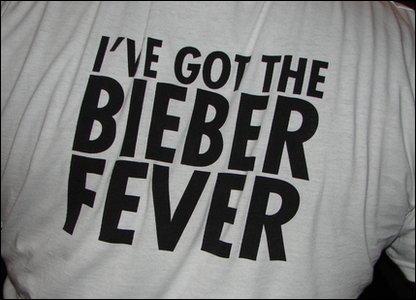
    Noun: a sickness, that has recently been becoming more common, where a girl, or boy, is extremely obsessed with Justin Bieber, and everything related to him. There is currently no cure.
    Justin Bieber is a name known through every household in America, whether a teenage girl is living there or not.  This heartthrob has been breaking hearts with his precious smile and his beautiful vocals since releasing a single in 2009.  His signature move: the hair swoop, has been making girls drool and his voice has recently been compared to a combination of Fergie and Jesus.  So, how did this pre-pubescent boy become such an America’s sweetheart?

    When Justin was just a boy, his mother decided that he had a raw and unforgettable talent.  She began posting homemade videos of her son singing his heart out all over YouTube.  The number of views that these videos received was astronomical.  Every day, hundreds of thousands of music fans viewed his videos and eventually, major industry insiders such as Scooter Braun, began to take notice of Justin’s talent. Braun quickly began recording Bieber and got him the opportunity to sing for R&B singer and songwriter, Usher.  He then signed with Raymond Braun Media Group. In 2009, Justin released his first single “One Time” that put him in the Top 30 around the world, and later his album entitled My World went platinum in the United States. Bieber is definitely America’s newest heart-throb.

    Can you Belieb it? He’s a talented singer, song writer, and can make any girl fawn over him.

    Justin Bieber’s mom started posting videos of Justin’s performances at the age of twelve and her efforts paid off because this lead to his famous discovery. Bieber can reach out to his fans better by uploading his music videos via his YouTube channel. His “One Time” Video earned him millions of hits through his channel. Braun took advantage of the YouTube channel in promoting Justin Bieber before he was even signed under RBMG. Justin Bieber continuously makes new posts of his music videos and his appearances on television shows and behind the scenes clips. Bieber found the right avenue to showcase his talents by using YouTube and eventually other social media outlets, such as opening a Twitter account so he could interact with his fans and supporters or you can find his Facebook page for updates. There is no denying through all these social medias Justin Bieber’s career has succeeded. It is easy to see that it’s not just young girls who have contracted Bieber Fever with the outrageous amounts of status updates, tweets, and blog posts that are all about him.

    So, what makes Justin Bieber a brand known through every household in America?  It’s not just the combination of his signature hair swoop, his purple button down, his skinny colored jeans, or his sensational voice.  Justin has branched out to creating perfumes and colognes, while also making himself incredible to the world of philanthropy.  Justin makes sure to give back to his fans.  He even spent Valentine’s Day, not with his girlfriend, but with one of his dearest fans, Avalanna Routh, a six year old suffering from an aggressive form of cancer.

    Will there ever be a cure for Bieber Fever?  We sure hope not!  With his angelic voice and his sweet face glossing every tabloid on newsstands, who would want a cure?

    -Laura Simmons, Christina Stevenson, Dorothy Conley, Mollie Berthold