Blog

  • Liam Neeson’s Revenge at Super Bowl XLIX

    Happy Monday everybody!! Were hoping that everyone, or at least most of you guys watched the Super Bowl and saw the New England Patriots beat the Seattle Seahawks. Although the Super Bowl last night was one of the most exciting championships to watch in the past few years, the commercials did not seem as great as previous years. Do you guys agree? However we weren’t disappointed after watching Liam Neeson’s commercial with Supercell and their very popular smartphone game called Clash of Clans. As we know Liam Neeson is most popularly known for his violent and crude character, which he has displayed in the past few years in the movie series Taken. Supercell picked a celebrity like Liam Neeson to attract an older audience that may be new to mobile gaming, an audience who may be fed up with the game and wanting to quit, and finally an audience looking for a new mobile game to spend their free time playing. Supercell picked an all-in-one knockout actor to provide the audience with a glimpse of what the Clash of Clans experience entails. This commercial ran up a total cost of $9 million, which is a lot of money to say the least. However, according to Forbes, as of 2013 Supercell totaled a revenue of $892 million. With this being said, the commercial is sure to boost their revenue yet again.

    After watching this Super Bowl commercial it is evident that Supercell effectively utilizes George Gerbner’s Cultivation Theory. According to Griffin (2011) resonance and dramatic violence coincide directly with Supercell’s Super Bowl commercial. At the start of the commercial the viewer sees Liam Neeson’s ‘village’ completely destroyed from another player. This experience is relatively common with this particular game, an experience that players deal with multiple times throughout each day. Current players who viewed this commercial can relate to the anger and need for revenge that Neeson displays. This combination amplifies the cultivation of the game through the dramatic violence displayed when a village is attacked in both the commercial and in the game itself. Supercell’s brilliant use of Neeson and the Cultivation Theory definitely has changed the opportunity to market mobile gaming and has stretched the boundaries of what it takes to make a successful Super Bowl commercial, that reaches a larger audience effectively. If you haven’t seen the commercial it is linked to this post, go watch it! What other commercials from Super Bowl XLIX did you enjoy?

    -Colby Cummings, Connor Gold, Chase Seymour
  • Sixth Time’s A Charm for Athletic Logo?

    Wednesday night marked an end to a year-long process of rebranding and redesigning the athletic logo for UNCW. The design was created by Joe Bosack & Company for $26,500. The company has a long history of redesigning university logos and UNCW expects the redesign to boost merchandise sales.

    Senior associate athletic director Rob Aycock claims that this new logo will be beneficial to the athletics program as a whole.“We think that this is going to be money well spent, to open up new revenue streams to better support our student athletes in the future,” Aycock explained.

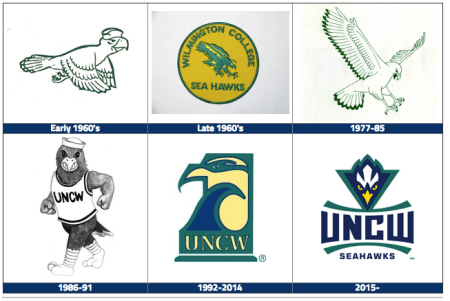
    This is the sixth logo for UNCW in its 68 year existence and the first redesign in 22 years. The department of athletics hopes that this new logo is more “aggressive” and “aspirational” than ones in the past. Below are the logos that have been used here at UNCW since the 1960’s.

    Screen Shot 2015-01-29 at 11.46.01 AM

    Students and alumni sounded off on Twitter Wednesday and Thursday night, expressing their thoughts on the new logo.

    https://twitter.com/DDorantich/status/560833772438827010

    https://twitter.com/TaylorHood/status/560830365615788032

    https://twitter.com/CaroDEscobar/status/560580810068459520

    Do you think the rebranding of the athletic logo is an improvement?

  • The Power of Perception

    The Power of Perception

    The Super Bowl offers companies a great opportunity that most take advantage of. It allows advertisers to appeal to a large number of potential clients, but more importantly, gives them a chance to change their brand identity, or to improve it.

    Featured image

    Super Bowl XLIX is going to have a power house of companies spending millions of advertising dollars to reach millions of viewers. According to the Nielson list  last year 111.5 million people watched the Super Bowl, and it’s commercials. Personally, I believe the commercials are half the fun if your team is not in the running. Companies build entire campaigns around a 30 second bit, and it works. The Super Bowl is an unofficial holiday, where people everywhere get together to see which team will rise to victory, or which company is going to have the best commercial.

    Some brands focus on changing perceptions consumers have during this time. They shed new light on an old product, or maybe change their usual target market. I always thought that Dove was a ladies product, from their deodorant to their hand soap. But Doves’ new commercial focus on the relationship a father has with his child. A bond that is best described as an unbreakable one, a fathers love. Today.com describes the commercial as a “tearjerker for the dads.” After I saw it I couldn’t agree more. Dove is appealing to the pathos of fathers viewing this commercial. It has a strong and clear message. The message redefines dove as a unisex product showing the real strength of men.

    The commercial’s aim is to change how the consumer feels about the product, while also rebranding towards a new target market, men. I’m excited with what Dove has brought to the table and I cannot wait to see what other commercials are aired during Super Bowl XLIX. For a full list of companies advertising in this year’s Super Bowl check out Adage.com.

  • Doritos is Trying to Crash the Super Bowl

    If you haven’t heard yet Doritos is trying to crash the Super Bowl. This is all a part of a four-step process where Doritos allows people to compete globally to create a 30-second Doritos brand commercial to air during the broadcast of Super Bowl XLIX. This competition started eight years ago, and each year it is revamped to keep it new and exciting. This years special twist is the winner will score their dream job working for Universal Pictures and a guaranteed US one million dollars. Talk about an awesome opportunity!

    Commercials were due on November 9, 2014, and voting for the best ten semifinalists started in early January. With the Super Bowl right around the corner, people only have until the end of today, January 28, 2015, to make their vote count, so head over to https://crashthesuperbowl.doritos.com/finalists to vote for your favorite. Don’t miss out on your chance to help the creator of your favorite advertisement’s dream become a reality.

    Still having trouble choosing your favorite advertisement? That’s okay, Doritos created The-Face-O-Rater to help you chose. According to Doritos “when it comes to what you like, your face never lies”. Doritos has created an application on the website that allows you to watch the videos, and while you watch Doritos accesses your webcam to use motion capture technology to detect how much you enjoyed the commercial. At the end of the commercial viewing it gives the viewer a rating of one to five stars to determine how much they enjoyed the advertisement.

    So what do you think? What advertisement is worthy of the grand prize? Comment below to let us know, and don’t forget to tune into the Super Bowl XLIX live on Sunday to figure out who won!

    Screen Shot 2015-01-28 at 11.14.21 AM-Kelli Hall, Mallory Brayman, Morgan McCleaf

  • Help Budweiser find the missing dog and win Super Bowl tickets

    Budweiser is well-known for its Super Bowl ads, more specifically the commercials that feature a beloved friendship between a puppy and a Clydesdale horse. Well, they’ve done it again this year BEFORE the commercial during the Super Bowl has even aired.

    rs_600x600-150122101946-600.Budweiser-Lost-Puppy.jl.012215

    Contrary to traditional advertisements, Budweiser is generating hype a week before the Super Bowl by releasing an advertising campaign entitled “Lost Dog,” that depicts the puppy has gone missing and the company wants consumers help to find him. On their social media pages, consumers can enter a sweepstakes to win two tickets to this year’s Super Bowl as the ‘reward’ for finding the lost puppy.

    Fans can also text BESTBUDS, which is the advertising hashtag, to a designated number to watch the pre-Super Bowl commercial and enter the sweepstakes. The video features the dog’s best bud, the horse, and their owner who encourages consumers to follow Budweiser on Twitter to see where the dog has been spotted. This helps Budweiser gain a larger following on social media, which will help establish brand recognition and recall. Seeing the puppy, or the hashtag #BESTBUDS, simultaneously connects the audience with the Budweiser brand. Additionally, it creates brand recognition for Super Bowl viewers who will be able to recognize the beer brand by the commercial’s plot line from the start.

    This constant interaction between the brand to the consumer has definitely defined Budweiser as a novelty and has separated it from other popular beer brands. By utilizing social media and texting, consumers feel as though they’re part of the brand’s campaign. They interact with Budweiser by posting photos of their own dogs and tweeting to the brand about where the dog may have been seen.

    Connecting with the audience’s emotional appeals may not drive sales immediately; however, the advertising tactics are generating a trustworthy brand and reaching new targeted consumers, such as women. Typically, beer brands target a male demographic through less emotional visuals, whereas Budweiser is transforming the beer culture by targeting a new and fresh audience.

    What do you think of their pre-Super Bowl advertising campaign? Is it effective in generating buzz?

    Kaitlyn Russell, Hannah Rodgers, Anna Joy Zima

  • Pepsi And The Power Of Rebranding

    Have you ever wondered how an organization designs a logo or rebrands itself? Over the many years of our lives, we have seen some of the biggest names in the industry rebrand themselves and change their logos, but why? Sometimes the changes of logos are so slight that the common consumer doesn’t even recognize the change or difference in the logo. However, these changes require a long and cost intensive procedure that entails a much longer process than you would think. According to Natalie Zmuda, an author for AdAge, Pepsi is a prime example of a company that has changed their logo five times in the past 21 years.

    In this video you can see the evolution of Pepsi in their rebranding efforts, taking into consideration the changes in packaging, public perception, and culture. So what goes into the rebranding process? According to Carolyn Brown, an author for Inc., there are a couple crucial steps involved when rebranding your organization. The first step is that brands must be ready for the rapid change of the market and consumers within the market. A brands logo and mission statement may have been sound and secure for a certain number of years, but times are changing. So brands must be willing to adapt. Another step is to research competition and customers, or to seek allies. Look at what competitors are doing and determine what makes your brand unique and different from theirs. Focus groups and distributing surveys are also great ways to figure out what consumers like and dislike about the brand. This information will help you make decisions down the road about logo change and rebranding. Finally, a brand must clearly communicate to the market why they are changing. The video above perfectly communicates the evolution of Pepsi’s logo and was done through a video format rather than a traditional press release or news conference. This gives Pepsi a unique way of describing their rebranding process.

    Pepsi’s success has been completely dependent upon its consumers who note Pepsi as their beverage of choice. According to Griffin (2011), the meaning of things and symbols arise out of social interaction from person to person, and we act a certain way toward symbols and things, based on the meaning we give those symbols. These ideas make up the theory of symbolic interactionism, which was generated by George Herbert Mead. For thousands, Pepsi is a symbol that represents much more than just a refreshing beverage and it is these customers that create the successful culture of Pepsi. For this reason, altering a logo is a step of faith, and can deter consumers that cherish the unique and classic brand look.

    Over the past few years did you notice that Pepsi was adjusting their logo? What does the Pepsi brand logo mean to you, when you see it?

    – Colby Cummings,Connor Gold, Chase Seymour

  • The “I Have a Dream” Scheme

    Few speeches in history are more commonly known than Martin Luther King Jr. “I Have a Dream” speech. Non-profit group Californians for Population Stabilization (CAPS) utilized this popular notion of Dr. Kings “dream” in a recent political ad condemning President Obama’s recent executive action that would grant amnesty to a large amount of illegal immigrants. Within the ad they claim that this action is taking away jobs from American citizens which destroys Dr. King’s true “dream” of equality, as it is giving priority to immigrant workers.

    At first glance, this ad seems to reach to make a connection between Dr. King’s ideas and today’s immigration issues. However, the ad utilizes Aristotle’s appeals of ethos, logos, and pathos. Using the “I Have a Dream” speech, CAPS appeals to Dr. King’s authority.  Logos can be seen in the stats and reports shown on the images that depict struggling Americans – a direct appeal to emotion or pathos.

    Joe Guzzardi, National Media Director for CAPS, suggests that President Obama is going against the equal treatment for all Americans that Martin Luther King Jr. worked so hard to promote. Last week, the House seemed to agree with Guzzardi when they voted “236-191 to pass a bill that would block funding for Obama’s immigration executive orders.”

    Did this ad impact you in any way that would affect your opinion on the situation?

    -Nick Bolick, Olivia Sadler, Patrick Wagner