Author: imcclass

  • USA: A Branded Nation

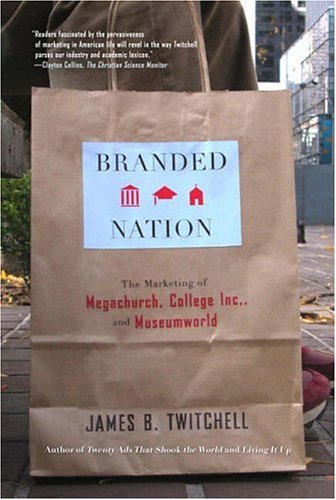
    Are you a church goer?  Have you attended/are you going to attend college?  Does visiting a national museum ever make your annual to-do list?  Have you considered yourself better off based on your choice of membership?  If you have answered yes to any or all of these questions, the follow-up question to ask yourself is whether or not you have recognized the marketing strategies these million dollar institutions utilize to get you to answer yes.  Believe it or not all three organizations have become marketing conglomerates that generate a specific brand targeted to specific audience members to lure in recurring attendance and membership which is highlighted in Branded Nation.

    Once thought of as “above marketing” establishments, James Twitchell , author of Branded Nation and English professor at the University of Florida , enlightens his readers with an awakening breakdown of the religion, higher education, and museum worlds related to marketing.  Despite the refute by ministers, university presidents, and museum directors opposing Branded Nation’s  argument, Twitchell  wittily examines all three cultural institutions to support his claims to show the permeation of branding and marketing among the high American culture.

    In our prerequisite course, Introduction to IMC, we were required to read Branded Nation to aid in understanding of high culture and low culture.  Twitchell gives an example of the brand surrounding the concept of an Evian bottle of water, a low culture.  Drinking Evian creates a story, as Twitchell would say, that depicts a different account versus drinking an Aquafina bottle of water.  Now, there is nothing wrong with drinking either water selection, however, Twitchell goes on to say that the way we look at advertising/marketing and the way we consume collide to make a story portrayal of ourselves and the market we engage.  This concept was highly known among the low culture such as music, movies, and clothing, but Branded Nation unwraps the unnerving advertising/marketing approaches within high culture ties, which keeps readers gripping the cover till the end of the book.

    If you are even slightly interested in marketing development, or if you qualify as a “yes” answer to the aforementioned questions, I highly recommend reading the words of Twitchell.  Although a bit skewed as some opinions are heavily emphasized, Branded Nation will change the way you look at your church, your college or university, and your neighborhood museum.  It will help you to take a more critical observation at the messages behind any brand or story and ask yourself even more questions regarding the marketing world and the quality of product(s) you are purchasing and accepting.  Above all else, read Branded Nation to discover why Twitchell ends with the quote, “Get used to it, because it ain’t gonna get any better.”

    -Allyson Corbin

  • Groundswell- winning in a world transformed by social technologies

    Social Media is a revolution that has undoubtedly changed the business world as we know it, but the question to many is not what is social media, it’s what do we do with it? Groundswell- winning in a world transformed by social technologies, answers just that question.

    Written by Josh Bernoff and Charlene Li of Forrester Research, the book talks about consumers are taking to the web through Facebook, YouTube and blogs and talking about your brand, company and products. It is up to us to take advantage of this consumer effort. The authors discuss how companies are gaining insights, experiencing increased profits and even exciting their own customers.

    Groundswell may be written about a phenomenon that is fairly new to our radar, yet there is real statistical data which backs up their claims. But don’t go thinking that this book is nothing but facts, the authors tell stories. They share stories with real people which made it both appealing and relatable.

    When talking about social media which deals with computers and technology it is easy to get caught up in the technological jargon. Groundswell does a great job of keeping its focus on the social aspect rather than the technology. It is about the people, both the consumers and the company rather then the mechanics.

    The book has started phenomena of some sort. It has it’s own webpage with links to the Groundswell blog. This blog kept up mostly by Bernoff discusses social technology in many aspects of the business world. He also suggests other reading material such as Linchpin by Seth Godin. Once you read Groundswell you are swept up In this trend and now have somewhere to go to further your insight.

    Students, teachers, professionals and analysts from all over have read the Groundswell. Positive Reviews have been written by accredited papers such as t the Boston Globe and New York Times. Industry leaders like Craig Newmark have even weighed in. He states “Internet-style communication tools change organizational communication completely, providing a means for workers to run organizations more effectively. Groundswell describes how this can happen in any organization, focusing on the human issues, which is the hard part.” With nothing but praise how could you not want to run out and pick up a copy today?

    Oh and some good news! Bernoff has recently announced that he has begun work on a new book Harnessing the Groundswell Look for it this summer!

    Jess Smith

  • IMC – The Next Generation

    Don and Heidi Schultz’s book, IMC—The Next Generation, is one that many of the students in this advanced IMC class have read at some point in our undergraduate careers. To those new to the discipline of integrated marketing communication, this book offers insight into developing relationships with customers and shows marketers how integrating their organization can help them focus on the customer. There are numerous cases and real-world examples provided that reveal how to use the IMC model presented in the book.

    They start the book by describing IMC as “a process through which companies accelerate returns by aligning communication objectives with corporate goals.” The importance of branding is emphasized throughout the book as they explain how much of an organization’s marketing efforts switched from focusing on the company’s products to focusing on the establishment of brands. Just as the primary focus of almost any successful business is also the customer, the primary focus of the book is the customer, stating that in a value-oriented IMC program, “Customers and prospects are treated as individuals, not as markets.”

    Readers of this book range from students studying IMC, to professionals trying to establish themselves in the business world. Other reviews are almost all positive and full of praise. One review stated, “If you care anything about Integrated Marketing Communications, you’ll read this book. This book has been a bible of sorts for me over the past few years. Anyone trying to figure out what’s going on in social media and the changing nature of the buyer should take a read through this first. Some of the areas may be a bit hard to grasp, but the methodology makes sense, and the Schultz team breaks it down into a step-by-step process that will make your marketing programs measurable (if you follow their advice).”

    Overall, IMC—The Next Generation comes highly recommended from critics, students and readers in general. It offers insight from a husband and wife team of professionals who understand IMC and how it can be used in the business and professional world.

    Nicole Doherty
    Stephanie Saulsbury
    Lacey Inman

  • Integrating Social Capital, The Court and Beyond

    As Black History Month comes to an end, many of us would be remiss to think that only about sixty years ago, names like Kobe Bryant, Michael Jordan, or Lebron James wouldn’t exist, or in essence they wouldn’t. Approximately 80% of players that make up the African-American National Basketball Association would not even be allowed on the court, if it weren’t for the efforts of 3 individuals who have truly changed the face of the game.

    A New York Times piece covered the 50 year commemoration of the first 3 African-American players to play in the NBA, which took place at a Knicks game in 2000. The article spoke about the men’s struggles with playing an integrated game in a segregated world. Earl Lloyd, Nat “Sweetwater” Clifton, and Chuck Cooper endured the ugly side of social capital on an everyday basis in the still separated America. Jeering fans often taunted the men when they played well, but ignored them if they played terribly. Lloyd said he “took special pains in those towns” to make sure he was called names.

    Though there were many negative aspects of social capital they experienced while in their early days as NBA players, there were also some positive aspects. NBA legend Bob Cousy was one of the white players who created positive social capital as a teammate to Chuck Cooper. Cooper’s widow stated that without Cousy’s continuous support, Cooper’s career wouldn’t have been near as long. She shared “once, they were down south, and the people at the restaurant put Chuck’s food out by a railroad track and Bob went out there and ate dinner with him.”

    These historic events happened without much fanfare at all. It happened after Jackie Robinson’s entrance into baseball and the NBA was nowhere near as popular as it is today. The impact of the positive and negative social capital experienced by these 3 players has truly affected the way we come together in sports. Many basketball fans couldn’t really imagine the game without flashy alley-oop passes from the Canadian star Steve Nash or a slamming Amare Stoudemire. Well just think, if the positive and negative social capital between Cousy and Cooper never brought them to a railroad track for dinner some time ago, what would the face of basketball look like today?

    Colby Lewis

  • Jay-Z Joins the NJ Nets on the Court of Social Media

    The New Jersey Nets have had a questionable relationship with Twitter, recalling a scenario not too long ago when their teammate, Terrence Williams, tweeted out how he regretted being drafted to the Nets. With this in the past, it appears the Nets are attempting to rekindle their relationship with the social media giant. They are now attempting to use its features a little more…constructively.

    The Nets are deemed by many sports fans as “historically bad” at basketball with a record of 5-51. Thus, they are attempting to liven up their fan base and keep the support on the court. In an article on February 23, 2010, the Nets unleashed their newest marketing effort to try and increase their wobbly attendance. They have announced a contest for fans to win tickets to Jay-Z’s concert on March 6th.  In order to be a “fan” and enter the contest, an individual must become a fan of the team on Facebook or must follow them on Twitter.

    Once a fan on Facebook, fill out a form before March 1st to be entered into the drawing. As a follower on Twitter, tweet the message “Hey @NetsBasketball I want to win two tickets to the Jay-Z concert at the Izod Center on March 6th. More info: http://bit.ly/jayznets.”

    It is clear the Nets are attempting to build a stronger social network to not only increase attendance but also foster an identity for the future. They are attempting to connect better with their fan base and build a lasting brand. With part owner Jay-Z on their side, this strategy might actually work. Let’s just hope Terrence Williams does not tweet out that he’d rather have Lady Gaga tickets…

    Rachel Kaylor

  • Athletes Better Watch Out

    We’ve all heard the advice, “Be careful with what you post on ________.” Just fill in the blank with your favorite social media. That is certainly the advice given to collegiate athletes about their Facebook, Twitter and MySpace accounts. Before the social media craze hit, many colleges and universities had no idea what social networking was until there was some incident being broadcasted by the news about some damaging pictures or comments that were posted on the internet. This according to a recent article on ESPN: The Life.

    How could schools counter this? What could administrators do to prevent such online scandals? Kevin Long had the answer. Long, founder of MVP Sports Media Training, came up with the website UDiligence.com. This site is the only automated service that helps collegiate athletic departments protect against damaging exposure. For a fee ($1,250 a year for 50 athletes or less and $5000 a year for 500-750 athletes), schools are provided with a monitoring system for student athletes’ Twitter, Facebook, and MySpace accounts. Schools type in keywords into the program that they would not like to see on their athletes’ social networking sites. If these buzz words are used, then administrators will be alerted via e-mail. Then, a detailed account of the instance is added to a spreadsheet log.

    This service is definitely a great program for universities to use. Instead of hearing of damaging instances through the news or on blogs, they are able to prevent and handle such issues before they make it to the press. Long believes his service is both a tool of protection and education. According to Long, “UDiligence.com is about protecting brand, image and reputation. And it’s about education and responsible social networking.”

    Ryan Corazzo, author of the article, notes that colleges aren’t the only users buying into Long’s services. NFL teams are also looking into the monitoring system. With UDiligence.com teams have the ability to gather information about potential draft picks. For years now, concerns of character issues have been raised after teams draft certain troublesome players. Problem players like Adam ‘Pacman’ Jones and Deltha O’Neal could have been better assesed if teams possessed a service like Long’s.

    Whether you are an athlete or not, maintaining your social networks is important. Your friends and followers aren’t the only people looking in on your posts or pictures. Potential employers and graduate schools google your name to get a glimpse of who you are. So take the advice, watch what you put up online.

    – Jesse Bazemore

  • I’m Lovin It! McDonalds Dominates Olympic Marketing Scene

    McDonald’s is the top sponsor for this year’s winter Games in Vancouver. Sportsfeatures.com describes how they have branded themselves as the Official Restaurant of the Olympic Games while opening three restaurant areas in the Olympic Villages in Vancouver and Whistler and the main press center in Vancouver.

    Much of the advertising is athlete-themed while embracing a “Share the Gold” slogan with Chicken McNugget promotions.  Along with the golden Chicken McNuggets, stores here in the U.S. are offering a new limited time sauce.

    McDonald’s is using three new advertising campaigns specifically targeting the Olympic season.  New items that have been added to the menu are the S’mores Pie and the Crème Brulee, and Crunch McFlurry.  To further support the Olympic themes, Happy Meals will include interactive toys of the 2010 Winter Games mascots.

    Outside of the Olympic themed advertising, McDonald’s is also continuing their Champion kids program which began at the Beijing 2008 Olympic Summer Games.  This program offers children ages 6-14 from all around the world the opportunity to personally experience the Games first-hand.  A panel of ten ambassadors at the Vancouver Games along with Olympic athletes judge essay entries to award the winners.

    As the Official Restaurant of the Olympic Games, McDonald’s focuses their advertising on supporting the Games and branding themselves through new winter themed menu items.  Their Champion kids program embraces the Olympic spirit while reaching out to involve young kids all around the world.

    Taylor Diehl