The North Carolina State Fair, an event whose humble origins begin with a small four day agriculture event held in 1853, has become a yearly tradition for many North Carolina natives. Much of the reason for the fairs current success is perhaps the diversity of attractions it offers. Whether you go for the fried food or displays of giant vegetables, livestock judging or pig racing, to peruse the craftsmanship in the Village of Yesteryear or to pursue the coveted prize of a giant stuffed animal at one of the many carnival games, there is a little bit of everything for everyone.
2015 has already seen record attendance numbers with its first Thursday, the 15th of October, setting an opening day record at 47,677 guests, breaking the previous record set in 2010. Many more visitors will make their way to Raleigh as the week continues and they are drawn to the many events and attractions.
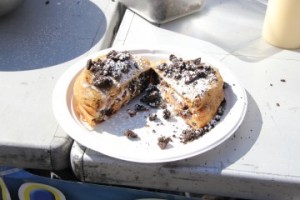
Of the many events and attractions, perhaps one of the most publicized is the State Fair’s fried food that has become infamous for being as creative as it is unhealthy. As a part of the State Fair’s social media, there is a blog run by the fair called the Deep Fried Blog. Of this years many deep fried sensations, the star of the show is a newcomer called, “Fry Me Over the Moon”, a combination a Moon Pie, Hostess Cupcake, Oreos, and Reese’s Cups, all deep fried into a single creation. Not only has this been publicized on the State Fair’s blog, but many other media outlets have covered this State Fair delicacy such as WNCW, The News and Observer, and WRAL, just to name a few.
While this modern fried phenomenon draws much attention, a less advertised, but long running tradition for many is the more relaxing Heritage Circle, a place where visitors can get fresh home made ice cream from the Grist Mill and listen to the line up of bluegrass musicians at the Bluegrass Stage. While bustling energy surrounds the novelty fried food vendors as people squeeze their way through the busier segments of the fair, Heritage Circle offers a completely different state fair experience. It is tucked away from the heavy foot traffic of the main paths in a much quieter wooded area where visitors can sit and enjoy the feeling of a simpler time.
Today’s fair goers are offered a wide variety of attractions that range from experimental to traditional. There is something for everyone this fall at the NC State fair grounds as the festivities continue until October 25th.
Cucalorus is Wilmywood’s premiere quirky film festival, showcasing independent films from local, national and international artists. Film connoisseurs sporting chunky glasses, artsy students in their thrift-store best and less interesting folk like you and I file into Thalian Hall (or one of the many other venues), settle down and wait for the lights to dim. This November will be the 21st year this little slice of art and culture draws people to downtown Wilmington.
I could barely convince people to keep coming after my twelfth birthday party, so how does Cucalorus garner a big crowd each consecutive year? A cohesive brand narrative, that’s how. And Cucalorus’ brand narrative is nothing short of weird—but in the good way. Let’s explore what makes Cucalorus cool.
It’s in the copy
While none of these factors are ranked in any specific order of importance, I am a word person and always like to read and evaluate the voice of an organization. Many organizations forget about this, not capitalizing its subtle importance. Bad organizations.
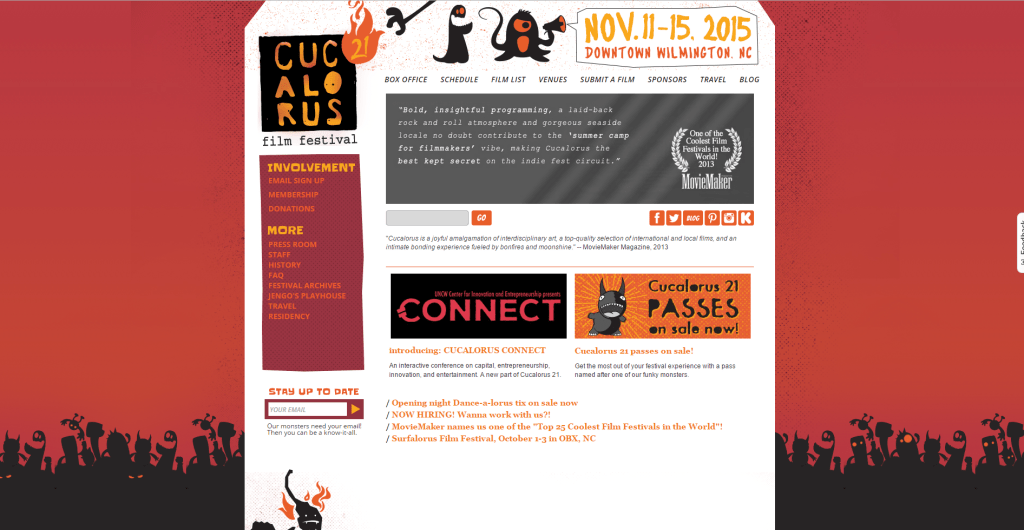
Cucalorus, on the other hand, has got its copy down pat. The copy, whether it’s online, in print or broadcasted on the radio, is how an organization communicates not only its news or events, but its personality, its voice and its image. Here’s a snippet of copy from Cucalorus’ donation page on their website:
“Hey Cucalorians!!! Do you need to get rid of unwanted cash? Make a donation and we’ll send you a tax deduction letter to send your fuzzy little friends at the IRS (they don’t need your money and clearly don’t know what to do with it!!). We do know what to do with it – we’re already plotting and scheming for the 21st annual Cucalorus Film Festival – taking place November 11-15, 2015!!! Help us fund the dreams and visions of artists all over the world by making a donation today.
Dreaming of eggnog omelettes!
Cucalorius.
The Cucalorus Film Foundation is a 501c3 non-profit and your donation is tax deductible to the fullest extent of the law.”
On first glance this might sound unprofessional and not the voice an organization would want to convey. The context, though, is important. Cucalorus’ audience is mostly the aforementioned artists, hipsters and independent film connoisseurs and Cucalorians. These types of people generally like funny, creative and quirky things (like Cucalorus). These types of people also tend to be skeptical of the IRS—not to mention the state cutting NC’s film incentive last year. So yes, it might be OK for Cucalorus to be a bit irreverent, and it’s their creative risk.
Digital presence, dude
If your business doesn’t have some sort of online presence (an email address counts), I would like you to write to me immediately by carrier pigeon and explain how you’re still surviving. An online presence is increasingly important each year, and now just having a website and Facebook isn’t cutting it. Brand cohesion across appropriate social media networks and inter-connectivity between them is vital.
Cucalorus not only has a website, Facebook, Twitter, Pinterest, and Instagram but their own blog and—drum roll—they are all updated. Bravo, Cucalorus. Content creation and audience engagement are essential to a successful IMC strategy.
Creepily consistent image
This one is tandem with the digital presence. IMC consists of advertising, public relations, marketing and every other single communication an organization can perform with its publics. Consistency in corporate communication allows the organization and its audiences to construct a narrative and image of the brand. This is what people can relate to. This is how we can see the quirkiness, irreverence and artsy personality of Cucalorus as if it were that weird kid in your English class who would always have some snappy reference to an obscure book even your professor hadn’t read. But less annoying.
The color scheme and design is consistent. The font-faces, graphics and little cartoon dudes are consistent. There’s well-organized navigation and that copy I was talking about earlier. The social media pages follow suit. There’s an article on this if you’re into academic papers. Basically, the author, Simon Torp from Odense University in Denmark, says that as an organization your communication through all channels must be consistent, accessible and in line with your self-image, public image and meta-image for people to take you seriously.
Zany staff workers
When I said all channels of communication, I meant all of them. Even the staff workers and volunteers need to be carefully selected and even briefed on an organization’s code of conduct. One time I went to a screening of a Cucalorus film at Thalian Hall and, not to get into too much detail, I, with the rest of the audience, was sternly asked by staff to partake in a ritual involving whipped cream, button pins and our tongues. Was I offended? No, but I could have been if I had been misguided by thinking Cucalorus was actually a convention for neo-Puritans. Because their self-branding and self-image don’t suggest that, I could expect something out of the ordinary. It’s the risk that Cucalorus takes to maintain its image and appeal to its target audience.
High-quality product
When it comes down to it, a business or organization is only as good as its product. Silly brand narrative and image aside, Cucalorus does a good job at what it does. It recruits and selects excellent film talent from around the world and showcases it in quality and entertaining venues. This is where word-of-mouth comes into play. Word-of-mouth marketing or WOM is an organic and invaluable means of public relations, advertising and marketing. Have you ever read a positive news story about an organization you love? Or has a good friend of yours recommended a product or service they favor? These are examples of WOM that can make or break an organization depending on whether they are in favor or against it. Maintaining the balance between brand narrative, professionalism and good business sense is how an organization thrives. While Cucalorus does an outstanding job of its own branding and controlled media, its reputation for quality and intrigue reign in filmmakers and spectators every year.
I am no way affiliated with the Cucalorus film festival professionally, nor do I represent it. I recognize good IMC in organizations and talk about it here. But, if you are tired of what the local theaters are playing, check out a showing of something interesting between November 11 and 15 downtown at Cucalorus.
Pumpkin is the flavor of fall. Products that offer limited edition seasonal pumpkin flavors and scents include pumpkin beer, pumpkin M&Ms, pumpkin spice marshmallows, pumpkin candles, pumpkin scented shampoo… and according to testers at the TODAY Show pumpkin spice Oreo’s are “especially tasty”.
But no one does it better than Starbucks and the Pumpkin Spice Latte.
Pumpkin Spice Lattes first appeared on the Starbucks menu in the fall of 2004. This is the beverage that kicks off their holiday seasonal drinks, even though it comes out in late August. The creamy pumpkin pie sensation mixed with a subdued coffee flavor created a taste that consumers immediately latched on to. One sip can bring you down memory lane, sharing an evening with your family, exchanging laughs and stuffing your bellies.
Along with scarves and sweaters, sipping on a Pumpkin Spice Latte has become a new fall accessory. The drink option reminded loyal customers why Starbucks was their brand of choice and offered incentive for potential new customers to engage in their products.
Seattlemet.com states that in October 2004, just one month after releasing the Pumpkin Spice Latte, Starbucks noted an 11 percent spike in their company sales compared to the previous year. It was official…the brand had struck orange.
In 2013, forbes.com reported that Starbucks has sold over 200 million pumpkin spice lattes and generated a revenue of over 80 million dollars.
But popularity has a price. The seasonal drink got so popular that it seemed to reach a tipping point. Last year in 2014, some consumers were losing their sense of identity from feeling too conformed by the Starbucks pumpkin spice fad. Customers became critical of the product and and found some weak spots to pick on. The beverage’s ingredients did not actually include pumpkin and did include caramel coloring. These two things were enough to start an anti-PSL movement. This movement grew to such a size that Starbucks revisited its IMC plan.
After 11 years with the same successful recipe, Starbucks reformulated to accommodate disgruntled customers. In addition to adding real pumpkin, the company devoted a large IMC effort towards branding this product. They have created a tumblr, an instagram, a twitter, and an entire brand identity just for one drink. The real Pumpkin Spice Latte now takes selfies and interacts with its audiences. Starbucks Efforts include having its own trending hashtag (#PSL), offering an iced version for warmer weather, and even a password that allows people to buy the drink earlier than it is official release date.
Will Starbucks be able to revive the pumpkin spice latte trend once again? Or will the PLS critics find some other problem to cling to?
Love Pumpkin Spice Lattes? Use the #PSL on Twitter, Instagram, or Facebook to gush about your love for this hot beverage. Or leave us a comment below and let us know what you think!
Watch Starbucks 2015 Campaign here: https://www.youtube.com/watch?t=112&v=la-h1sE3igs
-Aki Suzuki, Lexie Trimnal, Carey Shetterley, June Wilkinson, Carey Poniewaz
Candidates have really been trying to “woo” young people to vote. This demographic can be quite difficult to motivate and actually get them to do something. They all just really need someone who they can relate to before we can make a decision, you know like a celebrity who is endorsing one of the candidates. Remembering back to the last election, this was very successful in Obama’s favor. Many famous people were sporting the always fashionable Obama gear. He even made it on the runway! Who wouldn’t want a president that has made it on the Paris fashion runway?
Of course, not all ploys to get the youth to vote are quite so extreme and over the top. Rock the Vote is one of the biggest organizations trying to get young people to vote. They use pop culture, music, and new technologies to get them to register and have successfully signed up over five million young voters. The Millennial Generation makes up about 1/4 of the voting population which makes them an important demographic for politicians to market themselves to. Just in the last presidential election alone Rock the Vote registered 2.5 million voters. This was by far their highest number they have had yet.
College campuses are another great outlet for getting the younger crowd to register to vote. Statistics show that there is a much higher rate of educated youth voting versus the ones who didn’t attend college. This is the most convenient way to motivate this apathetic age group. Having an on campus presence is a good reminder of how easy it is to register. Since the 2000 presidential election it has been forced by federal law for postsecondary institutions to make a good faith effort to distribute voter registration forms to all of their degree seeking students.
The Presidential candidates now take the Millennial Generation a lot more seriously, then they ever did before. They want their voting numbers to go up and this large demographic can be the boost they need. As a member of this generation, I wonder what tactic they will use next to sway my vote?
– Mollie Berthold, Laura Simmons, Christina Stevenson, Dorothy Conley
A week from today, one of the most commercialized and superficial holidays will occur: Valentine’s Day. For those of you who are one half of a couple, Valentine’s Day is all about making your significant other happy, whether it involves showering him/her with gifts, making dinner reservations, or planning exuberant and normally unnecessarily expensive dates.
The beginning of February marks the time when store fronts become clad with hearts, cupid cutouts, and pink and red streamers. Around this same time, we begin to see an increasing number of men lurking around lingerie stores, especially Victoria’s Secret – and for good reason. Victoria’s Secret has a dramatic increase in sales during the season of romance. With their sexy print ads in magazines, their silky almost-obscene commercials, and their free “Lacie Pantie” giveaway, what man in their right mind would avoid giving their girlfriend/wife the gift of sexiness?
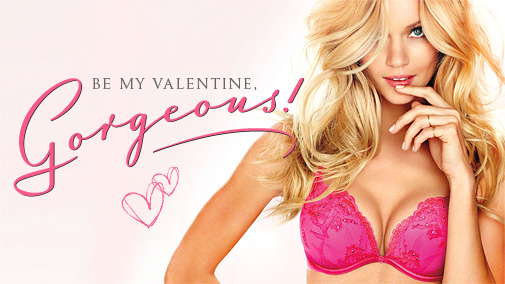
In their 2012 Valentine’s Day campaign, Victoria’s Secret Angels clad in pink and red barely-there bras and panties have advertised to their customers that with the gift of anything from their line of lingerie, their Valentine’s Day celebrations will be fabulous. In their sneak peek to their photo shoot, the Angels prance around in their under garments, smiling, laughing, and selling the ideas of sex and playfulness. In interviews, the girls claim that any man could win their hearts on Valentine’s Day by picking out something from the Victoria’s Secret shelves. One even says that if a man chooses something that he likes, it will give plenty of hints to his significant other.
Not only does this campaign appeal to male shoppers, but it also appeals to women. The Victoria’s Secret Angels encourage their customers to feel sexy, and by offering specials, free panties, and coupons during this season, women will certainly be able to feel like Angels.
So whether you are shopping for a significant other or are planning on spoiling yourself with brand new sexy lingerie, Victoria’s Secret will certainly be the place to shop this romantic season. And don’t forget to have a sexy Valentine’s Day, Gorgeous!
Love always, Christina Stevenson, Mollie Berthold, Dorothy Conley, & Laura Simmons
Valentine’s Day is a holiday dreaded by a great deal of people, both male and female, for various reasons. There is pressure on both genders to perform, declare emotions, and out-do previous years or expectations. Those who fail at this task of grandstanding may in fact find themselves without a date for next year. Okay, so there’s a ton of pressure on people in relationships, but what about those of us who are single? While some take pride in their solitude, others wish they had someone to be their valentine, and a few twitch at the mere thought of being in a relationship.
According to an article in the New York Times, being single is a prevalent occurrence these days with 59.9 million single women in America. This staggering rate may surprise some, but companies like Dove chocolate see these table-for-one ladies as a prime marketing demographic. They hope to strike a chord with this growing independent group by catering their advertising to the women who are without companions. That is why this year Dove has made a campaign to remind women Valentine’s Day isn’t just about romance.
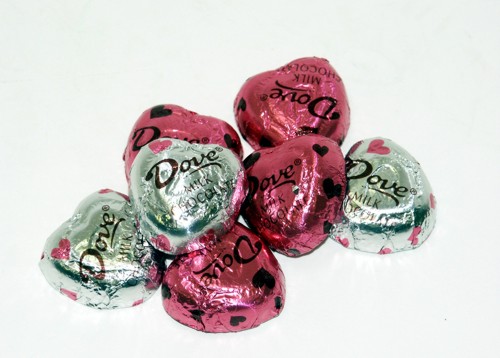
Dove is banking on the stereotype that single women will turn to chocolate this year on Valentine’s Day. Instead of the standard “Call me” or “I’m yours” found on the candy hearts we used to share with our playground crush, Dove has created a host of witty comments and placed them on the inside of their chocolate wrappers. Some of the best include, “You’re gorgeous,” “Sometimes I buy flowers for myself,” “My flaws are fabulous” and even the ever so uplifting, “Love yourself in a moment.” The new commercial features women sharing their Dove chocolates with everyone from their barista to their neighbor, and most importantly, themselves. Is this a message of independence for the strong woman? Or rather, a cheap ploy based upon the assumption that women alone on Valentine’s Day will inevitably console themselves with chocolate? Either way it’s hard to dislike chocolate, especially when it’s making single girls smile and promising not to judge if we have more than one.
By: Alexis Kapczynski, Kacy Cox, Josh Bowman, and Sara Kaloudis
It’s Super Bowl season and we, as viewers, are ready for the stream of entertaining advertisements that keep us occupied between breaks. I’m sure everyone remembers last years buzz worthy Star Wars inspired Volkswagen commercial. How can one not be enamored with a little boy in a movie quality Darth Vader suit that genuinely startles himself by using “the force” to turn on his dad’s new Volkswagen? Beyond all the cuteness, the commercial relays the push-to-start feature that the affordable (and apparently fun) German car has to offer.
To top its success from the last Super Bowl, Volkswagen has returned with yet another Star Wars inspired ad and the entertainment factor is undeniable. Yet what do barking dogs and Star Wars really have to do with the German automobile company?
Advertisers take full advantage of the hype surrounding the Super Bowl to create innovative, touching, and entertaining commercials. Companies will pay extraordinary amounts of money to ensure that their commercial is seen by the millions of viewers watching the game. After all, this one time of the year advertisers can assume that almost every single American is tuning in. What company wouldn’t want their product showcased at this time? It’s like a black Friday Christmas sale for advertisers. These companies want to bring attention to their product in anyway possible, even if that means their product isn’t even mentioned until the last three seconds.
In the Volkswagen ad, the viewer is unaware of the association between Volkswagen and Star Wars until the very end. This proved to be a very strategic move on VW’s part. Last year, companies were able to monitor which commercials made the biggest impact on viewers via Twitter, FaceBook and other popular social platforms. They measured the ad’s success by the number of times it was mentioned in the digital realm and were able to realize what struck a chord with the vast audience. What once seemed to be a hail marry concept of integrating marketing, advertising, and social media, is now an easy field goal for the IMC commercial championship. Volkswagen is betting that we will remember how fond we were of last year’s Star Wars theme and associate those same feelings with their brand this year as well. You can’t go wrong with puppies and kids, right?
-Alexis Kapczynski, Kacy Cox, Sara Kaloudis, Josh Bowman





 IMC Hawks Blog