Tag: Black Friday

  • Out With The Old, In With The New: Technology Decides It All

    Everyday you as a consumer are exposed to hundreds of thousands of brands. Over the decades the shopping industry has exploded with most brands disappearing at the same rate new ones appear, yet some brands have stood the cluttered test of time – one of those is Macy’s.

    Created in 1858 by Rowland Hussy Macy the Macy’s store was originally a dry goods store. Macy’s started to gain notable recognition in the 1900s with its holiday window displays and the hiring of Santa Claus for the stores. In 1924 the store moved to its current NYC location, on the corner of Broadway and 34th Street. This year was also the first Macy’s Day Parade, which was organized to celebrate immigrant employees new American Heritage.

    macys6n-2-web

    In 1944, Macy’s became apart of the Federated Department Stores, Inc., renamed Macy’s Inc. creating the world’s largest department store. Today, Macy’s has 800 stores in the United States and sells merchandise online.

    Macy’s isn’t the only iconic retailer – Sears Roebuck ring a bell? Starting in 1886, the mail order company prospered as it was able to provide low cost alternative to farmers. As mail order plants transitioned into stores, Sears found their place in city life and the retailer soon became a retailer giant. Today the store owns 863 mall-based operations and 1200 other locations including hardware, outlet, tire, and battery stores.

    sears catalogue

    Nowadays Macy’s and Sears are direct competitors, but it seems Sears, the company who invented mail order, can’t quite figure out online order.

    Holiday sales account for a large indicator of profit margins and often depict the health of a company. Sears seems to be in critical condition – US stores suffered a 9.2 percent drop. In decline for some time now, and with little to no improvement, some speculate the store could be gone by 2017.

    The history of an iconic brand is something that should be cultivated in your identity – it induces credibility, shows longevity, and prompts nostalgia. Yet being historic isn’t merely enough to remain vibrant. Iconic companies remain iconic because they are able to cultivate lasting relationships with consumers – at all time periods – and that means evolving.

    Looking at each retailers attempt to reach customers during the holiday seasons could explain Sears 9.2 percent drop in sales. Both have social media accounts, yet social media presence is widely disproportionate. Macy’s Instagram account has 150,00 followers while Sears has two Instagram accounts – “Sears” and “Sears Style” – yet both of the followers combined don’t even reach 8,000. A huge missed opportunity for Sears – Instagram is leading the way in social media, growing faster than Facebook, Twitter, and Pinterest combined.

    According to Gary Vaynerchuk’s article “The Road to Black Friday: Macy’s vs. Sears”, the use of social media by Sears is lazy. Choosing to ignore the social media culture they have posted irrelevant and uninteresting content such as a link to one of their commercials and an original YouTube video. While Macy’s post content that is culturally relevant, trendy, and formed around pop culture.

    Our culture today has switched, as James Twitchell describes it, “In the last generation we have almost completely reversed the poles of shame so that where we were once ashamed of consuming too much (religious shame), we are now often ashamed of consuming the wrong brands (shoppers’ shame)”. In this day in age a brand establishes and remains relevance by relationship cultivation, reinforcement, and engagement forged through technology – the Internet and social media. It seems Sear’s inability to adapt to technology has prevented them being able to participate in the younger crowds culture leading in profit and brand influence. As an American brand we hope Sears can get back into the groove but as they stand now they are the weakest link.

    In what other ways do old brands stay new? Can you think of any others that have had a hard time capturing new generations of shoppers? Or others that have done well?

    Caroline Robinson, Savannah Valade, Elizabeth Harrington

  • Give Thanks for Brand Names

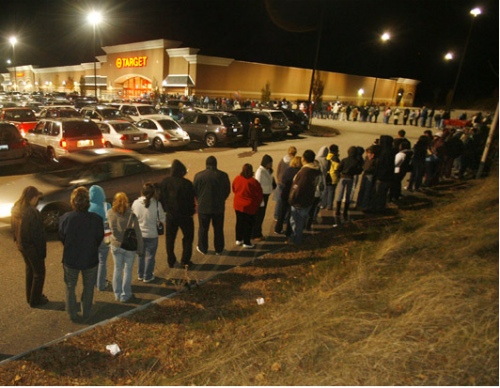
    On this Black Friday, like every other Black Friday before it, shoppers look forward to the best deals. Everyone wants the most they can get for the least they have to pay. Sure Thanksgiving was only a day before, but once the clock strikes midnight, all thoughts of Thanksgiving have left and the pressure of buying Christmas gifts have set in full-force. Black Friday is a day of ultimate competition between brands with similar target markets. Businesses want people to buy products simply because for today they can afford it, not because they necessarily need it. There is a balance that every business and shopper alike struggle with. This is the balance between quality, quantity, and price of a product. Black Friday is the day that no one has to struggle so much with this balance. Today marks a delicate exposure of brands and how low they are willing to go price-wise to beat out the competition but still make a hefty profit.

    It might pain a business to hang up those 50% off signs, but they must remember it is only for one day and in this one day, they know they will have more business than possibly any other time of the year. So why is it that while other stores are giving promos for additional percentages off purchases and knocking prices left and right while brands like Apple are “pushing it” to give $61 off a $600 product? This is what happens when your brand name is seemingly more valuable than the products themselves. Sure you can go to Best Buy and purchase a knock-off iPad for a quarter of the price, but when Black Friday is over, you are going to be wishing you had the apple logo on the back of the tablet. For the thrifty buyers whose ranking from most to least important is price, quantity, and quality, the fact that Apple does not subject themselves to sales and price slashing means that they will not be purchasing Apple products. However, if you have developed a brand loyalty for a certain brand name and you know whether that product is on sale or not you are going to buy that product, then Black Friday is exciting for you even if the sale is next-to-nothing. At the end of the day, you wind up $61 richer than you would have been.

    -Claire Dillard, Liz LaPuasa

  • Ready to shop ’til you drop?

    Gobble, Gobble! Happy Thanksgiving Eve! With all the impending excitement of a delicious home-cooked meal, time spent relaxing with family, the Macy’s Thanksgiving Day Parade, and of course football, let’s not forget about another American tradition: Black Friday. Every eager deal hunter and thrifty mom alike will be setting their alarm bright and early to take advantage of all this day has to offer. With deals such as Walmart’s Emerson 32″ LCD TV for $188 to Best Buy’s 24″ Dynex HD TV set for a crazy price of $79.99, the early hours are completely worth it.  Target has DVD’s for as low as $1.99 per DVD, while Sears is offering sweaters for 60 percent off from 4 a.m. to 1 p.m. only. With these prices, who needs to advertise? The prices seem to speak for themselves. However, this doesn’t seem to be the case. Companies seem to be spending a great deal of time and effort on their advertising campaigns, from targeted Black Friday commercial campaigns, to leaked Thanksgiving Day newspaper inserts.

    Target has put an interesting spin on things and has changed the way they have marketed to these consumers. Instead of bombarding customers with prices and products they should be looking forward to buying, they have tried a different technique: portraying a ‘stereotypical’ yet over the top Black Friday shopper.  The commercials feature a woman who has been counting down the days to shop at Target for Black Friday, and gives herself pep-talks and training sessions to prepare for the big day. This fresh way of advertising really seems to have hit a nerve with the public. This is a pure example of a well-executed targeted marketing message. It’s a tongue in cheek inside joke Target is portraying to their customers, “Yes, Black Friday shoppers are crazy, but, hey, with prices this good, there’s a reason to be,” Target has been spreading this campaign through traditional mediums, such as through TV commercials, as well as through social media. They have released additional videos of the “crazy Target lady” on Youtube, as well as giving her a personal Twitter account “ChristmasChamp” to the tune of over 13,000 followers thus far. Although the cost benefits from shopping on Black Friday speak for themselves, the advertising for this day certainly serves as a great positive reinforcement. Happy shopping!

    Phelps, Kingman, Hensley

  • We Wish You a Merry Chaos

    The holiday season is one of the most crucial times for the world of commerce. During the last quarter of the year the majority of businesses finally go into the black, or in others words, finally begin to make a profit. This time is not only the most lucrative, but also the most chaotic and busy. The extra productivity allows for problems that most corporations would not face throughout the normal fiscal year.

    For example, during the holiday season, FedEx enters into a frenzy of shipping, transporting, and employees are often over worked. In 1998, these over worked employees felt unappreciated, over worked, and under paid. Because of this, there was an expected strike from FedEx employees. This was ultimately due to a lack of positive communication between the corporations, in this case FedEx, and their stakeholders, the employees. They also have to deal with unhappy impatient customers and figure out a way to satisfy the demands of their stakeholders including employees and consumers, as well as all their other various stakeholders.

    These problems are just a few of the issues a corporation can face during the holiday season. Because of issues such as the ones FedEx faced, it is imperative for corporations to have successful communication in order to protect the interests of their reputation and profits.

    Breanna Alexander

    Lauren Dehart

    Lauren Smith

    Kelly Wiley