Tag: Apple

  • Big Brother is Watching You FaceTime: 30 Years After “1984”

    apple_1984_ad_5

    On January 24thApple Computer will introduce Macintosh. And you’ll see why 1984 won’t be like “1984.”

    On January 22, 1984, what is widely regarded as one of the greatest television advertisements of all time aired during the third quarter of Super Bowl XVIII. The one-minute spot is a postmodern representation of George Orwell’s 1949 dystopian novel, 1984, which depicts a futuristic totalitarian society stripped of all freedom and individualism.

    In 1983, Apple and IBM battled for market share as the two giants in the computer industry selling over one billion dollars of PCs that year. In 1983, at his company’s keynote address, Apple founder and CEO Steve Jobs made clear that IBM is a fierce competitor gunning to dominate the industry.

    “Dealers initially welcoming IBM with open arms now fear an IBM dominated and controlled future…they are increasingly and desperately turning back to Apple as the only force that can ensure their future freedom.”–Steve Jobs, 1983

    During his address, Jobs unveiled the ad to an exclusive audience for the first time, to thundering applause. The ad, created by Chiat/Day, ultimately positions Apple and Mac as empowering, liberating, and individualistic, unlike the IBM view that computers are nothing more than tools. IBM is gray, cold, mechanical. Apple is colorful, creative, independent. This ad separated Mac to start the “Mac versus PC debate” that is still relevant today.

    mac-pc

    Which of these guys do you picture in an office at IBM?

    In 2009, Hunch did a survey to analyze personality traits between Mac and PC users. They found that Mac users are more likely to see the existing world as the same all the time and want to be seen as different and unique. They are more apt to call themselves “verbal”, “conceptual”, and “risk-takers”.  The Mac brand is still as relevant today as it was 30 years ago at its introduction, and its consumer base reflects it.

    The “1984” ad has also found itself injected into American culture. In 2007, Phil de Vellis used the visuals from the Macintosh ad and made it into “Vote Different”. It uses sound bites and images of 2008 Democratic presidential candidate Hillary Clinton to put her in the role of “Big Brother”—the role IBM took in the original ad. The woman with the sledgehammer that represented Mac became equated to Barack Obama. The video went viral and is a great example of using appropriation to communicate a message.

    From “1984” to “Think different.” to “Get a Mac”, Apple’s advertising for Macintosh has continued to embody the individualism Steve Jobs envisioned for the brand. Now, 30 years after it was introduced, what does the Mac brand mean to you?

    Nathan Evers

  • Do the (RED) Thing

    One of the most successful examples of cause marketing is the Product Red campaign that was launched in 2006. This was when the Red foundation paired up with recognizable brands such as Starbucks, Gap, Coke and Apple to raise money for HIV/AIDS. Since its launch, the organization has raised $215 million. This money goes straight to The Global Fund, who invests 100% of the earnings to HIV/AIDS programs in Africa. This marketing seems to be benefiting both parties because while the nonprofit is raising money and visibility, the for-profit is gaining customers who support the cause. BRSL_Lockup_October2013

    The reason cause marketing is so popular is because it gives consumers an extrinsic and intrinsic reward  for their purchases. The extrinsic motivation to buy the product is the product itself. While the intrinsic motivation is to walk away knowing that you just donated money to a good cause. In the book Cognitive Surplus, Clay Shirky describes how times are changing and people are now doing things just because they want to, not because they are getting rewarded. I agree with him and believe that people are still going to buy products that they already wanted or needed before they found out it was connected to an organization. If someone wants Starbucks, they are going to get it whether or not it is on the day that the company is donating to the Red foundation.

    What do you think? Have you ever gone out of your way to buy a certain product, because you knew a percentage of your purchase was going to go to a good cause? Would you buy a Red iPod, even though you wanted the green one? Take a minute and think about if you are more driven by intrinsic or extrinsic motives.

    -Ashley Creps

  • The Apple of Consumers’ Eye

    Everyone wants a bite of the Apple – Apple Inc., that is. The company has innovated the world of technology ever since the release of its first computer in 1976. Since then we have witnessed the evolution of all of their products, particularly the iPhone. Extreme supporters of the brand have been known to camp out in line for hours, even days, to get their hands on the newest version of the phone, and on any given day it’s not uncommon to hear the familiar sound of the iPhone ringtone. So what’s the secret to their success? The answer is their brand management.

    Part of the allure of Apple is its exclusivity. Apple Inc. was originally thought of as a company that offered products for rich professionals ahead of their time, and Apple seemed to be ok with that.  However, the creation of the iPod and then the iPhone expanded Apple’s brand to reach a larger demographic. The iPhone was groundbreaking in its launch in 2007 because it offered its customers an innovative smart phone, at a price that was in reach of most middle class Americans. Despite the fact that the iPhone was still significantly more expensive than others at the time, more people were able to join the Apple family because it was cheaper than many of its other products. People that purchased the iPhone still had money, but could justify spending the extra cash for the features it provided. Even today the iPhone is arguably in a class of its own, and has become the gold standard in the smart phone industry.  But the craze hasn’t ended. Apple announced it would be releasing not one, but two new significantly different, versions of the iPhone this fall: the iPhone 5s, and iPhone 5c.

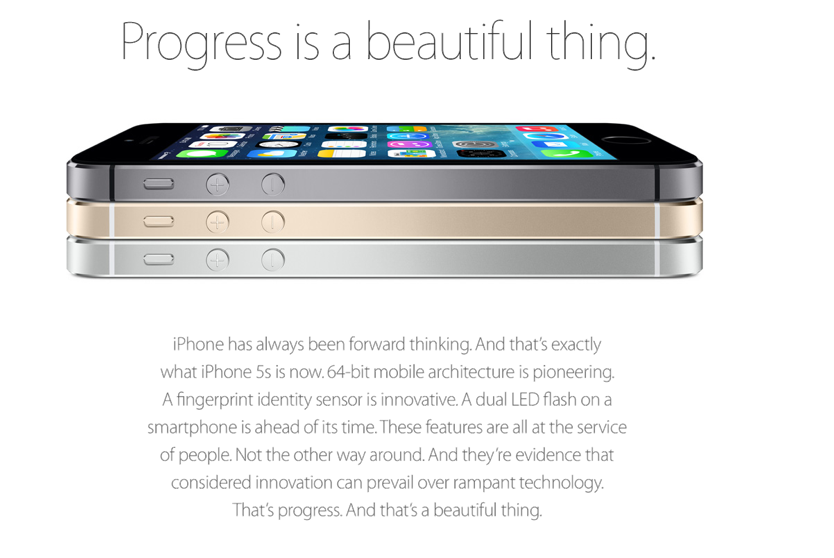
    The iPhone 5s is aimed at the same people who Apple has always targeted. It is the advanced version of the 5– still pricey, with the same design of its glass face and back. The newest features include on top of other things, a fingerprint scanner, higher quality camera, and a faster processor. The 5s also comes with a new top of the line operating system, the iOS 7, which technology enthusiasts everywhere have been excitedly waiting for. The 5c is in a completely different playing field.

    Image

    Image

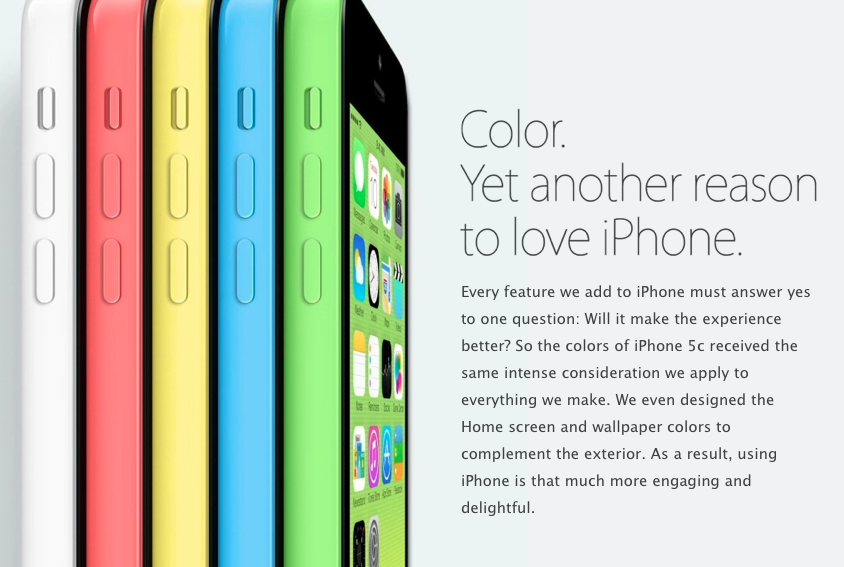
    The iPhone 5c is aimed at a different audience that Apple has never acknowledged. Operating under the new iOS 7 system, the 5c features improvements to the iPhone 5 such as longer battery life, the ability to support more LTE bands, and a slightly improved FaceTime camera. But here is the difference–the design and price. The 5c is plastic and comes in five different colors, and for a 16 GB iPhone 5c you will pay only $99 dollars. This is a 100-dollar difference from the starting price of the iPhone 5s and previous iPhone releases. Apple seems to be catering to potential customers that may not have been able to enjoy the apple experience due to high prices. So why the big change, Apple?

    James Twitchell, author of Branded Nation says, “Pay attention to your brand or lose your business” and CEO Tim Cook explained in Apple’s September keynote speech, “This allows us to serve even more customers.” So what do we make of all of this? With market prices that are less expensive than the average competitor prices, Apple appears to be confident reaching out to the completely new demographic. But will this help them beat out competition? Is it showing the public that competition has become a threat to the all-mighty iPhone? Will it turn off loyal customers who pride themselves in being able to afford the Apple experience? Only time will tell if introducing the 5c with the 5s will benefit the Apple brand.

    -Caroline Robinson, Jade Lester, Meghan Carey, Morgan Jones, Savannah Valade

  • What’s That Doing There?

    After a long day of work or school most of us like to sit down and shut off the batteries. Some people (including myself) do this by
    enjoying a nice beverage and turning on the Netflix. The appeal of a service like
    Netflix is, of course, the elimination of the commercials that disrupt our viewing
    pleasure on live T.V. One night, I sat down and turned on The Office, I was
    instantly bombarded with company logos and products. As the actors go about
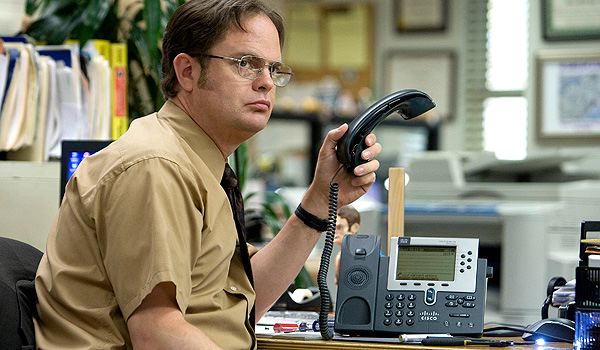
    their typical work day, the camera conveniently focuses on the Cisco Systems
    Telephone on Dwight’s desk and the HP logo on the computer that Pam uses as she
    hides behind her desk. These logos are not in the frame by coincidence, but
    rather they have been carefully positioned by the show’s producers. This discreet
    advertising strategy is known as product placement.

    Business dictionary defines product placement as “an advertising technique used by companies to subtly promote their products through a non-traditional advertising technique, usually through appearances in film, television, or other media.” This form of advertising is initiated through an agreement between a product manufacturer and whichever media company owns the program featuring the product. In the vast majority of product placement agreements the media company receives economic benefit as the manufacturers often pay a fee to have their product (or brand name) used, mentioned, or significantly featured in a program.

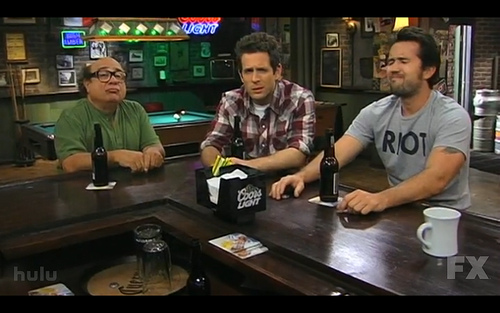
    Product placement is everywhere. A few notable shows that are known proponents of this technique are American Idol (Coca-Cola cups for all judges), It’s Always Sunny in Philadelphia (Coors Light consumption and signs prominently placed in the bar), and 30 Rock (which features multiple Apple products.) This form of advertising has been around for years and will continue to thrive as long as people keep consuming media. In this way, companies continue to ensure that viewers have plenty of exposure to their product, even if certain audience members have learned to maneuver around those pesky commercials.


    Michael Nunes, Daniel Schaefer, Lexie Huss, Zach Abramo, Callie FenlonDann Williams, Lauren Habig

  • Remember When… “Apple” Was Just A Fruit?

    Who could forget the first time we were able to hold hundreds of songs from our entire CD collection in the palm of our hand?  Or how about the first time we could browse through every artist in our musical arsenal with a gentle swipe of the thumb?  Today, Apple has taken the world by storm with a variety of products that all date back to the original iPod MP3 player, which was released on October 23, 2001.  This sleek invention took the world by storm by allowing people to store hours upon hours of music into a relatively small device that could easily fit in your pocket.  The era of cassette tapes and Walkman CD players had reached an end after the iPod hit the shelves.

    Image

    Almost six years later, on June 29, 2007, Apple had another technological breakthrough with the release of the highly anticipated iPhone.  The iPhone was a combination of an iPod, phone, camera, and mini computer and gave consumers a more media based alternative to the then popular Blackberry.  People were now able to make phone calls, listen to music, take pictures and surf the web with one sleek, pocket-sized device.

    Since then, Apple has consistently raised the bar by releasing new versions of the iPod and iPhone with new features and abilities that keep people wondering, “what will they do next?”

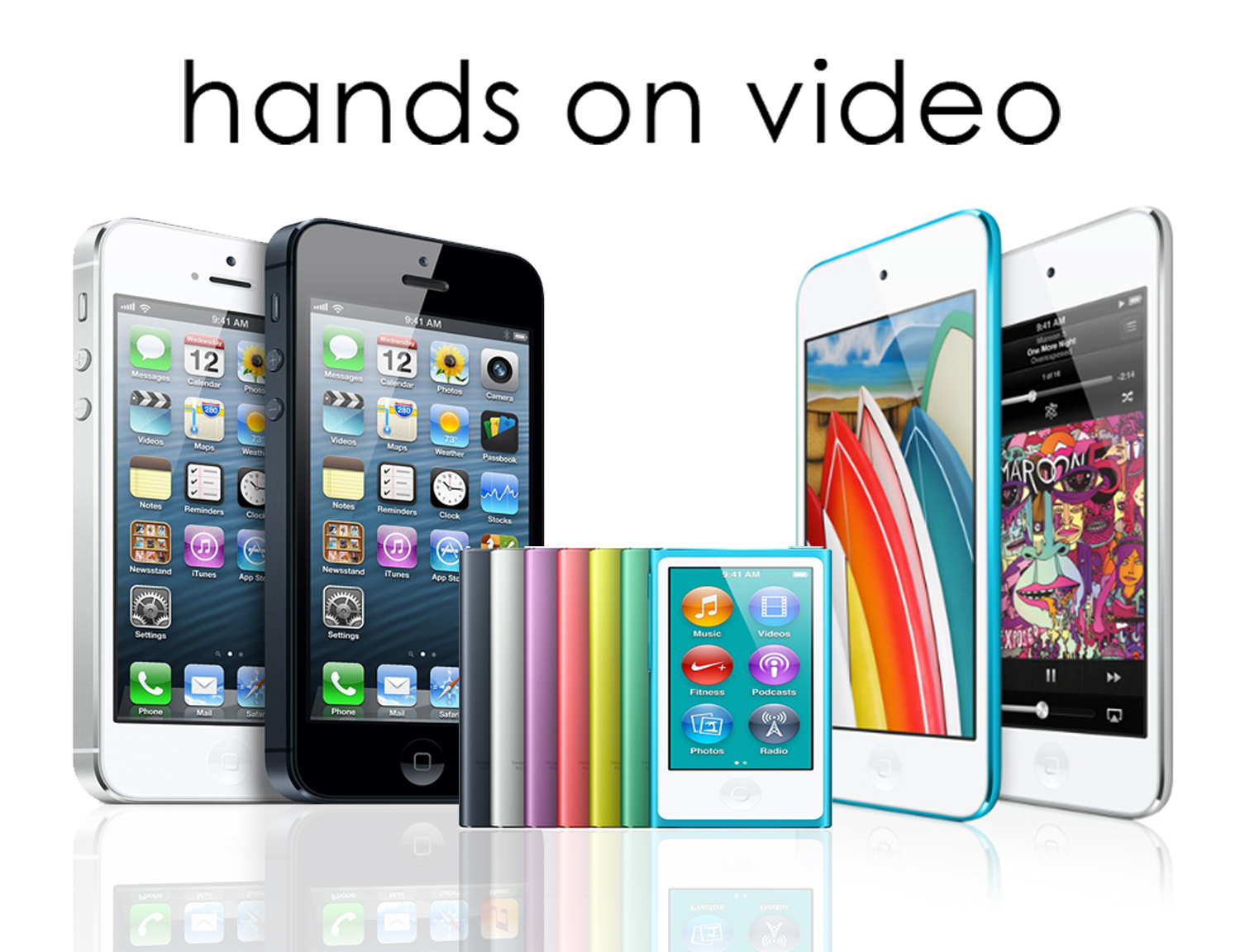
    On Wednesday, Apple unveiled the newest generations of the iPod touch, iPod nano, and the iPhone 5 to a public who was highly anticipating the “next big thing” in the technology market. Although the new iPod touch and nano caught a lot of attention with their new sleek, colorful design and advances in features such as the camera and the display, the iPhone 5 was the hottest topic.Image

    Over the past year, Apple fanatics have been wondering how the iPhone 4s could ever be topped. Before the unveiling, there were rumors that the iPhone 5 would come in many different colors, have a larger screen, and be made of liquid metal. After all of the hype, everyone fell silent around 10:00am on Wednesday, September 12, 2012 and finally caught a glimpse of the newest iPhone. Although it does not come in colors or liquid metal, the iPhone 5 has some notable changes in appearance.  At 7.6 mm thin, the iPhone is the thinnest and lightest smart phone on the market. In order to make the phone even lighter, the touch screen has also been altered and layers have been removed, increasing the clarity of the screen. Although the phone is thinner, it is a bit taller than the iPhone 4 and iPhone 4s.  Borrowing from the extremely popular MacBook, Apple has chosen to make the iPhone 5 from a combination of aluminum and glass.

    The sleek, sexy new design is not the only advantage of the newest iPhone.  For the photographer, Apple has included a camera with the ability to take panoramic shots, record HD video, and make edits.  Everyone’s favorite celebrity, Siri, has gotten even smarter than before and is capable of answering more questions.  A new application, called Passbook, is there to keep all of your tickets, boarding passes, and gift cards in one easy to reach spot.

    The iPhone 5 certainly has major developments, but will it be enough for people to trade in their iPhone 4s? Apple is marketing their newest creation as “the biggest thing to happen to iPhone since iPhone.” Many people believe that Apple has a tendency to sell society things they never realized they really needed and wanted until Apple told them it was important. Will their marketing techniques work? Or will people settle for holding on to their iPhone 4s for a little while longer?

    Jessie Butner, Meaghan Beam, Zach Abramo, Jack Lane

  • Give Thanks for Brand Names

    On this Black Friday, like every other Black Friday before it, shoppers look forward to the best deals. Everyone wants the most they can get for the least they have to pay. Sure Thanksgiving was only a day before, but once the clock strikes midnight, all thoughts of Thanksgiving have left and the pressure of buying Christmas gifts have set in full-force. Black Friday is a day of ultimate competition between brands with similar target markets. Businesses want people to buy products simply because for today they can afford it, not because they necessarily need it. There is a balance that every business and shopper alike struggle with. This is the balance between quality, quantity, and price of a product. Black Friday is the day that no one has to struggle so much with this balance. Today marks a delicate exposure of brands and how low they are willing to go price-wise to beat out the competition but still make a hefty profit.

    It might pain a business to hang up those 50% off signs, but they must remember it is only for one day and in this one day, they know they will have more business than possibly any other time of the year. So why is it that while other stores are giving promos for additional percentages off purchases and knocking prices left and right while brands like Apple are “pushing it” to give $61 off a $600 product? This is what happens when your brand name is seemingly more valuable than the products themselves. Sure you can go to Best Buy and purchase a knock-off iPad for a quarter of the price, but when Black Friday is over, you are going to be wishing you had the apple logo on the back of the tablet. For the thrifty buyers whose ranking from most to least important is price, quantity, and quality, the fact that Apple does not subject themselves to sales and price slashing means that they will not be purchasing Apple products. However, if you have developed a brand loyalty for a certain brand name and you know whether that product is on sale or not you are going to buy that product, then Black Friday is exciting for you even if the sale is next-to-nothing. At the end of the day, you wind up $61 richer than you would have been.

    -Claire Dillard, Liz LaPuasa

  • A World Without Jobs

    When you think of the economy, you think jobs. When you think of the current status of the economy of the United States, you think “we have no jobs.” But, have you ever thought about a world without Jobs?

    Just over a month ago, the CEO of Apple Inc., Steve Jobs, stepped down from his position as the head of one of the most powerful companies ever to exist. Amidst health issues, Jobs resigned from his job as possibly the most brilliant and innovative software developers and business man of all time. When this happened, Apple enthusiasts’ around the world stopped to ask themselves, “what will Apple be like with no Jobs?”

    Just a little over a month ago, we considered Apple to be at a loss for losing Jobs, yet now the entire World is grieving over the passing of Steve Jobs. Yesterday, the 56 year-old mastermind behind the Macintosh Computer, the iPod, iPhone, and the iPad, passed away ending his battle with a rare form of pancreatic cancer.

    While we sit and listen to our iPod’s and play Angry Birds’ on our iPad’s and call our friends from our iPhone’s, we have a piece of Steve Jobs with us. While much of the nation remains unemployed and our economy’s fate is unknown, we can be at peace knowing we got to experience Jobs before he was gone.

    — Jordan Hill, Michela Noreski, Ashley Nelson