Tag: 9/11

  • “Did I do that??”

    With a week full of fails, I imagine that readers will display a facepalm or two. Ad fails are fairly common and many are laughed off and explained through the phrase, “Everyone makes mistakes.” While ad fails often hit us in our funny bones, some offend readers far more than expected. This past year, AT&T and Esquire Magazine produced some facepalm-worthy ads that hit our country in one of its most sensitive spots: 9/11.

    What was supposed to be an anniversary tribute to those who died in the Twin Towers turned into an outrageous ad for AT&T. The company tweeted the below photo as a 13th anniversary mark of respect to 9/11. The tweet immediately went viral, leading to hundreds of angry comments within minutes that claimed the ad was “tacky” and “tasteless”. The image was pulled from Twitter within an hour, followed by a tweet from the carrier saying, “We apologize to anyone who felt our post was in poor taste. The image was solely meant to pay respect to those affected by the 9/11 tragedy.”
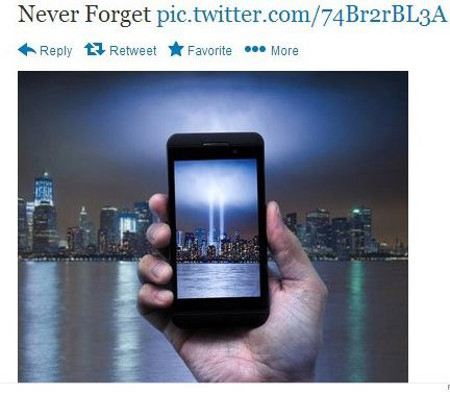
    Image

    It seems that in this situation, AT&T just can’t do anything right. Users of Twitter still were not happy with the apology, admitting that it’s insincerity somehow made the situation worse. Some consumers were so outraged that they threatened to change phone carriers, all because of this ad. In today’s market, finding new customers costs six to seven times more money than it would cost to maintain them. Finding new customers can’t be easy, especially after the bad media attention that AT&T received once the photo was released. If the Twitter comments live up to their words, AT&T could be out a lot of cash by the end of this year.

    AT&T was not the only company to bring the facepalms this past 9/11. Esquire Magazine’s online server accidentally posted an iconic photo next to a headline for another article. Instead of describing it, here’s an example of “a picture is worth a thousand words” :
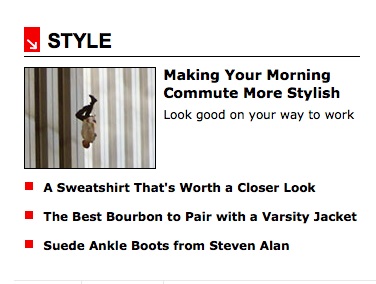
    Image

    Following the post, Esquire tweeted a half-hearted apology saying, “Relax, everybody. There was a stupid technical glitch on our “Falling Man” story and it was fixed asap. We’re sorry for the confusion.” I imagine that Esquire did not consider their Return on Investments (ROI) when posting this tweet. While such outrage over a glitch may seem silly, taking the time to post a genuine apology would secure their consumers and perhaps draw in more. Because the Huffington Post reported on the incident, consumers from all over the world could unsubscribe from the magazine, causing a bad ROI for Esquire. It seems that a genuine “I’m sorry” tweet from the magazine would be far worth the investment it takes to produce the post. Instead, they received a negative return in response to their unenthusiastic efforts.

    #fail #facepalm

    -Dylan Fowler

  • Remember When…We Didn’t Live in a Web 2.0 World?

    What do you think of when someone asks you “Remember When?” Among the historical disasters that have plagued our world, the media has always played a prominent role in the information that is released to the rest of the world. For example, in 1986 a huge explosion occurred at a nuclear power plant in Chernobyl, Ukraine. Even though nuclear power represented a large technological step forward for mankind, our technology in regard to media was still lacking. In fact, the Soviet Union tried its hardest to keep any information regarding the disaster out of media coverage. Not only did it take a long time for the rest of the world to find out about the disaster, but when they did, many of the facts were inaccurate and misleading. This is only one of the many examples in which getting authentic news coverage was halted by the government. Also, the mediums in which the information was made public were very minimal.  There are many other events that occurred during World War I, World War II, The Cold War, Vietnam, etc. that were not made public as well due to the lack of technology in that era.

    In more recent years, a new dawn of technology has signed the beginning of the Tech Age as well as the information Era. These new technological discoveries have further allowed us to transfer information liberally and have also given us the privilege of instant access to information that would otherwise have been difficult or tedious to find in the past. With improvements in technological development, such as the internet, we now have new global platforms that further enable and enhance the flow of information.

    We saw the amazing impact of the Web 2.0 technological age on the fateful day of September 11, 2001.  The new millennium called for the drastic cell phone advancement from bulky older versions to a new PDA form.  The advantages of this transformation really came to light when doomed passengers were able to make one more phone call home on their descent.  Also, real-time coverage about the day’s events was available instantaneously for the world to follow.  Unlike the decades prior, we did not have to wait for the evening news or rely on word of mouth information about the attack.  Americans could simply turn their television on, tune into their radio, call someone on their cell phone or access the internet from their PC or smart phone to keep up with ongoing news that day.  While this was beneficial to the average American that wanted to be informed, it proved especially pivotal for family members that had loved ones working in the buildings that were attacked.

    Every major advancement in society comes with its consequences.  While the technology era has birthed an easier way of living and communicating, the new wave of innovations came with a downside characterized by the improper usage of this knowledge via the media. Nowadays the media is manipulated all the time; these negative effects often come from lobbies that push political agendas or use inaccurate sources.  It is hard to determine what is credible on the web today due to the fact that almost anyone can access it.  Even with the disadvantages that come along with the new technology enhanced media, events such as September 11th prove the importance of getting accurate information in a timely manner.

    Sasha De Vecchi, Lindsay Gallagher, Jay Reilly, Cary Welborn

  • Blaming based on Naming


    While we remember the tenth anniversary of the 9/11 attacks, we recall the sadness and despair felt nationwide when the lives of nearly 3,000 people were lost.  The murder of the many innocent bystanders shocked the world, and resulted in distrust among certain races and religions.  Is it human nature to want to place blame in the wake of such tragic circumstances?  Maybe so, but it is very important to be sure that the blame goes to the rightful place.

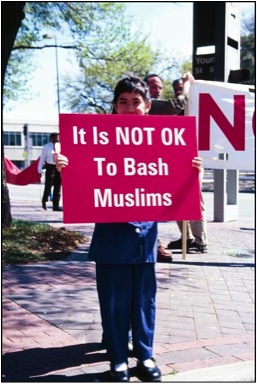
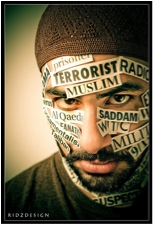
    The attacks of 9/11 were the doings of extremist terrorist groups, in particular, Al-Quada.  Sadly, many people who do not stay abreast of current events and political issues associate the attacks with all Middle Easterners and/or all Muslims.
    Al-Quada is NOT representative of all Middle Easterners or all Muslims, and thinking so is an appalling mistake that some people have been making over the last ten years.   This act of stereotyping someone based on their religion or appearance can be associated with branding.  Some think that branding is about how you present yourself, but branding is really about how other people see you. Unfortunately, in many parts of the world, instances of intolerance, discrimination, and acts of violence occur based solely on discrimination against ethnicity and appearance.

    In the book, “The Authenticity Hoax” by Andrew Potter, he explains the difference between actual truths and perceived truths.  Since the media is such a powerful force in our society, they may inadvertently allude to something that changes the truth in your mind from the actual truth to a perceived truth.  Another problem is that we live in communities with members who share the same beliefs and motives.If your community tends to think ill of a certain group, religion, race, etc. you are prone to such beliefs as well.  Unfortunately, the only way to avoid being persuaded by the media and your community is to disconnect yourself from society, according to Potter.  As PR and IMC students,we agree with Mr. Potter, but we have also learned that there are ways to filter information to stay as close to the “actual truth” as possible.

    We must always look at both sides of the story, and question everything.  For each possible scenario, ask yourself every question that it could be associated with.  All Americans are not members of hate groups like the KKK.  All Christians are not gay hating anti-progressive activists, and all Muslims are not terrorists.

    – Stephanie, Claire, & David

  • Branded in FIRE

    If you ask a kid what he wants to be when he grows up, he doesn’t think about the benefits, hours, or even how much he would get paid. They run on another type of scale dealing with popularity, familiarity, or uniform. A lot of kids originally hope to grow up to be like their mom or dad, no matter what job their parents may hold. For example, if you ask ten-year old Christopher Cannizzaro from New York what he wants to be when he grows up, he will tell you, “a Firefighter just like my dad”. Christopher was only ten months old when his father, New York City fire fighter Brian Cannizzaro, rushed to help the victims trapped in the twin towers on September 11th, 2001.

    Brian never came home.

    Only knowing his father through the pictures and stories told by his mother, Christopher plans to follow in his father’s footsteps. In this case, like many others, there is something much more powerful than the shared bond between this father and son dynamic. There is a legacy. Born in the flames of who they serve and in honor of the people of who they love. It is a brand. The brand of the firefighter.

    As college students, we were about ten years old on September 11, 2001. We all remember where we were when the twin towers were attacked and the reactions of those around us. The devastation on every news channel overwhelmed all of us with an emotional bond unlike anything else before. A deep and powerful connection was made between every American, as we mourned the loss of our own. This was one of the most impactful creations of shared meaning within our country’s history; bringing our country together despite the color of skin, economic status, or beliefs. At that moment, we were united. At that moment, we recognized our heroes.

    The aftermath of 9-11, showed how the strength of our nation helped us all to rise

    and overcome tragedy.  With a death toll of 6000+ Americans, the light at the end of the tunnel seemed to be non-existent. The FDNY went into the flaming twin towers on the sunny morning of September 11th without an ounce of resistance.  They were the heroes that gave our country hope, and never gave up.  The appreciation we have for them as a brand of American heroes will never be let go and the strength we gained from that day will never weaken.

    Before 9/11, many Firefighters were often the unsung heroes of our communities all over. Their job is to put themselves into the path of danger to save people’s lives and homes.  They protect where we live and some of them are volunteers. Living the life of a firefighter means serving everybody, no matter the circumstances. There is no special set of qualifications that you need to have to be rescued; they don’t even have to know you for them to risk their lives for you.  Every time a call comes in, they gear up knowing that it could be their last. On September 11th 2001, 346 of these extraordinary people made the ultimate sacrifice.. for you.

    We are indebted to the 346 American fire fighters who lost their lives that day. Not just because of the day that we all remember but because of how they lived their lives and what they stood for. We all have something to learn from this. Coming together one day in September is not enough to honor these people who served our nation. It should be through our daily lives that we strive to serve and help others like they did for us. This is the brand of the Firefighter. The brand that symbolizes heroism and hope for all Americans.

    Firefighters Prayer

    -Jared Sales, Sally Shupe, Oliver Evans

  • How Much is Too Much?

    As the ten-year anniversary of September 11th quickly approaches, many Americans are beginning to prepare for the remembrance of the lives that were lost on that day. All across the country, people are buying extra American flags to place in their windows, commemorative pins, banners, posters, and even coin sets. And that is exactly what marketers want them to do.

    NYCWebstore.com boasts an impressive display of 9/11 commemorative goods from Twin Tower ornaments to hang on the Christmas tree with care, to memorial umbrellas, to FDNY and NYPD shot glasses. Although some of the profits from these “limited edition” items do go towards The FDNY Foundation, we are not told exactly how much.  None the less, at least our conscience can be comforted knowing some part of our consumer spending is for the greater good. However, unfortunately we cannot say the same for all products.

    What better way to remember than through the unique 9/11 Commemorative Coin Certificate? But if a coin-certificate doesn’t tickle your fancy, fear not for the National Collector’s Mint has a variety of coins to choose from including a brand new coin rolled out to honor the 10th anniversary. Now only $29.95 can help you “pay homage to America’s heroes and remember the day that changed America forever… order today!” 

     We do not mean to make light of 9/11. For many of us, this marks an extremely important day in our country’s history and is a day that we will not soon forget. However, when is too much? When does our need for consumption begin to take over so much that we need to have teddy bears, snow globes, and necklaces to help us “remember our heroes”?

    – Jessica Kingman, Alaethea Hensley, Lauren Phelps

  • Osama=0, Facebook & Twitter=2

    Last night social media networks exploded with the news of Osama Bin Laden’s death. If you have a social media account, there was no way you did not hear the news before President Obama’s speech. Most people, especially members of the millennial generation, spread the news around the world like wildfire. On Facebook, statuses were updated every second with celebratory posts of the death of the most hated person since Adolf Hitler. Twitter set a new record on traffic, with an average of 4,000 tweets per second from the beginning to the end of President Obama’s speech.

    How does this relate to IMC? IMC incorporates social media, which helps create social capital. It is evident that last nights social media event fostered a community around the country and globe of American nationalism, helping to reunite the country once again as the United States of America. In all of our debates over whether social media inhibits social capital, it is now quite clear that social media is a driving force in creating social capital, and on a large scale.

    Here’s to you IMC, for helping create a community one status and tweet at a time.

    -Allison Day, Jessica Berinson, Megan Canny, Melissa Gagliardi, & Scott Burgess