Blog

  • The Shallows: What the Internet is Doing to Our Brains

    Have you ever wondered as technology continues to advance and we continue to use this technology, what effects this might have on us?

    It is not something that most people think about every day as most of us only see the benefits that new technology brings. Sure the challenge to stay in the “real” world is evident, as social media has become more and more prevalent, but what about more long-term effects that all of this technology can have.

    The Shallows by Nicholas Carr, a 2011 Pulitzer Prize finalist, answers this question as it relates to possibly one of the most impactful advancement in information technology, the internet.

    The infographic below illustrates Carr’s two central ideas about how the internet is changing the way we think.


    Whether it was books, clocks, or maps, these forms of information technology have always influenced the way humans thought, and the internet is simply the newest tool at our disposal.

    Carr’s First Point 

    Carr’s first point is that the human brain is always developing.

    He refers to experts in neuroscience to prove that the brain continues to change in response to its environment. Depending on the stimulus, the neural pathways in our brains are rerouted in response.

    Once Carr establishes that our brains are susceptible to change, he explains how the internet is forcing us to think in a non-linear fashion, as opposed to the traditional linear way of thinking that books made us think in.

    The Effects of the Internet

    This non-linear way of thinking means that we are now more accustomed to scanning for pertinent information as well as receiving information with minimal effort. So even when we are done using the internet, the effects of the internet do not leave use. Our brains still want to process information in this non-linear way.

    The benefits of using the internet and thinking non-linearly are that we can process more information faster and more efficiently than ever.

    The question now becomes, as we continue to use the internet, will these benefits continue to outweigh the potential downsides.

    Check out The Shallows to find out if the internet is changing the way we think for better or worse!
  • Temptation

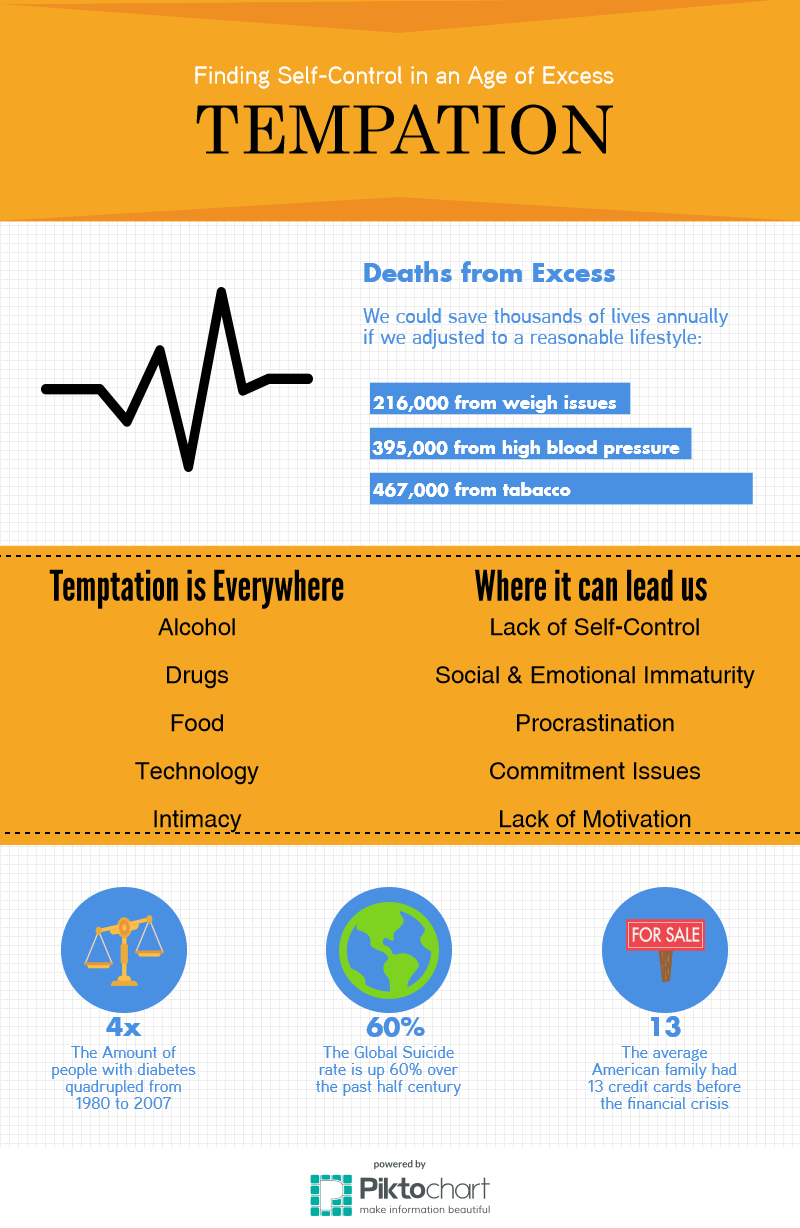
    Temptation, by Daniel Akst, discusses how we live in a time of unlimited access. Contact with nearly any person is available with the touch of a button. Food, delivered right to our doors, are fattening us up more than ever. Alcohol, drugs, and tobacco are still rampant in society. More than half of all deaths in the United States can be attributed to overindulgence of some sort. Hearth attacks and diabetes from food. Cancer from cigarettes. Organ failure from alcohol.

    Despite this, Americans continue to consume more than we ever have before. Our consumption is unchecked, and we show no signs of slowing down. Its starting to have some dramatic effects.

    new-piktochart_21528188_7e0737d1679eba61519413a53c8b7e560f17c4b6

    As you can see from the chart, our gluttony has increased exponentially over the last few decades, and it affects much more than just our physical health. Suicide is higher than ever in developing countries. Our ability to handle finances responsibilities has faltered, as debt continues to increase. Technology has decreased our ability to focus, and increase our ability to consume, and it’s had some serious side effects. We are more likely to procrastinate and commit, are ability to communicate socially has suffered.

    So I know this has been depressing to read, but there are ways to fight this! Remove willpower from the situation if possible. We suck at fighting urges, so removing the urge it;s the first step. Also, surround yourself with human connection. we are much more honest with ourselves when we are around people that we consider close. Finally, set a routine. If we follow our routine, it makes it much more difficult to break.

    I recommend this book to anyone who finds themselves falling into bad habits, like me and my issues with unhealthy food (Pizza and Cookout).  Like I stated earlier half of all deaths could be prevented. Don’t be another statistic! Fight! What are some temptations you find yourself falling into, and what can you do to help yourself? Also, what are some ways to ethically advertise and market products that can fall under this category or addictive substances?

  • new-piktochart_21510375_24e098ca1645ad3f83fa7a62e082a5eb49c4fc5f

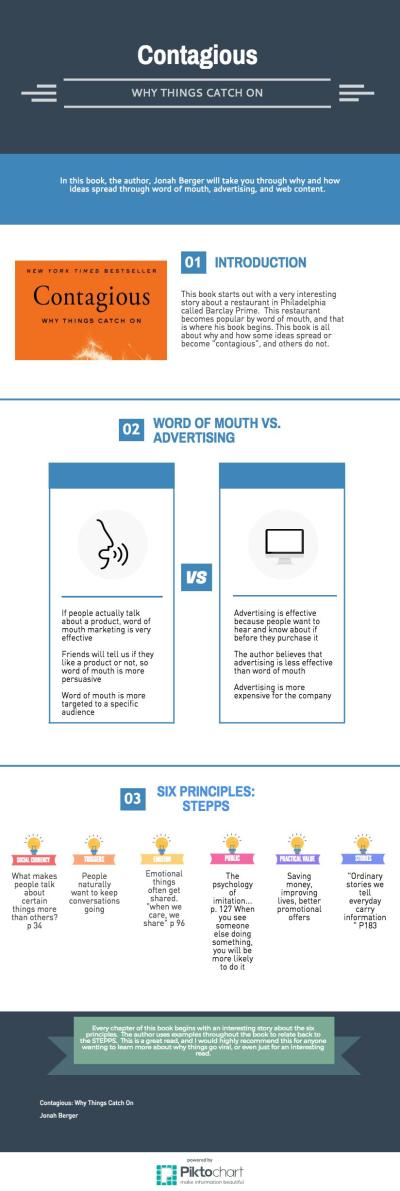
    Contagious, by Jonah Berger was all about how things catch on, or become “contagious”.   The book started out by talking about a popular restaurant, Barclay Prime.  When this restaurant came about, there was almost no advertising involved, but it still became a huge and famous place to eat.  Berger begins by talking about how this restaurant became “contagious” by only word of mouth.  This made him curious about how other ideas and products spread, and how advertising and word of mouth effects what people will do and buy.

    His book was broken into six chapters which were his six principles throughout the book.

    The first was social currency.  This was all about what makes someone talk about something more than another thing, and how it spreads.

    The second was triggers.  He believes that people naturally want to keep a conversation going, so if there is a pause or break in the conversation people will be more likely to bring up an idea or product.

    Emotion was his next principle.  He believes that if someone is passionate about something, then they will be more likely to talk about that thing.

    Principle four was called public.  He states that if you see someone else doing something, you will be more likely to do that thing too.   If someone is talking about and idea or product, or doing something new, you will be more likely to want to try that idea or product for yourself.

    Practical value and stories were the last two principles.  Practical value was more on the advertising side rather than the word of mouth side.  Berger believes that if a product saves money or improves your lifestyle you will be more likely to buy that product.  Stories was the last chapter and principle that Berger spoke about.  He said that ordinary stories we tell everyday get spread, and if an idea or product is in one of those stories, people will be more likely to buy that product.

    This book was all about how ideas and products spread.  Berger did a fabulous job of incorporating his own stories and personal events in the book.  This book was a super easy and interesting read.  I would recommend it for anyone looking to spread an idea or product, or even just if you’re looking for a new book to read.

    -Jennifer Howard

  • The Substance of Style

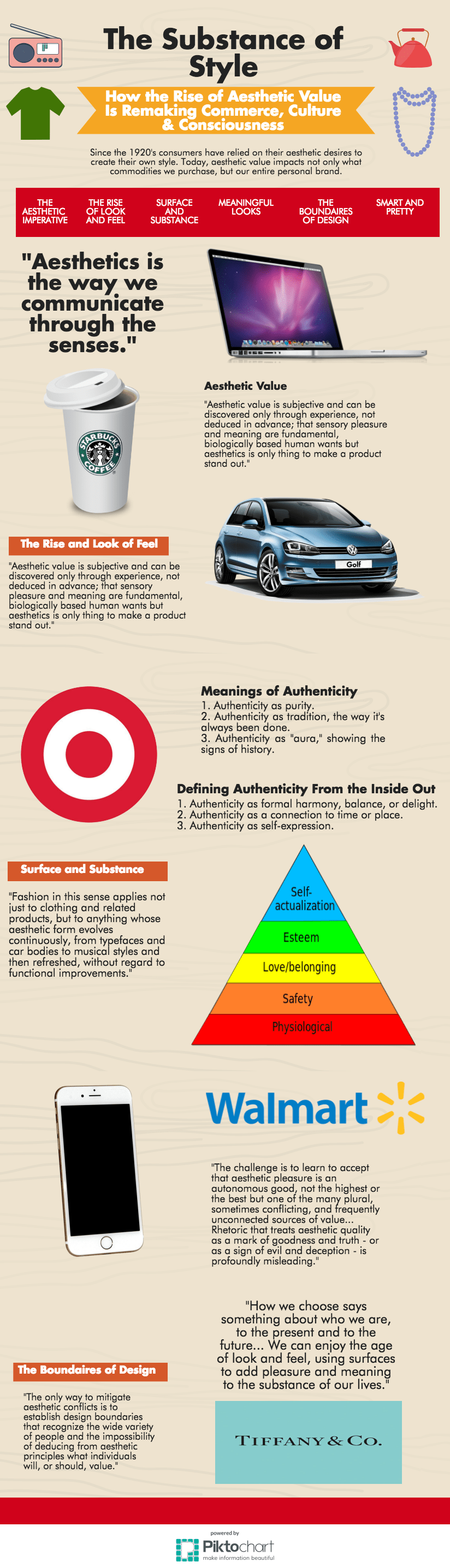
    The “Substance of Style,” written by Virginia Postrel, slings readers into the world of culture, commodities, and aesthetics.

    The book in written into six different chapters and main ideas:

    1. The aesthetic imperative
    2. The rise of look and feel
    3. Surface and substance
    4. Meaningful looks
    5. The boundaries of design
    6. Smart and pretty

    Each of these chapters explores how our personal brand and aesthetic is built to how it is managed to why having a certain aesthetic can have a negative connotation.

    Postrel examines how authenticity and Marlow’s hierarchy of needs play a role in our substance of style. Her analyzes goes deeper into how important it is for us humans to recognize what we believe to be valuable and real, versus what is not.

    new-piktochart_908_0bae657f0b06cf3717fe8cdc13d71dc6c62ff6c7

    So, if you are interested in learning more about aesthetic value and how it has impacted society in terms of hot commodities, authenticity, and brand identity check out The Substance of Style by Virginia Postrel.

    By the end of the book you will have a better understanding on more than just Aesthetic value and its importance, you will understand how the surface of every person and product may not say much at all about its substance, but it does have significance and value all on its own.

    The novel can be purchased on Amazon, Barnes and Noble, and your local bookstores. There is also an audible book for any of those who are not into reading!

    — Stephanie Spencer

  • SHORTCUT: A Book About Connections


    Analogies surround the world we live in. Whether they find themselves shaping our inventions, technology or even speeches. Analogies help shape the way we think. They create roadmaps in our brains that help understand foreign concepts. They help persuade using emotions and they use stories to help understand abstractions. Without analogies, we would have a hard time understanding concepts which are new to us.  John Pollack the author says “people with an understanding of analogies have a better chance of becoming more creative, more persuasive and are more likely to achieve their goals”. This book makes you realize how much of our everyday language does consist of analogies. We find it in our ads, apps, political debates, legal arguments, logos and every day conversations. Shortcut has five main idea which are that analogies fuels thought, shapes outcomes, sparks innovation and persuades.


    Analogies are so powerful because they structure our thoughts. They can shape the way people think about a situation. If it is used at the right time and place it can potentially give the exact outcome you want. Analogies leverage on experiences people already have, making them feel familiar and therefore convincing. Many politicians use analogies to get their points or ideas across. For example, the “revolving door policy” which was put in place by Dukakis. The campaign capitalized on famous cases where a convicted felon was let out of prison and shortly after committed another crime bringing him back to where he started. The commercial ad was just as you would think, prisoners walking in and out of a revolving door. With the simple analogy of the revolving door the audience could understand the point the politician was trying to make, but in a more powerful way. Ultimately this was voted one of the ads which left the biggest impression in that year’s election.


    Analogies also spark innovation. A quote in the book says “innovators are those who spot useful analogies before others do and figure out how to put them to work” (pg. 107). Even in an article form 1905 titled “modern profession of invention” points out three important qualities for an inventor and they are 1) be persistent 2) cultivate your imagination 3) look for analogies. Charles Darwin the founder of the idea behind “survival of the fittest” came upon his realizations through analogy. Darwin recognized a potential analogy between geological and biological processes the specifically that of the impact of small gradual changes over extremely long periods. The book quotes that “he reasoned that if a modest meandering stream could, by eroding grains of sand one by one, eventually crave a mighty canyon, perhaps small random changes in a plant or animal cold influence their relative reproduction and survival rates over successive generations, and thus gradually alter both form and function to yield new species” (pg. 74).


    Lastly analogies can persuade. Reasoning by analogies is used a lot in the legal system. Jurist look at past situations to form precedent over a present case. They make persuasive arguments via analogy and they don’t have much choice in this it is how we form understandings. MLK was well known for his use of analogies, especially in his “I have a dream speech” his analogies between biblical suffering and American struggle was what made his speech so powerful. Without the use of the comparisons, the speech wouldn’t have moved the country like it did.


    The most persuasive people link conceptual “dots” in a way that their audience can grasp new connections and form deeper meaning which resonate as true, even if they aren’t. (pg. 161). This book takes you through not only the creation of analogies but also their use in innovation, persuasion and forming connections. He also offers 5 steps to creating a successful analogy which are: use something that is familiar to explain something that is less familiar, highlight similarities and obscure differences, identify abstractions, tell a coherent story and resonate emotionally. analogies offer conceptual and emotional shortcuts and offer us a new way to solve problems. Analogies create discovery and help communicate ideas in a new fresh way. Pollack couldn’t have ended his book with a better quote “the perfect analogy makes things as simple as possible, but no simpler.


    -Isabella Martinez

    Infrographic - com 438 .png

  • THE SONIC BOOM

    Carly Sprinkles Infographic

    “The quickest way to understand the power of sound is by seeing what happens when it’s gone…” Can you imagine a world without sound? A world where you can’t hear your family’s voices, your favorite music, cars honking at each other, shoes clicking on the floor as people walk, the heart-wrenching sound of your phone hitting the floor… these are a few of the thousands of sounds that we hear and process daily that make up our environment, create meaning, and construct our memories.

    In The Sonic Boom, Joel Beckerman and Tyler Gray analyze the way in which we hear and process sound. This process is a subconscious yet integral part of the way in which we understand our world, thoughts, emotions, memories, and more. Though it sounds complex, Beckerman continuously reiterates throughout the book that it’s not necessary to be a scientist to understand the concepts in this book. Hearing sound is a natural part of the human experience, therefore it involves all of us. Beckerman discuses many different things that are part of the human experience that we can all relate to. For example, he talks about the Super Bowl, and how the number of viewers sky rocketed when one simple thing was added to the middle of the game- music. Beckerman also discusses an interesting concept, how Disney World has mastered the “sound of silence”. By this, he means that we never experience true silence, only sounds that we associate with silence. Disney creates a peaceful atmosphere outside of their parks with with sounds that we associate with “peace and quiet”, such as soft bird noises.

    There are two things that you can gain by reading The Sonic Boom. First, the ability to recognize and use certain sounds to your advantage to reach your communication goals. Second, an understanding of the affect that the hundreds of sounds we hear per minute affect our thoughts, emotions, and decisions.

    The Sonic Boom is for everyone. Beckerman and Gray write in a way that keeps us hooked from beginning to end, and appeals to everyone. The book is especially individual in the way that it looks past the basic psychology and neuroscience on the topic and recognizes the equally as significant way that sound affects us on a deeper level, by touching our hearts and souls and things that make us human.

  • How Social Networks Can Make Us Smarter: Social Physics

    Anthropology, sociology, and psychology are all branches of science that have previously explained human behavior. But the Digital Age has introduced the need for a new way to look at how the new social networks are affecting human behavior and the rate and flow of ideas: social physics.

    new-piktochart_21509652_1ef5bfb0b34122c710c4f669bbdab5cd053d5698

    Alex Pentland’s, ‘Social Physics’ is a series of research the MIT scientist has collected through the experiments of both his own and of others’, about how the digital breadcrumbs we are leaving are explaining vast new areas of human behaviors.  Social physics starts with understanding that the way we look at human behavior now; as groups in markets or classes, is OUTDATED. And too broad. Pentland proposes that we create more than enough data to study within our own networks of individual interactions.

    Here is a breakdown of the book in 4 parts:

    Part I: Social Physics- The basic breakdown of Pentland’s idea. The two building blocks of social physics are idea flow and social learning. Idea flow is essentially exploration, the process of finding new ideas, and engagement, creating a behavioral norm from the idea. Social learning is creating human behavior from idea flow.

    • One of Pentland’s most interesting studies called The FunFit study is in this part, and basically, supports the idea that social network incentives can create organizations guided by change (it starts on pg. 67)

    Part II: Idea Machines- Breaks down how social physics is composed of patterns of interactions, and those patterns create intelligence. When a pattern of interaction is created, things like creativity and productivity are affected and increase.

    Part III: Data-Rich Cities- This part is the base of part IV in Pentland’s book, and explains the local effect of social physics. One interesting point in this part is that we essentially create 3 basic patterns that ‘set the rhythm’ of your neighborhood, city, etc. The patterns;

    what you do on your typical school/workday

    what you do on your days or evenings off from pattern #1,

    and lastly, what you do every once in a blue moon, the wild card days

    are exposed by our digital breadcrumbs, and can be seen from something as small as your mobile data usage. These bread crumbs can be used to directly measure human behavior. The population is defined by tribes, all of which have their own 3 patterns where rhythms are predictable every day of the week.  Even disease spread in your neighborhood is affected by social physics.

    Part IV: Data-Rich Societies- Wraps up the whole idea of the book and applies it to society as a whole. Because of the ease of access to all of the data we are leaving, exchanging, and creating, there needs to be a new way to look at privacy. Pentland’s New Deal on Data proposes 3 things:

    you have the right to have data that is about you.

    you have the right to fully control the use of data that is about you.

    you have the right to spread or destroy data that is about you.

    In Greek mythology, Prometheus gave life to his clay figures with fire.

    Social physics is that fire. So what does it all mean? Are we truly progressing? Will we regret it all?

    You are already living social physics-

    you might as well read it , and understand it (

    and understand it.

    (and you might as well buy it for as low as $3.98 on Amazon)


    Kayla Millie ’17