Blog

  • The NFL Goes Pink?

    Everything turns pink in the month of October, and for good reason. Companies of all types step up to the plate to raise awareness for a wonderful cause. Breast cancer affects millions, one in eight women will develop it in their lifetime. Since so many are affected by this awful disease, it is no surprise that so many businesses take the initiative to raise money and awareness.
    nfl-pink

    The NFL, although known for making everything from their uniforms to penalty flags pink, has been under fire recently for their misleading campaign. It has been said that no money actually goes to breast cancer research, not even a single dollar. The proceeds from the campaign are donated to the American Cancer Society (ACS), who then use the funds to build awareness and provide screenings for women over the age of 40. A representative from the ACS, Tara Peters, spoke to a writer at VICE Sports and said, “The money that we receive from NFL has nothing to do with our research program.” VICE also found out that all of the NFL donations go to an “ACS CHANGE program,” which awards grants to community health facilities located within 100 miles of an NFL city with the purpose of educating women about breast health.

    Being educated and getting your screenings is no doubt important for being proactive with your health but it is not the same as diagnostic mammography. As research provides these new facts it is easy to see why the NFL would be receiving criticism for dishing out their medical advice by saying that “Annual Screening Saves Lives.”

    The past few months have not been the best for the NFL or its image. They are usually applauded for the participation and donations towards breast cancer “research.” But following suit of the recent scandals, the generosity of the NFL is misleading and fans are left unhappy once again. The organization has had a major hit to their image, brand, and reputation. The scandals regarding abuse towards women and children have already received a lot of attention, and now with this misleading campaign information being fed to customers, the image takes another hit. An organization’s brand is supposed to display the vision and values and what is believed to be moral or ethical. While the employees of the NFL are trying to take initiatives to show they don’t support domestic abuse or child abuse, such as the new policy regarding domestic violence and punishments, those things are erased when a new scandal occurs. They are donating to a good cause, however it is not as much as they say and doesn’t go towards what is being advertised. The organization may be trying to make up for the scandal and decisions made in the past, but it seems as though they can’t keep up. What does this say about the brand of the NFL and the people who work for it? A brand is supposed to show what is believed to be ethical and the vision and values of the organization. So what is the vision of the NFL and what do they think is morally right?

    By: Kelli Hall, Stephanie Jordan, Morgan McCleaf, Shawn Rause, and Danielle Walters

    Photo Credit: The Business of Sports

  • Yoplait USA: Friends in the Fight

    For more than fifteen years, Yoplait USA, the popular yogurt brand, has raised both money and awareness for breast cancer. Since 1998, Yoplait USA has supported breast cancer in conjunction with the Susan G. Komen® through cause marketing, which involves commercial activities that aligns a brand with a cause in order to create benefits for both. In this case, cause marketing helps Yoplait promote and market their products to consumers while raising funds to donate to Susan G. Komen®.

    This year, according to Susan G. Komen ‘s website, Yoplait’s cause marketing program is entitled “Friends in the Fight.”  From October 1, 2014 until November 15, 2014, “Yoplait Original and Greek products will feature pink lids. The lids will carry a code that consumers can redeem, through April 1, 2015, at www.Yoplait.com/friendsinthefight and choose to direct their 10 cents donation to Susan G. Komen.” Past cause marketing campaigns between Susan G. Komen® and Yoplait, such as “Save Lids to Save Lives,” have continued to be similar in effect. This year’s title, “Friends in the Fight,” seeks to to demonstrate that Yoplait and its consumers can come together to make the fight against breast cancer more manageable.

    Through this program, Yoplait is encouraging consumers to actively participate in their cause marketing campaign by having them physically go online to donate their lid’s ten cents code. This year’s options include Susan G. Komen, Bright Pink and Living Beyond Breast Cancer, all of which help those who are or have been diagnosed with breast cancer. Yoplait’s cause marketing agreement is to make a minimal $350,000 donation split among the organizations.

    Video shows how to donate to one of three breast cancer foundations

    By actively engaging consumer participation via cause marketing, Yoplait says on its website that their efforts represent their “brand persona” and exemplified their consumers.  Cause marketing is a tactic that can not only be beneficial for both parties, but also positively shape the brand’s image by associating said brand with a cause that affects everyday people, such as breast cancer. Creating a positive brand persona that illustrates a commitment to a cause, Yoplait has continually been a popular brand that consumers love.

    -Kaitlyn Russell

  • WWE Works to K.O. Breast Cancer

    This month is Breast Cancer Awareness Month, meaning that brands and organizations are once again “going pink”.One organization that you might not have expected to adopt this color this month, is the male dominated World Wrestling Entertainment.  According to WWE chief brand officer Stephanie McMahon , 1/3 of all WWE viewers are in fact women!  Every week 13 million people, 4.3 million women, tune in to watch the smack downs.

    The campaign called, “Courage Conquer Cure,” is continuing throughout the month of October.  The WWE is donating 20 percent of their online retail sales and their live events revenue, primarily Monday Night Raw. WWE is utilizing all of its assets in raising awareness and money to the Susan G. Komen foundation.  They are promoting the campaign on WWE Network, social media, and also on E!’S Total Divas, a reality television series about ring girls for the WWE. The wrestler’s apparel and equipment, such as the ring rope, is pink to help raise awareness.

    McLuhan’s (1964) Media Ecology theory explains how media and technology affect the way we communicate and understand the world around us. WWE takes advantage of this principle by utilizing the color pink and other symbols related to Breast Cancer Awareness through multiple technological outlets. They also take advantage of the fact that so many other organizations use this month to promote the cause by jumping on the bandwagon to gain more buzz.

    Many brands are outspokenly supporting breast cancer awareness this month. They promote awareness of this disease and their brand itself. It is difficult for brands to tie together their image and philanthropic efforts successfully.  Do you think WWE’s efforts to try to integrate breast cancer awareness into their brand is an effective route for them to take?

    -Margaret Cafasso, Kierstin Geary, Connor Gold, Olivia Sadler, and Hannah Zeskind

  • “The Nordstrom Way”

    b_1nordstrom

    Imagine this: You’ve just received the brand-new watch you’ve wanted all season for Christmas. You eagerly take it to the store you purchased it at the next day to get it resized when you realize there is a gem missing. The clerk immediately takes the watch without question, apologizes for the inconvenience, and mails you a new one within two business days. What store repetitively goes above and beyond for their customers? Nordstrom, established in 1901, has centered their company’s culture around promoting above-and-beyond customer service policies for their clientele. A department store known for their variety of upscale designer products, Nordstrom’s customer service reputation has even made its way into the form of a book, The Nordstrom Way.

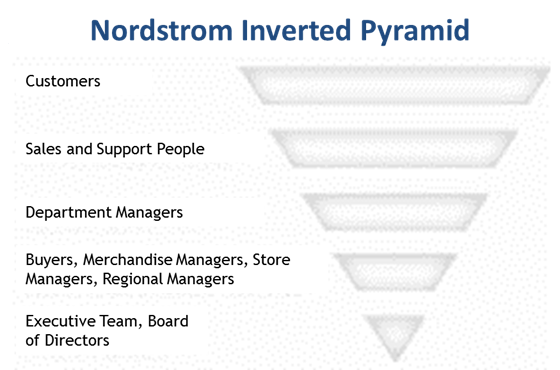
    If you flip through the book, it all comes down to Nordstrom’s #1 rule: “Use your best judgment in all situations. There will be no other rule.” This use of employee autonomy allows Nordstrom employees to be able to rationally assist customers in the way they would like to be treated while shopping. Nordstrom’s business model directly correlates to the Cultural Approach to Organizations theory, which states that, “an organization does not have a culture, it is a culture.” Nordstrom’s key goal lies in putting the customer before anyone else. By walking around the counter to hand you your purchase, not pointing in the direction of an item, but walking you to it, and taking returns (even in the most unlikely circumstances), Nordstrom centers their organization around the customer experience.

    Nordstrom-Inverted-Pyramid

    Now seen as a company for one of the highest regards for customer service, Nordstrom has created a culture within their organization, which many try to emulate. This ties in with the standards that Nordstrom holds for customer satisfaction. According to Forbes, there are three standards a company should uphold to ensure customer satisfaction. Why the service is of value, the emotional response the customer should feel, and the expected method for accomplishing the service in question completes the formulation of Nordstrom’s service model. By capitalizing on these three service model ideals, Nordstrom continues to be one of the most recognized brands for the ideal customer experience.

    -Angelica DiPaolo, Morganne McIntyre, Anderson McNaull, Madeline O’Connor, Rachel White

  • Trader Joe’s Triumphs over Competition.

    According to Forbes Magazine, Trader Joe’s tops all other grocery chains in customer service satisfaction. After The results of a study done on consumers in North America, Trader Joe’s ranked first on atmosphere and fast check out, and second in cleanliness, courteous staff, merchandise selection and accurate pricing. The interesting part to all of this is that it did not make it into even the top five of convenient location, low prices and one-stop shopping. The fact that people choose Trader Joe’s for the atmosphere and customer service over low prices and convenience tells us that there may be more to where and how we shop than good deals and ideal locations.

    While we may choose a grocery store for its prices and selection, it is the atmosphere and employees that keep customers loyal. Trader Joe’s prides itself in offering shoppers a friendly experience and unique experience from the traditional grocery store.Trader Joe’s strives to keep their customers happy and make their shopping experience as enjoyable as possible. The store is inviting and easy to navigate, the employees are dressed causally and always appear happy but most importantly the store takes the extra step to create an identity that the customer feels like they can connect with. Trader Joe’s attempts to tell a story through their store and find ways to appeal to their customer’s senses. By empathizing with their shoppers they can offer the best products for their happiness, health and wallet, which, in return, helps them with customer satisfaction and overall retention.

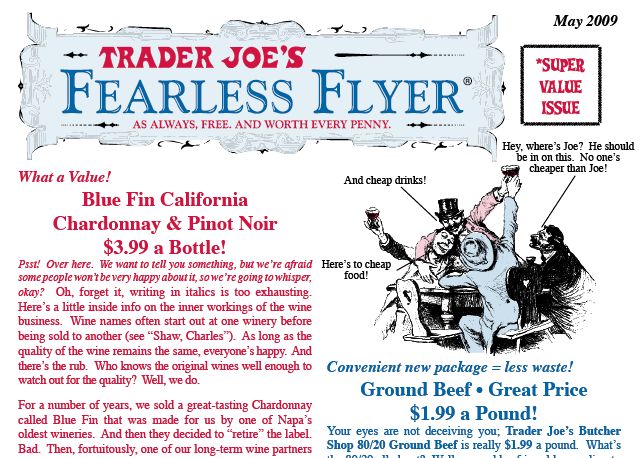
    trader-joes-fearless-flyer-may-20091

    Many companies, like Trader Joe’s, try to appear more approachable than their competitors by using the idea of Corporate Storytelling. They try to show us they are real people with real stories versus a box store or mega corporation. If you take a look at the Trader Joe’s website, they have an entire timeline starting from the first store to today and a page on the story of the company. The writing is friendly and casual, inviting us to interact with them and develop a relationship with the store. Other ways they work to connect with the shopper is through their Fearless Flyer newsletter. Each month they choose store items and invite customers to try new recipes, give feedback or come in for seasonal favorites. During the month of October, Trader Joe’s is featuring Pumpkin flavored items and consumers are eating up the Pumpkin Bread Mix, Honey Roasted Pumpkin Ravioli, and of course the Pumpkin Spice Coffee. By paying attention to the items customers want and offering a pleasant place to do your shopping, Trader Joe’s humanizes their company and moves away from the traditional cold and sterile grocery store environment. By creating a genuine identity and a story to support their actions, they differentiate themselves and offer a unique shopping experience.

    -Brandon Hawkins, Bobby Huckabee, Tony Mangili, Savannah Mitchell, Danielle Salas

  • Amazon Makes It Easy to Remain a Loyal Customer

    Having effective and accessible customer service creates a repetitive buying habit, which in turn creates loyalty. Loyalty is crucial to a brand since it is much more cost effective. It is five times more costly to gain a new customer than it is to keep an existing customer. One example of a brand that does a fantastic job of using effective customer service to maintain its consumer base is Amazon. They were even named the number one company for customer service by a market researcher, Temkin Group, in 2011.

    amazon-logo-transparent

    Amazon is a brand name that almost all of us have come to know and love. As college students, we especially love Amazon when it comes to buying textbooks because they are much cheaper than on-campus bookstore prices. Another reason we love Amazon is because of their customer service. We all can probably think of a time when Amazon messed up a part of our order, but we can probably also remember a time when Amazon helped us get it straightened out with little to no effort. Amazon has impeccable customer service, and because of that we return again and again for all of our online ordering needs.

    Along with their customer service, Amazon offers great loyalty programs. They offer Amazon Prime and Amazon Student (a special edition of Amazon Prime for Students that includes a free six month trial). Amazon Student allows students to have free two day shipping which comes in handy for those who wait until the last minute to order books or supplies. Amazon also allows you to schedule deliveries for products that you order on a regular basis so you don’t have to worry about it when you run out. This helps to create a relationship between consumers and the Amazon brand. When Amazon does not fail us we are much more likely to become return buyers. In the long run, having fantastic customer service is cheaper for Amazon than recruiting new customers to use their services.

    -Stephanie Jordan, Morgan McCleaf, and Danielle Walters

    Photo Courtesey of: Amazon.com

  • Target’s Security Breach: How Safe Are You?

    Target, a very popular and extensive corporation, experienced security breaches from November 27th until December 15th 2013. Target recognized this lapse in security and responded accordingly to its consumers. How and when Target responded to this event were crucial in how the public perceived and continue to perceive Target, while also playing a factor in whether or not customers would shop there again. On December 19, 2013 Target released a message, giving its customers a detailed account of what occurred. According to Target there was an “unauthorized access to Target payment card data” which included “customer name, credit or debit card number, and the card’s expiration date and CVV.” Target openly apologized for the incident stating that their customer privacy and protection was of their utmost concern (Target 2013).

    Target Image

    Target exhibited use of the Situational Crisis Theory, which is not only a theory, but also an applicable plan to react to a crisis, like their breach in security. According to the University of Illinois, a crisis must be identified as the appropriate cluster crisis. In Target’s case, they chose a victim cluster crisis. This cluster states that an organization is also a victim of the crisis, making the company seen as less of a threat. In addition to identifying the correct cluster, there are four main strategies that can be used in response to a crisis.

    Table 3: SCCT crisis response strategies
    Primary crisis response strategies
    Deny crisis response strategies
    Attack the accuser: Crisis manager confronts the person or group claiming something is wrong with the organization.
    Denial: Crisis manager asserts that there is no crisis.
    Scapegoat: Crisis manager blames some person or group outside of the organization for the crisis.
    Diminish crisis response strategies
    Excuse: Crisis manager minimizes organizational responsibility by denying intent to do harm and/or claiming inability to control the events that triggered the crisis.
    Justification: Crisis manager minimizes the perceived damage caused by the crisis.
    Rebuild crisis response strategies
    Compensation: Crisis manager offers money or other gifts to victims.
    Apology: Crisis manager indicates the organization takes full responsibility for the crisis and asks stakeholders for forgiveness.
    Secondary crisis response strategies
    Bolstering crisis response strategies
    Reminder: Tell stakeholders about the past good works of the organization.
    Ingratiation: Crisis manager praises stakeholders and/or reminds them of past good works by the organization.
    Victimage: Crisis managers remind stakeholders that the organization is a victim of the crisis too.
    Source: Coombs, W.T. (2007b).

    Target had a serious problem on their hands since more than 70 million of their customers’ private information was stolen. The company knew that if they did not regain the trust of their customers they would choose to shop elsewhere. Target’s CEO, Gregg Steinhafel, promptly sent out messages on December 19th and 20th to the customers, but he did not openly admit that they had knowledge of a malware attack on their systems. This is an example of the diminishing strategy, in which an organization attempts to minimize blame and responsibility for an event. Throughout both messages, Target used words like “unauthorized access”, “crime”, and “incident”.  These terms are carefully chosen to save face and make it seem as though Target was a victim in the security breach alongside the customer. In order to rebuild their image, Target’s PR practitioners knew how customers would respond to personal information being stolen and what words to use to reassure its consumers that it is safe again to shop at Target.

    In the opening line of the message from the CEO, Target referred to customers as “Target Guest” and stated that, “our brand has been built on a 50-year foundation of trust with our guests, and we want to assure you that the cause of this issue has been addressed and you can shop with confidence at Target.” The messages from Target’s CEO utilize the Rebuild strategy by apologizing to customers and stockholders. The company used the Bolstering strategy, reminding customer about the good of the organization, by reminding them of how target built its foundation on trust for over 50 years.  The shopping conglomerate used diminishing, rebuild, and bolstering strategies in their press releases and messages to customers to separate themselves from the breach, rebuild trust with customers and remind them that Target has proudly served the community for fifty years.

    Fast forward almost a year later and Target is still one of the largest shopping chains in the country. According to USA Today, Target reported second-quarter earnings of $234 million, compared with earnings of $611 million in the same period last year. It appears as though Target’s attempts to regain customer confidence were not as successful as they had hoped. The company may have missed the target on this one.

    – Spencer Brenes