Blog

  • 50 Shades of Grey

    If you have been paying attention to entertainment news lately, you are probably aware that the 50 Shades of Grey movie is coming out this week, in conjunction with Valentine’s Day. It seems like every year, cheesy romantic comedies are released on or around the same time as the holiday. In 2012, it was The Vow; in 2013, it was Safe Haven, and last year it was Endless Love. Just five years ago, the movie Valentine’s Day, featuring a celebrity-packed cast was released. This year, the film is a bit darker than previous years, but it is still expected to be a hit.

    What effects will the release of a hyper sexualized movie like 50 Shades of Grey have for the holiday that it has not had in past years? Many people, especially older generations, blame media and Hollywood for the younger generations distorted views of romance and relationships. 50 Shades of Grey features a masochistic relationship, and by releasing the film on a day that traditionally centers around love and the giving and receiving of gifts, it brings a different light to Hollywood’s views on love and romance. According to the theory of Media Ecology by Marshall McLuhan, media profoundly influences society, and has an effect on human perception and understanding. If this is the case, then the release of 50 Shades of Grey could have an impact on how moviegoers perceive and understand Valentine’s Day, and relationships in general.

    This isn’t the first example of the content of the movie not matching the traditional themes of the holiday. Christmas Day is an example of big movies hitting theaters on a holiday. However, the movies released on Christmas Day are often action movies, which are seemingly unrelated to the holiday. Is there an advantage to releasing a movie on a holiday? Perhaps it’s easier to create advertisements around memorable dates. Maybe these holidays are a time that people expect to spend time with their families and loved ones, and seeing a movie together is the perfect way to do that. Either way, it seems that the trend of advertising high-profile movies around a holiday is here to stay. Do you think this helps increase profits? Let us know in the comments!

    -Mallory Brayman, Kelli Hall, Morgan McCleaf

  • Is Coffee the New Chocolate?

    With Valentine’s Day right around the corner, singles and couples alike are scrambling to make plans for the big day in hopes of not spending it alone. Behind Christmas, Valentine’s Day is one of the biggest money makers for American businesses, with over half of American citizens celebrating the holiday each year. This year, it is expected that Valentine’s Day spending will soar to over $15.7 billion. That is why businesses change, alter, and incorporate unique aspects into their marketing strategies in order to capitalize on the large population of Valentine’s Day spenders.

    Starbucks, like many other businesses, has turned holidays into commodities by associating their coffee with the feeling of ‘love.’ This year, they’ve teamed up with Match.com, a dating website, to create the World’s Largest Coffee Date. According to the profiles on Match.com, meeting for coffee is one of the most common first dates, so Match.com has created a “Meet at Starbucks” feature to facilitate easy coffee dates in the future. This not only increases Starbucks’ audience, but also gives consumers a more in-depth experience with their brand.

    starbuckxmatch-app-01-2015_0

    Additionally, on February 13th from 2 p.m. to close, Starbucks across the country will host the World’s Largest #Starbucksdate, which will promote people meeting and talking for the first time over a cup of coffee. Coffee drinkers are prompted by the Starbucks website to “invite someone” to join them on a #Starbucksdate. Anyone can create an invitation and send it to whomever they want to invite them to join in a Valentine’s Day coffee date. This illustrates the commodification of Valentine’s Day by using a tangible product–coffee–to represent or be exchanged for the feeling of love or friendship.

    Starbucks will offer a special menu for two that includes drink and dessert pairings for only five dollars. For example, one pairing on the menu is the White Chocolate Mocha and a heart-shaped cookie. Starbucks will also be enhancing the ambiance by having live music and props to take pictures with to document your #Starbucksdate. This will help to create a memorable and positive brand association with Starbucks for consumers who don’t usually drink their coffee.

    While this may seem like an elaborate scheme to get people to drink their coffee, Starbucks was smart when they decided to market themselves in conjunction with Match.com. Coffee is a common first date commodity, so it only makes sense to combine Valentine’s Day, first dates, and coffee to create the perfect marketing trifecta.

    Would you participate in the World’s Largest #Starbucksdate?

    – Anna Joy Zima, Hannah Rodgers, Kaitlyn Russell

  • The Compelling Commodity of Love

    What is a commodity? According to Merriam-Webster Dictionary, and other various dictionary websites, a commodity is something that can be bought and sold, or a good or service that is interchangeable with other similar commodities. Most of these are defined as hard and physical goods like food, metals, and textiles. However for advertisers, commodities are much more. Take our topic of the week. Love.  This upcoming weekend is Valentine’s Day, which like many other big holidays in our country, has been turned into a commodity that businesses swarm to take advantage of in the form of influential and effective advertisements

    According to National Jeweler  (2015), a consumer research agency, Americans will spend almost $4.8 billion dollars on jewelry this upcoming Valentine’s Day. Due to the fact that Valentine’s Day has become the expected holiday to buy a loved one a nice gift of some sort, it is the advertising culture we have come to accept that has really influenced us to make these purchases.

    One common example is Kay Jewelers, a huge mall-based jewelry store owned by Sterling Jewelry. Kay Jewelers creates a perfect example of the influence in love as a commodity, heavily influencing shoppers to buy their products through their advertisements.

    Look at the Kay Jewelers “Love Embrace” commercial above. It’s corny, but effective. Did you notice the theme throughout the commercial? Obviously it’s loving and embracing your loved ones, but with a clever but cliché twist on how buying one of Kay’s diamond necklaces will “surround her with the strength of your love”, pun intended. If you look at most of Kay’s commercial, which are all very similar to this one, you can see the idea and motif of how love is being turned into a commodity that sells.

    The key to Kay Jewelers success is their focus on how we create and reinforce cultural values with the purchases we make, in other words the ritual approach to advertising. According to Hovland and Wolburg, the ritual approach “Isn’t just about sending messages through space, but the maintenance of society in time and representing shared beliefs within a culture” (59). We have gradually transformed into a society that links action, such as buying a diamond necklace, to love; the bigger, or more expensive the gift, the greater the giver’s love is perceived. Valentine’s Day is not a ritual in itself; it is merely just another day. However, advertising has conditioned us to rank one’s love on “good” jewelry and “bad” jewelry eventually attributing the amount of love one feels for another to a physical gift.

    What are your feelings about Valentine’s Day? Are you expecting a great experience from your boyfriend or girlfriend? If so, think about how advertisements have created a misconception about love?

    -Colby Cummings, Connor Gold, Chase Seymour

  • NFL Says No More

    After a tough couple months for the NFL with scandals like that involving Ray Rice, the organization took the opportunity of their biggest game of the year to attempt to rebuild their image. They did this by partnering with the anti-domestic violence campaign “No More” to create an emotionally charge advertisement about the issue.

    The commercial shows a house that has been torn apart partnered with audio from real 911 calls from women who was a victim of domestic violence. She is forced to pretend like she is ordering a pizza in order to not cause suspicion from her abuser, as he is in the house. The chilling ad makes the viewer think about the challenges of victims of domestic abuse.

    The NFL is implementing a new personal conduct policy that all NFL employees and athletes must abide by. The new policy includes “a more extensive list of prohibited conduct, independent investigative procedures, and specific criteria on paid leave for an individual charged with a violent crime.” There will also be a “6 game suspension involving violent conduct, including domestic violence and sexual assault.” By implementing these new policies the NFL hopes to see a change in violence and raise awareness through the No More campaign.

    The NFL has been criticized for being reactive instead of proactive. Is the NFL’s image too late to fix or are you “up to listen?”

    -Nick Bolick, Olivia Sadler, Patrick Wagner

  • The Saddest Super Bowl

    I’m sure almost all of you watched the commercials this past Sunday. Many people look forward to the usually entertaining and comical commercials the Super Bowl provides us with. But this year the commercials were downright sad. You can view the ones deemed “saddest of 2015” here:

    Nationwide, Nissan, and Microsoft all used advertisements using children in order to evoke emotion. As if the sad children weren’t enough, Dodge threw in a commercial with cute old people reminiscing on the glory days. If none of those got your tear ducts working, then I challenge you to watch the Budweiser puppy commercial. If this advertisement didn’t make you shed a few tears into your beer, then you might want to get checked out. Overall, the commercials had a more somber tone this year. But why?

    lost-dog-1024

    According to Variety, the latest research shows that consumers have been proven to switch to products that support social causes. They predict that this means the Super Bowl ads could be more serious for years to come. But is their “social cause” as moving when it is only a lone commercial geared to make them more money? Or is it beneficial that consumer’s social interests will be reflected and supported by companies? What do you think?

    -Spencer Brenes, James Cronberger, Jill Jardine

  • Really, Nationwide?

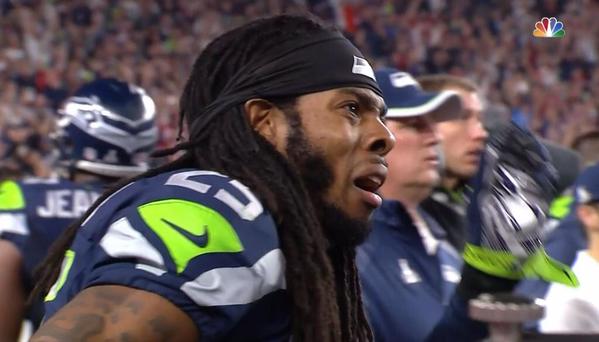
    Did anyone else notice the not-so-funny tone of Super Bowl commercials this year? It seems like all of the advertising agencies got together and agreed to make viewers cry instead of laugh. Most notably, the Nationwide “Make Safe Happen” commercial. The ad features a little boy saying all of the things he couldn’t do, like learn to ride a bike or get “cooties” from girls. In the middle of all of the “awww”s from viewers, the little boy states, “I couldn’t grow up, because I died…” The viewers “awww”s quickly turned to shock and everyone shared a stunned expression similar to Richard Sherman’s.

    http://i3.kym-cdn.com/photos/images/original/000/907/711/782.jpg

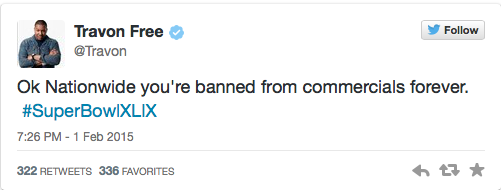
    The commercial has a PSA-type message about preventing accidents in the home. There is footage of an overflowing bathtub, a fallen TV, and spilled detergent. This Nationwide commercial has a very different mood than the one aired earlier in the night that starred comedian/writer, Mindy Kaling. Viewers took to Twitter to share their opinions of the commercial.

    Screen Shot 2015-02-03 at 9.48.38 PMScreen Shot 2015-02-03 at 9.48.44 PM

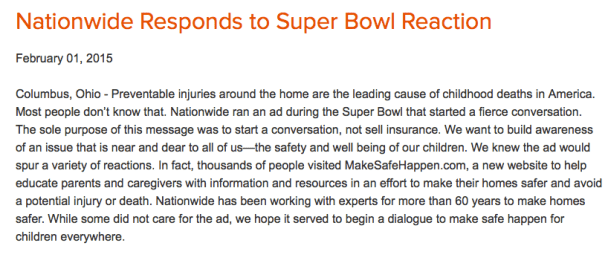
    Clearly this “Make Safe Happen” commercial did not settle well with viewers. Nationwide responded with a statement on February 1st regarding the negative feedback.

    Screen Shot 2015-02-03 at 3.48.30 PM

    The statement claims that the commercial was meant to start a conversation about making homes safer for children. It did start a conversation, but a different one than desired. People are talking about how depressing the commercial is and why Nationwide took it upon themselves to try to start this particular conversation. The statement says they aren’t trying to sell insurance, but Nationwide is an insurance company.

    So what is the actual goal of this advertisement? Why spend so much money for a primetime commercial spot that doesn’t positively benefit the company? What do you think Nationwide actually expected to happen after airing this commercial?

    -Kelli Hall, Mallory Brayman, Morgan McCleaf

  • Coca Cola #MakeitHappy

    We live in the age of technology. Our generation  has almost unlimited access to the Internet through smartphones, tablets and computers. Most people in the millennial generation  are familiar with the use of technology. Since many of us consume technology on a daily basis, information can be accessed and shared with the touch of a button; however, not all of that information is positive.

    Coca Cola recognizes that and addresses this problem in their latest Super Bowl commercial, #MakeitHappy. Because of their already established ethos from being a well-known and trusted brand, they’re able to reach out to a large targeted audience. The commercial portrays individuals who are consuming negative information on the Internet, but the power of Coca Cola is used to turn this negative information into something positive to spread happiness. Utilizing a message that targets nearly all users of technology helps the brand connect directly with consumers who may face the negative effects of technology.

    The goal of this advertisement isn’t to tell consumers how delicious their soda is or why they should buy it, but instead they are working to create brand awareness with their company and happiness. If Coca Cola can make other people happy, then it can make you happy too. Their focus is on creating brand awareness so that when consumers see Coke, they associate it with positivity and happiness.  In this age of technology that can easily misused, Coca Cola here is to help spread some happiness around.

    This type of advertising is consist with other Coca Cola advertisements such as #AmericaisBeautiful, which has created a solid brand foundation that consumers are familiar with. By using consistency, Coca Cola is able to use their advertisements to start a conversation with its consumers.

    So, How will you #MakeitHappy this year?

    -Anna Joy Zima, Hannah Rodgers, Kaitlyn Russell