Category: Corporate Communication

  • Corporate Communication Wrap Up

    As our time in the Corporate Communication classroom comes to a close, the information and knowledge that we have gained will continue with us as we each venture out after graduation into our desired career field.  Among the class of communication majors are students interested in event planning, public relations, integrated marketing communication and advertising, just to name a few.  Corporate communication is involved in all of these industries.  As stated in Corporate Communication: a guide to theory and practice by Joep Cornelissen, one of our required readings for the course, “Corporate communication is a management function that offers a framework for the effective coordination of all internal and external communication with the overall purpose of establishing and maintaining favorable reputations with stakeholder groups upon which the organization is dependent.”

    When the course first started back in August, not a single student in the class knew what the definition of corporate communication was.  Even though everyone registered to take the class, no one really had an idea of what it entailed.  Today, every student in the class has a definition of corporate communication, as well as plenty of detailed and background information that will give people a better understanding of the topic.  A big improvement from three months ago, wouldn’t you agree?

    We have covered a variety of forms of corporate communication that take place in sports, music, movies, politics, crisis management and careers this semester.  We have learned that communication is essential when it comes to an organization’s corporate image and identity, reputation, stakeholders and shareholders.  We have learned what makes a company go from good to great, the characteristics of a great company and why every company should strive to become one.  We hope we have left everyone with a better understanding of corporate communication.

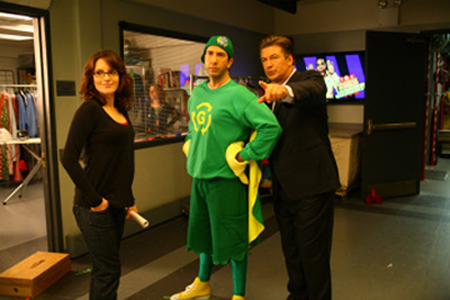
    REMINDER! This week is NBC’s Green Week!  Green Week runs from November 14-21.  All this week, green topics will be featured into news and your favorite shows on the NBC network, such as 30 Rock and The Office, as well as special reports, fundraisers and documentaries.  Join NBC in celebrating the numerous ways that you can make a difference in the environment.

    -Danielle Dorantich

  • “Look! It’s SpongeBob!”

    I don’t know about most people, but for my family, Thanksgiving just would not be Thanksgiving without flipping the channel back and forth between football and the Macy’s Thanksgiving Day Parade. Although I enjoy watching football, I can’t help but hope that the parade ultimately wins the battle of the remote control. I can remember watching the parade on TV since I was a little kid, anxiously awaiting the arrival of my favorite cartoon characters’ floats and to get that first glimpse of Santa Claus.

    Besides being a Thanksgiving Day tradition, the Macy’s Thanksgiving Parade is also an example of corporate communication. In the 1920’s, many of Macy’s department store employees were new immigrants to the U.S. The employees wanted to celebrate the American holiday with the type of festival they had loved in Europe. So, on Thanksgiving Day, 1924, the employees marched down the streets of New York City dressed in their favorite costumes. There were floats, balloons, and even live animals from the Central Park Zoo in the parade! With a live audience of over 125,000 people, the parade was a hit!

    Since 1924, the Parade has gone on every year, except during World War II when rubber and helium could not be wasted. In the 1950’s the Parade was first televised nationally, thus securing its place as an American holiday tradition.

    The Macy’s Thanksgiving Day Parade gives Macy’s department store quite a favorable image. This beloved parade, mostly marketed towards children, emphasizes Macy’s commitment not only to the community, but to every member of the family. Programs sponsored by organizations for the community, such as the Macy’s Parade,  create a perception of  that organization in customer’s minds. By sponsoring such a wholesome family event, Macy’s establishes its corporate reputation as being a store for the entire family.

    So, as you’re nodding off on the couch this Thanksgiving Day after eating too much turkey, listening to your family members yell “Change it back!” every few minutes the channel is changed, I hope you stop on the Macy’s Thanksgiving Day Parade. I think this parade creates a favorable image for Macy’s; what do you think?

    http://www.nyctourist.com/macys_history1.htm

    Fran Greene

  • We Wish You a Merry Chaos

    The holiday season is one of the most crucial times for the world of commerce. During the last quarter of the year the majority of businesses finally go into the black, or in others words, finally begin to make a profit. This time is not only the most lucrative, but also the most chaotic and busy. The extra productivity allows for problems that most corporations would not face throughout the normal fiscal year.

    For example, during the holiday season, FedEx enters into a frenzy of shipping, transporting, and employees are often over worked. In 1998, these over worked employees felt unappreciated, over worked, and under paid. Because of this, there was an expected strike from FedEx employees. This was ultimately due to a lack of positive communication between the corporations, in this case FedEx, and their stakeholders, the employees. They also have to deal with unhappy impatient customers and figure out a way to satisfy the demands of their stakeholders including employees and consumers, as well as all their other various stakeholders.

    These problems are just a few of the issues a corporation can face during the holiday season. Because of issues such as the ones FedEx faced, it is imperative for corporations to have successful communication in order to protect the interests of their reputation and profits.

    Breanna Alexander

    Lauren Dehart

    Lauren Smith

    Kelly Wiley

  • Corporate Christmas?

    Holidays are usually perceived as a happy, carefree time of year, however, when reaching the holiday season corporations have to discuss and agree upon the appropriate way to acknowledge the different holidays. This is especially true in public school systems. In a school system such as a catholic school it is to be expected which holidays will be celebrated and even taught. However, in the case of UNCW, a public, non-denominational university special considerations must be made in order to not offend or exclude different beliefs. Instead of putting up specific decorations UNCW puts up things like wreaths with pretty red bows and some simple white lights. In my opinion they do a very tasteful and appropriate display of festivity without any favoring of a certain holiday or religion.

    This same phenomena can be seen in large business setting corporations. Many times instead of Merry Christmas you will see “Happy Holidays” or instead of hosting a Christmas party it will be titled as a Holiday Party. This sensitivity to others beliefs is respected in the office I work in, instead of sending Christmas cards to the donors and committee members the secretary sends out Thanksgiving cards that are very general and just say how appreciative our office is of our donors.

    This is not to say that the holidays are overlooked. There are still things such as holiday grab-a-dates, tacky Christmas sweater parties, decorations, holiday breaks from school, delicious food and even some festive weather to look forward to!
    -Emily Hunter

  • Corporate Holiday Humbugs

    It’s getting to be that time of year, when the weather drops below 40 and people start to prepare themselves (and their bank accounts) for the holiday season. From turkey, stuffing and cranberries; to presents, garland and twinkling lights, there is always someone convincing you that the holiday season will be even more memorable if you spend just a little more money. Companies gear up for this busy season, creating entire strategic plans to tackle the influx of customers that will be searching their shelves and racks for the “perfect” presents this year. Television Ads and radio commercials turn from normal to intensely tacky within a week after halloween, and you begin to wonder how advertisements for holiday merchandise progressed to this magnitude.

    Many believe that the religious background of the holidays celebrated around this time of year gets overpowered by the materials and tangible items that are repeatedly portrayed to consumers. However, this is not the only gripe that is muttered around this time of year. Companies everywhere are constantly trying to change the way they reach their customers around the holiday season: ranging from television and radio advertisements, to mailing catalogues and going door to door. Many people view this as intrusive and not a very persuasive way to promote sales within the company.

    As a result, many believe there must be a balance: where families can celebrate the holiday season and enjoy time with their families and friends, all while avoiding the initial panic that so many experience when the season arrives. Companies must be able to advertise in a manner that doesn’t send chills down consumer’s spines every time they hear a radio ad and create havoc within the shopping malls to make that 3a.m. sale. After all: its a season where families should enjoy their time together, instead of the gifts they receive.

    -Lora Hampton

  • .. And the ballots are in!

    It’s voting week! So, what can be more perfect than to talk about political communication?

    Political communication.. what’s that?! Political communication attempts to directly relay information to its publics. It is a form of communication between a politician and potential voters and is also directly comparable to corporate communication in a different form. Political Communication focuses on communication in public settings, which can include specific techniques such as persuasion, and include communication theories such as the argumentation theory.

    Let us remind you that corporate communication focuses on communication between and among individuals and groups in organizations. Political communication is very similar. In addition, it incorporates the essence of mass media and new media to enhance many aspects of a campaign.

    Marketing is a key component in both corporate communication and political communication. Regarding the 2010 elections, marketing techniques have really taken on a new spin. This new marketing spin has incorporated the use of the new advancement of social media. Within elections, social media is shaping the political landscape, as it is for many corporations. The idea of embedding social media into the campaigning aspect of politics has proven to have a huge importance in creating more channels as well as expanding networks that are able to reach high numbers of people today.

    Social Media has also allowed for the creation of virtual groups, which serve as a connection between like-minded people. This streamline of internet and social media allows these groups the ability to reach other to others, express their opinions and persuade them to follow their lead. This concept has shown to strengthen many politicians political campaigns.

    This technology has allowed us to reach new possibilities in both political communication and corporate communication. Tuesday, November 2nd is voting day. Use social media to check out the candidates and make sure to go VOTE!

    -Arielle Williams

  • Crisis Averted? A Quick Lesson in Crisis Communication from Toyota

    2010 has not been the best of years for Japanese automaker, Toyota. Once known for its reliability and safety, Toyota’s brand image has taken a major hit due to several recalls over the past year. At the beginning of 2010 the car manufacturer was forced to recall millions of vehicles due to a sticking accelerator pedal that led to accidents, and even deaths in severe cases. Just last week, Toyota announced another recall on over 1 million Toyota and Lexus models due to faulty brake master cylinder seals and fuel pumps. The defective seals could cause break fluid to leak onto the break pads, causing them to deteriorate and become spongy, thus making them less effective and even dangerous.

    First, their cars accelerated on their own, now their cars can’t stop? Yikes! These two major recalls don’t exactly speak to Toyota’s image of being reliable and safe. Because of this, the automaker has had to step up and do some major crisis communication. Luckily, Toyota gained some valuable experience with their first major recall, making last week’s recall seem minor in comparison.

    Unlike the first recall of the year, where Toyota supposedly knew about the flawed accelerator long before they decided to alert the public, this time the company quickly addressed the defective seals and issued a voluntary recall. In any crisis it is important for a company to make the public aware of the issue before it is leaked to the media. If this is done properly, the company can save face. If they try to hide the issue it may appear as if they do not care about the safety of consumers, which has the potential to create even bigger problems.

    The way the crisis is addressed by the company also has a major impact on how well it is received by the public. Toyota’s January recall is a prime example of what not to do when handling a crisis. Their lackluster crisis communication left a lot to be desired, but with October’s recall the company has done a much better job. Recall information is readily available on Toyota’s website, however, what is more noticeable are Toyota’s “Safety First” advertisements at the top of the recall page. Because of all of the issues plaguing the Japanese carmaker, their crisis communication team has gone in to overdrive in attempt to repair the brand’s tarnished image, hence the reason all of the Toyota commercials you see today are centered around safety and reliability.

    All in all, Toyota has done a much better job handling its second major recall of the year, but issuing two major recalls does not do wonders for the brand’s image. Thanks to some help from their crisis communication team, we have seen the company recover a little, but it is still going to feel the effects from the issues it has faced this year. We’ll have to wait and see how good their PR is in the upcoming months to see if they can regain their position as one of the top auto brands in America.

    Sarah McIntosh, Sean O’Connell, Eliza Wadson, Jocelyn Walson