Author: imcclass

  • Seeing one’s corporation from the other side

    The CBS reality series “Undercover Boss” follows high-level chief executives as they slip anonymously into the rank and file of their companies. The purpose of this show is to show the CEOs of these large corporations what it’s really like working in the lower levels of the company. By the end of the episodes, these CEOs and high-level execs see the effects their decisions have on the entire company, right down to the lowest level employee. This show relates to our Corporate Communication class because it depicts the lack of communication that so often exists between upper level management and the lower level employees. By experiencing first-hand the hard work that their employees do, the CEOs realize that there needs to be improvements in their company’s communication strategies.

    The pilot episode featured the CEO of Waste Management, Larry O’Donnell. After working among the garbage collectors of his company, O’Donnell recognized the need to solicit advice from his garbage collectors before launching company-wide initiatives. O’Donnell clearly learned from his experience on “Undercover Boss.” Corporate Communication involves actively communicating and engaging with stakeholders. By listening to his employees’ needs, O’Donnell is helping shape Waste Management’s corporate reputation into a positive one. Corporate Identitity should reflect upon employees’ values and feelings about the company. Larry O’Donnell is working towards a strong corporate identity for Waste Management by simply listening to his employees and communicating their values throughout the company.

    Ari Nateman

    Fran Greene

    Lacey Inman

    Megan Regele
  • Corporate Communication in 30 Rock

    It is becoming very clear to us that we are surrounded by corporate communication, but then again all of us writing this blog are in a class that conveniently shares the same name.  Communication Studies majors are not the only ones who encounter the area under discussion.  Unless you are a hermit, we would be willing to bet that you too have experienced the phenomenon that is corporate communication!

    Since corporate communication is everywhere, we thought it would be easy to pick out examples of it in the TV shows and movies we watch.  Wrong.  We couldn’t think of many examples that demonstrate corporate communication right off the tops of our heads.  Then, one of our group members offered up the suggestion of 30 Rock, the NBC sitcom created by Saturday Night Live writer and actress, Tina Fey!

    Although there are examples of corporate communication throughout the four seasons of 30 Rock, we decided to focus on the pilot episode for the sake of this blog.  At the beginning of the episode, Liz Lemon, played by Tina Fey, goes into what she thinks will be a normal day at work as the head writer for “The Girlie Show.” That is until she is called to the 50th floor to meet with her boss.  Expecting to see Gary, her usual boss, Liz is surprised when she is instead greeted by Jack Donaghy, played by Alec Baldwin, and even more shocked to find out that Jack has replacedGary.  Jack starts the conversation by informing Liz that much to her dismay they need to “retool” The Girlie Show in order to increase male viewership.  To achieve this, Jack suggests adding movie star, Tracy Jordan, played by Tracy Morgan, to the cast.  Despite her discontent, Liz agrees and from this we can begin to see corporate communication in action.

    Let’s look at Liz’s The Girlie Show as a brand; the brand is not capturing a male demographic, so network executives feel that it is time to introduce a new strategy.  This strategy comes in the form of Tracy Jordan, whom they believe will bring in viewers from the XY population.  Luckily, viewers receive the introduction of Tracy well and ratings increase, thus increasing the popularity of The Girlie Show brand.  In this instance, the viewers are the equivalent to consumers; they are stakeholders who determine whether the show stays on the air or gets canceled.  Tracy Jordan is another stakeholder, but he can be likened more to an employee of a company.  He doesn’t want to see the show do poorly because his job could be in jeopardy.  Liz, along with the other actors, and the network executives are also stakeholders in the organization.  If the show doesn’t do as well as hoped then their jobs are also on the line.  This is obviously a simplified explanation, but it demonstrates corporate communication nonetheless.

    -Sarah, Jocelyn, Sean, and Eliza

  • “You do not get 500 million friends without making a few enemies.”

    In 2003, a few Harvard undergraduate computer geeks sat down and began working on a project. What came out of this project was the world’s fastest growing and, perhaps, the most popular social networking site ever created.

    This story is the framework for the new movie Social Network, which highlights the life of Facebook creator, Mark Zuckerberg. After six years, Zuckerberg has become the world’s youngest billionaire and Facebook the world’s most popular media network. In our fast pace moving society, time is money and money is time; and time itself, invaluable. So, a networking site that gives you the power to communicate with over 500 million users at any time is the world’s most powerful marketing and communication tool. In recent years, this “power” has been channeled by millions of businesses in order to promote their business and reach more potential clients. This gives additional lower-cost advertising that can reach more people. It’s a “no brainer”.

    In corporate communication, just as in Facebook, networking is key. The more associates/clients, or in the case of Facebook, friends a company has, the more their product, identity, and reputation is supported and exposed. Understanding and executing this idea is key for successful corporate networking. Let’s use Facebook as an example.

    Jane goes to a party and her friend Kate introduces her to her friend Sarah. The next day, Sarah friend requests Jane on Facebook and Jane accepts. Jane notices the hot guy from her English class, Joe, is friends with Sarah. So Jane friend requests Joe. Joe and Jane begin Facebook chatting. Now Joe and Jane are friends.

    Yes, it’s just that easy … Well not really, but this is why networking is important in corporate communication. Replace Jane with the vice president of Pepsi, for example. He goes to a function or benefit with other corporate “royalty” and is introduced to the head PR representative for Nike. One thing leads to another, and suddenly you have Lebron James on your TV with a basketball in one hand, a Pepsi in the other, and two Nike shoes on his feet. This is social networking at its finest. Networking is seen all around us every day. Whether it’s for social or corporate reasons, it’s an effective tool for successful communication.

    Does the movie discussed in the article sound interesting to you?  Check out the movie trailer here.

    Breanna Alexander
    Lauren Dehart
    Lauren Smith
    Kelly Wiley

  • Corporate Communication in AMC’s Mad Men

    Going back to defining Corporate Communication, a corporate narrative is essential to any company. No series understands this idea better than the AMC series, Mad Men. The show has gained great success winning numerous Emmys for its depiction of advertising in the 1960s. An episode we thought that showed the best example of creating a corporate narrative was, “The Wheel.” In this episode, the main character, Don Draper is pitching an advertising idea for Kodak’s slide projector product.  In pitching this idea he makes the point of nostalgia being sensitive but potent. In doing so, nostalgia becomes the key part of the product’s narrative. Nostalgia appeals to consumers’ emotions while also enticing them to buy the product. Draper furthers the product’s narrative by changing the name from “The Wheel” to “The Carousel” because a Carousel, like nostalgia, takes you back in time. By creating this narrative, Draper has taken a piece of rather unexciting technology and transformed it into a sentimental family necessity.

    To check out this episode click here.

    -Gracie, Meghan, Wade and Emily

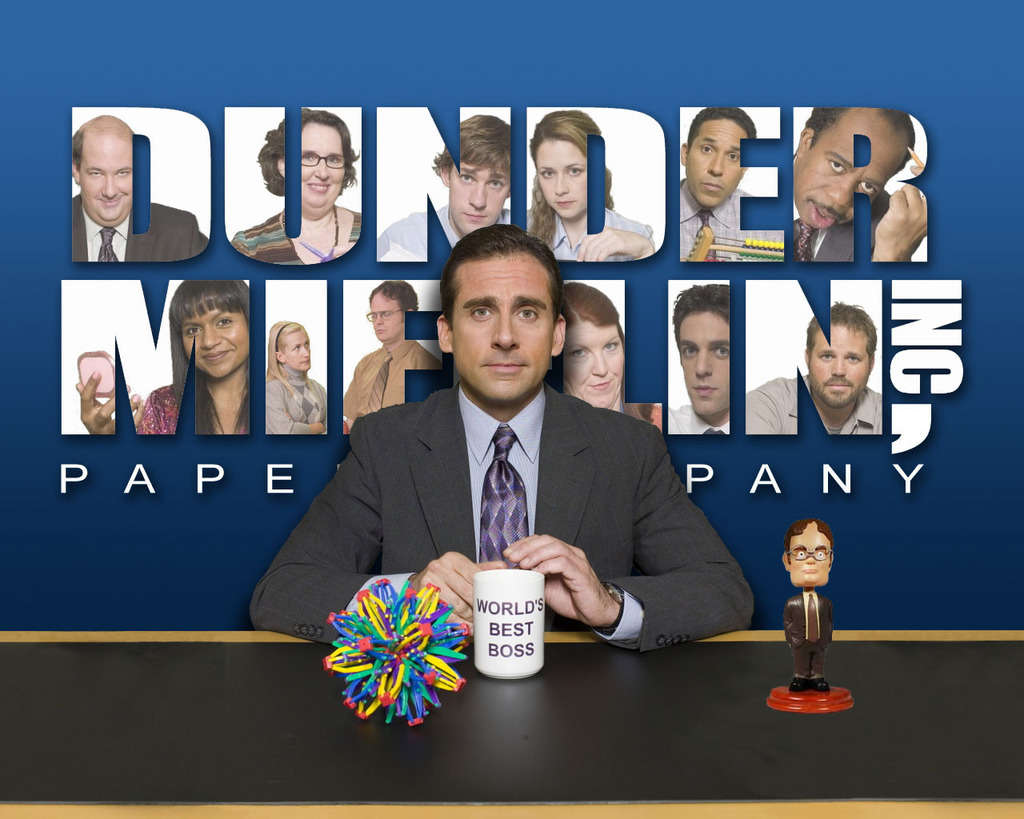
  • Corporate Communication Gone Wrong: The Office

    This week in class we will be discussing Corporate Communication in television and movies.  NBC’s show The Office, starring Steve Carell, is a prime example of Corporate Communication gone wrong.  Each episode humorously depicts stereotypes of life in the office while giving countless examples of incorrectly used communication tactics.

    A specific example of this is during the Product Recall episode, when an obscene watermark is printed on papers for a local high school.  One important aspect of Corporate Communication is a company’s ability to manage relationships with stakeholders.  They do this through building and maintaining strong, differentiated corporate reputations.  These reputations are created and established when organizations are able to communicate a consistent vision and image to their stakeholders.  In the Product Recall episode, the employees of Dunder Mifflin exemplified very poor crisis management skills.  For example, certain employees are coached on how to answer phone calls from upset customers and instead of effectively addressing the problem, they were told that if they “got bored they should try using fake names and accents”, making a joke of the entire situation.

    Another example was when in preparation for the arrival of the press the employees found it most important to hand select the most attractive people to put in the front, focusing all their attention on physical appearance rather than position or knowledge of the subject.  In addition to these two examples, in this episode The Office also completely showed disregard to the importance of stakeholders and their effect on the company.  Specifically, the client who was given the paper with the obscene watermark, one of the Dunder Mifflin’s most important customers, met with Regional Manager, Michael Scott, to discuss the situation.  Instead of showing sincere remorse for the outcome of the paper, Michael verbalized that “she was pretty unimportant”, more than likely losing her future business with no cares.

    While this is only one example of ways The Office teaches us how NOT to implement Corporate Communication, every episode holds many examples.  Effectively dealing with crisis in an appropriate way and communicating a consistent and clear image and reputation to publics is vital to the success of any company.  If every corporation had a Regional Manager like Michael Scott Corporate Communication would have an entirely different definition.

    -Arielle, Haley, Lora, Danielle

  • Corporate Communication in a Nutshell

    Corporate communication is one of those terms that appears simple, but when one starts analyzing the true meaning of the concept it’s not easily defined.  The previous few blogs all had to deal with trying to define or explain the meaning for the broad term corporate communication.   As a group we summed up what the other groups said about corporate communication and got these key points from their blogs:

    -Corporate communication includes many aspects including corporate identity, narrative, reputation, brand, symbolism, integration, persuasion, etc.
    -It’s vital that the communication within an organization stays consistent since the corporate world is ever changing and. Therefore the communication process or pattern must be a constant to keep everyone on the same page
    – Crisis management is vital to have a plan for a crisis within a corporation or organization.

    Giving a one sentence definition for something that covers such a huge area is a difficult task but our group came up with this as out definition:

    “Corporate communication is the process of building and maintaining a corporate identity, reputation, and image through persuasive communicative interaction that creates a consistent brand narrative.
    There is also a huge focus on maintaining communication internally and externally using public relations and marketing strategies to constantly engage their stakeholders to create a strong long-term relationship.”

    Ari Nateman

    Fran Greene

    Lacey Inman

    Megan Regele

  • Corporate Communication for Pomegranate Books

    Corporate Communication.  The term sounds easy enough to understand, right? So, what is it exactly?  We compiled the following working definition:  “Corporate communication is the Building and maintaining of a corporation’s brand and reputation by consistently and persuasively communicating its narrative and identity through the integration of symbols.”  (It’s not perfect, but it’s someplace for us to start.)

    You may be thinking to yourself, “Great, this blog has provided us with yet another definition of corporate communication.”  Rather than beating a dead horse with a definition stick, we decided to focus more on the importance of the individual components of corporate communication and how they all work together to build and maintain a corporation’s brand and reputation.

    Corporate communication isn’t just a stand-alone subject.  It is composed of many facets: the brand, its reputation, its identity, its narrative, and how symbols play into the creation and maintenance of all of these.  To help gain a better understanding of corporate communication in the real world, we decided to look to a company here in Wilmington that displays many of the aspects of corporate communication.  The company we chose is a local, independent bookstore known as Pomegranate Books.

    We analyzed the methods that Pomegranate Books uses to build its brand and create relationships with its customers.  Let’s first look at the brand Pomegranate has created for itself as an independent bookstore that accommodates local writers and literary groups.  Their identity is rooted in the fact that they are smaller than the chain bookstores, while boasting to be the largest independent bookstore in Wilmington.   Their size allows them to better communicate with and cater to their local clientele.  They do this through good old-fashioned word of mouth, as well as social media platforms such as Facebook, Twitter and blogs.  On their facebook page, they consistently ask their followers what they are reading at the moment. This promotes a dialogue with their customers, which helps reinforce their narrative.  By combining social media, word of mouth, and press releases, they keep their reputation and identity consistent.

    Pomegranate Book’s reputation is that of a “small, but well-curated” bookstore that caters to the community.  They communicate their reputation through their products and practices. Their narrative is based on their heavy involvement in the community.  The shop’s friendly staff supports businesses, charities, book clubs and events such as featuring local authors and holding book signings.  This helps to reinforce their local identity and reputation.

    Pomegranate Books uses the logo of none other than a pomegranate to symbolize their company.  Much like the fruit of its namesake, Pomegranate Books has many seeds at its center. Through Pomegranate Book’s corporate communication, these seeds can sprout into helpful contributions to the community and create a positive environment.  Our group feels that this quaint little bookstore offers a true example of corporate communication at work.

    -Sean, Eliza, Jocelyn, Sarah