Tag: Media

  • Government Down, Ratings Up

    The political landscape of today is a far cry from what it was just a few decades ago. Radio chats and newspaper headlines are obsolete in comparison to the speed and accessibility the Internet offers for political communication. This past week, headlines on every major network ringed “government shutdown”.

    As usual, polarized politics have kept the Republicans and Democrats in gridlock as Congress disputes the budget and Obamacare. Inability to reach consensus has left millions of workers temporally furloughed, while others are unable to attend work at all. The turmoil of the national government continues as the shutdown advances into this week, which leaves us wondering, could the media be enjoying all this anxiety?

    With the introduction of the 24/7 new cycle, cable networks are now in constant competition to fill news holes and beat competitors ratings. What is news, what is analysis, and what is entertainment are supposed to be notably different, yet the three are becoming harder for the public to differentiate between. Has the constant monitoring of the shutdown become the perfect manifestation for the media?

    News networks’ websites are filled with headlines, sidebars, and blogs about the shutdown. Their social media sites are providing hourly updates of Congress, urging people to follow the bombardment of links going to their website articles. And their programming has become a mixture of analysis and entertainment as their “bipartisan” debate on the subject often features a right-wing versus left-wing commentator “discussing” (yelling) their opinions.

    cnn

    As outlets continue to label the shutdown as a “showdown”, it becomes evident horse race journalism is no longer only applicable during election coverage, but has transcended into the way politics are viewed and reported every day.

    Matthew C. Nisbet describes the reporting style and its features. Horse race journalism focuses predominantly on which players are most adept at gaining power while undermining the chances of the opponents. Rather than foregrounding the context of political issues or policy proposals, journalists focus on: who’s ahead and who’s behind in the policy battle, the primary persons involved, and the shifting tactics that are employed.

    Polling and public opinion surveys are central feature in horse race journalism. Claiming they supply “objective” data, reporters use the results to define who is winning while gaining additional news pegs for the reasons of such successes or failures.

    Public opinion surveys act as a competitive advantage in the news marketplace, filling the demand for “anything new” in the 24 hour coverage cycle. “Polls say” and “Poll show” headers allow journalists to make their own independent attributions without relying on consensus of experts. As a result, a constant emphasis arises between sets of ideologies and/or sets of political actors.

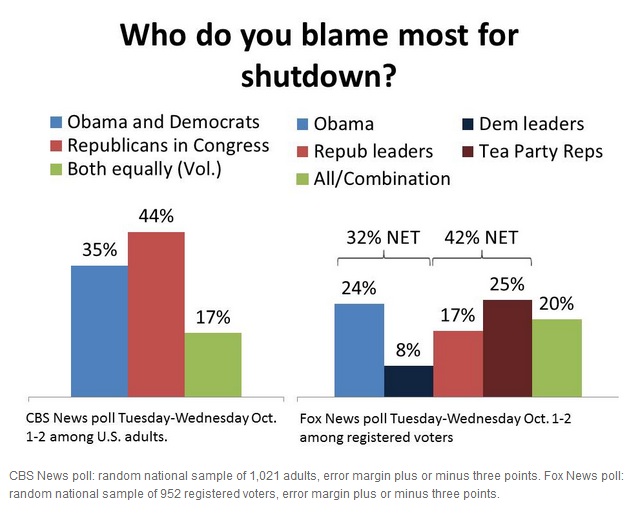
    Almost every major news network has been asking its viewers and readers to chime in on “Who’s to blame?”

    poll 3

    Rather than explaining policy, media outlets have framed the shutdown into a simplistic game of winners v. losers, Democrats v. Republicans, Obama v. Congress. Outlets are then using their polling results to create further news articles that act as nothing more than a survey report.
    poll 4

    Their strategy has not been in vain.  During prime-time, Monday through Thursday of the past week, ratings for CNN were up 68%, MSNBC up 54%, and Fox up 49%. As viewers continue to tune in, we are left begging the questions: Is the press providing an informative medium for exercising the public’s right to know? Or has the shutdown turned into another political spectacle for media to cash in on?

    – Savannah Valade

  • The Importance of Social Media in the 2012 Election

    More and more are the variety of social media through which voters are able to use.  These are convenient and simple tools that are effective ways to express the opinions of voters and influence the course of the electoral campaign. The role that social media has been critical in drawing conclusions about the outcome of the 2012 election. According to various studies, websites like Facebook have caused an increase in voter registration. Ultimately, social media networks are the powerful influencers that are often capable of moving large quantities of votes. It is important to recognize that an electoral campaign that is closer and pays closer attention to real human dynamics has a completely different approach than the traditional campaign. Nowadays, an effective campaign should be based less on the money spent and more on the intelligent use of new technologies to create new bonds with the everyday voter.Ultimately, the roles of social networks, new media as well as the weight of the establishment are all factors that will have a crucial role in deciding the electoral dispute.

    As previously stated, social media has encouraged many young eligible voters to register and vote. For many of the past elections, the young demographic is not properly represented in voting. This year, there are record numbers for college aged students voting.  Much of this can be attributed to social media outlets.  Young people in general use social media more than any other demographic (to date). Also, social media websites such as twitter allow you to follow each candidate and get quick, short, and frequent updates on what they plan to make their policy be if they are to be elected. This is only the second election that we are able to follow Candidates directly on Twitter since it did not exist prior to 2006. Also, Twitter has gained a substantial amount of users since the 2008 election. On Twitter, there are trending topics, and subjects regarding the recent presidential election have been trending at record numbers. Social Media allows people to get quick and easy access to information about the election.

    Both presidential candidates devoted much time and effort to boost the collection of information and social media sharing amongst voters. In the current election, Barack Obama and Mitt Romney have predominately utilized Facebook, Twitter, and YouTube, which are the top powerhouse tools of social media today. As the election progresses, candidates have concentrated their efforts on “swing voters”. Swing voters are voters who have yet to make up their minds and plan to wait till the very last minute to make a decision about who to vote for. Social media can establish a medium for interchange between our presidential candidates and many of these swing voters, avoiding an influence on votes that have already been established.  This reveals the importance of social media and web video usage in terms of voting. Not only can social media institute this medium that allows a campaign to be specifically modified for particular voters, but it provides value for each candidate, resulting into fewer costs for ads. The cost of advertising through social media is much less than the cost of paying T.V. channels to run advertisements; not to mention the impact of online ads have been reported as just as good or perhaps even better than the ones shows on television. All political parties in the current election have greatly benefited from these recent online updates and social media enhancements.

    Sasha De Vecchi, Lindsay Gallagher, Jay Reilly, Cary Welborn

  • Barefoot? Not with TOMS Shoes!


    Many of us are familiar with the shoe brand TOMS. The company, started by Blake Mycoskie, commits itself to donating one pair of shoes to a child living in poor conditions for every pair of shoes it sells. TOMS’s program of giving was the result of its owner traveling to South America and finding that many children were contracting diseases through their bare feet, as they were unable to afford or obtain shoes. Mycoskie decided to manufacture his company’s shoes in an eco-friendly and vegan manner. TOMS are made using supplies from an organization, Livity, specializing in “low environment impact materials” (information based on a 2008 interview between Mycoskie and San Diego Loves Green reporter Allie Bullock Kagamaster).

    Not only does TOMS market their product as a philanthropic exercise, but it also markets itself as an organization dedicated to environmentally sound products. The company is able to create establish integrity for its product among potential customers who are concerned with social and environmental issues. Partnering social and environmental values, allows TOMS products to stand out amongst competitors.

    TOMS has gone a step further than its usual shoe donation program; by implements its “One Day Without Shoes” campaign. This campaign is meant to raise awareness of the dangers faced by individuals who do not have shoes to walk in, in areas where environmental conditions, such as chemical contamination and littering of glass, syringes and debris, can cause multiple diseases. “One Day Without Shoes” also encourages individuals to buy shoes from the company so that TOMS can donate shoes to these individuals.

    The “One Day Without Shoes” campaign is designed in a way that the company’s customers and followers can actively participate in it. When going to the company’s website, a person can email the page to their friends and family, post it on Facebook, or follow the campaign on Twitter. This implementation of social media shows that TOMS Shoes is aware of the powerful impact individuals can have when marketing a message, just by sharing information with friends on social media they are already using, and that can be viewed by mass numbers of friends and peers.

    Also on the campaign’s website, TOMS Shoes encourages individuals to share videos and photos of themselves without shoes and an explanation of what the experience meant to them. Followers can find their own marketing devices to spread the word of the campaign on the website. Rally signs, street stencils, pocket info cards, stickers, profile pins and banners, DIY t-shirts, and displays can be downloaded from the campaign’s website for the event.

    “One Day Without Shoes” has also found many corporate partners to participate in its campaign. These partners are Aol., Discovery, essie, flickr, just wink by American Greetings, Kiehl’s, Kind Healthy Snacks, and SIMS. The “One Day Without Shoes” campaign shows the ways in which organizations rely on various societal values and corporate marketing techniques to draw attention to their brand or promotion.

    -Ashley Oliver,Hunter Wilson, Josh Vester, Molly Jacques

  • Wait, they care about my vote?

    Candidates have really been trying to “woo” young people to vote. This demographic can be quite difficult to motivate and actually get them to do something. They all just really need someone who they can relate to before we can make a decision, you know like a celebrity who is endorsing one of the candidates. Remembering back to the last election, this was very successful in Obama’s favor. Many famous people were sporting the always fashionable Obama gear. He even made it on the runway! Who wouldn’t want a president that has made it on the Paris fashion runway?


    Of course, not all ploys to get the youth to vote are quite so extreme and over the top. Rock the Vote is one of the biggest organizations trying to get young people to vote. They use pop culture, music, and new technologies to get them to register and have successfully signed up over five million young voters. The Millennial Generation makes up about 1/4 of the voting population which makes them an important demographic for politicians to market themselves to. Just in the last presidential election alone Rock the Vote registered 2.5 million voters. This was by far their highest number they have had yet.

    College campuses are another great outlet for getting the younger crowd to register to vote. Statistics show that there is a much higher rate of educated youth voting versus the ones who didn’t attend college. This is the most convenient way to motivate this  apathetic age group. Having an on campus presence is a good reminder of how easy it is to register. Since the 2000 presidential election it has been forced by federal law for postsecondary institutions to make a good faith effort to distribute voter registration forms to all of their degree seeking students.

    The Presidential candidates now take the Millennial Generation a lot more seriously, then they ever did before. They want their voting numbers to go up and this large demographic can be the boost they need. As a member of this generation, I wonder what tactic they will use next to sway my vote?


    – Mollie Berthold, Laura Simmons, Christina Stevenson, Dorothy Conley

  • Foursquare U

    Back before texting and tweeting, students on college campuses relied on announcement boards and gossip floating in the student center to find the popular hang out spots or know about the latest buzz. Today, news about and around campus is instant. Most major universities have embraced social media over the past decade and are using it to reach college students in a unique way. But how can universities gain access to real-time social trends on campus? Welcome to the new and evolving world of geosocial networks.
    Geosocial or “location-based” social networks are on the rise, with the forerunner being foursquare, a mobile app launched in 2009 that allows users to “check-in” to various locations and share where they are and what they are doing with their friends. Access to real-time location data from foursquare allows marketers and businesses to know what locations are “trending” as well as the demographics of users checking-in to their establishment. With the growing momentum of foursquare, universities are hopping onto the “check-in” train and recognizing foursquare on campus.
    Why should universities be interested in foursquare? For starters, foursquare currently has 15 million users and over 1.5 billion check-ins worldwide, with a growth rate of 3400% in 2010. Chances are that your business or venue is already on foursquare and users have probably checked in and maybe even left some tips. Information that users enter when creating a venue may be incorrect, but universities that claim their venues can add appropriate information to academic buildings to ensure the best overall experience for faculty, students, and guest.
    Universities are beginning to recognize the potential value of information gathered using geosocial networks. What does 4pm look like on campus? Is the library packed? Are students working out? Applications like foursquare can also attract visitors on campus by offering “check-in” deals (ex. 10% off a shirt when you check-in to the campus bookstore), creating a self guided mobile tour of academic venues, and leaving historic information or helpful tips for different locations.

    Most importantly, foursquare is free advertising (for now). Not only that, but it can be interactive and rewarding for users, perhaps by giving away free university gear for going to the library, attending a campus event, or staying healthy at the gym. The possibilities for university marketing are endless.

    By: Hunter Wilson, Josh Vester, Ashley Oliver, Molly Jacques

  • Oh Red, How I Love Too

    There are many legends and stories explaining the history of Valentine’s Day and St. Valentine, but one thing remains the same; Valentine’s Day is a holiday where lovers express their affection for one another.  Every year marketers use the same tactics to attract their love struck consumers into the arms of their products. Valentine’s Day advertisements are flooded with hearts, flowers, and of course the colors of love: red and pink. Red and pink symbolize passion and tranquility and are considered the most romantic colors. However, the appeal of generic pink candy and red roses will eventually run its course. So it’s time to spice it up and show your love that you put some real effort into this Valentine’s Day.

    M&M’s are promoting their brand this Valentine’s Day season by offering a sweet alternative to help consumers express their feelings to their loved ones.  The commercial features “Red,” the helpless romantic candy bite, who cannot respond to the love of his life with the three words, “I-Love-You.”  M&M’s understands that it is not always easy to express your feelings. With that in mind they are here to make it easier with personalized M&M’s. Popular messages include “Be mine,” “You make me melt”, “You Had Me at Hello” and “I Love You.” M&M’s also features a prepackaged Valentine’s Day blend with an assortment of colors, sayings and symbols. If that won’t cut it the Romance Bundle may be for you. It comes complete with a teddy bear and three bags of personalized M&M’s wrapped up in a gift box.  Remember, personalization shows that you took time out of your glamorous day to care!

    Through this strategic marketing plan, M&M’s enhances their brand by making it convenient for their consumers to spice up Valentine’s Day. M&M’s are one of the few companies that offer personalized messages on their candy products. This allows the company to stand out against the assortment of chocolaty competitors. Keep in mind that personalized candies aren’t just for Valentine’s Day, but also for any of life’s sweet moments.

    -Kelsey Bendig, Andrea Blanton, Brooke Keller, Brian Burch

  • Have a Sexy Valentine’s Day, Gorgeous!

    A week from today, one of the most commercialized and superficial holidays will occur: Valentine’s Day. For those of you who are one half of a couple, Valentine’s Day is all about making your significant other happy, whether it involves showering him/her with gifts, making dinner reservations, or planning exuberant and normally unnecessarily expensive dates.

    The beginning of February marks the time when store fronts become clad with hearts, cupid cutouts, and pink and red streamers.  Around this same time, we begin to see an increasing number of men lurking around lingerie stores, especially Victoria’s Secret – and for good reason.  Victoria’s Secret has a dramatic increase in sales during the season of romance. With their sexy print ads in magazines, their silky almost-obscene commercials, and their free “Lacie Pantie” giveaway, what man in their right mind would avoid giving their girlfriend/wife the gift of sexiness?

    In their 2012 Valentine’s Day campaign, Victoria’s Secret Angels clad in pink and red barely-there bras and panties have advertised to their customers that with the gift of anything from their line of lingerie, their Valentine’s Day celebrations will be fabulous. In their sneak peek to their photo shoot, the Angels prance around in their under garments, smiling, laughing, and selling the ideas of sex and playfulness. In interviews, the girls claim that any man could win their hearts on Valentine’s Day by picking out something from the Victoria’s Secret shelves. One even says that if a man chooses something that he likes, it will give plenty of hints to his significant other.

    Not only does this campaign appeal to male shoppers, but it also appeals to women. The Victoria’s Secret Angels encourage their customers to feel sexy, and by offering specials, free panties, and coupons during this season, women will certainly be able to feel like Angels.

    So whether you are shopping for a significant other or are planning on spoiling yourself with brand new sexy lingerie, Victoria’s Secret will certainly be the place to shop this romantic season.  And don’t forget to have a sexy Valentine’s Day, Gorgeous!

    Love always, Christina Stevenson, Mollie Berthold, Dorothy Conley, & Laura Simmons