Tag: Marketing

  • Flacco’s “Lovin’ It”

    From his first infamous trip to purchase a 10 piece nugget meal, to now being featured in a full scale McDonald’s advertisement, Joe Flacco is now not only representing the NFL scene, but the fast food scene. Many companies have harnessed and benefitted from the use of the pathos and emotion in their advertising campaigns to attract current and future consumers. McDonald’s has started a new advertisement campaign with Ravens’ quarterback and recent Super Bowl XLVII MVP, Joe Flacco. With the Ravens’ latest win in Super Bowl XLVII, Flacco has become a household name, contributing to a rise in Ravens’ supporters and fans. As the new football season revs up, McDonald’s is appealing to the crazed fans young and old alike who have a passion for their team and what it believes in.

    Although Flacco is a respectable and genuine role model who is described by many as humble and “the guy next door,” this is not just a question of the effect of pathos being used in this campaign, but also ethos. By doing the commercial for McDonald’s, which is well known for their appeal to younger consumers, Flacco could be seen as ethically responsibly for the image he puts out for young children. Young boys and girls may look up to him because of his celebrity appeal and athletic status and think they should eat McDonald’s because he does. In the advertisement, Flacco is shown eating McDonald’s new “Mighty Wings” which are (480 calories and  31 fat grams). As a well known sports icon, Flacco is constantly in the limelight. He is a fit and healthy individual, which will create the image of eating McDonald’s as an attractive and healthy option. This may cause misleading perceptions about the health benefits of McDonald’s and in Flacco losing credibility as a professional athlete.

    Logic (Logos) may be factored in when looking at the obvious benefits that McDonald’s will gain from having Flacco in their advertisements.  Having a well known athlete sponsor your brand is a sure fire way to bring in revenue and was a good marketing move by McDonald’s.  On the other hand, logic also tells us that McDonald’s does not provide the healthiest food that we can put into our bodies.  The nutrition facts cannot be hidden by a super fit athlete.  Do you feel as though Flacco lost or gained credibility by endorsing McDonald’s?  How do you think McDonald’s credibility has changed or stayed the same, knowing the type of people they feature in their advertisements (particularly athletes)?

    We can almost be certain that aside from the ethical questions that this ad brings up, there will be a rise in support of McDonald’s by a deeply rooted Ravens’ fan base. This brings about a win-win situation for McDonald’s and Flacco off the field.  So, who knew that a simple 10 piece nugget meal from McDonald’s would land him yet another win?

    -Aaron Love, Kara Zimmerman, Rachel Clay, Rebecca Hobbs

  • Back-to-School- Back to Taxes

    As of this past August, there will be no more tax-free weekends for NC. That’s right, you read that correctly- North Carolina repealed the sales tax holiday in efforts to increase revenue for the state. What is known as the “tax-free weekend” started in 2002, and has become a prime time for families looking to save money to purchase school supplies, clothing, footwear, sports equipment and even some electronics with no sales tax. Retailers say that other than Black Friday, tax-free weekend is the busiest shopping time in NC. However, the repeal of the tax-free holiday was erased by the General Assembly as part of the state’s tax overhaul. (According to a WRAL news report, the state lost more than 13.5 million in tax revenue on the 2012 tax-free weekend.)

    North Carolinians have only celebrated tax-free weekend for eleven years, but in that short duration, marketing in North Carolina has evolved to persuade consumers to take advantage of the tax break. Companies use flyers, commercials, promotional emails, web advertisements, and even add additional discounts on top of low prices in efforts to beat out competitors by drawing in the inevitable crowds of customers to their stores. Below is an example of a promotional email, sent out by Kohl’s, which gave customers a reminder of the tax-free weekend, along with an extra incentive to bring them to the store.

    Image

    Due to the slower summer season, businesses cling to these holidays to boost sales. That makes us wonder… how will the removal of tax-free weekend change future marketing for North Carolina businesses?

    Advertisers and marketers know that people in North Carolina will not be as easily inclined to spend large amounts of money in such a short period of time with no extra tax break, so what are they going to do? We can only guess what will happen next year, but we predict companies will amp their creativity in the back to school season. Brands like American Eagle and Teen Vogue are paving the way and are praised for their back-to-school campaigns, which include special events such as fashion shows and a huge social media presence.

    We know people are always going to have to buy back to school items, but now the main concern is are they going to buy as much without the incentive? Marketers are going to have to reinvent the way they communicate persuasive marketing to North Carolinians and deliver their new promotions in a way that our state will accept them. How do you think advertising tactics will change in NC now that there is no more tax-free shopping? Will you be spending as much money on back to school gear?

    – Caroline Robinson, Meghan Carey, Morgan Jones, Savannah Valade

  • The Transparency Angle

    What’s even real these days? It may or may not be a question that’s crossed your mind recently, but it is causing a stir in companies and ad agencies.  Transparency and authenticity are in, and flashy propaganda is on its way out.  It’s no surprise that businesses continue to refine the concept of authenticity for the purpose of marketing strategy.  What could be more lucrative than to convince consumers that a product can bridge the disconnect between modern civilization and reality, especially in a society constantly seeking meaning?

    Chick-fil-A is one company that is now taking the advertising approach of transparency, inviting customers for behind-the-counter tours at all of their locations.  This blazes the path for their upcoming menu improvements, such as salads with more nutrient-rich ingredients focused on harnessing the concept of authenticity in their food offerings.

    However, restaurant chains aren’t the only ones using this strategy.  Dove, a brand owned by Unilever, started the “real beauty” campaign in 2004 in the hopes of expanding the definition of beauty and promoting self-esteem in women of all shapes and sizes.  This week the company released a video to tell women “you’re more beautiful than you think” by comparing how women view their own beauty with how strangers view them.  This type of advertising goes beyond showing the consumer how authentic a product is; it makes the audience consider the authenticity behind their own self-image.

    The Authenticity Hoax, a book by Andrew Potter, takes apart the ideal of the “authenticity” that we’re all striving for.  He looks at the areas of our lives where we feel connected to experiences, the world, and nature, and how society has lost the true meaning of authenticity in the process of seeking it out.  In his conclusion he says, “we are trying to find at least one sliver of the world, one fragment of experience, that is innocent, spontaneous, genuine, and creative, and not tainted by commercialization, calculation, and self-interest.”

    The minute authenticity became a brand in and of itself, people wanted to have it, and companies are more than happy to sell it.  Dove may highlight the reality of the average woman versus the size zero models in many other ads, but that doesn’t mean they’re not capitalizing on some other ideal.  Authenticity is the new thing to have.  The problem is, just as Potter points out, authenticity is pretty much a false goal.  Chick-fil-A can show its customers where they make the food, but that doesn’t mean anyone’s life is more real because they ate a chicken sandwich that wasn’t frozen.

    Ally Walton

  • Google Takes Over Mobile Advertising with Admob

    The online advertising market is growing but not only when it comes to computers. Facebook is no longer the only company with mobile ad news.  Google recently launched a new system for advertising within mobile cell phones and smart phones, “AdMob: solutions for mobile advertising and the monetization of the most recognized and reliable name in the field of mobile advertising, also known as Google”.

    This new system presents solutions for advertisers who want to promote their brand and acquire new customers by advertising on mobile phones, solutions for agencies that want to expand their advertising campaigns to mobile platforms, and solutions for application developers who want to add Admob as a platform for distribution and monetization. The AdMob-AdWords integration also makes it easier for small and medium sized businesses to spend on Google mobile ads.

    google-new-acquisition-admob

    Admob uses an advanced algorithm of ad selection that allows businesses to contextualize and optimize advertising revenues (similar to Google AdSense). Inserting ads is very easy and can be done without a WordPress plugin, which is usually used to create a mobile version of the site. All a business has to do is simply enter the code in the website page that is generated with Admob to automatically fill in the “banner” advertising within the site.

    “This is about enabling scale for industry,” said a rep for the company. “Anybody that’s buying performance media through AdWords can now very easily add mobile display to campaigns. We have a lot of customers that buy search and desktop display through one interface. Now they’re adding mobile display to that.”

    google-admob

    As Google grows stronger in the field of mobile advertising, they are claiming their spot in this fast growing sector. In fact, connecting ad platforms has been a focal point for Google this year, as they are enhancing their mobile ad targeting capabilities.

    Admob is a tool that should not be underestimated. In fact, the company’s mobile display ads appear in more than 300,000 apps on phones, establishing themselves as the world biggest mobile advertising company. I think this is a smart move for Google as it seems that everyone in this world now uses smartphones on a daily basis. Companies can easily target consumers at any time of the day because our phones are always with us. Furthermore, brands can stay at top-of-mind awareness because consumers can see their advertisements whenever they use an app. By offering this advanced mobile advertising technology, Google is maintaining their spot as a major technological powerhouse, and helping clients meet their advertising needs.

    Sasha De Vecchi & Julia Tompkins

  • How Kotex Got Almost 700,000 Impressions with their Pinterest Campaign

    In the past few years, Pinterest has been the protagonist of a real-life international explosion, a phenomenon with incredible numbers constantly growing worldwide. The steady growth of their users, combined with the social media’s careful attention to what is now clearly a new platform of communication, has led many brands to explore and take advantage of this viral sensation. Kotex, a famous feminine hygiene brand owned by Kimberly-Clark, partnered with the lesser-known (at least until now) Israeli social media agency Smoyz, for the first Pinterest-based campaign that finds expression in the initiative “Women’s Inspiration Day.” The creative talents of Smoyz searched and analyzed thousands of boards of women who eagerly use the social media site, until they finally selected 50, the muses who would then become the medium itself for the campaign.

    Once the “muses” were selected, they analyzed all of their boards on the website trying to find out what inspires them, after which the brand created individually personalized gift packages with the products they wanted decorating them with different styles that would capture each one’s attention. The 50 users selected to receive the packages did not have to do anything but re-pin Kotex’s original invite. How did this tactical advertising strategy go? Well, the numbers speak for themselves: 50 sent packages, 2284 interactions and almost 695 thousand impressions.

    907098_10200444288963285_716261723_n

    This marketing experiment was a huge success, a buzz that then involved several other social media platforms such as Facebook and Twitter, not to mention the amount of traffic generated to the brand’s websites. Both Kotex and Smoyz did a great job at carefully taking advantage of Pinterest’s peculiarities, such as females’ natural predilection for this specific social media, which holds about 68% of female users. Their careful demographic analysis combined with the use of the website for the production of gifts that were “tailored” around the user was refreshing and original.

    For quite some time now, Kotex has been conducting strong content advertising strategies, starting from their very own official site, which is home to a fairly populated online community. In fact the brand has already hosted several successful initiatives such as the campaign “Stand Up for What’s Real.” The campaign is primarily targeted at young women between the ages of 14 and 24 and it is aimed at helping women to talk about a subject that is usually viewed as taboo. Overall, this campaign certainly opens an interesting new chapter when it comes to online marketing by once again demonstrating how the dynamics of communication, thanks to the new media, are increasingly moving towards a more “tailor-made” approach.


    – Sasha De Vecchi

  • Reaching New Heights in Creativity

    How many billboards do you take notice to on your daily commute? I honestly could not recall the last one I saw or what it was promoting. I am sure I am not alone in this realization. These strategic advertisements are lined down the highway like dominoes, yet many do not even double take to see what they have to offer. That is the point, right? To be noticed? I am sure that advertisers do not spend thousands of dollars on outdoor advertising just to have it passed by without a second thought. However, surprisingly 71% of drivers notice billboard ads according to an article entitled The Strange Impact of Billboard Advertising. With that being said, agencies have some ammunition for their brands if executed correctly. Even though we may not remember every advertisement we pass, we are subconsciously taking it in. The challenge is to effectively present your brand so that they work as effectively as they are intended to. Here are a few that are quite bold and competitive:

    Okay, so we know, statistically speaking, they work well but the question is: what makes billboard advertising effective enough? The whole purpose in this choice of advertising is not to be informative, I mean we only have about 4 seconds in the drive by to take it all in, but rather to create a lasting impression of the brand. Stephen Littlejohn puts it well in his textbook on “Theories of Communication.” In chapter 7 he discusses the idea of ‘Message Reception and Processing.’ This theory implies that a communicator has 2 levels of intent: informative intention and communicative intention. Informative intention hopes that the audience is made aware of something and communicative intention being that the audience realizes the purpose of it. That is the goal with outdoor advertising. Within a matter of seconds the viewer should be visually made aware of the brand or product. Then, the advertiser has hopes that they made a big enough statement that they remember the brand, even if it is triggered in the depth of our sub-conscious somehow.

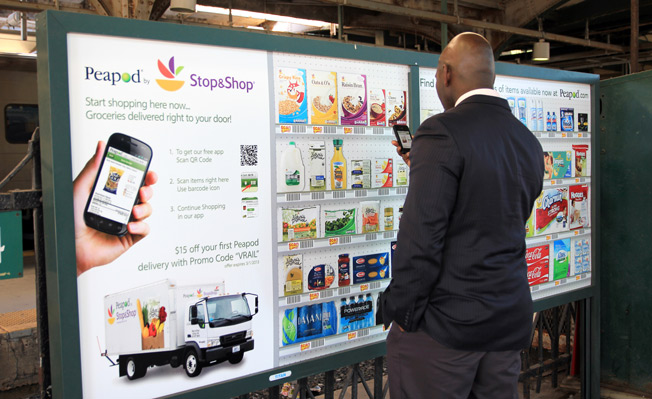
    What does this mean for advertising? In order to make the impression on people that they hope for, advertisers have to aim to be engaging, bold and informative all at the same time. The brands and products are resting on a visual representation…telling a story. Some of the ones seen today have accomplished just that and have been very beneficial to maintaining their brand names.  For example, the creative “Peapod” allows those on foot to access an interactive screen when they need to complete a quick grocery shop. Shopping on the go has never been easier. Image

    The target audience for this display is those who lead busy lifestyles and don’t permit much time to complete daily necessities. This type of shopping is entertaining and even seems enjoyable. The user-friendly screen only requires a smartphone, the free ‘Peapod’ app, and a quick wave over the bar code to scan the image above it. Instant groceries are right there, only a scan away.

    Needless to say, advertising is making some huge improvements in their promotion of products via billboard ads. The article 40 Absolutely Brilliant Billboard Ads displays images of some of the most recently developed billboards which have been highly effective.It seems that Outdoor Advertising is finally reaching new heights in creative presentation, communicating to the public that they are something worth looking at!

    -Katelyn Alston

  • The Galaxy S4

    What could be better than Siri you ask? Apple better watch out because they may have recently developed a new top competitor. Samsung’s newest phone the Galaxy S4 is soon to be released at the end of April 2013. The Galaxy S4’s, or GS4, dimensions and weight are slightly larger than the iPhone5, but so is the screen size for those who like to see a bigger picture.

    image

    The GS4 processing speed is 1 .9GHz with the Android 4.2.2 operating system, which is considerably faster, than iPhone5’s processing speed of 1 GHz on the iOS operating system. To see a table of more comparisons, click this link. When it comes to the camera, GS4’s Super AMOLED panel at 441 pixels per inch is significantly denser than iPhone5’s 326 pixels per inch. The GS4 camera also has crazy new features such as the recording of front and back cameras at the same time.

    So what new technological features does the Galaxy S4 have that could really disperse the iPhone fanatics? When choosing between the Galaxy S4 and the iPhone5 the design, display, apps, and processing system are all based on individual preference, but the Galaxy S4 interface is just on a completely new level. PC mag.com states, “Android features a much more customizable interface for advanced users, which lets you configure your phone exactly how you want it.” The interface has a feature called Air Gestures, which includes motion sensors of hand movements to control the display with out even touching the screen. They have Smart Stay, which tracks your eyes to tell if you are looking at the screen. If you are watching a video, Smart Pause will automatically pause the video for you when you look away. Smart Scroll will check when you are reading a scroll up and down when you tilt the device.

    image    image

    This April we will all be able to see for ourselves if the iPhone has a real competitor; and if Samsung’s new features using hand and eye sensors are handy to use on a day-to-day basis or just plain creepy!

    -Kelsey Raskob