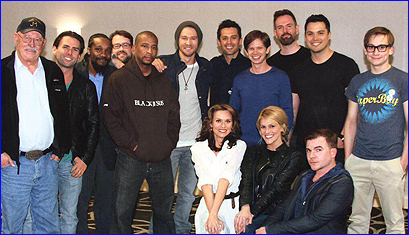
This past year, Wilmington was home to two exclusive One Tree Hill reunions, where the TV show once took place. Hundreds people came out to interact and reminisce with their favorite characters from the show. Commuters traveled from all over the nation and even overseas to Wilmington for the three-day event. Tickets started at $35 and increased up to $795 for a VIP experience. Fans who were willing to pay these high amounts obviously have a deep connection with the show or the characters.
Brands that cultivate a culture around their product and are able to build a lasting relationship with their consumers. The creators of One Tree Hill are able to continue the brand without producing a product. This benefits not only the show, but allows consumers to identify and participate with a culture that shares their common interests.
What other brands have cultivated their image to go beyond their product?
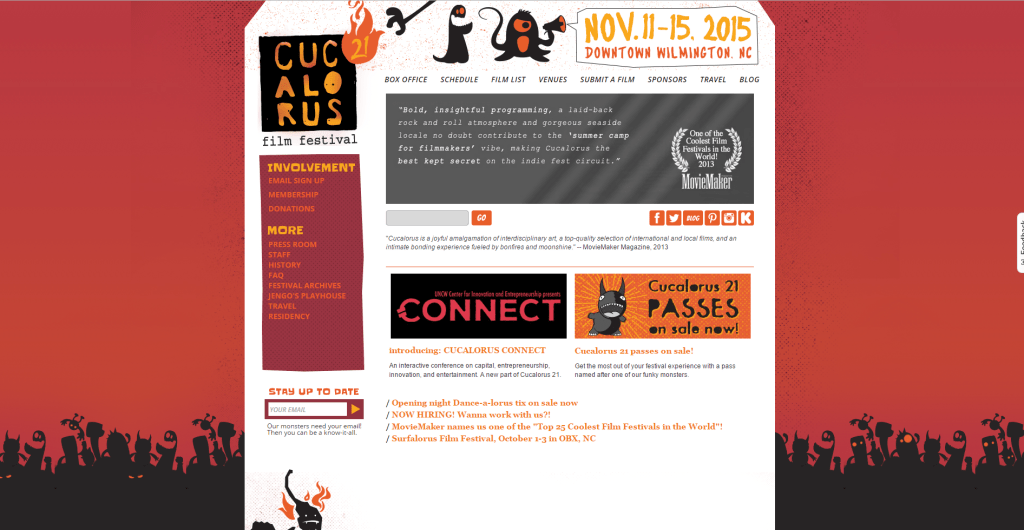
Cucalorus is Wilmywood’s premiere quirky film festival, showcasing independent films from local, national and international artists. Film connoisseurs sporting chunky glasses, artsy students in their thrift-store best and less interesting folk like you and I file into Thalian Hall (or one of the many other venues), settle down and wait for the lights to dim. This November will be the 21st year this little slice of art and culture draws people to downtown Wilmington.
I could barely convince people to keep coming after my twelfth birthday party, so how does Cucalorus garner a big crowd each consecutive year? A cohesive brand narrative, that’s how. And Cucalorus’ brand narrative is nothing short of weird—but in the good way. Let’s explore what makes Cucalorus cool.
It’s in the copy
While none of these factors are ranked in any specific order of importance, I am a word person and always like to read and evaluate the voice of an organization. Many organizations forget about this, not capitalizing its subtle importance. Bad organizations.
Cucalorus, on the other hand, has got its copy down pat. The copy, whether it’s online, in print or broadcasted on the radio, is how an organization communicates not only its news or events, but its personality, its voice and its image. Here’s a snippet of copy from Cucalorus’ donation page on their website:
“Hey Cucalorians!!! Do you need to get rid of unwanted cash? Make a donation and we’ll send you a tax deduction letter to send your fuzzy little friends at the IRS (they don’t need your money and clearly don’t know what to do with it!!). We do know what to do with it – we’re already plotting and scheming for the 21st annual Cucalorus Film Festival – taking place November 11-15, 2015!!! Help us fund the dreams and visions of artists all over the world by making a donation today.
Dreaming of eggnog omelettes!
Cucalorius.
The Cucalorus Film Foundation is a 501c3 non-profit and your donation is tax deductible to the fullest extent of the law.”
On first glance this might sound unprofessional and not the voice an organization would want to convey. The context, though, is important. Cucalorus’ audience is mostly the aforementioned artists, hipsters and independent film connoisseurs and Cucalorians. These types of people generally like funny, creative and quirky things (like Cucalorus). These types of people also tend to be skeptical of the IRS—not to mention the state cutting NC’s film incentive last year. So yes, it might be OK for Cucalorus to be a bit irreverent, and it’s their creative risk.
Digital presence, dude
If your business doesn’t have some sort of online presence (an email address counts), I would like you to write to me immediately by carrier pigeon and explain how you’re still surviving. An online presence is increasingly important each year, and now just having a website and Facebook isn’t cutting it. Brand cohesion across appropriate social media networks and inter-connectivity between them is vital.
Cucalorus not only has a website, Facebook, Twitter, Pinterest, and Instagram but their own blog and—drum roll—they are all updated. Bravo, Cucalorus. Content creation and audience engagement are essential to a successful IMC strategy.
Creepily consistent image
This one is tandem with the digital presence. IMC consists of advertising, public relations, marketing and every other single communication an organization can perform with its publics. Consistency in corporate communication allows the organization and its audiences to construct a narrative and image of the brand. This is what people can relate to. This is how we can see the quirkiness, irreverence and artsy personality of Cucalorus as if it were that weird kid in your English class who would always have some snappy reference to an obscure book even your professor hadn’t read. But less annoying.
The color scheme and design is consistent. The font-faces, graphics and little cartoon dudes are consistent. There’s well-organized navigation and that copy I was talking about earlier. The social media pages follow suit. There’s an article on this if you’re into academic papers. Basically, the author, Simon Torp from Odense University in Denmark, says that as an organization your communication through all channels must be consistent, accessible and in line with your self-image, public image and meta-image for people to take you seriously.
Zany staff workers
When I said all channels of communication, I meant all of them. Even the staff workers and volunteers need to be carefully selected and even briefed on an organization’s code of conduct. One time I went to a screening of a Cucalorus film at Thalian Hall and, not to get into too much detail, I, with the rest of the audience, was sternly asked by staff to partake in a ritual involving whipped cream, button pins and our tongues. Was I offended? No, but I could have been if I had been misguided by thinking Cucalorus was actually a convention for neo-Puritans. Because their self-branding and self-image don’t suggest that, I could expect something out of the ordinary. It’s the risk that Cucalorus takes to maintain its image and appeal to its target audience.
High-quality product
When it comes down to it, a business or organization is only as good as its product. Silly brand narrative and image aside, Cucalorus does a good job at what it does. It recruits and selects excellent film talent from around the world and showcases it in quality and entertaining venues. This is where word-of-mouth comes into play. Word-of-mouth marketing or WOM is an organic and invaluable means of public relations, advertising and marketing. Have you ever read a positive news story about an organization you love? Or has a good friend of yours recommended a product or service they favor? These are examples of WOM that can make or break an organization depending on whether they are in favor or against it. Maintaining the balance between brand narrative, professionalism and good business sense is how an organization thrives. While Cucalorus does an outstanding job of its own branding and controlled media, its reputation for quality and intrigue reign in filmmakers and spectators every year.
I am no way affiliated with the Cucalorus film festival professionally, nor do I represent it. I recognize good IMC in organizations and talk about it here. But, if you are tired of what the local theaters are playing, check out a showing of something interesting between November 11 and 15 downtown at Cucalorus.
Film is a massive industry that grosses billions of dollar everywhere. Film is a living breathing entity that has a huge impact wherever it can find a home. For a long time film has been a staple of the Wilmington community. Despite being a tiny town in comparison to megacities like Charlotte and Raleigh, you can always find Wilmington pointed out in some way on a map of North Carolina. Film is just one of the things that we, as a city, do.
Famous shows like One Tree Hill and blockbuster movies like Iron Man 3 and The Conjuring have called at least one locale in Wilmington home. It’s hard to resist shooting here when we have such beautiful scenery, historic buildings and easily accessible sweeping landscapes. It also helped that until recently North Carolina provided excellent grants and incentives for filmmakers to use our natural beauty. Wilmington got it’s nickname “Hollywood of the East” because our scenery and incentives have attracted filmmakers to our area more than anywhere else. So, what’s going to happen with the recent decision to remove many film incentives from our budget? Well, before you answer that question you have to really look at how film affects the areas where it takes root. What better place to look than the most famous name in film?
A brief history of Hollywood: Hollywood started as a simple ranch outside of L.A. which slowly grew into a small town. Hollywood was annexed by LA in the early 1900s due to the fact that Hollywood was having an issue with its water supply and LA had a good aqueduct system in place. Hollywood really began to come into its own when filmmakers began to flee there because Thomas Edison’s Motion Picture Patents Company was imposing strict rules on independent filmmakers and often suing them to stop their production. These filmmakers accidentally stumbled on Hollywood after filming in nearby LA and after very successful shoots in the area they began to set up shop, the first studio being built in 1919. The Hollywood sign itself actually originally said Hollywoodland to advertise a new housing development. It fell into disrepair and the Chamber of Commerce commission a restoration, removing the last four letters and restoring the others. When TV sprang up in the 1950s, Hollywood was an obvious choice for studios and many of the existing studios there, like MGM and Warner Bros, decided to dip their hands into that industry as well. From then on, Hollywood has continued to be an icon of the American film industry, despite most studios moving on to other areas around LA. The only movie studio remaining in the actual Hollywood area today is Paramount Studios. (Source of all this history: http://www.u-s-history.com/pages/h3871.html)
So, how did Hollywood become a synonym for American film? Well, the obvious answer is that filmmakers saw incredible opportunity in Hollywood and all decided to jump in the same boat. What we’re interested in is the way the image of Hollywood was created. Without film, Hollywood would just be another suburb in the barren country around LA. Somehow, through coordinated management of meaning, Hollywood because a famous place for famous people to create famous content. Let’s break it down based on the three prongs of the CMM theory. The first is coherence. In order for a message to be successful and meaning to be created, it must be coherent. In this case, Hollywood established itself as a haven for filmmakers early. While its discovery may have been a mistake originally, a clear message was sent by the town of Hollywood later: we are a place where you can come and film in peace. Next is coordination. Through the installation of the Walk of Fame in 1956, the creation of the Oscar in 1929, the building of five major theaters from five massive companies in the late 1920s and the restoration of the massive Hollywood sign in the 1940s, the town of Hollywood narrowed down its focus and decided what it wanted to be known for. The town sent out a message that being in Hollywood was rewarding for studios and actors alike. Hollywood really decided to take an engagement approach in its marketing by targeting its audience with incentives that it knew they would like. All that was left after that was to keep them there, and this is where the last prong, mystery, comes in. Before its surge in the 1920s, Hollywood was a massively untapped area, a veritable gold mine of beautiful scenery and largely untouched history. This led filmmakers to wonder else was in store. This may also be one of the reasons that Hollywood has lost steam and studios over the past few decades. The mystery is gone for studios as they know exactly what to expect from the area and viewers can expect to see much of the same scenery as the area is used over and over again. Maybe this is why film has expanded to so many other areas like Wilmington. Regardless, Hollywood did not become an icon through chance. After its discovery, the town made a coordinated effort to communicate the fact that it was a great place for film and incentivize filmmakers and actors alike for setting up shop there.
So what does this mean for Wilmington? Well, it means that the loss of our film incentives will cause a major problem. How can we bring studios here without communicating to them that we are a great place for film? How does the industry affect our image? What will Wilmington be if not the “Hollywood of the East”? I suppose you’ll have to come back tomorrow if you’d like to find out.
– Griffin Weidele, Austin Moody, Allen Wooten, Luci Keefer, Scott Uraro
In the recent years, a surplus of movies and TV show remakes has been surrounding society. From examples such as “Footloose” and “21 Jump Street,” it seems that producers are running out of gas and dwelling on the idea of making past success future successes as well. Remakes are nothing new and in some instances, can be even better than the original. This has also held true within the music industry due to a variety of songs being revamped and remixed by more recent artists.
With a currently unstable economy, Hollywood is no exception to the “Remake Era” that is upon us. Directors and producers are sticking with older titles and storylines that have proven to be profitable. Remakes have become a lower-risk tactic that ensures a steady purchase in ticket sales, which leads to a higher profit. In fact, according to New York Magazine, next year, one in three movies will be based on previously published or filmed material. People will show up to watch a title they already love or have an emotional connection with. If it is good, it brings them joy and allows them to reminisce. On the contrary, if it is bad, it rekindles a nostalgic flame within them.
In addition to completely remaking movies, the film industry has also been re-releasing movies in 3-D. Films such as “Titanic” and “Finding Nemo” have endured incredible success and in return have made their way back to the big screen. They are essentially the same movies that were in theaters years ago except that they are now three-dimensional. Some people are marveled by this twist, but others may think this tactic is a little flat and almost lazy. Instead of coming up with new and thrilling ideas, they are releasing movies they predict are going to be making money, because they already did in the years prior. The idea that they are new and exciting just because they are three-dimensional may be a bit of a stretch, but consumers seem to be buying into it. “Titanic 3-D” grossed 25.6 million dollars in sales the first week it was in theaters, adding to the 1997 overall sales of 1.84 billion. While this is extremely successful, the movie still fell behind both “American Reunion” and “The Hunger Games” during the first weekend it was shown, proving that remakes will not necessarily boast the same success as original versions.
Movie remakes aren’t an extremely new idea, but they seem to have become more prevalent in recent years. Hollywood is trying desperately to maintain to stay alive and profitable by focusing on films that feature accustomed titles and brands. There has been even more pressure to do that recently due to the lack of different movie ideas as well as the unstable economy. Basically, most Hollywood filmmakers believe that “fan reminiscing” can be its own brand of effective marketing. As time passes, new ideas and evolving technology allow older movies to be redone to reach their full potential. Even if these movies are more technologically inclined, some fans want more out of a remake. Some directors are even resorting to creating new versions of movies that are already remakes, which hints that Hollywood is simply running out of new and profitable ideas. In result of this, the term “remake” is often being associated with a negative connotation. Also, many older movies are viewed as a “classic” and people are hesitant to see change in such movies. An example of this would be the remake of “E.T” that has been released this year. This is a landmark movie from thirty years ago, and many people do not like the thought of it being redone to include the technology of 2012.
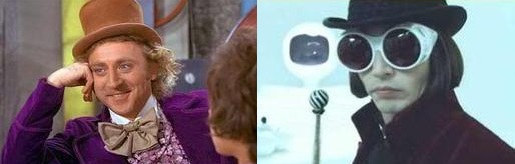
Another great example of a drastic remake is “Charlie and the Chocolate Factory”. Many fans were outraged by the 2005 remake of the 1971 masterpiece. While the movie was very created and technologically advanced, many people enjoyed the simplicity of the original version. While this is all open to interpretation and based merely on opinion, many can agree that it is a lot harder for fans to openly accept a remake when they loved the original version.
In today’s world, new and exciting story-lines are hard to come by. While revising original versions can deem profitable, there are consequences to be considered. Reactions of audiences that enjoyed original versions can be an issue as well as gaining support from people that did not like the original in the first place. Also, these movies can be successful from a financial point of view, but it is not likely they will be as successful as the original was. Regardless, we will not be escaping the “Remake Era” any time soon, which is evident by the fifty remakes that were made in 2012 alone.
Since the very first Academy Awards ceremony in 1929 there has always been a prestige and honor surrounding the awards. But lets face it, the era of Hollywood glamour has been replaced by Joan Rivers and obnoxiously unfunny skits between Anne Hathaway and James Franco. The Oscars prove time and time again to be the most “stuffy” of all awards shows and continues to try to appeal to their top viewers, the 50+ age group, while vaguely attempting to reel in younger viewers. Through choosing young popular actors such as Anne Hathaway and James Franco, the Oscars attempted marketing to a younger age group. What had much potential turned out to be a disaster as numerous news sources called it an “Oscars Bomb.” In a promo video for the 84th Annual Academy Awards this Sunday, Funny or Die released a long drawn out parody between Michael Myers and Kevin Kline. Needless to say, the Academy was making an effort to appeal to the majority of moviegoers, 18-29 year olds, by joining forces with a popular online comedy troupe. Will the Academy reach their much-needed younger audience this year? Or will the Academy fall behind to become the old stuffy grandfather of awards shows?
By: Molly Jacques, Hunter Wilson, Josh Vester, and Ashley Oliver.




 IMC Hawks Blog