Tag: Facebook

  • Have You Experienced the Rainbow?

    If you haven’t been to the Skittles website in a while (or perhaps, ever) now would be a good time to take a peek.  What you might expect to be a typical site, designed to provide advertisement and purchase opportunities, has undergone quite a facelift.  Unlike most sites, the website for Skittles has been reborn as a social media machine disguised as a blog.  Near the top of the page is the familiar Skittles slogan, “Taste the Rainbow.”  Scroll down a bit, and you’ll find an entirely irrelevant tweet from the Skittles Twitter account. @Skittles says, “It’s all fun and games until the chinchillas show up with the karaoke machine.” Next come a few phrases like “lace the train slow,” “trace the vein bro,” and “encase the faint glow,” all with coordinating pictures and all rhyming with the original slogan of “taste the rainbow.” Add a few quirky videos, more interesting tweets from fans, and many opportunities to share things via social media, and  you’ve pretty much summed up Skittles’ entire online marketing tactic.

    The Skittles commercials take on a similar level of oddity as their website.  Whether it’s a teenager catching “Skittles pox” from a “highly infected” friend with the message to “contract the rainbow,” or a guidance counselor eating Skittles out of a student’s unibrow with the message to “pluck the rainbow,” these commercials seem to be getting stranger and more extreme year to year.  So, do these weird messages work to promote their product?  Their 23 million Facebook fans, 47,000 followers on Twitter, and nearly 10 million views on YouTube would suggest that they do.

    As a product that has been a favorite with candy-lovers since their appearance in 1979, Skittles has little need for getting their brand noticed so much as keeping their brand relevant.  That’s exactly the idea behind their weird marketing.  By showcasing their social media followers on their website, and giving fans something different to talk about, Skittles is making people rethink what they already know about Skittles and driving them back to their brand.  The genius behind this tactic is that the product hasn’t changed.  What they are changing is stated right at the top of their site.  “Experience the rainbow.”  Skittles is changing the whole experience associated with their little chewy candies in a colorful shell to be more exciting and hilarious than before.

    What seems to appeal to consumers these days, especially to Skittles’ target market of pre-teens and adolescents, is the eccentric and the humorous.  Skittles has mastered both of these arts.  Not only are they staying relevant, they’re staying interesting.  As advertising trends continue to shift, Skittles will doubtless continue to meet the needs of their consumers and remain a favorite fruity snack to all.  The only question now, is what comes next.

    Ally Walton, Hannah Eure, Gene Lee, Lauren Habig, Erin Kiffmeyer

  • The Importance of Social Media in the 2012 Election

    More and more are the variety of social media through which voters are able to use.  These are convenient and simple tools that are effective ways to express the opinions of voters and influence the course of the electoral campaign. The role that social media has been critical in drawing conclusions about the outcome of the 2012 election. According to various studies, websites like Facebook have caused an increase in voter registration. Ultimately, social media networks are the powerful influencers that are often capable of moving large quantities of votes. It is important to recognize that an electoral campaign that is closer and pays closer attention to real human dynamics has a completely different approach than the traditional campaign. Nowadays, an effective campaign should be based less on the money spent and more on the intelligent use of new technologies to create new bonds with the everyday voter.Ultimately, the roles of social networks, new media as well as the weight of the establishment are all factors that will have a crucial role in deciding the electoral dispute.

    As previously stated, social media has encouraged many young eligible voters to register and vote. For many of the past elections, the young demographic is not properly represented in voting. This year, there are record numbers for college aged students voting.  Much of this can be attributed to social media outlets.  Young people in general use social media more than any other demographic (to date). Also, social media websites such as twitter allow you to follow each candidate and get quick, short, and frequent updates on what they plan to make their policy be if they are to be elected. This is only the second election that we are able to follow Candidates directly on Twitter since it did not exist prior to 2006. Also, Twitter has gained a substantial amount of users since the 2008 election. On Twitter, there are trending topics, and subjects regarding the recent presidential election have been trending at record numbers. Social Media allows people to get quick and easy access to information about the election.

    Both presidential candidates devoted much time and effort to boost the collection of information and social media sharing amongst voters. In the current election, Barack Obama and Mitt Romney have predominately utilized Facebook, Twitter, and YouTube, which are the top powerhouse tools of social media today. As the election progresses, candidates have concentrated their efforts on “swing voters”. Swing voters are voters who have yet to make up their minds and plan to wait till the very last minute to make a decision about who to vote for. Social media can establish a medium for interchange between our presidential candidates and many of these swing voters, avoiding an influence on votes that have already been established.  This reveals the importance of social media and web video usage in terms of voting. Not only can social media institute this medium that allows a campaign to be specifically modified for particular voters, but it provides value for each candidate, resulting into fewer costs for ads. The cost of advertising through social media is much less than the cost of paying T.V. channels to run advertisements; not to mention the impact of online ads have been reported as just as good or perhaps even better than the ones shows on television. All political parties in the current election have greatly benefited from these recent online updates and social media enhancements.

    Sasha De Vecchi, Lindsay Gallagher, Jay Reilly, Cary Welborn

  • Celebrity Branding Through Social Media

    Nowadays, there is a wide variety of ways to advertise and promote one’s image as well as many products through personal branding. Celebrities are among the first to take advantage of the new social media phenomenon to further promote themselves and products they have endorsed.  Social media outlets such as Facebook, Twitter, YouTube, Instagram, Tumblr, Pinterest, etc. have been in a state of constant growth, as they cater to both the average consumer as well as celebrities. Interconnectivity has played a crucial role in keeping celebrities globally connected to a wider public in order to further promote themselves and gain a higher level of exposure.

    When it comes to many things such as self-branding and the use of social media, one must elaborate a thought-out, cohesive strategy in order to achieve optimum results. First of all, it is important to keep in mind that not all celebrities wish to accomplish the same thing through their social media outlets.  There are many reasons for a celebrity to join a social media site, from simply connecting with fans to promoting a product or event.  Also, each social media medium serves a different purpose and targets a more specific audience. In a recent trend, celebrities have been representing themselves by “opening up” and increasing their level of self-disclosure through many forms of social media. This could be due to the fact that it is believed that social media can be used to build trust with fans as well as build and develop a more personal connection with them by allowing them to see the “real” superstar.  For example, it is difficult to feel a personal connection to President Obama.  By following Obama on Twitter or Facebook, one might feel that this personal relationship has greatly improved.  Not only is this beneficial for the average American, but it could indirectly help Obama.  For example, someone that does not currently have a stance on politics could follow Obama on Twitter, like what they see, and vote for him in the next election.  This is just one example that portrays that social media outlets are a powerful, mass communication tool.  That being said, it is important for one to remain very conscience about what they say.  It does not take much for a tweet by a celebrity or political figure to create a huge controversy, whether or not they intended it to.  We sometimes forget that celebrities are human beings that make mistakes, and one of these mistakes could be by putting too much personal information on the internet.  Voicing an opinion can easily offend many other people.  The celebrity could in theory remove the tweet, but that does not mean it will be deleted from the Internet.  With the millions of followers many celebrities have and the fact that celebrities tend to keep social media outlets as public as possible, almost anyone could snap a screenshot of the tweet immediately and continue to circulate it through the web.

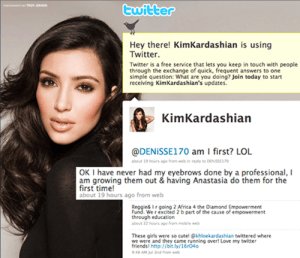
    While there are disadvantages for celebrities putting their lives on the World Wide Web, outlets such as social media can also be used as a free type of advertising or promotion.  Almost all main-stream celebrities have utilized multiple forms of social media from blogs to Twitter.  Britney Spears, Kim Kardashian and Justin Bieber are all examples of celebrities that have endorsed various products and used social media (more specifically, Twitter) to promote them. This has shown to be an effective marketing technique at little or no cost to them.

    Not every celebrity endorses a certain product, but they do essentially brand themselves when they decide post on social media sites.  Whether they mean to or not, the content they post reflects their personality and in turn, allows followers to characterize them.  Mastering how to effectively brand one’s self on these sites has in essence became a modern day art.  In today’s day and age, a social media suicide could destruct the celebrity’s image as a whole.

    Sasha De Vecchi, Lindsay Gallagher, Jay Reilly, Cary Welborn

  • Remember When… Social Media Was Not Overrun With Ads?

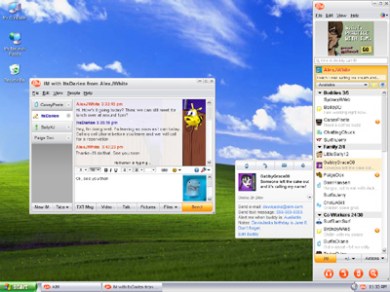
    Do you know how to transfer your buddy list? What is your Myspace song today? Why did you lower me in your Top 8? Where did you get your buddy icon? Remember when these were your biggest worries on social networking? Nowadays, a social networker must be fully aware of everything they post, every picture they are in, and even everything they click on.                            Image

    When social media first began, it is doubtful that anyone could have predicted where it is today. Employers search Facebook, Twitter, and LinkedIn before hiring new staff. School systems are implementing cyber bullying policies across the nation. Even our parents are sending us friend requests. It is hard to come by someone who doesn’t have a Facebook or Twitter. Due to the popularity of social media, it is no surprise advertisers want to tap into this huge online market.

    Image

    What began with AOL Instant Messenger, evolved into the Myspace fad, and now Facebook, Twitter, FourSquare, Pinterest, LinkedIn, and Instagram have joined the scene. After Myspace died out, there was much debate about how long Facebook would last. With the help of advertisers, it seemed like it could potentially last forever. Unfortunately, with the rise of other social networking sites, Facebook has seen a less than desirable decline in popularity. Now Mark Zuckerberg, the CEO of Facebook, is having to persuade advertisers to continue investing. In an interview covered by ABC News, he “[promised] better results as Facebook’s mobile app is made friendlier to advertisers.”

    What does this mean for users?  More advertising headed your way! If you’ve seen Facebook’s login page lately, you might notice that it has officially been sold. It is hard not to notice as it takes up more than three-fourths of the screen. When Myspace sold their front page, it was the first sign they were not cutting it anymore. Does this mean Facebook’s “in” time is ending soon too? Not if Zuckerberg can help it.

    You might notice the sidebar ads following more closely to your internet searches. As Facebook tries to evolve to keep up with the market, Zuckerberg stated that he would like to make Facebook a search engine that could compete with Google. It is no coincidence that the items you were looking for on Amazon a couple of days ago are popping up in the ads you see on Facebook.  Long gone are the innocent days of simply “lol”ing with your buddies on AIM.  It seems now more than ever before the public will become a constant target for advertisers.

    Will this increase in advertising on Facebook lead to a shift in which social network is the most popular? Will Instagram and Twitter combined be able to wipe out Facebook? Would it even matter because Facebook owns Instagram? Or will the dark horse network, Google +, take the internet by storm?

    G2G. Mom needs the comp. TTYL 🙂 ❤

    Alexandra Huss, Caroline Merrill, Alyssa Morrello, Lauren Van Trigt, Daniel Williams

  • Challenge: Build Your #brand In 140 Characters

    Social media is a growing evolutionary electronic forum around the world.  Some argue that Twitter and other social media sites are becoming the journalism of the 21st century. There are numerous social media outlets which allow their users to instantly connect with thousands of online communities and share a limitless amount of information.  From celebrity Tweets to Facebook events, wall posts to Pinterest pins, people are staying connected in a variety of forms on the Internet.  Twitter, founded in 2006, has become one of the leading social media outlets allowing users to stay up to date with current events. From international businesses to famous celebrities, Twitter allows its users to feel connected to whomever they choose to follow.  Celebrities like @Kim_Kardashian, @Heidi_Klum, @Ryan_Seacrest, and @Snooki all use Twitter to enhance their #brand and attract followers.

    The use of social media sites is becoming one of the most dependable and fastest ways to sell and promote products. In just a few clicks marketers can have access to any target audience they desire. Twitter is an efficient way to connect people to ideas and enhance their #brand awareness. It also allows marketers to engage their audience in a manner where the consumers actually want to receive information. Twitter can also be used as a research method to learn what their target audiences are tweeting about and incorporate those ideas into their marketing strategies. Twitter can be used to build and enhance a personal #brand by making connections with their target audience and answering their questions and comments directly.

    With each tweet, celebrities are promoting and advertising themselves in 140 characters or less. Some celebrities control their own accounts while others are maintained by their PR agent. Using Twitter for publicity increases their popularity while establishing their #brand.  It also allows celebrities to establish more of a personal connection to their fans. Sometimes celebrities will re-tweet and reply to comments, questions or concerns that their fans send.  This gives them an understanding of what their fans like and dislike about their #brand. Twitter provides these celebrities an opportunity to prove that they are just like everyone else.

    @Kelsey_Bendig, @Brian_Burch, @Andrea_Blanton, @Brooke_Keller

  • Will The Force Be With You?

          It’s Super Bowl season and we, as viewers, are ready for the stream of entertaining advertisements that keep us occupied between breaks. I’m sure everyone remembers last years buzz worthy Star Wars inspired Volkswagen commercial. How can one not be enamored with a little boy in a movie quality Darth Vader suit that genuinely startles himself by using “the force” to turn on his dad’s new Volkswagen? Beyond all the cuteness, the commercial relays the push-to-start feature that the affordable (and apparently fun) German car has to offer.
         To top its success from the last Super Bowl, Volkswagen has returned with yet another Star Wars inspired ad and the entertainment factor is undeniable. Yet what do barking dogs and Star Wars really have to do with the German automobile company?
         Advertisers take full advantage of the hype surrounding the Super Bowl to create innovative, touching, and entertaining commercials. Companies will pay extraordinary amounts of money to ensure that their commercial is seen by the millions of viewers watching the game. After all, this one time of the year advertisers can assume that almost every single American is tuning in. What company wouldn’t want their product showcased at this time? It’s like a black Friday Christmas sale for advertisers. These companies want to bring attention to their product in anyway possible, even if that means their product isn’t even mentioned until the last three seconds.
         In the Volkswagen ad, the viewer is unaware of the association between Volkswagen and Star Wars until the very end. This proved to be a very strategic move on VW’s part. Last year, companies were able to monitor which commercials made the biggest impact on viewers via Twitter, FaceBook and other popular social platforms. They measured the ad’s success by the number of times it was mentioned in the digital realm and were able to realize what struck a chord with the vast audience. What once seemed to be a hail marry concept of integrating marketing, advertising, and social media, is now an easy field goal for the IMC commercial championship. Volkswagen is betting that we will remember how fond we were of last year’s Star Wars theme and associate those same feelings with their brand this year as well. You can’t go wrong with puppies and kids, right?
    -Alexis Kapczynski, Kacy Cox, Sara Kaloudis, Josh Bowman
  • Another Day, Another “Gunman”

    It was not our plan to write another blog post about university safety communication however, for the second day in a row, one of North Carolina’s universities was faced with a crisis as a reported gunman was spotted on campus. Much like how the University of North Carolina Wilmington alerted their students, East Carolina University also utilized all tools necessary in order to notify their students. Officials issued a complete lockdown and notified students via e-mail, phone calls, text messaging and social media sites. However, the role social media played in UNCW’s crisis is far different from what happened at ECU.

    Reports of a gunman walking through campus started circulating around 10 am this morning and there was surveillance of a man with a cowboy hat carrying what looked like a large riffle walking on a 5th Street, a road that runs through the campus. As students were locked up in class, tweets began to flood in reporting the incident and some even saying that they saw the gunman and that there were hostages. However, after three hours of searching the Greenville Police tracked down the suspect and found that the “rifle” was in fact an umbrella. Greenville police Sgt. Carlton Williams stated that rumors circulating on social media sites such as Facebook and Twitter caused authorities to “chase ghosts” and follow leads that were false.

    Although yesterday’s post focused on how social media has allowed us to share and cooperate in moments of crisis, there is also a negative side to the impact it has on the crisis communication. Officials utilize the tweets and posts on social media sites in order to gain information and as you can see from today, often have to take those tweets at face value. There’s always that “better safe than sorry” feeling, especially in the wake of the Virgina Tech massacre, but to what extent should authorities follow-up on information provided through social media?

    -Alaethea Hensley, Jessica Kingman, & Lauren Phelps