Tag: Consumerism

  • Sexy Drunk Candy Day

    A blog featured by our IMC predecessors two years ago touched on the roots of Halloween, evidently for informational purposes. But if we look at the origin of the holiday, and compare it to the simple consumer monster it is today, what does it say about our culture? How did it transform from a festival rooted in serious meaning to whatever it’s supposed to be today?

    Halloween started with the Celts many moons ago, over time it was adapted and changed by the Romans, and became what we know it as today in the 1900s. None of that is really important. What is important is how we cannibalized the traditions and passed them along, while turning the holiday into nothing more than a consumption animal party.

    The phenomenon that explains this is Social Construction of Reality, but how did it get to this? It seems that most traditions were forged in some pretty substantial fires, but American culture has a way of reducing the importance of history to make some money. The idea behind the tradition is not communicated to growing generations, and the meaning gets lost behind the ways we celebrate. Then the Americans who grow up and pay money to be a part of the “tradition” end up satisfied with their part in the whole ordeal while walking away a little poorer, and just as ignorant.

    A Google Search of “Halloween Sales 2013” turns up a link to coupons from retailers pushing to sell costumes, candy, and other Halloween-related things. A short list of the companies offering these discounts are Aeropostale, The Popcorn Factory, Party City, Amazon, Toys R Us, the Disney store, Babies R Us, Walgreens, Land’s End, Pier 1 Imports, Petco, Hot Topic, The Home Depot, Urban Outfitters, Williams-Sonoma, Cotton On, Sears, Roaman’s, and Target. Apparently Tide is also in on the Halloween action (from my colleagues’ Monday post).

    None of the companies’ ads say anything about the Celts or the Romans.

    One Halloween participant properly respecting the Celts.
    One Halloween participant properly respecting the Celts.

    Nobody ever told me what Halloween was about. I just learned to associate it with costumes and candy from my mom. It’s kind of like St. Patrick’s Day, which (you would think) is not too relevant to Americans that lack origins in Ireland, but is extensively used to increase sales and get people drunk. The fact is, today, that all Halloween really is about are costumes, candy, and partying. Most holidays end up being just another reason to party in America, but Halloween is the most notorious for partying being its sole purpose.

    Ask around, especially on campus, and people will have a whole slew of methods for celebrating the holiday. If a person has kids, they will dress their kids up and walk around to get candy on Halloween. Some folks may stay inside and hand out candy to other people’s kids if they feel up to it. Those who don’t have kids will probably dress up and get drunk.

    That’s about it.

    I could talk about the implications of the most prevalent American Halloween costumes featured in our local costume shops (which are perfectly in tune with the holiday’s roots), but everyone knows that it all pretty much ranges from “sexy nurse,” to “sexy M&M”  or “sexy pirate” for women, and “pirate,” to “caveman” for men. Most Halloween emphasis is placed on the costume. The rest is on the party or the candy.

    It doesn’t have anything to do with any of the reasons it was created. Sure, there’re Jack-O-Lanterns that have survived in homage to ol’ Stingy Jack, but does anybody reading this know about him (assuming that any one of the extremely cool tales about him is the one responsible for the tradition)?

    I say, since Halloween seems to just be an arbitrary holiday nowadays, that we change the name completely, maybe to “Sexy Drunk Candy Day.” Let’s reconstruct the reality of Halloween. Why not?

    – Chad Darrah
  • BOBS vs. TOMS

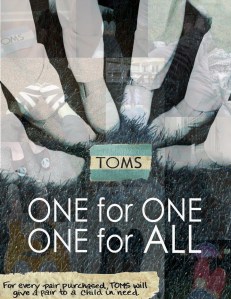
    When discussing brand identity, two important points are the “how” and the “why.” Why a business does what they do, and how they do what they do; the motives and the execution. A brand like TOMS shoes gets consumers hooked with the why. Blake Mycoskie was visiting a village in Argentina when he encountered the effects of poverty. He was forced to confront the number of children without shoes. This inspired him to start a new kind of for-profit business, one that donates as much as it sells. Thus, the TOMS shoe company was born with the slogan, “One for One.” With every pair of shoes purchased, TOMS donates a pair to children in need.

    When the company began it was a risk. One that was not promised to prosper, but had good intent. The company began with three basic colors of the same type of canvas shoe, and has now expanded beyond Mycoskie’s wildest dreams. The brand identity of TOMS is simple: give. As Mycoskie states, “Incorporate giving into everything you do.” So what happens when the giver meets the thief?

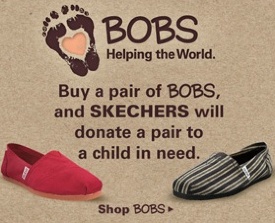
    Skechers is infamous for stealing other shoe companies product concepts. For example, in 2009 Reebok launched the “EasyTone.” In 2010, Skechers launched “Shape-Ups.” Both shoes were designed to provide the same benefit of turning everyday activities into an easy way to get fit. Now, Skechers has released a line of canvas shoes called “BOBS.” The shoes are nearly identical to the TOMS design and sport the same promise of donating a pair of shoes to children in need with every pair purchased.

    The problem is the public hasn’t accepted BOBS with the same open arms that TOMS was embraced with. BOBS has stolen the “how,” but lacks a convincing “why.” Has the thief gone too far this time? The reviews on BOBS have been less than satisfactory. The Skechers company has been called everything from fraudulent to mean-spirited. Their brand identity has been tarnished for their latest rip-off which seems to have struck a deeper chord with the American market.

    Does it matter? The kids who need shoes are still getting shoes. Do they care if the label on their shoes reads BOBS or TOMS? Should we?

    Alexandra Huss, Caroline Merrill, Alyssa Morrello, Lauren Van Trigt, Dann Williams

  • How Much is Too Much?

    As the ten-year anniversary of September 11th quickly approaches, many Americans are beginning to prepare for the remembrance of the lives that were lost on that day. All across the country, people are buying extra American flags to place in their windows, commemorative pins, banners, posters, and even coin sets. And that is exactly what marketers want them to do.

    NYCWebstore.com boasts an impressive display of 9/11 commemorative goods from Twin Tower ornaments to hang on the Christmas tree with care, to memorial umbrellas, to FDNY and NYPD shot glasses. Although some of the profits from these “limited edition” items do go towards The FDNY Foundation, we are not told exactly how much.  None the less, at least our conscience can be comforted knowing some part of our consumer spending is for the greater good. However, unfortunately we cannot say the same for all products.

    What better way to remember than through the unique 9/11 Commemorative Coin Certificate? But if a coin-certificate doesn’t tickle your fancy, fear not for the National Collector’s Mint has a variety of coins to choose from including a brand new coin rolled out to honor the 10th anniversary. Now only $29.95 can help you “pay homage to America’s heroes and remember the day that changed America forever… order today!” 

     We do not mean to make light of 9/11. For many of us, this marks an extremely important day in our country’s history and is a day that we will not soon forget. However, when is too much? When does our need for consumption begin to take over so much that we need to have teddy bears, snow globes, and necklaces to help us “remember our heroes”?

    – Jessica Kingman, Alaethea Hensley, Lauren Phelps