Tag: commercial

  • The Super Bowl will never be the same

    The Super Bowl draws in more than 100 million viewers each year from around the world. Some watch for the game but many of these viewers only watch for the debut commercials. Companies spend upward of 4 million dollars for one 30-second spot during the four-hour broadcast.

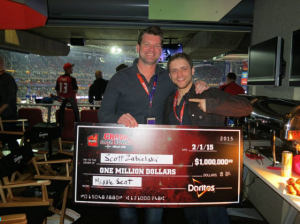
    Although we will still see the classic Budweiser and Coke commercials, Doritos will be ending a 10 year tradition. Since 2006, Doritos has run their “Crash the Super Bowl” campaign, which allows consumers to submit a 30-second ad that could be aired during the Super Bowl. This has generated some of the top Super Bowl commercials of the last decade.

    Screen Shot 2015-09-10 at 2.55.19 PM

    After 9 years, 8 installments, 32,000 entries and 7 million dollars in prizes Doritos is abandoning the project because of risks involved. The company feels the contest would no longer be profitable because of increasing prices for ad space.

    Screen Shot 2015-09-10 at 3.00.28 PM

    On one side, Doritos now has the reins of their Super Bowl ads; however, ending the contest could upset participants and viewers that have followed the campaign. While we still have the 2016 “Crash the Super Bowl” ad, it remains to be seen how Doritos will position themselves for Super Bowl LI.

    Do you think Doritos’ decision to end the campaign will impact them positively or negatively?

    -Nick, Melanie, Mary & Patrick

  • Branding Through Your Speakers

    Nowadays it is almost impossible to escape the sounds of music. Beginning with your morning alarm, music can be heard throughout the day whether through a ringtone, car stereo, speakers, or even advertisements. Many companies are harping on this trend by finding ways to integrate particular artists, bands and up-and-coming music groups into their brands.

    The use of music is a strategic marketing tactic because it helps to bridge the gap between companies and consumers by allowing them to share similar lifestyles. If the music used in advertisements positively resonates with the audience, then it is likely that the product will, in-turn, be portrayed positively. According to Simmons and Simmons, “Consumers who live part of their lives through music are passionate people who care about the content they chose to engage in.” This is why the use of music must match the purpose of the message in order to be memorable and thus successful.

    The Uses and Gratifications Theory can also be incorporated into this idea of music and branding. This theory deals with how people use media to their advantage, either to gain something or form some sort of image/relationship with something else. Consumers are also able to use the media for reference to gain knowledge about a brand and their products.  In this case, brands are using music to help form their image and how they want to be seen by their publics.  By purposefully incorporating artists that they think will further their particular commercial, campaign or even runway show, brands can use music to solidify their message and image.

    Taco Bell’s commercial for Doritos Locos Tacos incorporates the use of music by featuring “Take a Walk” by Passion Pit. The commercial features the quick paced song along with multiple snapshots of tacos piling up on top of each other while moving across the screen.  At the end of the ad, the voiceover says “Taking tacos where no one thought they would go.”  This is a small but memorable connection to the title of the song played in the background and would be noticeable to anyone who knew the title or heard the lyrics.  The message Taco Bell was trying to send their audience was that their tacos are easy to take on-the-go and are able to be eaten everywhere.

    Can you think of any examples of how a brand has used a popular artist in their commercial?  How has the music affected the way you think of the brand or company?

     -Aaron Love, Kara Zimmerman, Rachel Clay, Rebecca Hobbs
  • Flacco’s “Lovin’ It”

    From his first infamous trip to purchase a 10 piece nugget meal, to now being featured in a full scale McDonald’s advertisement, Joe Flacco is now not only representing the NFL scene, but the fast food scene. Many companies have harnessed and benefitted from the use of the pathos and emotion in their advertising campaigns to attract current and future consumers. McDonald’s has started a new advertisement campaign with Ravens’ quarterback and recent Super Bowl XLVII MVP, Joe Flacco. With the Ravens’ latest win in Super Bowl XLVII, Flacco has become a household name, contributing to a rise in Ravens’ supporters and fans. As the new football season revs up, McDonald’s is appealing to the crazed fans young and old alike who have a passion for their team and what it believes in.

    Although Flacco is a respectable and genuine role model who is described by many as humble and “the guy next door,” this is not just a question of the effect of pathos being used in this campaign, but also ethos. By doing the commercial for McDonald’s, which is well known for their appeal to younger consumers, Flacco could be seen as ethically responsibly for the image he puts out for young children. Young boys and girls may look up to him because of his celebrity appeal and athletic status and think they should eat McDonald’s because he does. In the advertisement, Flacco is shown eating McDonald’s new “Mighty Wings” which are (480 calories and  31 fat grams). As a well known sports icon, Flacco is constantly in the limelight. He is a fit and healthy individual, which will create the image of eating McDonald’s as an attractive and healthy option. This may cause misleading perceptions about the health benefits of McDonald’s and in Flacco losing credibility as a professional athlete.

    Logic (Logos) may be factored in when looking at the obvious benefits that McDonald’s will gain from having Flacco in their advertisements.  Having a well known athlete sponsor your brand is a sure fire way to bring in revenue and was a good marketing move by McDonald’s.  On the other hand, logic also tells us that McDonald’s does not provide the healthiest food that we can put into our bodies.  The nutrition facts cannot be hidden by a super fit athlete.  Do you feel as though Flacco lost or gained credibility by endorsing McDonald’s?  How do you think McDonald’s credibility has changed or stayed the same, knowing the type of people they feature in their advertisements (particularly athletes)?

    We can almost be certain that aside from the ethical questions that this ad brings up, there will be a rise in support of McDonald’s by a deeply rooted Ravens’ fan base. This brings about a win-win situation for McDonald’s and Flacco off the field.  So, who knew that a simple 10 piece nugget meal from McDonald’s would land him yet another win?

    -Aaron Love, Kara Zimmerman, Rachel Clay, Rebecca Hobbs

  • Starburst: A Pack of Contradictions

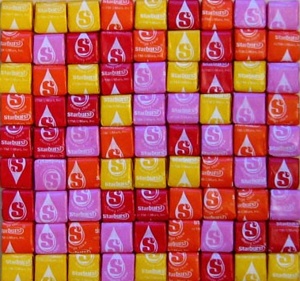
    The latest news on the Starburst brand is that Starburst has launched a new campaign where it focuses on “contradictions.” The most recent Starburst commercial plays on the candy’s “contradiction” of solid, yet with a juicy consistency. The company’s new commercials come off to be very strange, which is exactly the point. With all of the commercials that are constantly played throughout the world, more specifically the United States, it is getting increasingly difficult for advertisements to stand out among the others. In an effort to stand out, companies are creating commercials that seem to be strange but memorable. An example of one of these weird Starburst commercials is the commercial where a Korean man is portrayed as a Scottish man due to the bagpipes and kilt he is wearing. This man is standing with a child who is dressed the same way but eating a Starburst and states, “One contradiction eating another!” Another commercial consists of a screaming mime that is supposed to portray a contradiction. Clearly mimes are not supposed to talk. The most famous of these Starburst commercials though, is a commercial where a dog is riding in the car with a group of men. The dog has its back side sticking out of the window of the moving car, and one guy in the car claims that the dog is a contradiction for doing so, since normal dogs stick their heads out of windows. It is clear that this commercial was effective in at least making a memorable impact on consumers, whether the impact was positive or negative. The commercial’s growing popularity is displayed through the 43,900 results that appear on Google after searching “Starburst your dog is a contradiction”.
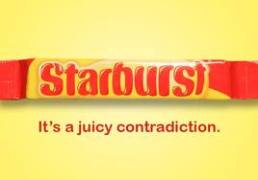
    ImageThis Starburst commercial was very successful; however there is much scrutiny that is coming from it. There are many articles and blogs published about how the people shown in these Starburst ­­commercials are not actually a contradiction. One article specifically, titled “Ass-Backwards Starburst Dog Isn’t Really a Contradiction” discusses how the people in these commercials have traits that deem to be opposites, but are not actual contradictions. Author Tim Nudd states, “Now, we get this new spot with a dog who likes to hang his ass out a car window—and he’s called a contradiction. Isn’t he really just a dog with an unusual preference?” There are numerous articles similar to Nudd’s, claiming that these commercials do not actually portray contradictions at all. Therefore, their whole message is distorted and their credibility is in question. Both sides can be argued extensively due to the fact that the word contradiction has many different definitions.

    Under the Dictionary.com definition, a contradiction is a “person, thing, or situation in which inconsistent elements are present”. Based off of this definition, these commercials would correctly portray contradictions. However, under other definitions such as, “a contradiction is two propositions used in combination where one makes the other impossible. It is something that is A and non-A at the same time. A contradiction, therefore, cannot exist in reality, since existence exists” would not consider the people or the dog in the Starburst commercials to be contradictions. These commercials are being closely examined for the accurate or inaccurate usage of the word “contradiction” by many viewers all over the world; however, this brand of candy’s new campaign theme, “Celebrating the contradictions that make life so interesting,” is capturing thousands and thousands of fans daily. The Starburst brand has also created an online “Contradictions Project,” which is seeking to involve fans all around the nation to log on to the Starburst Facebook page and submit common contradictions of their choice. For every contradiction a fan lists, that person will be added to the $250,000 donation, which is partnered with VH1’s Save the Music Foundation, to restore music programs across the country. Whether these new Starburst commercials are considered to be weird, incorrect, humorous, or just plain stupid, the reality of it is, their new theme is making the Starburst brand even more popular than it already was.

    Image

    Sasha De Vecchi, Lindsay Gallagher, Jay Reilly, Cary Welborn

  • The Oscars Generation Gap

    Since the very first Academy Awards ceremony in 1929 there has always been a prestige and honor surrounding the awards.  But lets face it, the era of Hollywood glamour has been replaced by Joan Rivers and obnoxiously unfunny skits between Anne Hathaway and James Franco.  The Oscars prove time and time again to be the most “stuffy” of all awards shows and continues to try to appeal to their top viewers, the 50+ age group, while vaguely attempting to reel in younger viewers. Through choosing young popular actors such as Anne Hathaway and James Franco, the Oscars attempted marketing to a younger age group.  What had much potential turned out to be a disaster as numerous news sources called it an “Oscars Bomb.” In a promo video for the 84th Annual Academy Awards this Sunday, Funny or Die released a long drawn out parody between Michael Myers and Kevin Kline.  Needless to say, the Academy was making an effort to appeal to the majority of moviegoers, 18-29 year olds, by joining forces with a popular online comedy troupe.  Will the Academy reach their much-needed younger audience this year? Or will the Academy fall behind  to become the old stuffy grandfather of awards shows?

    By: Molly Jacques, Hunter Wilson, Josh Vester, and Ashley Oliver.