Tag: CBS

  • FCC Reviews Rules and Regulations

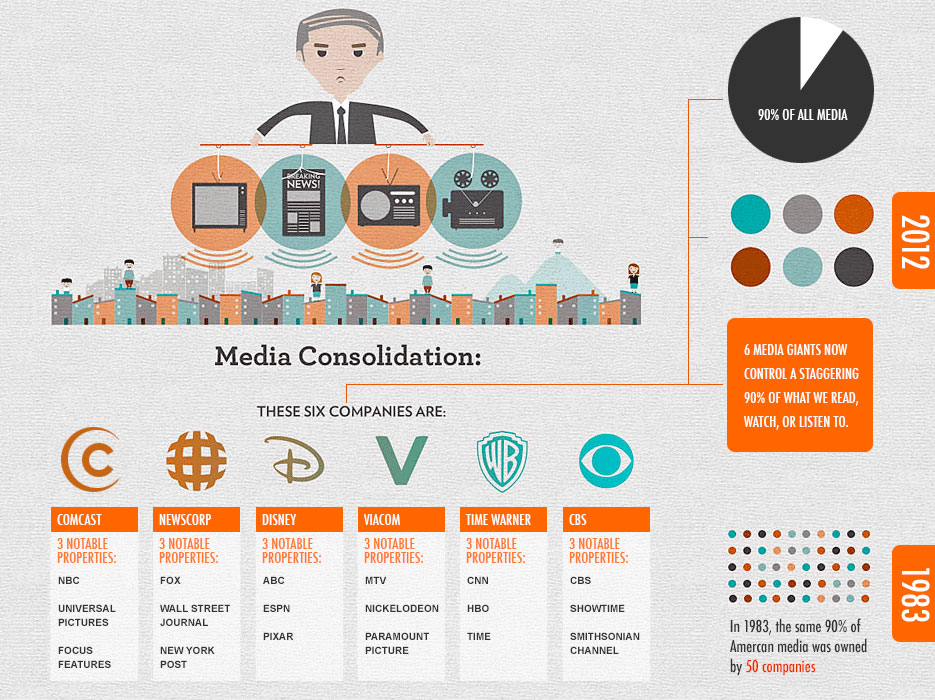
    As the final four teams prepare to battle it out in March Madness, it’s a sure bet that sports fan are waiting to see what else the tournament has in store this season. With coverage, updates, and analysis, it’s also a pretty sure bet that these fans are tuning into ESPN – the station that has become the sports authority. But did you know that the testosterone filled station is owned by a company that producers princesses fairytales – Disney? Did you know Disney also owns ABC, Marvel, Pixar, and Touchstone. Part of what’s known as the “Big Six” – Comcast, News-Corp, Disney, Viacom, Time Warner, and CBS – account for 90% of media ownership across the ­states.

    media_consolidation

    The process of consolidation through mergers and acquisitions, has led to media conglomerates – few companies owning all of the media outlets.

    Many argue that media consolidation hurts competition by blocking out new media companies. According to Senator Wellstone, media give people access to a wide variety of opinions, analyses, and perspectives and it holds concentrated power accountable to people. With only a few companies controlling all the media the two functions of media (listed above) are compromised. Specifically related to advertising, a combination of media also leads to monopoly over audience and advertisers.

    Today, the Federal Communication Commission (FCC), an independent US government agency responsible for controlling media regulation, will vote to make TV station’s joint sales agreements (JSAs) subject to current ownership rules. The commission will also vote on a rule that prohibits two or more of the top four TV stations in a market from jointly negotiating agreements with pay TV providers.

    Tom Wheeler, FCC Chairman, cited that the considered changes were motivated by evidence that suggested the rules that protect competition diversity and localism have been circumvented.

    JSAs are an arrangement many see as a loop hole around the limits on owning no more than two TV stations in a market. With endorsement from the Department of Justice, the FCC is now moving ahead with the rule “that if the owner of one station in a marketing sells 15 percent or more of the advertising time for another, then it will be deemed to have ownership interest in the station.”

    Broadcasters are fighting back. Gordon Smith, president and CEO of the National Association of Broadcasters, says, “The real loser will be local TV viewers. This proposal will kill jobs, chill investment in broadcasting, and reduce meaningful minority programming and ownership opportunities.”

    Stations that do have JSAs will have two years to dismember deals. However, stations can apply for a waiver in which JSAs will be examined on a case by case basis to determine if public interest is served by keeping the agreement.

    Additionally, as part of the 2014 review, the FCC will propose to keep the ban on owning more than two TV stations, but question whether the cross-ownership ban between TV, radio, broadcast, and newspapers should be lifted.

    However, while the five commissioners of the FCC will all vote on the issue, the ultimate decision may be left in the hands of just one, Democratic commissioner Mignon Clyburn. The issue has split the five down party lines with the GOP commissioners, Ajit Pai and Mike O’Rielly speaking out against the proposal. In order to advance the ruling, Wheeler will need the favor of both democratic commissioners.

    While the commissioners are deciding, we are left wondering to what degree will these rules affect our media markets? Will Clyburn’s decision trend toward more or less regulation?

    Tell us what you think. Should the FCC approve the JSA rule? Are media conglomerates affecting the free flow of information to society? Or has the Internet made possible enough independent outlets?

    Savannah Valade, Caroline Robinson

  • “Who are you wearing?”

    The 55th annual Grammy awards will be airing live on CBS this Sunday, and it is certainly safe to say that there is much buzz about the fashion. In fact, the Grammy awards are known for their crazy, over the top red carpet looks. Who could forget Jennifer Lopez’s cleavage bearing VersaceImage dress that she wore to the 2000 Grammy awards? Or Pink performing in a nude colored body suit at the 2010 Grammy awards? Well, it won’t be happening this year.

    The CBS Standards and Practices Committee sent out an email asking attendees, including performers, to adhere to a stricter dress code policy this year. The email specifically stated that outfits exposing “bare fleshy” areas of the body would not be tolerated. On top of this, attendees have been asked to refrain from wearing clothing items that would display blatant product placement, obscene/foreign language, or advertising personal causes in the form of lapel pins.

    So with the new dress code policy, not only have the attendees of the Grammys been affected but the designers as well. Designers receive a lot of advertising and publicity at awards shows by having celebrities wear their gowns and suits. With the very recent enforcement of this dress code, what will designers and those attending the show do to make sure they are adhering to these rules? Designers have been working for moImagenths and months to have their gowns/suits ready to be worn on the red carpet in hopes of getting their names out there, or even better, getting their gowns/suits on the best dressed list. It will certainly be interesting to see what will go down this Sunday night.

    – Zach Abramo, Callie Fenlon, Lauren Habig,  Alexandra Huss, Michael NunesDaniel Schaefer, Dann Williams

  • Ad it all up

    The anticipation of the 2011 TV line up is almost complete as we
    are wrapping up the first week of an intense premiere season. Coming soon we
    will view the Nielson rating which will say which show came out on top with the
    most viewers and what networks picked the best shows to debut. However, there is
    more to just ratings from a show that make it popular, there are strategies
    weaved into placing certain advertisement’s along with the viewers of those
    shows.

    When watching the recent Emmy award-dominating force, Modern
    Family, on Wednesday
    evening
    ,  did you notice that actress Sofia Vergara, who plays the role
    of gorgeous Gloria Pritchett, debuted her new clothing line at K-Mart for the “
    You are Woman, So dress like a Woman line”? Maybe the nostalgic 60
    second Pepsi commercial caught your attention while watching the hit show X
    Factor on Fox which took the audience on a journey through the
    past. The commercial starts off as a new performer about to enter
    the stage but before he goes on he picks up a can of Pepsi, takes a swig, then
    stares at the logo it then evokes emotion from the new performer and, it
    sends him into a tumbling daydream full of Pepsi’s pop stars past commercials,
    such as the late Michael Jackson, Ray Charles and Mariah Carey to name a few,
    then you are left to a blurred vision of this man about to enter the stage and
    become his own start like those who drank Pepsi its first big brand spot touting
    its connection to the program.

    Is it a coincidence for both of these commercials to premiere
    simultaneously with these shows? You would be silly to consider such a
    thing. Thematically, the spot placement of each advertisement is
    seamless. Pepsi really is wondering who will become the next, since they have
    promised the winner of The X Factor a starring role in a Super Bowl commercial
    this winter.  Sofia Vergara knew she had the “mom” and “working
    women” audience during the Modern Family season premiere; ABC and Sofia knew
    those mom’s and working women were those who helped nominate her for the 4
    Emmy’s this year. It was a perfect fit for one of the highly anticipated comedy
    shows to integrate Sofia’s personal achievements.

    The Nielsen rating suggests that consumers are watching TV more
    than ever before, which makes what they are watching an integral and essential
    part of a marketing campaigning for brands. This is there one opportunity this
    fall season to make impact on those targeted viewers to entice them to purchase
    a can of Pepsi over Coke, or that leopard Mini skirt at K-Mart over the
    over-priced department stores. These are ad placement strategies, brands and
    networks have merged together to get more bang for your buck.

    – Jordan Hill, Ashley Nelson, Michela Noreski

  • Charlie Sheen: Nightmare For CBS?

    You must be living under a very large rock if you haven’t been hearing about Charlie Sheen this past week. It all started about a month ago when Sheen was taken to the hospital after a 36 hour cocaine binge with adult entertainers. Because of this, CBS decided to put the show in which Sheen stars, Two and A Half Men, on hiatus. Last week, Charlie Sheen made some very derogatory comments about the decision to postpone the show and its creator, Chuck Lorre, on a radio show. CBS then announced that the remaining season will be cancelled. This set Sheen into a heated verbal rampage on several television interviews which involve him calling for a pay raise, as well as threatening to sue for upwards of $320 million. It’s important to note here that Sheen is already the highest paid actor per episode on television at $1.25 million.

    Are the executives of CBS stewing over a PR nightmare, or are they enjoying the attention? You have to guess that having such a wild man going on tirades against your organization is very bad press for your network, but can CBS spin this in their favor?

    CBS isn’t really a network that has been known for groundbreaking, controversial programming. They have been branded more subtly, with most of their primetime shows consisting of crime dramas, standard sitcoms, and reality shows like Survivor. However, one of the most successful programs they have is Sheen’s very one Two and A Half Men, where he already portrays a wealthy man named Charlie living in Malibu with a penchant for loose women and drinking (not much of a stretch for Sheen). You would think that after the outlandish appearance Sheen has been putting on display, they would be inclined to cut all ties with the loose cannon. However, CBS would actually do well to embrace the attention Sheen has created. He recently set a Guinness World Record of being the fastest person to reach 1 million Twitter followers. He opened the account on March 1st, and he now has 1.4 million and rising as I write this. The public just can’t get enough of him. He may be a train wreck, but that’s the thing; people can’t look away. Charlie Sheen has definitely added interest to his own brand, and if CBS can reconcile with him, Sheen could help them improve theirs. We are seeing an increased demand to the drug-free, new look Sheen and it seems that people want to see him succeed. The amount of viewers tuning in to see him on his first episode back to Two and A Half Men could do both parties good.

    Every corporation knows that adaptation is important. There are going to be curveballs thrown at you and you need to learn to roll with the punches. CBS needs to take this potential disaster and do what they can so everyone benefits. They don’t want to be branded as an organization that condones that sort of behavior, but by getting Sheen back onto the screen so his new fans can adore him is what I like to call winning. Do you think Charlie Sheen is worried about how his brand is being seen or do you think this is what some people have to do in order to become the most successful?

    -Will Cosden, Brianna Golden, Drew Mayer, Lindsey Baggett, Micaela Fouhy