Tag: Brand Image

  • The Transparency Angle

    What’s even real these days? It may or may not be a question that’s crossed your mind recently, but it is causing a stir in companies and ad agencies.  Transparency and authenticity are in, and flashy propaganda is on its way out.  It’s no surprise that businesses continue to refine the concept of authenticity for the purpose of marketing strategy.  What could be more lucrative than to convince consumers that a product can bridge the disconnect between modern civilization and reality, especially in a society constantly seeking meaning?

    Chick-fil-A is one company that is now taking the advertising approach of transparency, inviting customers for behind-the-counter tours at all of their locations.  This blazes the path for their upcoming menu improvements, such as salads with more nutrient-rich ingredients focused on harnessing the concept of authenticity in their food offerings.

    However, restaurant chains aren’t the only ones using this strategy.  Dove, a brand owned by Unilever, started the “real beauty” campaign in 2004 in the hopes of expanding the definition of beauty and promoting self-esteem in women of all shapes and sizes.  This week the company released a video to tell women “you’re more beautiful than you think” by comparing how women view their own beauty with how strangers view them.  This type of advertising goes beyond showing the consumer how authentic a product is; it makes the audience consider the authenticity behind their own self-image.

    The Authenticity Hoax, a book by Andrew Potter, takes apart the ideal of the “authenticity” that we’re all striving for.  He looks at the areas of our lives where we feel connected to experiences, the world, and nature, and how society has lost the true meaning of authenticity in the process of seeking it out.  In his conclusion he says, “we are trying to find at least one sliver of the world, one fragment of experience, that is innocent, spontaneous, genuine, and creative, and not tainted by commercialization, calculation, and self-interest.”

    The minute authenticity became a brand in and of itself, people wanted to have it, and companies are more than happy to sell it.  Dove may highlight the reality of the average woman versus the size zero models in many other ads, but that doesn’t mean they’re not capitalizing on some other ideal.  Authenticity is the new thing to have.  The problem is, just as Potter points out, authenticity is pretty much a false goal.  Chick-fil-A can show its customers where they make the food, but that doesn’t mean anyone’s life is more real because they ate a chicken sandwich that wasn’t frozen.

    Ally Walton

  • Advertising Pranksters FOOL Consumers

    Bacon flavored mouthwash, lunchmeat DVDs, and glass-bottom airplanes?? This year’s April Fools holiday has caused an eruption of many brands’ foolish pranks going viral on social media. Some brands have even gone as far as creating spoof commercials and print ads along with their playful posts and tweets.

    For example, the P&G brand, “Scope” ran an ad on Facebook promoting their new “Bacon Flavored Mouthwash.” As you can see below, the company created a video spoof and several advertisements with catch phrases such as “Taste breakfast while washing it away” to promote this fictitious new product before they came out with the final phrase, “APRIL FOOLS!”

    Another brand having fun with this holiday is the movie rental company, Red Box, who is advertising “Sandwiches at Redbox.”

    To keep up with their April Fools promotional efforts, Red Box noted that they will be offering 50 cents off their rentals today only by entering the promo code “APRILFOOLS.”

    Virgin Atlantic Airways founder Richard Branson fooled customers in his blog featuring a new “glass-bottom airplane.” (Not for those afraid of heights!)

    The main reason marketers have chosen to embrace April Fools Day pranks is to make consumers laugh and create a lasting impression. However, these advertising pranksters may have another prerogative: by playing April Fools jokes via social media, these brands have the opportunity to go viral and target the new generation of social media natives.

    I think this is a smart tactic for advertisers as it shows that they can poke fun at themselves while promoting a playful culture that consumers can enjoy. Furthermore, as these spoofs go viral, they are gaining more traffic to their company webpages where actual products can be marketed and sold.

    Daniel Kahneman, author of Thinking Fast and Slow introduces the idea that our minds are associative machines where there are two systems at work. While advertisers may be promoting fictitious products to fool consumers, they are also taking advantage of our associative minds. By being playful and enjoying the holiday, consumers may associate these brands with being lighthearted and fun, further promoting a positive brand image.

    All in all, these April Fools pranksters have the right idea: using humor in advertising and focusing on building relationships with consumers should lead to a more positive brand image and (hopefully) increasing sales!

    Julia Tompkins

  • Drink Neuro: Functional Beverage, Functional Branding?

    Founded in 2007 by Diana Jenkins, Neuro has become a premium functional beverage.  The beverages slogan “Light it Up” hints at the drinks infusion of science to spark the body’s reaction in order for consumers to live and not merely exist.  Neuro provides a beverage that ignites your passions and stimulates your mind, fueling consumers to live life in color.  Neuro created a beverage for a healthier life through vitamin D and appetite control.

    Image

    The creator, Diana Jenkins creatively designed each Neuro bottle to be fully recyclable.  There are 8 flavors of Neuro water, all only 35 calories, and none contain artificial flavors or colors.  Some of the flavors include neuroTRIM, which slows your appetite, neuroSONIC to increase your ability to focus, neuroSLEEP to help you rest, and neuroGASM, which makes your blood flow.

    Do these drinks actually do what Neuro promotes or is it just a giant branding stunt to help sell their product?  According to warnings on each bottle or Neuro, the statements made by the company have never been evaluated by the Federal Drug Administration and are not to be used as daily supplements.  This makes it seem that the statements made by the company are purely for branding purposes and to catch the consumer’s attention.

    Following these claims Neuro has completed other stunts in order to hitch their brand image.  We all know the saying sex sells and Neuro hopped on the idea by publishing photo shopped images of half naked women covered in Neuro beverages.  By surfing the Internet for Neuro ads there are three main photos of headless, half clothed women, all which read “It’s All About You.”  Are these photos also how they hope to create their brand image or is it just another way to draw attention to their product?

    Image

    Neuro is a fairly new product and company; it is vital that the company produces a strong brand image.  It is those companies who are able to create that positive brand image that successfully compete with competitors.  Neuro sounds like a new trendy beverage but are they employing the right tactics to brand themselves effectively.   Neuro is a functional beverage but are their branding methods functional?

    Jessie Butner, Meaghan Beam, Zach Abramo, Jack Lane

  • Going Green, Brings Green

    Brands can promote themselves through almost any medium nowadays. Pens, stickers, posters, billboards, you name it, you can put your brand on it. Planet Earth Promotions is a company that is designed to help brands promote themselves in an eco-friendly way. There is constantly increasing awareness about environmental protection and a greater consciousness about how important it is to protect these environmental and natural resources. Planet Earth Promotions is leading the way for this “EcoSmart” promotional item trend.

    Planet Earth Promotions’ mission statement indicates that their “goal is to help companies and corporations around the nation proactively enhance their brand through the use of environmentally conscious and educational promotional items”. They have certainly delivered in this respect. This company has been ranked #1 in promotional advertising for the past ten consecutive years. Not only are they paving the way for other companies, they have become a greatly successful brand that is little to no impact on the environment. Planet Earth Promotions has built a successful brand on a trend that is becoming increasingly important as time goes on. This brand is very strong considering they have remained at the top of the list from Arizona Magazine for the last ten years and they are here to help other brands.

    They are able to offer many alternatives for companies to help cut back on environmental damage by providing recycled goods, information about recycling and environmental days in the USA and tips to bring pollution down. With so many companies shifting focus to being the “EcoSmart” companies and LEED (Low-energy electron diffraction) certified, it is a challenge to stay on top. Planet Earth Promotions has paired up with other environment-friendly companies such as AWEA (American Wind Energy Association) and Women’s Business Enterprise to built a very powerful and successful brand and continue to pave the way for other companies looking to create environment-friendly products and solutions for all varieties of businesses.

    – Julius Roberts, Leanna Marshall, Leslie Tyler and Bryce Koonts

  • What’s Your Unique Brand Style?

    UNCW’s Communication Studies Day includes an informative Dress for Success Fashion show for college students of all ages and levels. The fashion show will also include skits demonstrating the importance of an elevator speech, professional attire, portfolios, and how necessary it is to be prepared for interviews. This year the theme, “Will You Make the Cut?” is based upon the Food Network show “Chopped.”

    One idea about IMC manifested in this fashion show is that company image and brand management is very vital for growth and success. Individuals, as well as companies, have always had their own image and have to manage their own brand. It is sometimes hard for college students to transition from a student image that they have had for the past 13 years to a business professional image. The great part about the fashion show is that it shows students how to transition from their current image and brand to something more professional.

    Whether people realize it or not, we are branding ourselves every day through the types of clothes we choose to wear in professional or unprofessional settings. Your unique brand style can be a description of who you are in a job interview setting. It is very important to make interpersonal connections with job interviewers through your developed style and authenticity that will make you stand out from others. Branding yourself when looking for a job is very similar to branding a product. Basically, you are selling yourself as a product to your potential employer with the goal of standing out amongst the rest. Are you casual business, formal business, chick, trendy, preppy, classic, or a hybrid of several?

    By: Laura Simmons, Mollie Berthold, Dorothy Conley, Christina Stevenson

  • Oh Red, How I Love Too

    There are many legends and stories explaining the history of Valentine’s Day and St. Valentine, but one thing remains the same; Valentine’s Day is a holiday where lovers express their affection for one another.  Every year marketers use the same tactics to attract their love struck consumers into the arms of their products. Valentine’s Day advertisements are flooded with hearts, flowers, and of course the colors of love: red and pink. Red and pink symbolize passion and tranquility and are considered the most romantic colors. However, the appeal of generic pink candy and red roses will eventually run its course. So it’s time to spice it up and show your love that you put some real effort into this Valentine’s Day.

    M&M’s are promoting their brand this Valentine’s Day season by offering a sweet alternative to help consumers express their feelings to their loved ones.  The commercial features “Red,” the helpless romantic candy bite, who cannot respond to the love of his life with the three words, “I-Love-You.”  M&M’s understands that it is not always easy to express your feelings. With that in mind they are here to make it easier with personalized M&M’s. Popular messages include “Be mine,” “You make me melt”, “You Had Me at Hello” and “I Love You.” M&M’s also features a prepackaged Valentine’s Day blend with an assortment of colors, sayings and symbols. If that won’t cut it the Romance Bundle may be for you. It comes complete with a teddy bear and three bags of personalized M&M’s wrapped up in a gift box.  Remember, personalization shows that you took time out of your glamorous day to care!

    Through this strategic marketing plan, M&M’s enhances their brand by making it convenient for their consumers to spice up Valentine’s Day. M&M’s are one of the few companies that offer personalized messages on their candy products. This allows the company to stand out against the assortment of chocolaty competitors. Keep in mind that personalized candies aren’t just for Valentine’s Day, but also for any of life’s sweet moments.

    -Kelsey Bendig, Andrea Blanton, Brooke Keller, Brian Burch

  • All The Single Ladies

    Valentine’s Day is a holiday dreaded by a great deal of people, both male and female, for various reasons. There is pressure on both genders to perform, declare emotions, and out-do previous years or expectations. Those who fail at this task of grandstanding may in fact find themselves without a date for next year. Okay, so there’s a ton of pressure on people in relationships, but what about those of us who are single? While some take pride in their solitude, others wish they had someone to be their valentine, and a few twitch at the mere thought of being in a relationship.

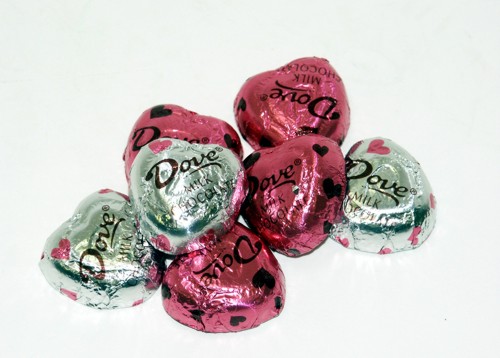
    According to an article in the New York Times, being single is a prevalent occurrence these days with 59.9 million single women in America. This staggering rate may surprise some, but companies like Dove chocolate see these table-for-one ladies as a prime marketing demographic. They hope to strike a chord with this growing independent group by catering their advertising to the women who are without companions. That is why this year Dove has made a campaign to remind women Valentine’s Day isn’t just about romance.

    Dove is banking on the stereotype that single women will turn to chocolate this year on Valentine’s Day. Instead of the standard “Call me” or “I’m yours” found on the candy hearts we used to share with our playground crush, Dove has created a host of witty comments and placed them on the inside of their chocolate wrappers. Some of the best include, “You’re gorgeous,” “Sometimes I buy flowers for myself,” “My flaws are fabulous” and even the ever so uplifting, “Love yourself in a moment.” The new commercial features women sharing their Dove chocolates with everyone from their barista to their neighbor, and most importantly, themselves. Is this a message of independence for the strong woman? Or rather, a cheap ploy based upon the assumption that women alone on Valentine’s Day will inevitably console themselves with chocolate? Either way it’s hard to dislike chocolate, especially when it’s making single girls smile and promising not to judge if we have more than one.

    By: Alexis Kapczynski, Kacy Cox, Josh Bowman, and Sara Kaloudis