Tag: Advertising

  • Reaching New Heights in Creativity

    How many billboards do you take notice to on your daily commute? I honestly could not recall the last one I saw or what it was promoting. I am sure I am not alone in this realization. These strategic advertisements are lined down the highway like dominoes, yet many do not even double take to see what they have to offer. That is the point, right? To be noticed? I am sure that advertisers do not spend thousands of dollars on outdoor advertising just to have it passed by without a second thought. However, surprisingly 71% of drivers notice billboard ads according to an article entitled The Strange Impact of Billboard Advertising. With that being said, agencies have some ammunition for their brands if executed correctly. Even though we may not remember every advertisement we pass, we are subconsciously taking it in. The challenge is to effectively present your brand so that they work as effectively as they are intended to. Here are a few that are quite bold and competitive:

    Okay, so we know, statistically speaking, they work well but the question is: what makes billboard advertising effective enough? The whole purpose in this choice of advertising is not to be informative, I mean we only have about 4 seconds in the drive by to take it all in, but rather to create a lasting impression of the brand. Stephen Littlejohn puts it well in his textbook on “Theories of Communication.” In chapter 7 he discusses the idea of ‘Message Reception and Processing.’ This theory implies that a communicator has 2 levels of intent: informative intention and communicative intention. Informative intention hopes that the audience is made aware of something and communicative intention being that the audience realizes the purpose of it. That is the goal with outdoor advertising. Within a matter of seconds the viewer should be visually made aware of the brand or product. Then, the advertiser has hopes that they made a big enough statement that they remember the brand, even if it is triggered in the depth of our sub-conscious somehow.

    What does this mean for advertising? In order to make the impression on people that they hope for, advertisers have to aim to be engaging, bold and informative all at the same time. The brands and products are resting on a visual representation…telling a story. Some of the ones seen today have accomplished just that and have been very beneficial to maintaining their brand names.  For example, the creative “Peapod” allows those on foot to access an interactive screen when they need to complete a quick grocery shop. Shopping on the go has never been easier. Image
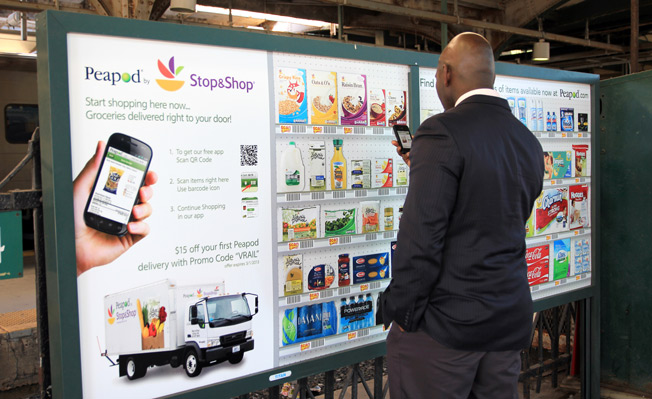
    The target audience for this display is those who lead busy lifestyles and don’t permit much time to complete daily necessities. This type of shopping is entertaining and even seems enjoyable. The user-friendly screen only requires a smartphone, the free ‘Peapod’ app, and a quick wave over the bar code to scan the image above it. Instant groceries are right there, only a scan away.

    Needless to say, advertising is making some huge improvements in their promotion of products via billboard ads. The article 40 Absolutely Brilliant Billboard Ads displays images of some of the most recently developed billboards which have been highly effective.It seems that Outdoor Advertising is finally reaching new heights in creative presentation, communicating to the public that they are something worth looking at!

    -Katelyn Alston

  • March Madness = Advertising Mayhem: The competition is heating up!

    The brackets are in! For all you college basketball fans, March Madness has officially begun. According to USA Today, the NCAA basketball tournament brings in more TV advertising revenue than the NFL playoffs and even the Super Bowl, reaching a whopping 1 billion dollars in 2012. Columnist Bruce Horovitz says it will only get bigger. Despite your feelings about the teams and the games they are playing, this can only mean one thing for advertisers: the standards are skyrocketing. A 30-second spot during the college basketball championship game is running at about 1.4 million dollars. With a price like that, we can only expect some crazy, entertaining commercials.

    Just as many big-name brands come up with new advertising campaigns for the Super Bowl, they will have to step it up even more this March. The credit card company, Capital One, has already begun to roll out their campaign partnering with Charles Barkley and Alec Baldwin as the faces of their commercials. While the ads are pretty funny, I think Capital One could step it up a notch in the creativity department for the big game. Here is a clip of one of their new spots you may have already seen on the air:

    According to Forbes magazine, Capital One is also advancing their campaign by adding the hashtag #rallycry to the end frames of their advertisements to keep the conversation going, targeting those passionate bracket participants. I think this is a smart decision, from an advertising standpoint, as Capital One has really kept their target audience in mind.

    As for other brands to look out for when you’re watching college basketball this month are Buick, Acura, Dove Men+Care and ING, all of which will be advertising heavily during the NCAA tournament. To quote Dale Buss, columnist for BrandChannel.com, “Let the madness begin.”

    -Julia Tompkins

  • The Next Big Thing… Coming Soon.

    Have YOU had the Cool Ranch Doritos Locos taco yet?  I can’t say that I was waiting anxiously outside of my local Taco Bell on March 7th when this new wonder debuted, but millions of taco fans could barely contain their excitement.  Not convinced?  Follow Taco Bell on Twitter or Facebook and you’ll experience the overwhelming response.  On March 4th Taco Bell announced via social media that fans could get the new Cool Ranch DLT (Doritos Locos Taco) a day early and the response was a mix of joy and outrage.  Many fans hopped on the chance to indulge while others were shocked to discover that their local chain had not gotten the memo.

    It seems that Taco Bell knows exactly what their fans want and have aimed to deliver.  In fact, the franchise has focused their advertising for the new DLT on their fans.  Working their fan base, the earliest announcements of the new taco came in the form of teasers, meant to fuel the DLT craze and build anticipation.

    Next came a series of ads featuring tweets from fans about the new taco sensation. Since the rise of social media, companies have been able to receive more direct feedback from their fans and have taken advantage of this in their ads.  Through these ads Taco Bell is not only able to highlight fan comments, but also feature these fans in the ad, emphasizing their delight in finally having the Cool Ranch DLT.


    Starting to sound familiar? You might be thinking back to the iPhone 5 and Apple’s promise to finally deliver all of the features that fans have been anxiously awaiting.  So is this new, fan-based advertising genius or overdone?  That’s up for us as consumers to decide.  After all, gone are the days of simply consuming advertising.  Today, we can all be a part of the magic behind the ads.

    Ally Walton

  • “Eight Glasses a Day”

    Lately, companies have decided to start selling a product within the realm of “water enhancing” powders. The Kraft Foods company is doubling down with a liquid water enhancer aimed at a younger demographic. Their slightly expensive product is called MiO, and it has been marketed to appear cooler than the plainer Crystal Light packets. Starting from the packaging, MiO comes in a small, drop shaped, portable container, which makes it easier to use in any quantity. In fact the product’s slogan is “Add a little or a lot!”

    Image

    Crystal Light has recently introduced its newest product, Crystal Light Liquid. It seems like a better tasting, healthier take on the MiO brand concept. Just like MiO, Crystal Light Liquid is a liquid drink mix that one can add to any glass or bottle of water, eliminating the mess and the science of powder drink mix. There are currently six favors to choose from, including Strawberry Lemonade, Blueberry Raspberry, Iced Tea, Mango Passionfruit, Peach Bellini, and Pomtini. Not only are the mixers 0 calories, they are also gluten-free. It’s Crystal Light’s way of saying that one can now “indulge in all your favorite flavors without the added calories.” In addition, its compact packaging makes it easy to take anywhere on the go.

    I think Crystal Light has done a better job advertising their product. I specifically like their television commercials for it, because they are quite interesting. They feature several glasses of water; each with a different amount of the liquid mix in it, while in the background there is a woman’s voice saying “I like to think of myself as unpredictable”. There are other similar commercials with the woman saying other things about her mood or personality. The idea is that one can put in as much or as little of the mix as they want, to suit whatever mood they may be in. “Six Flavors. Zero Calories. Endless Possibilities. For Every Shade of You.” This is an interesting angle to sell to people because they no longer have to worry about how much powder mix to put with a certain amount of water. Instead, the consumer is in power and gets to be the master mixologist. MiO’s commercials are these awkward commercials with these crossbreed animals engaged in conversation. I think it was supposed to be a unique idea targeting a younger crowd, but for me it was a complete miss.

    Image

    Although MiO gets credit for the originality of the idea, it appears that Crystal Light is firing back full throttle with its own, unique twist on advertising it. Not to mention Crystal Light is already has its common household name to back it up. Which do you like better? Find out for yourself.

    Jay Reilly

  • Advertising Outside of the Digital World

    Advertising can virtually take place through any medium, but today the forerunners are through television and the Internet/social media. With all sorts of different technologies available to us, other forms of advertising have nearly become obsolete. So the question is: how do these mediums stay relevant in a culture dominated by technology/digital advertising? When I was deciding what I wanted to write this post on, I did some scanning on the Internet (I know… ) to get some ideas. I came across some really interesting articles that sparked this notion in my head.

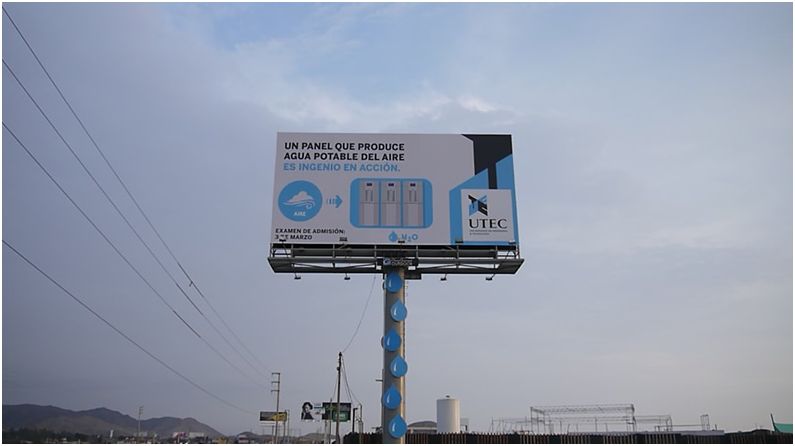
    The first article I came across was about a billboard in Lima. Lima is situated right next to a desert, and the average rainfall per year is only about 1.1 inches. Being a coastal city, Lima does have one good source of water in the air, which can reach up to 98% saturation some days. Given this information, scientists and advertisers in Lima teamed up to create a billboard that would harness this damp air and convert it into drinking water for the citizens of Lima. The billboard is able to generate about 25 gallons of clean drinking water a day. So not only is the billboard receiving high traffic, but it is also providing the service of clean water.

    Image

    On a completely different note, across the world in Dubai, Fanta and advertising agency OgilvyOne created the world’s first ‘tastable’ print advertisement. The advertisement encourages the consumer to quite literally tear a piece of the advertisement off and take a taste, in order to promote the new orangey flavor of their soda. Although some may be hesitant to actually taste the advertisement for a number of different reasons (germs, etc.), it is certainly receiving an abundance of attention throughout various other mediums, such as articles, blogs, and word-of-mouth.

    And lastly, bringing it back home to the United States, a few weeks ago HBO placed an advertisement in the New York Times promoting their television show “Game of Thrones”. The advertisement covers two full pages and features the shadow of a dragon over ‘fake’ stories that are actually relevant to the show. HBO placed similar advertisements on their own building in Los Angeles and on websites such as IMDB.com.

    Image

    It is refreshing to see that there are companies out there still using other advertising mediums besides just television and the Internet/social media. Also, I am relieved to see there is still some creativity and thinking outside of the box left in the world. In the end, it will be these advertisements that will be remembered, regardless if they were successful or not, because of their uniqueness.

    Callie Fenlon

  • Are You Getting Scroogled?

    Beginning March 1st, Google will be implementing a new privacy policy which will affect all of its products/services offered in order to gain a better perspective of their consumers and give them a more personalized experience. With the new privacy policy, Google will be able to gain more access to personal information by pulling material from all Google-operated services/products, such as E-mail, and using that information to create personalized advertisements to the user. This idea is similar to the one discussed in our earlier blog post titled “Not to Burst Your Bubble….”. With a better understanding of their users, Google will better be able to sell advertising, which in fact, is a main source of revenue for the company. Also, advertisers will be willing to spend more money with Google, if Google is bringing them more customers.

    This privacy policy change has certainly upset a number of people, but it might be safe to say none like Microsoft, a competitor of Google’s. Within recent weeks, Microsoft has released a number of advertisements via print and YouTube blatantly attacking Google and its new privacy policy. With the headline, “Have you Been Scroogled?”, and the advertisements tearing the privacy policy to shreds, it’s hard for one to not compare these advertising campaigns to those of the presidential elections.  It is unclear what the purpose of the advertisement is until the very last couple of seconds in which the Microsoft Outlook logo is revealed. There is even a website dedicated to the campaign. Upon visiting, the user is given the option to sign a petition against Google and the option to try Microsoft Outlook. The irony behind this whole situation is prevalent in several ways. First, Microsoft is placing these anti-Google advertisements on YouTube. Second, when searching for “Microsoft anti-Google ads” through the Google search engine, the websites provided where splattered with banner/marginal ads for Microsoft. When performing this same search through Bing (a search engine owned by Microsoft), the websites provided had shown ads sponsored by Google. This pattern resembles the concept of a “strange loop” within the Coordinated Management of Meaning theory. According to Littlejohn (1999, in Theories of Human Communication), these occur when “the rules of interpretation change from one point in the loop to another, causing a paradox, or strange loop, in which each contexts disconfirms the other”.

    http://www.scroogled.com/

    As of now, a little less than 10,000 people have signed the petition, which is only a small fraction of the G-mail users, and the YouTube advertisement have received far more “dislikes” than “likes”. Maybe this strategy isn’t as successful as Microsoft had hoped it would be. With Google being the most popular search engine, it is going to take more than that to persuade its users to up and switch to Microsoft. What does this say about Microsoft as a company? Will this be the new advertising technique of the future? Will we no longer see companies like Coke and Pepsi beating around the bush but rather taking deliberate stabs at one another? Only time will tell, but it will be interesting to see where the rest of Microsoft’s campaigning takes us.

    Callie Fenlon

  • S.O.S.

    The night has progressed and you are about to make your move when the inevitable question arises, “do you have a condom?” This is the premise that Durex has based their new campaign on. The S.O.S. campaign is an “app powered” one-hour condom delivery service discreetly operating between 4pm and 4am. When one first runs across this ad they may think it is a parody, but this is a service that already exists in certain cities, such as Dubai. The company plans to further expand the campaign to more cities. In today’s busy world, everyone loves a delivery service. How else would we get our last-minute pizzas, packages, flowers…condoms? The new Durex campaign, launched by the Buzzman firm, is ingenious and definitely outside the realm of normal advertising. The unique aspects of this campaign clearly exemplify why this firm has been credited with the development of captivating campaigns in the past. Future endeavors should not be far behind when examining their exciting new usages of message, labels, and systems.

    S.O.S. (short for “Save Our Souls”) is globally recognized as a distress signal. Viewing the YouTube commercial on Durex condoms it is evident that the sense of urgency, emergency, distress (if you will) associated with an S.O.S can easily be transferred to something less immediately life-threatening.  It was genius to associate their entire campaign on the premise that this product and service is not only a service people may want, but a good they most definitely NEED!  The name itself alerts potential consumers of this product to the fact that it could be important for their lives.  Buzzman of Paris is the firm credited for the original development of this campaign, which may explain why Paris is the leading city in votes for implementation of delivery service (or is it because Paris is truly the city of love)?  Either way there is definitely potential for geographic growth.

    sos_condoms

    http://www.sos-condoms.com/

    Not surprisingly, YouTube is a vehicle for advertising both the product and service.  Social media is being adopted by most modern businesses as a way to connect with audiences on a personal level which allows them to identify and solve the needs and wants of their target audience. The sensual and provocative usage of filming in the commercial fits perfectly the “edginess” that the campaign strives for, while remaining appropriate to the standards of social media. Not only does this medium provide unlimited amounts of information, it builds brand image and is yet another way to gain valuable information about its consumer.  A win-win for Buzzman,Durex and the customer!

    Retailing is the sales of goods and services from businesses to the end users. Durex, in this retail plan, concentrates on its brand image and loyal consumers for selling the product itself (the condom) but this plan furthers the retailing process by integration of a new supply chain of their product.  Rather than purchasing their products by the counter at a pharmacy, or even online, the timeliness and personal service is considered.  Why should pizzas be the only show in town?  Condoms have hit the big time in this retail venture.  It should be interesting to see how this takes off.  The worst-case scenario is that Durex gets people talking, and their condoms “protect” Buzzman’s reputation for fresh ideas.

    – Zach AbramoCallie FenlonLauren Habig,  Alexandra HussMichael Nunes,Daniel Schaefer