Blog

  • Anything you can do, I can do better… and cheaper!

    In the world of sports, it is never a surprise to see Gatorade as a major sponsor. Their product has been placed into events including NHL games, the MLB home run derby, and the Super Bowl. With that being said, not seeing Gatorade as one of the official sponsors of the 2012 Olympic games in London was a surprise. The reason for Gatorade’s absence in the 2012 London Games is because Powerade, a product of Coca-Cola, bought the sponsorship for over 100 million dollars and blocked Gatorade out. Gatorade did not fret when they were faced with this challenge. Instead of accepting defeat and letting Powerade run all of the sponsorships and advertising, Gatorade decided to respond with a commercial of their own.

    In this commercial, Gatorade not only openly states that they did not sponsor the 2012 Olympics, but also to spin it into an extremely effective advertising technique. They portrayed the overall message stating that they were not there on the billboards and buses, but instead they were there “for real” inside the best athletes in the world. Gatorade did an excellent job in embracing the fact that they could not officially sponsor the event, but still being present in the advertising and overall experience of the event

    In accordance, Powerade also plays an interesting role in their advertising by pointing out the fact that you may not know the athletes that they sponsor. This brings another aspect to the table that can be compared directly to Gatorade. Everyone knows the big time athletes like Derek Jeter, Tiger Woods, and Usain Bolt who are sponsored by Gatorade; but there are few people who are familiar with the athletes that Powerade sponsors. Powerade decided to base their commercial on the athletes that are not as famous, but the underdogs of the world.

    Coca-cola spent over 100 million dollars to sponsor the Olympics and Gatorade attempted to catch their audience’s attention with one commercial. The bigger the risk, the bigger the pay off, right? So what do you think… did Powerade come out ahead?

    – Alexandra Huss, Caroline Merrill, Alyssa Morrello, Lauren Van Trigt, Dann Williams

  • Has the Branding of Humans by Companies Gone Too Far?

    Marketers and advertisers have been getting more and more creative with how they choose to promote their brand and products. A recent trend has been the one of the “walking billboard.” Many people have been willing to brand almost any part of their body for the right price.


    In more recent years, tattoos have been seen as both as cultural icons as well as innovative methods to deliver a specific message. Web sites such as LeaseYourBody.com, TatAD.com, BodyBillboardz.com, HumanBanner.com, and LivingAdSpace.com connect brands and potential advertisers with individuals who are willing get “branded” for money.

    Many popular brands such as Volvo have used these creative tattoo advertisements to further promote their cars. Linda Gangeri, national advertising manager of Volvo Cars of North America, said their tattoo man was a way to get people to think differently about the Volvo brand.  Being a “walking billboard” is an extreme example of how people are being used to creatively advertise for brands in today’s society.

    There are less permanent and drastic ways in which someone can brand themselves for a company. Clothing is a great example. Clothing will always be a great tool for human branding because it is one of the first things we notice about the appearance of others.  In recent years, there have been rumors circulating that Abercrombie and Fitch pays individuals to come into their store and shop whilst wearing their clothes.  Even more recent are the allegations that the company has done the exact opposite as well. In 2011, the company reportedly offered the cast members of MTV’s “Jersey Shore”, specifically Mike “The Situation”, to not wear their clothes while filming the popular TV series. They felt that the cast members wearing their clothes affected their brand negatively rather than positively and did not want to be affiliated with the show. Clothing is also largely used by brands that are not restricted to apparel to benefit both the clothing store, and their own brand. For instance, the clothing store “Hot Topic” sells a variety of different t-shirts from many different companies. One of the big examples is the “Twilight” series. By selling shirts that relate to the book or movies, the people who buy these shirts then become walking billboards for both “Twilight” as well as “Hot Topic”. Clothing has been and remains to be a great tool for human branding for the simple fact that in society, appearance really does seem to be everything. If someone is attractive and is wearing a t-shirt that promotes something, most people that see this person are likely to be influenced by what is being advertised on the shirt.  The “Legalize Gay” shirts from “American Apparel” are a great example. Not only does the shirt promote a cause, but some people even think it’s trendy. This caused the design to become a quick success for “American Apparel”.

    Along with self-branding through choice of apparel, companies use celebrities to promote their brand by paying them a great deal of money to wear their clothes, jewelry, hats, sunglasses, etc. In 2003, famous tennis player Serena Williams signed a sponsorship contract with Nike which agreed to pay her over 8 million dollars a year just to wear Nike’s logo on her uniforms and visors while playing. Not only is Serene getting paid; she does not even have to buy her clothes from Nike because they are given to her. The better and more popular the athlete, the more money companies choose to invest into that particular person or team. Tiger Woods is another athlete that has been ridiculous sums of money just to wear and boost certain brands. Before his sex scandal, Tiger allegedly made between 55-60 million dollars from endorsements.  After, the controversy, he makes about 20 million less, but still an incredible amount of money just to wear Nike apparel.  This marketing strategy applies to fashion and luxury brands as well. On the “red carpet”, interviewers are constantly asking who designed celebrities’ dresses or what brand of jewelry are they wearing. Throughout the past couple of years, the number of film stars that accept fees for wearing a brand’s designs or jewels at the Academy Awards and other red-carpet events has significantly increased. Lucie Greene, the author of many articles located in FT Magazine, stated that “last year US Weekly reported that Oscar host Anne Hathaway was paid $750,000 by Tiffany & Co to wear its jewels throughout the ceremony. The same story said that Gwyneth Paltrow was paid $500,000 to wear Louis Vuitton baubles during her live performance” that same night of the Oscars. Businesses are looking for every possible way they can find to market their brand and increase sales and participation. Phillip Bloch, a professional stylist who works with the popular celebrity Sandra Bullock, along with many other famous clients, views this pay-to-wear trend a smart branding strategy. “It’s a business more than ever now”, Bloch says.

    Over time, the ways in which people are used to promote and essentially brand a company have evolved.  While clothing has been around for quite some time, the creative ways in which it is used has been changing in recent years.  Celebrities have been used to wear a brand and increase revenue.  As notes, extremes such as being a “walking billboard” have become more and more prominent.  As is natural in a social setting, people are extremely influential upon one another.  Thus starts the argument that as technology develops over time, the ways in which humans are used to advertise will as well.

    Sasha De Vecchi, Lindsay Gallagher, Jay Reilly, Cary Welborn

  • The Twilight Saga Continues

    There was once a time when the word “vampire” was associated with fear, scary movies, and evil. No one wanted to be a vampire; they wanted to hide from vampires. Over the past few years words associated with vampires have been more along the lines of “sexy,” “exciting” and “cool.”  Many people believe you can trace these changes back to Twilight, the book series that was turned into a movie in 2008. Stephenie Meyer, the author of the Twilight saga, completely altered the image of a typical vampire around. Vampires used to be portrayed as terrifying people who would only come out at night, slept in a coffin, and had skin that looked almost grey.  Meyer portrayed vampires as suave, fashionable, intelligent, and desirable. Instead of being harmed by sunlight, Twilight vampires simply sparkled when they were in the sun.  Young girls across the country swooned over Robert Pattinson when he became the star of the movie series. Many women even stated that they wanted to become a vampire.

    Since the first Twilight book hit bookstores back in 2005, this romanticized idea of vampires escalated into quite the fad in the entertainment industry. TV stations began to make their own spin offs of the vampire stories. Two of the most notable vampire shows are HBO’s “True Blood” and The CW’s “The Vampire Diaries.” Both of these shows took hold of the idea of vampires having a vast amount of sex appeal. The casts are made up of attractive young men and women who spend a lot of time in romantic relationships with one another. Men and women alike are attracted to the vampires depicted on their television screens. These shows market vampires and their lives as being sexy, as you can see in the commercial for season 2 of The Vampire Diaries.

    TV producers saw the craze that the Twilight book and movie series created and took Myers’s idea and ran with it.  True Blood and Vampire Dairies have also created a strong audience that is keeping the Vampire trend alive.  These shows have not altered the image of vampires quite as much as Twilight did, rather they have definitely brought more attention to the vampire trend in the United States. Will these blood-suckers continue to be sexy and desired by all, or will vampires go crawling back to their coffins and return to their more spooky origins?

    Jessie Butner, Meaghan Beam, Jack Lane, Zach Abramo

  • “The Final Installment”…Part 1…Part 2…Part 3…

    If you’re like most true bibliophiles, the idea of turning your favorite book series into a movie may raise your skepticism flag.  In (fairly) recent years, as the film industry inevitably runs out of original ideas to produce, we have witnessed many of our favorite book characters come to life on the big screen. Generally speaking, response to this phenomenon is varied; some people love seeing the stories play out before their eyes and others bemoan every little discrepancy between the two forms.  Regardless of this fact, more and more book series are being turned into movies every year, and people don’t seem to have a problem paying to see them. These films are attracting the “original” series lovers as well as viewers who have never read the books (but don’t have to now…how convenient).

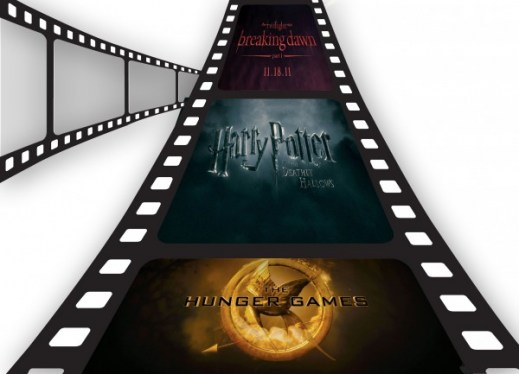
    Recently, we’ve seen many of our favorite Young Adult book series arriving in theaters across the country. Some of the most notable series include the Harry Potter books, The Twilight Saga, The Lord of the Rings Trilogy and, most recently, the Hunger Games Trilogy. Something interesting to note about these particular series is the book-to-movie ratio… all of the above have (or will have) one extra movie added to the lineup. When Harry Potter fans found out that the 7th movie of the series, The Deathly Hollows, would be one of two eventual installments, reactions were mixed amongst book and movie fans alike. However, in 2011 when The Deathly Hollows part 2 was released, Americans spent more than $169,189,427 (according to IMDB.com) for tickets on the opening weekend alone. This illustrated an extreme willingness of Americans to participate in the expansion of a well-loved entertainment franchise.

    The innovative idea of splitting the final movie of a series into two parts continues to grow in popularity.  The last book of the Twilight series (Breaking Dawn- due in theaters November 2012) and the Hunger Games (Mockingjay – part 1 is scheduled for release in 2014, part 2 in 2015) will be broken into two parts as a movie. While the Lord of the Rings trilogy is affirmation that if producers really try, a three-part book series can be effectively made into a three-part movie series, creators have probably recognized that they missed the “cash cow” on this one. The Hobbit,which originally preceded the trilogy in book form, will be released in December of this year and (you guessed it!) it will be coming out in TWO parts

    .

    Whether you love the idea of even MORE of your favorite series becoming available, or you resent that fact that you have to wait YET ANOTHER year to see the completion of the series it is hard to refute that this technique is extremely effective. It’s enjoyable, convenient, and logical (I’ve already seen the first 7 movies…what’s one more?). So sit tight! The end of your favorite series will be coming EVENTUALLY to a theater near you!


    Lauren Habig, Hannah Eure, Erin Kiffmeyer, Ally Walton, Gene Lee

  • “The Evil Empire”

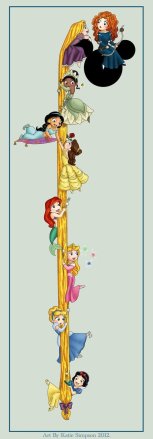
    When we were growing up, Cinderella taught us how important faith can be, Snow White taught us how important friends are, and Sleeping Beauty taught us how important following our dreams can be. However, the upcoming generation is growing up with extremely different Disney princesses than we knew. What began as the princess trifecta of Snow White, Cinderella, and Sleeping Beauty, has turned into nine princess movies all representing different images and values to the next generation of children. There is a question raised by many of whether or not the Disney princesses are teaching children the right lessons. Some have even ventured to ask: Is Disney really the evil empire?

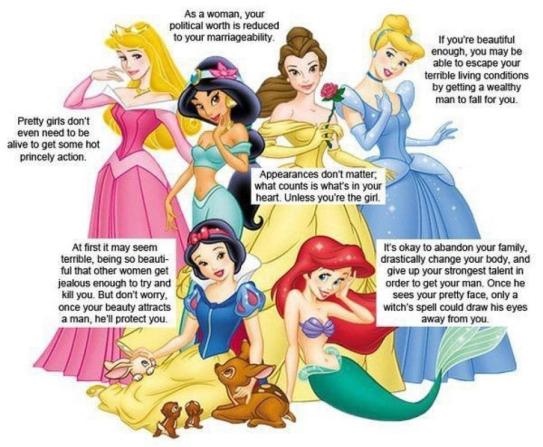
    As a brand, Disney has faced harsh criticism from the feminist movement due to the way they have portrayed women in the past. A recent meme surfacing all over the internet that de-glorifies the Disney movies from fairy tales to poor life lessons. For example, Belle is described as just a pretty face and the meme insinuates that the Beast only fell for her because of her looks. This is an oversimplification of Belle’s character as the Beast falls for her not for her looks but her intelligence, caring nature, and personality. However, the meme is not entirely wrong as not all of the early princesses are portrayed in such a dynamic manner as Belle. Cinderella and the prince barely shared a dance before they fell madly in love and Ariel ditched her entire family to marry her prince.

    In order to help manage their image, or perhaps in attempt to keep up with the times, Disney took on the challenge of making their newer princesses more dynamic and stronger female leads. Disney also released an African-American princess after receiving criticism for not having enough diversity in their fairy tale stars. An idea they really try to communicate with their new princesses is that princesses do not have to be damsels in distress. In Tangled, Rapunzel takes charge of her own life by disobeying her “mother’s” wishes. In the process, she discovers her real family and her true love. This could be seen as Disney’s ode to following your heart with more action than Cinderella took. However, the movie openly references alcohol blackouts, violence, and criminal behavior. Is this Disney trying to appeal to an older generation or avoid seeming old fashioned and out of date? Either way it wasn’t entirely in line with the identity of their prior princesses. Is this a new kind of Disney Princess we are seeing? Or a fluke straying from what Disney really represents?

    – Alexandra Huss, Caroline Merrill, Alyssa Morrello, Lauren Van Trigt, Dann Williams

  • Hollywood’s Attempt to Stay Alive: The Era of Movie Remakes

    In the recent years, a surplus of movies and TV show remakes has been surrounding society. From examples such as “Footloose” and “21 Jump Street,” it seems that producers are running out of gas and dwelling on the idea of making past success future successes as well. Remakes are nothing new and in some instances, can be even better than the original. This has also held true within the music industry due to a variety of songs being revamped and remixed by more recent artists.

    With a currently unstable economy, Hollywood is no exception to the “Remake Era” that is upon us. Directors and producers are sticking with older titles and storylines that have proven to be profitable.  Remakes have become a lower-risk tactic that ensures a steady purchase in ticket sales, which leads to a higher profit.  In fact, according to New York Magazine, next year, one in three movies will be based on previously published or filmed material. People will show up to watch a title they already love or have an emotional connection with. If it is good, it brings them joy and allows them to reminisce.  On the contrary, if it is bad, it rekindles a nostalgic flame within them.

    In addition to completely remaking movies, the film industry has also been re-releasing movies in 3-D. Films such as “Titanic” and “Finding Nemo” have endured incredible success and in return have made their way back to the big screen. They are essentially the same movies that were in theaters years ago except that they are now three-dimensional. Some people are marveled by this twist, but others may think this tactic is a little flat and almost lazy. Instead of coming up with new and thrilling ideas, they are releasing movies they predict are going to be making money, because they already did in the years prior. The idea that they are new and exciting just because they are three-dimensional may be a bit of a stretch, but consumers seem to be buying into it.  “Titanic 3-D” grossed 25.6 million dollars in sales the first week it was in theaters, adding to the 1997 overall sales of 1.84 billion.  While this is extremely successful, the movie still fell behind both “American Reunion” and “The Hunger Games” during the first weekend it was shown, proving that remakes will not necessarily boast the same success as original versions.


    Movie remakes aren’t an extremely new idea, but they seem to have become more prevalent in recent years. Hollywood is trying desperately to maintain to stay alive and profitable by focusing on films that feature accustomed titles and brands.  There has been even more pressure to do that recently due to the lack of different movie ideas as well as the unstable economy.  Basically, most Hollywood filmmakers believe that “fan reminiscing” can be its own brand of effective marketing. As time passes, new ideas and evolving technology allow older movies to be redone to reach their full potential.  Even if these movies are more technologically inclined, some fans want more out of a remake. Some directors are even resorting to creating new versions of movies that are already remakes, which hints that Hollywood is simply running out of new and profitable ideas. In result of this, the term “remake” is often being associated with a negative connotation.  Also, many older movies are viewed as a “classic” and people are hesitant to see change in such movies.  An example of this would be the remake of “E.T” that has been released this year.  This is a landmark movie from thirty years ago, and many people do not like the thought of it being redone to include the technology of 2012.

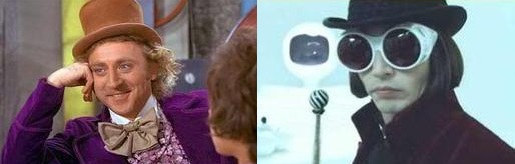
    Another great example of a drastic remake is “Charlie and the Chocolate Factory”.  Many fans were outraged by the 2005 remake of the 1971 masterpiece.  While the movie was very created and technologically advanced, many people enjoyed the simplicity of the original version.  While this is all open to interpretation and based merely on opinion, many can agree that it is a lot harder for fans to openly accept a remake when they loved the original version.

    In today’s world, new and exciting story-lines are hard to come by.  While revising original versions can deem profitable, there are consequences to be considered.  Reactions of audiences that enjoyed original versions can be an issue as well as gaining support from people that did not like the original in the first place.  Also, these movies can be successful from a financial point of view, but it is not likely they will be as successful as the original was.  Regardless, we will not be escaping the “Remake Era” any time soon, which is evident by the fifty remakes that were made in 2012 alone.

    Sasha De Vecchi, Lindsay Gallagher, Jay Reilly, Cary Welborn

  • Are You Checked In?

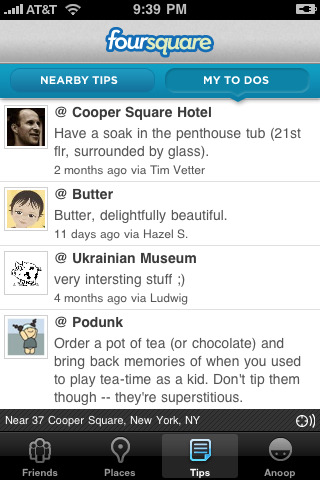
    Social media has created a new obsession with knowing what everyone else is doing and where they are at all times. Foursquare takes this obsession to a whole new level. Users of Foursquare check in to various places, comment on their service or products with tips for other users, post pictures, and gather points to become the “mayor” of their favorite restaurants or stores. There are currently over 25,000,000 people who use Foursquare to connect to places and over 1,000,000 businesses.

    ImageBusinesses take advantage of this social media site in order to brand themselves and attract new customers. Foursquare offers several free methods to improve the buzz about a brand. A business can create updates to local users by uploading pictures of specials or events that are taking place at their location. They can also offer discounts specifically to users. For example, Chick-fil-a offers free chicken minis the first time you check in. Some local businesses offer 10% discounts on the first purchase. Sports, non-profits, entertainment, and music can also utilize Foursquare to get their name out to potential fans. The television network Bravo has a page to share tips from individual Bravolebrity’s about locations they frequent.

    Image

    Although many businesses benefit from using Foursquare, there is also a risk of costumer’s damaging your reputation. Users can leave tips for their friends or strangers about whether or not the product is good. This uncontrolled form of advertising can be very dangerous. On Best Buy’s page, tips range from “make sure the people who work there know what they’re talking about. The TV department there lacks in this area” to “Dig the environment!!” Tips left by customers can be read by anyone looking at your page and have the ability to either damage or build your reputation. Businesses are unable to defend themselves or respond to these tips.

    Businesses considering joining the Foursquare network must weigh the pros and cons and consider the risk of bad tips. With over 25,000,000 users and growing, businesses can get their brand spread to new and potential customers and create hype about exclusive Foursquare discounts. Do you think it is worthwhile for businesses to jump on the Foursquare band wagon?

    Jessie Butner, Meaghan Beam, Zach Abramo, Jack Lane