Blog

  • White House Ballers

    With the re-election of President Barack Obama there is one sport that is overwhelmingly happy that he is staying another four years, and that sport is basketball. It is obvious to all that President Obama loves basketball and is more than happy to use his influence to help spread the game. It is well-known that he likes to fill out the NCAA March Madness brackets that everyone goes crazy for and is surprisingly good at it. Like most major sports, the NBA  championship team gets to visit the White House and meet the President for a photo-op. Obama,of course,  isn’t complaining since he is a huge NBA fan and has been to several games during his Presidency. Never before has a President been so involved with one sport that he can call upon the biggest name athletes in the NBA to come help him out at different charities and fundraiser events at any point in time and they will come running. For example, in this election year, Michael “Air” Jordan hosted a 3 million dollar fundraiser for President Obama in New York and had NBA players like Carmelo Anthony, Rajon Rondo, Kyrie Irving, Joe Johnson, and Paul Pierce in attendance to play some hoops. With so many NBA superstars on his side he gets a good amount of publicity and respect from basketball fans all over the country. Obama is so integrated into the basketball world that the video game “NBA 2k13” has him show up as a character in the game to greet you at the White House when you win the championship in the game.

    Obama in 2K

    This is great publicity for the Commander-in-Chief, as basketball fans everywhere will see the President’s face every time they win the championship.  He may be the first President with the ability to advertise in a video game just because he loves the game of basketball so much. On election day he even plays his now-traditional “Election Day” basketball game with several big name NBA stars and a variety of White House aides. We think it’s safe to say that many basketball fans and basketball console gamers will be seeing more of President Obama the next four years.


    Eugene Lee, Lauren HabigErin KiffmeyerHannah EureAlly Walton

  • Four More Years… of Media Frenzy?

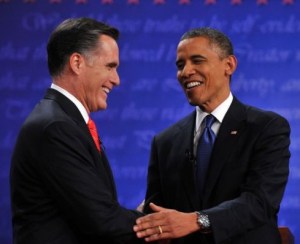
    All night long Americans were glued to their televisions or their computers anticipating the results of the 2012 Presidential Election. Around 11:20PM on Tuesday, November 6th America got their answer: four more years for President Barack Obama. Some celebrated and some cried. This election deepened the political divide between Americans unlike any other election. What made this election different from any other? The answer is the mainstream media bias.

    Even though Obama’s campaign team stood their ground in the battleground states, the real winner should be media outlets. Whether it was the presidential debates or the campaign trail, media coverage was everywhere. Does this increased access to information via the media mean we are better informed than we used to be? The mainstream media is our main source of information; we rely on them to know what is going on outside of our bubble.

    The question is… what happens when the media takes on a biased role? A major criticism of the media is that it isn’t just giving us information but also conditioning us about how to think about the issues. CNN and Fox News are criticized as two of the most biased sources in the market, and they are also two of the largest. This means the same story can be presented on both outlets but the facts included can persuade the reader to feel a certain way about the issue. This article from CNN states that Romney supporters were asking for Fox News instead of CNN when it became clear that Obama was taking the lead. This is good news in that it means people are aware of the biased, however, turning to a known biased source to get the story you want compromises the credibility of the information you receive.

    Media bias is everywhere. It is nearly impossible to get just the facts on the current issues. As informed consumers, this leads us to question how the bias impacts the general public. What happens when the public accepts the bias opinion as factual information? For one thing, the party divide deepens. A conservative tuning into Fox News sees his/her beliefs reaffirmed day after day, and the same happens when a liberal tunes into CNN. After a while, this can create a red and blue polarization. In some cases the divide has increased so much so that the two parties cannot begin to reason with the opposite side. Does this mean it is the media’s fault we have become so divided in our political views?

    Now that the election is over, it is time that we refocus our attention on the issues at hand in our country and work together for the greater good of America despite personal political affiliation. Is this still possible with such biased media? Regardless of who won, how do we now come together to do what is best for America? President Obama: the media will either provide a platform to cultivate support for your ideas, or tear every move you make to shreds. As citizens of this great nation, we are all rooting for you… the President of the United States of America.

    – Alexandra HussCaroline MerrillAlyssa MorrelloLauren Van TrigtDann Williams

  • The Importance of Social Media in the 2012 Election

    More and more are the variety of social media through which voters are able to use.  These are convenient and simple tools that are effective ways to express the opinions of voters and influence the course of the electoral campaign. The role that social media has been critical in drawing conclusions about the outcome of the 2012 election. According to various studies, websites like Facebook have caused an increase in voter registration. Ultimately, social media networks are the powerful influencers that are often capable of moving large quantities of votes. It is important to recognize that an electoral campaign that is closer and pays closer attention to real human dynamics has a completely different approach than the traditional campaign. Nowadays, an effective campaign should be based less on the money spent and more on the intelligent use of new technologies to create new bonds with the everyday voter.Ultimately, the roles of social networks, new media as well as the weight of the establishment are all factors that will have a crucial role in deciding the electoral dispute.

    As previously stated, social media has encouraged many young eligible voters to register and vote. For many of the past elections, the young demographic is not properly represented in voting. This year, there are record numbers for college aged students voting.  Much of this can be attributed to social media outlets.  Young people in general use social media more than any other demographic (to date). Also, social media websites such as twitter allow you to follow each candidate and get quick, short, and frequent updates on what they plan to make their policy be if they are to be elected. This is only the second election that we are able to follow Candidates directly on Twitter since it did not exist prior to 2006. Also, Twitter has gained a substantial amount of users since the 2008 election. On Twitter, there are trending topics, and subjects regarding the recent presidential election have been trending at record numbers. Social Media allows people to get quick and easy access to information about the election.

    Both presidential candidates devoted much time and effort to boost the collection of information and social media sharing amongst voters. In the current election, Barack Obama and Mitt Romney have predominately utilized Facebook, Twitter, and YouTube, which are the top powerhouse tools of social media today. As the election progresses, candidates have concentrated their efforts on “swing voters”. Swing voters are voters who have yet to make up their minds and plan to wait till the very last minute to make a decision about who to vote for. Social media can establish a medium for interchange between our presidential candidates and many of these swing voters, avoiding an influence on votes that have already been established.  This reveals the importance of social media and web video usage in terms of voting. Not only can social media institute this medium that allows a campaign to be specifically modified for particular voters, but it provides value for each candidate, resulting into fewer costs for ads. The cost of advertising through social media is much less than the cost of paying T.V. channels to run advertisements; not to mention the impact of online ads have been reported as just as good or perhaps even better than the ones shows on television. All political parties in the current election have greatly benefited from these recent online updates and social media enhancements.

    Sasha De Vecchi, Lindsay Gallagher, Jay Reilly, Cary Welborn

  • The End is Near…

    That’s right folks… election day is just around the corner! After a long year of campaigns taking over commercials, social media, and highway grass, it is high time the winners are decided. The question is: do you know who you will be voting for? If you find yourself in need of some unbiased information on the election, check out this non-partisan voter resource created by UNCW’s Media and Politics class! UNCW Know Your Vote is intended to help voter’s like you get the facts without the spin. Information is available on both the presidential and North Carolina’s candidates for governor. Along with links to fact checkers, mainstream media sources, and political blogs! Be sure to check it out and let us know what you think!

    -Alexandra Huss

  • “Dare to Soar”

    Colleges and universities are places that can unify people from all over the world.  They have sports, clubs, fraternities and sororities, honor societies and many other groups and opportunities to unify the student body.  Another way schools have started to unify people is with words.

    This year will be the first year with Gary Miller as the chancellor of UNCW.  When he was inaugurated in early May 2011, Miller brought with him a new way of thinking and a new school slogan: “Dare to Soar.”  With this new slogan, Miller wanted to try to echo the school motto, which is “dare to learn,” and bring students together in hopes of achieving higher goals than were previously set.

    Image

    Miller hopes that this new slogan will help build the UNCW brand.  The school already has a very solid brand because of its academic values and Miller hopes this new slogan will further better the brand name.  He hopes that this new slogan will show an aspiration to reach higher goals in the future and reflect the soaring growth of our school.

    As UNC Wilmington students, we noticed the attempt to unite the school and motivate the student body with words. There are many other schools which have created slogans that have utilized powerful words that were intended to convey specific messages to students, faculty, and the community surrounding these colleges. After the shootings at Virginia Tech, the school used the words “Together We Stand” to make sure that the students who had survived the horrific events could all unite to get through the tragedy.

    Some words have been associated with certain campuses for decades. Harvard University, for instance, has the word “veritas” written across the university arms. Originally, the phrase was long and dealt with the truth of Christ and the church. However, today the campus has changed the motto to simply mean “truth” and is a reminder of the morals and standards at Harvard.

    Image

    Many campuses attempt to bring these powerful phrases onto their campus to motivate and unite their students. The question is, do these words always create the campus environment that they are trying to create? Are these words really powerful, or are they just trying to be powerful? How long will the students remember these slogans and mottos?

    Zachary Abramo, Meaghan Beam, Jessica Butner, Jackson Lane

  • Just say anything to win.

    With the 2012 presidential election day right around the corner, the candidates have found themselves in a television battlefield. Each candidate hopes to take his opposition down by firing loaded words weekly. It seems that advertisements to vote for a candidate have instead evolved into advertisements to not vote for their competitor. Both the Obama and Romney campaigns have spent millions on these largely negative commercials that appear to be overflowing our televisions, especially in battleground states. As viewers being constantly bombarded by accusatory messages, are these presidential candidate advertisements doing more harm than good?

    Romney has recently received immense criticism for a misleading television advertisement that aired primarily in Ohio about Obama and the auto industry. The commercial states that Chrysler is moving Jeep production to China because of Obama’s failed policies, a claim that aimed to hit home with the thousands of Ohioans employed in the industry. Although Chrysler does intend on building Jeeps in China, it can be interpreted from the advertisement that Chrysler will stop making Jeeps in the United States and move all production to China. The Democrats’ response to Romney’s claim used blunt terms attacking Romney’s character. The claims were deemed as “outrageous assertions” and Biden even asked of their competitors at a rally in Youngstown, Ohio, “Have they no shame?”

    These responses may have successfully portrayed Romney as a “liar,” but Obama’s auto advertisement used some of the most biting rhetoric yet, according to The Detroit News. It emphasizes Romney’s “wrong-headedness on the auto bailout” (as cited from The Detroit News’ editorial page) but never mentioned the paper’s overall endorsement for Romney in the election.

    Every word in a speech by a presidential candidate is deliberately chosen. Each phrase in a campaign advertisement is carefully crafted. Nothing presidential candidates deliver is accidental, innocent, or meaningless. Politicians are most successful when their campaigning efforts communicate the precise message their audience wants to hear. But what happens when they will say just about anything to win?

    Erin Kiffmeyer, Hannah Eure, Eugene Lee, Ally Walton, Lauren Habig

  • Sandy Shopping Spree?

    As we watch the terrifying coverage of Hurricane Sandy hitting the Northeast, here in North Carolina we are thanking our lucky stars that we managed to escape the worst of it. However, there is one aspect about natural disasters that is challenging to escape: the advertisements. Among all of the advertisements directed towards helping those in need, there is one in particular that stands out all on its own. American Apparel, a clothing company notorious for its no-holds-bar approach to promoting their company, sent out an email blast Monday morning in an attempt to draw in online shoppers who apparently would be “bored” in the storm. This callous disregard of the life-threatening conditions that people are facing quickly went viral.

    Many people have taken to social media like Twitter and Facebook to voice their outrage at the lack of compassion American Apparel has shown for the victims of Sandy. Twitter users were quick to bring up the companies past marketing blunders including an attempt at a plus size model search.

    Needless to say, American Apparel knows how to stir things up. This advertisement was poorly worded at best, and completely ignorant at worst. Regardless, everyone is talking about the “Sandy Sale.” Is this a bad thing for American Apparel in the long run? There is a popular saying in our culture that “there is no such thing as bad publicity.” Part of what our professor, Dr. Persuit, teaches us in Integrated Marketing Communication is how to be thoughtful consumers. In order to do this, the marketing strategies American Apparel employ should have an effect on whether or not we decide to purchase their product. A year from now while you are perusing the mall and finding the perfect piece to complete your closet, will it matter if it happens to be an American Apparel item? Will this advertisement even pop into your memory or will you merely remember hearing something about American Apparel once upon a time?

    – Alexandra HussCaroline MerrillAlyssa MorrelloLauren Van TrigtDann Williams