Blog

  • High Fashion Hits Home: Dolce & Gabbana

    If there is one fashion name that has never been afraid to add a splash of culture to their line of clothing, it is definitely Dolce & Gabbana. They have already made quite the impression during this Spring’s Mercedes Benz Fashion Week, which began on February 6 and is currently going on until tomorrow. During this particular fashion week, D&G made the decision to advertise the entirety of their displayed clothing line as an Italian tourist department. Their goal is to gear their clothing to those who want a taste of the true Italian culture, while serving as an overall advertisement of the country of Italy itself.
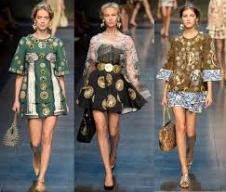
     images

    The decision to dedicate their Spring line to the Italian culture came from co-founder, Domenico Dolce’s wishes to include a taste of his hometown of Sicily, Italy. The team of designers wanted to bring archaeology of the Italian island to life, with its many layers of history, drama and religion. The other part of the collection represents the Greek ruins of Sicily, in all of its springtime beauty. Stefano Gabbana refers to this part of the collection as “a dream of Sicily.” The goal was to represent these different angles, and to invite people around the world to purchase a glimpse into this Sicilian lifestyle.

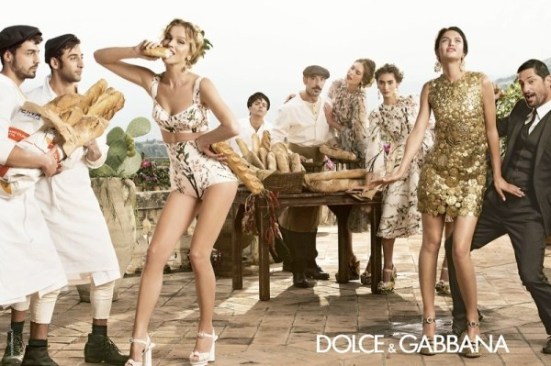
    The Italian theme of Dolce & Gabbana’s recent campaign is clearly depicted in their print advertisements. Each picture plays on stereotypes by humorously portraying the typical Italian culture (all in high fashion clothes, of course). Featured on-location in Italy, the photo-shoot captures the essence of a traditional Italian family, complete with the loud, boisterous women as the life of the party and their large families in tow.
    Dolce-and-Gabbana-Spring-2014-Ad-4-600x399

    Each advertisement exudes liveliness as models forgo their typical high fashion poses, and instead pour energy and Italian charisma into each shot. In the foreground, models can be seen wearing D&G’s new Spring collection, with fabrics and patterns that embody and were inspired by the Mediterranean’s local colors and Greco-Roman temples. The models also engage in stereotypical Italian activities, such as dancing, scorning their children, and buying goods such as fish and bread. Viewers are transported through the lens, across the world to experience traditional Italian culture in Dolce & Gabbana’s new campaign.

    DG PE 12_progetto donna.indd

    There is no doubting that Dolce & Gabbana have, in all their departments, uniquely used their cultural approaches to differentiate themselves in the high fashion world. The embedded concepts of history and culture will attract a vast variety of publics. Through their advertisements and on the runway, D&G have raised the high fashion bar, especially with competing Italian designers (Prada, Gucci, and Georgio Armani). Dolce & Gabbana’s Spring 2014 collection can accommodate any rendezvous a conservative woman may attend. They have taken a sort of “back road” approach which more than likely sells than other high fashion brands. They went for more doable than the over-the-top, un-wearable line that the average woman could not wear to any event.

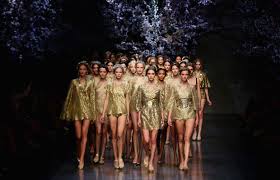
    Gabbana described the collection as “an unconscious dream,” in the sense that the clothes exemplified the blend of the real and the irrational that can only be found in dreams. The line is truly a dream and captivating at that. The Sicilian lifestyle has been opened for all to discover and enjoy through the D&G Spring 2014 line. The genius use of the culture of Sicily has provided limitless ideas of inspiration for Domenico Dolce and Stefano Gabbana, setting themselves apart from the rest of the high fashion domain. For the finale, the gilded army of women that strutted the catwalk offered another vision of female empowerment that has stirred conversations between other designers all week. Dolce and Gabbana have given the fashion world romantic maximalism at its best. The design duo’s cultural orientation without being too common or over the top. Innovative, not so much, but wearable, indeed!ewfew
    D&G have definitely grabbed our attention with their new look. Does adding a splash of culture make their line more desirable? Or do you think the typical “high fashion” is more successful on the runway?

    -Briana McWhirter, Emily Foulke, Hannah Turner

  • #VersaceLovesGaga

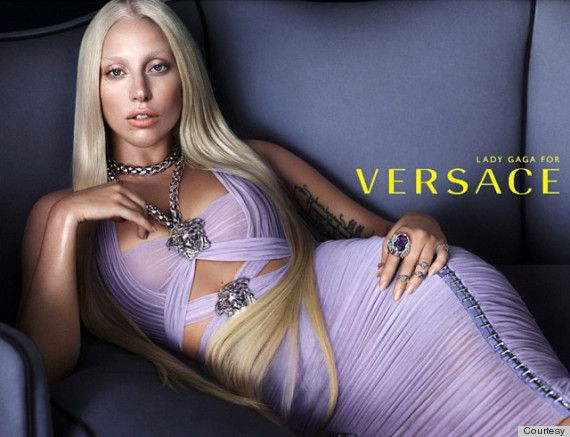
    Ever wonder what could happen if two fashion superstars like Donatella Versace and Lady Gaga got together?  They would open up a whole new world of consumers to both of their brands.  Versace is a well-known luxury clothing brand that been around since 1978.  The head lady in charge now is none other than Donatella Versace herself.  Although Donatella is distinguished as a talented designer, it’s her vibrant persona that makes her even more famous.  In recent years Versace usually went with non-famous models in their ad to focus more on the clothing instead of a celebrity name on it.  This spring fashion season Versace is trying a new campaign with Lady Gaga as the focus.

    This change up in the ad routine of Versace is very positive considering the social power these women have.   In leading up to this announcement, the two have been seen together everywhere.  This new well established friendship is great for the Versace brand.  Lady Gaga is a very influential woman not only in music, but in fashion.  When someone thinks of Gaga, their first thought is “I wonder what she’s wearing this time?”  She has a major advantage because of her power to expose this brand as much as possible.   Versace is thought of more as a mature brand, but with Lady G’s influence over a younger generation this can reel in a completely different group of purchasers then before.

    Lady Gaga is quite possibly a twenty-four hour ad campaign for the Versace clothing brand.  She is constantly being photographed in this brand that is then exposed all over the internet and in magazines.  She truly has embraced the product, she is being paid to promote to exact detail including her new Donatella look.

    Not only do these ladies have reach on tabloids, but their social media sites are a huge way to endorse the company as well.  The combined followers on twitter for Versace and Gaga is over forty-two million people.  The two are always promoting one another on various media sites, creating this whole new revolution for Versace. Including a personalized hash-tag for the Versace endorser herself, #VersaceLovesGaga.  This has been trending all over twitter, just proving how much influence she has also in the cyber world. This seems to be an extremely beneficial partnership for both brands and we’ll continue to see growth in Versace and Lady Gaga this fashion season.

    Melissa Shampoe

  • The Half-Naked Truth

    Sex sells products. Despite the moral implications involved, advertisers continue to rely on sex appeal and promiscuous behavior to sell products. Now it’s easy for us to recognize the problems that arise as a result, and you don’t need to be a Mississippi fundamentalist to do so. Sex is so engrained in our media that one cannot watch 15 minutes of television without being shown sex in some form or another. From an advertisers perspective sex is a very powerful tool, simply put, the consumer is human and inherently will become intrigued when viewing material related to sex. This trend is often times seen in fashion advertisements.

    abercrombie-fitch

    Many of us can remember walking into an Abercrombie store at some point in time and being bombarded with gigantic posters of half naked men and women. So long as humans have an inherent need for romance we will continue to gravitate towards depictions of the desired sex, much like a moth to the flame. So of course we must beg the question of ethicality rather than opening up our wallets whilst drooling like a Neanderthal. Well a business insider article did just that when they published an article entitled “13 Brands That Use Sex to Sell Their Products” and sure enough Abercrombie and Fitch was included along companies like American Apparel, Armani, Old Spice, and Axe Body Spray. Funny story I had a friend confide in me once that he was afraid to use Axe body spray as a child because he thought it would turn on his mother and sister. The ethicality of high-powered pheromone mists is next week’s subject matter.

    Recent attempts to woe consumers can be seen in advertisements of the past Superbowl, specifically in regard to David Beckham’s appearance in the H&M commercial. In the commercial viewers are asked to tweet either #covered or #uncovered while watching David Beckham prance around in his underwear. As a heterosexual male even I can tell you that it is very effective.

    Fashion companies have found a prosperous way of communicating their brands to their target audience because they know what message will resonate with the audience. Not only does sex resonate, it helps to bring in a higher average of gross income per year for the more frequently advertised and credible fashion lines. One can’t help but wonder whether the value of popular fashion brands would depreciate if the sex appeal approach was no longer used in advertisements.

    Austin Johnson, Jade Lester

  • Marc’s Makeover: Marc Jacobs’ decision to rebrand… is it the right one?

    Deciding whether or not to rebrand your company is an immense decision. Your brand is the face and personality of your company. It is what viewers connect with. Changing this identity will greatly affect your company, but if done right the market can soar.

    Fashion designer Marc Jacobs has decided it is time for his company, Marc Jacobs International to rebrand. In an interview with David Amsden from W Magazine Jacobs explains the troubles the Marc Jacobs brand had encountered. Describing the brand as having been “diluted” from his lack of creative supervision and merchandisers pushing his design team.

    In order to fix this Jacobs decided to leave his position at Louis Vuitton to grow his company, which includes boutiques, clothing lines such as Marc by Marc Jacobs and Little Marc Jacobs (a children’s clothing line), Bookmarc (a bookstore), and more.

    Some changes have already taken place such as his decision to move his offices from Manhattan to London and his decision to part with longtime campaign photographer Juergen Teller after he creatively disagreed on the Spring 2014 ad campaign which features Miley Cyrus. 

    marcmiley

    So what is Jacobs looking to do? He’s looking to redesign the logo and packaging, to build his shoe and handbag lines, and maybe even change the name, which he told W Magazine that he had always hated.

    Rebranding can be daunting between redefining research, audiences, creative campaigns, and even products, but for those experiencing continuous losses, it is often the best way to launch back into the market.

    In recent years, another clothing line, Burberry, underwent a widely recognized successful rebranding campaign. Over the years, the British line went from being known for its historically iconic outwear, to being associated with cheapest form of high fashion, and even gang wear.

    In 2006, the company hired Angela Ahrendts and in the next six years, she turned the ubiquitous brand back to luxurious. First, Ahrendts did what she called “buying back the company.” Reigning in the 23 licenses Burberry had around the world, control was brought back to the company with centralized executive and creative offices that could maintain product authenticity and exclusivity.

    Secondly, Ahrendts recognized we are in the age of digital consumption and a digital generation – tapping into the resources social media and technology offers. In stores, sale assistants are equipped with iPads, and mirrors transform into screens displaying catwalk images. Online, the company continues to grow its presence, attracting over 16 million fans on Facebook, and over 2 million followers on Twitter. Burberry also uses YouTube to broadcast campaigns, events, music, and even corporate news. 

    However, rebranding is not exclusive to high profile companies, the challenges above are things that can be experienced in all types of companies: personal, mid, or large. So how do you know if you should rebrand your own company? From Katie Morrell’s article “10 Signs You Should/Should not Rebrand” here are some warming signs that your company should rebrand.

    Macro problems

    Maria Ross, author of Branding Basics for Small Business: How to Create an Irresistible Brand on Any Budget (2010, Norlights Press) suggests that if a company notices that their target customers are choosing the competition over their own company and if a decrease in sales is also trending, rebranding should be considered.

    Look and function don’t match

    Another element that should be considered when having a decrease in customers is “From a cosmetic point of view, when you look old and your looks don’t reflect what you are or what you deliver, it may be time to rebrand,” said Susan Betts, senior strategy director for New York-based FutureBrand North America.

    Attracting the wrong customers

    Rebranding is beneficial when a company wants to change their target customers. It gives a company an opportunity to create a new brand identity that the new target audience has the chance to connect too.

    Management change

    When a company changes management, it is normal that policies and values change as well. When a companies values change, rebranding is a good idea.

    Philosophy/function change

    When a company changes it’s direction, rebranding can showcase to customers what they may or may not be aware of concerning this change. Betts also mentions rebranding should be considered when a company has a “New philosophy or a changed philosophy”.

    These signs are great examples to take heed from, but it is important to note rebranding should not be done unless it has been proven your brand identity is the root of your problems. Branding is the largest initial investment for a company, it sets the spring board for your identity, association, and customers. Rebranding is an even bigger investment – an attempt to reintroduce ideas to already established and preconceived perceptions is no easy task, it is one that must be thoroughly strategized. For Burberry, reigning in and refining their identity proved to be the best decision the company has made. For Jacobs, we will see what his creative vision produces.

    What companies do you think have faltered recently or over the years? Who needs to rebrand?

    Caroline Robinson, Savannah Valade, Elizabeth Harrington

  • What makes Super Bowl advertisements special?

    Have you ever wondered why Super Bowl commercials receive as much coverage as the upcoming game? What makes game-time ads so popular? The best-rated commercials tend to bring on nostalgia and/or pull at our heartstrings. Among the hype and anticipation, there are speculations that ads are beginning to lose the impact they used to have with the audience. Some have reported that advertisers are giving us too many teasers, which reduces the element of surprise on game day.

    There are conflicting opinions on what makes an ad good.  An article published in Entertainment Weekly compared the best and worst 2014 Super Bowl ads, stating “snacks Doritos and M&Ms, which usually bring it hard for the Super Bowl, barely registered.” USA Today, among others would disagree with this statement, placing the Doritos Cowboy Kid ad in the top two of their pick lists.

    The average cost for a 30 second ad was around four million dollars. Anheuser-Busch chose to purchase five smaller ad slots spread out over the game. This strategy gave them more exposure throughout the four-hour time span without sacrificing quality. Their Puppy Love ad is among the best rated this year.

    According to International Business Times, the Super Bowl is the most viewed sporting event on television. With 111.5 million people watching this year, it offered more advertising exposure than most opportunities. Unlike regular programing, people prefer to watch sports live, increasing the chance of commercials being seen. Companies are willing to pay higher prices for advertising during prime time events. In the modern world of fast-forward and re-wind, most commercials are skipped over.

    A report in Forbes estimated a 30 second ad during the 2014 Winter Olympics will cost around ninety-six thousand dollars.  They are predicting more advertisements will move online as more people are watching events on the Internet. A 30 second spot to advertise during the Olympics is approximately 3.75 million dollars less than the cost of a Super Bowl ad.  Could this difference explain the built-up hype and anticipation of the commercials we watch during the Super Bowl?

    I have to wonder if the excitement most of us feel when waiting to watch a commercial is induced by the media. With the amount of money that is on the line in an effort to reach new customers, the teasers and pre-game media coverage seem almost needed to make us feel that these ads are more special than the ones than run every day. But the real question is, does it work? Do the appearance of big-name actors and commercials which pull at the heartstrings makes you want to run out and purchase their products? Regardless of why we watch, next year I will be one of the people waiting with anticipation for the next Super Bowl ad to run.

    Susan Willetts

  • P&G Sochi Countdown Ends Today!

    Grab your patriotic gear and set your TV recordings—the 2014 Winter Olympics begin today! While the official opening ceremony will not be held until tomorrow, the first five events of the Olympics are being held today. As the world has anxiously been awaiting the kickoff to the winter games, official sponsors have been preparing promotional material for months in order to promote their brand in conjunction with the Olympics.

    One of the Olympics’ worldwide partners, Procter & Gamble, created an entire “Thank You Mom” advertising campaign for the 2012 London Olympics, thanking moms for their hard work and dedication in assisting their children to become Olympic athletes. Whether it was waking their children up for early practices, or simply driving them to training sessions, the campaign highlighted the mother’s supportive role of the athlete’s journey to worldwide success.

    This year, P&G won over the hearts of many with an emotional second chapter to the campaign, titled “Pick Them Back Up”, specially crafted to promote this years Winter Olympics. Check out the video below.

    Tear-jerking, right? Since its premiere during the Golden Globes, the video has gone viral and has been viewed over 13 million times on YouTube. With the slogan, “For teaching us that falling only makes us stronger,” the commercial effectively hits America’s soft spot by thanking mothers for encouraging their children to pick themselves up after they fall and keep working towards their dreams.

    In addition to the heart-warming tribute to moms, P&G also created feature videos on specific 2014 Winter Olympic athletes and their mothers. Each video gives the world insight on the athlete’s unique journey to the Olympics, and the backbone behind their success—their mom.

    P&G strategically incorporated pathos into their campaign in order to entice and persuade viewers using an emotional appeal. By inviting the world into the Olympian’s lives and sharing their stories, P&G gives viewers the chance to connect and relate to the athletes on an emotional level before the games begin. We watch as the future Olympians stumble, fall, get back up and push forward on their journey to become professional athletes.

    untitled

     The commercial gives the audience an opportunity to join and follow this year’s Olympians on their path to success by utilizing elements of pathos. The story has all of the warm and fuzzy emotions people typically like to see: smiling babies, determined children, great triumphs and most importantly, supportive mothers. After viewing the video and witnessing the athlete’s triumph over hardships, we feel the emotional obligation to follow the stories of the current Olympic athletes.

    “A mom’s love of a young child who is an athlete is a universal emotion,” Vice President of P&G said about the advertisement, “These commercials create positive feelings. When consumers think about the brand, the feelings will transfer over.”

    With the special “thank you” being directed at moms everywhere, the idea is that parents and children will want to immediately run to one another and share a misty-eyed hug. P&G  wants to associate themselves with the inspiration that accompanies the supportive relationship between a mother and child, as well as provide an opportunity for the viewer to join in on this feeling.

    P&G has done an incredible job  branding themselves as a family-valuing company. Through the newly released commercial for the “Thank you, Mom” campaign, that began back in October 2013, P&G has reinforced consumers that they believe in family and are devoted to all of the hard working mothers in the world. In the first video in the campaign P&G stated, “The hardest job in the world, is the best job in the world. Thank you, Mom.” This campaign has become one of the largest multi-brand activations in the company’s history. P&G is delivering their brand message for the Sochi Olympics through a variety of media channels globally.

    Marc Pritchard,P&G CMO, states that the focus of their marketing tactics have shifted predominantly to the internet. “I really think about it as digital first. We think of search and social and video and display as the first focus. That’s where our consumers are spending their time” stated Pritchard. The campaign has already been a huge success through its emotional components accompanying the Olympics to market its products’ relationships with consumers, especially to the mothers of the world.

    By incorporating pathos and reinforcing their family brand image using mothers as a focal point, P&G aims to increase brand propensity within their target audience. They hope that connecting to the audience on an emotional level, and in conjunction with the Olympics, will persuade consumers to chose their brand over their competitors. Do you think this ad worked? Does this campaign make you want to watch the Olympics?

    -Briana McWhirter, Emily Foulke, Hannah Turner
  • Ambush Marketing, Rule 40, and the Sochi Controversy You Aren’t Hearing About

    Have Olympic advertising partnerships gotten too big? Have rules and restrictions protecting these “official sponsors” gone too far?

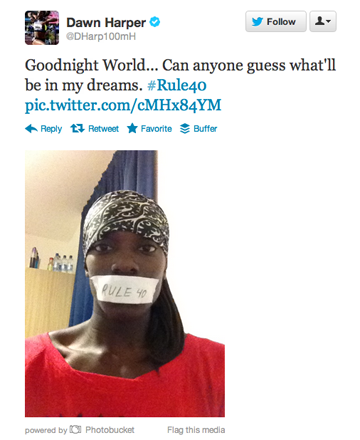
    Dawn Harper Tweets her Opinion of Olympic Rule 40
    Dawn Harper Tweets her Opinion of Olympic Rule 40

    Two-time track and field medalist Dawn Harper thinks so.  That’s why she posted this tweet with #Rule40 in protest of the IOC’s infamous Rule 40 during the 2012 Olympics in London.

    If you aren’t yet familiar with Rule40, it is a total ban on an athlete’s promotion of personal sponsors and their ability to acknowledge those who helped them get where they are today. It is especially focused on social media, where it has become a commonplace for athletes to thank sponsors with pictures and personal statements.

    Harper isn’t the only athlete to voice her displeasure with the effective “gag order” on competitors, but with companies spending upwards of $100,000,000.00 to associate their brands with the Olympics Games, is it really that hard to see why #Rule40 is in effect?

    Some have even gone as far to refer to the situation as a “battle”. Yet, despite the activism surrounding #rule40, without a doubt the biggest threat to the official Olympic sponsors is the ever-pervasive ambush marketers, silently stalking and waiting for their chance to steal some the Olympic brand name.

    These controversial ambush marketing campaigns attempt to capitalize on high-visibility events and locations through brand association without having to pay for the high-cost of officially sponsoring an event. My favorite example of ambush marketing involved the Minnesota Timberwolves selling this advertisement on the side of their stadium, where it happens to only be viewable from inside the nearby Minnesota Twins baseball stadium (where the official sponsor is Target).

    View of Timberwolves basketball stadium from inside the Twins baseball stadium
    View of Timberwolves basketball stadium from inside the Twins baseball stadium

    Ambush marketing may have been around in the advertising world for years, but the Olympics are seen as “the flagship event for ambush marketing”. Creative campaigns by infamous ambush advertisers like Nike often times attract more online buzz and conversation than the actual official sponsors.

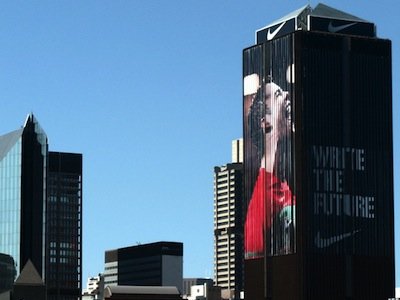
    During the 2010 World Cup in South Africa officially sponsored by Reebok, advertising juggernaut and infamous ambush marketer Nike, placed an eye-catching ad on the fourth tallest building in the entire city of Johannesburg. When paired with a lengthy viral video, many agreed that Nike had effectively hijacked the sponsorship from Reebok and gained closer brand association with the World Cup event.

    Nike ad in Johannesburg during World Cup 2010
    Nike ad in Johannesburg during World Cup 2010

    Another ambush marketing giant, Subway, has already launched its attempt to steal some association from the upcoming Sochi games.  Summer Olympian Michael Phelps and retired speed-skating icon Apollo Ohno both appear in TV commercials for Subway’s “$5 foot long campaign” due to some legal loopholes discovered by Subway.

    So is it reasonable for the IOC to implement Rule 40 to help protect sponsors? Freeskiier David Wise recently commented that, “[he] understand[s] the Olympics are a moneymaking game, but it’s sad for [him] to have all these sponsors who have really taken care of [him]…[he’s] on the biggest stage [he] can possibly be on and [he] can’t give them the representation they deserve.”

    Another athlete and social media enthusiast, Nick Goepper, has stated that he will be completely off of social media for the entirety of the Olympics. “I think it might be safer not to tweet anything,” said Nick, the 19-year-old favorite to win Ski Slopestyle gold. “All I know, it’s pretty much zero tolerance for branding.”

    The Sochi games are only 3 days away, but the media blackout protecting the games’ sponsors has been in effect since January 26. When the final medal is awarded and the closing ceremonies complete, which brands will you associate with the games? Which advertisements and commercials will be the most talked about and discussed? Is $100,000,000 too much to pay for a loose association with the Olympic rings?

    Will the “ambushers” steal the spotlight once again?

    – Greg Rothman