Blog

  • Embrace the Madness, with the Press of a Button

    Tomorrowland has always been known for being the best of the best when it comes to the festival world. This event, which takes place in Belgium, just celebrated its tenth anniversary by going above and beyond expectations. While the Tomorrowland bracelets are a piece of artwork in themselves, this year they were more than a keepsake. Tomorrowland just created the perfect way to market the festival with the press of a button. Not only do they serve as a memento but the bracelets also give you the ability to connect with Facebook so that you can find and add friends that you make at the festival. When you meet someone at the festival that you want to keep in touch with, each of you can simultaneously press the heart shaped button on your bracelet and it will send you a “Friendship email” with all the contact information of the person you just met. Later you can log into Facebook and finalize the connection.

    Festival tech has advanced in recent years to give attendees a better experience by using them to enter the festival, pay for food and beverages and now connect with social media. Now that attendees can connect with each other instantly, from all over the world, Tomorrowland can take their online presence to a whole new level and use their fans to create free Word of Mouth Marketing.

    The company ID&T, based in Belgium, is responsible for a variety of festivals including Tomorrowland and now TomorrowWorld, in the United States. This is the first company to create such high tech bracelets and could be the beginning of an entirely new festival experience. As more people press the heart shaped button, all of their posts, photos and videos can be shared around the world and used by ID&T to promote themselves without lifting a finger. Word of Mouth Marketing gives the attendees control of the message. When the information is coming from a third party source, people tend to trust it more than coming from the company itself. While WOM marketing is not always the most reliable, social media has increased communication and results.

    This year, the second TomorrowWorld will take place in Georgia and based on the success of the bracelets in Belgium, they will also be used this year in the US. People are already excited to use this new feature and it appears to be working based on the five million Facebook followers and the limited number of tickets left.

    ID&T is paving the road for how festivals should operate by remembering to focus on the attendees experience while still using this new technology to their advantage.

  • The Social Media Music Festival: Music Midtown

    The month of September gives music lovers a run for their money. Well, maybe not a run for their money but definitely something to spend it on. With the iHeartRadio Musical Festival and Music Midtown Festival this past weekend (September 19th) and TomorrowWorld coming up this weekend (September 26th), it creates a dilemma for music festival participants. Which one is worth the money? While iHeartRadio Festival may have had over 10 headlining performances packed into two days, 100,000 people chose to attend Music Midtown in Atlanta, Georgia. Granted Music Midtown is at least $500 cheaper.
    While Bonaroo and iHeartRadio have created a brand for themselves due to being around for many years, Music Midtown is just beginning to make its mark. According to “The Value of a Twitter Follower” presented by @TwitterSmallBiz, 72% of followers are more likely to make a future purchase. Music Midtown has a strong presence on social media, before and continuing after the festival. The countdown began on Twitter seventy days before the event up until the day of. The countdown featured pictures of the festival in past years and of the venue.

    Bxvpn-JIUAExdIi.jpg-largeThe Twitter page provided ways for followers to win tickets to the festival, weather forecast updates (the event has had terrible weather in the past), and engaged with not only attendees of the festival, but artists and other organizations on Twitter. With the expansion and popularity of social media, organization members with social media skills have a leg up to those who don’t. Shiffman (2008) refers to the shift of fundamental marketing theory and practices, the “age of engage.” According to Shiffman, “the age of engage is a new era of marketplace and marketing communication grounded in widespread socio-cultural movement characterized by people engaging and being engaged in more participative, collaborative, user-generated ways.” Basically, the marketplace has changed into an interactive practice. It is normal now for companies to talk directly with consumers through Facebook or Twitter. Music Midtown took advantage of social media knowledge and interacted with both attendees and hopeful attendees. On September 16th, three days before the festival kicked off, @MusicMidtown tweeted “TELL US: Who are you most excited to see at #mm2014? The tweet received multiple responses with 115 favorites and 117 retweets. The people in charge of the Music Midtown Twitter account can also be seen interacting with other brands who are promoting the artists performing at the festival. Rolling Stone Twitter account tweeted the vine below with the Tweet ”#GrumpyCat is bummed she isn’t the cat on our #LanaDelRey cover.”

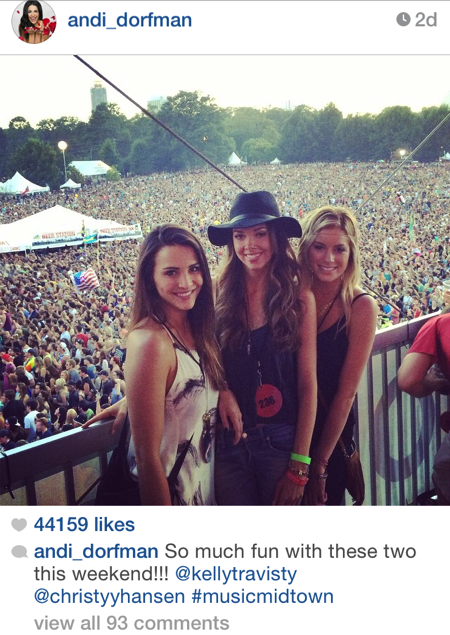
    The attendees of Music Midtown were also engaging with the festival on social media. The most recent “Bachelorette” Andi Dorfman and her fiance/winner from the show posted multiple Instagram pictures throughout the weekend of their experience at Music Midtown.

    IMG_9878IMG_0995

    Engagement from both consumers and organizations is crucial in today’s marketplace. Companies receive feedback from consumers on social media and consumers are informed about companies they are invested in. Since Music Midtown was able to utilize social media to increase the engagement with their attendees before, during, and after the show, this may have contributed to their overwhelming ticket sales.

    -Kelli Hall, Morgan McCleaf, Danielle Walters, Stephanie Jordan, and Shawn Rause


  • From The App To The Stage: The iHeartRadio Music Festival

    The fourth annual iHeartRadio Music Festival took place this past weekend at the MGM Grand Garden Arena in fabulous Las Vegas. Thousands of fans packed the arena for the two-day musical extravaganza to see the stellar performances of their favorite musical icons. This festival is unlike any other music festival because it is more Vegas style. Not only do they have the nightly shows, they also have day performances in the iHeartRadio Music Festival Village so attendees can party non-stop throughout the day and on into the night.

    iHeartRadio-Music-Festival-14

    This day in age, we are living in a period known as the postmodern period. The Postmodernism Theory focuses on the belief that our realities are what we make them to be. Our reality is constructed by our individual selves or social groups and are subject to change integral to time and place. In relation to IMC, Postmodernism illustrates that consumers are buying into a certain lifestyle rather than an actual product. This theory sheds some light on why consumers are willing to pay such extravagant amounts of money to attend this festival. It’s not so much about the music but more about the Vegas lifestyle that they are able to be a apart of, even if only for a weekend. According to Forbes, it costs a pretty penny to get in on the action. The average secondary market price for Friday’s shows was $766.09 and $651.28 for Saturday’s performances. If this was too steep of a price, you could still view the show from afar with an average get-in price of $182 on Friday and only $100 on Saturday. More than 25,000 people flock to Las Vegas every year for the musical gathering. You may be wondering how all of these people hear about the festival. The answer is simple: radio.

    According to the Uses and Gratification Theory, users select mediums that give them the most satisfaction. Once the medium is chosen, the user actively integrates it into their lives. In a study appointed by the Radio Advertising Bureau in the U.K., it was discovered that happiness and energy levels were increased by 100 percent when the subjects listened to the radio. The Users and Gratification Theory alongside of the study explains why radio has been so successful. However, iHeartRadio supplies the proof.

    Before the music festival, Clear Channel Communications launched the iHeartRadio music app in April 2008. Since then, the app has been downloaded 97 million times. Aside from the app, iHeartMedia (the new name for the iHeartRadio franchise as of September 16, 2014) owns and operates 840 broadcast radio stations across the country. Between iHeartRadio and the broadcast radio stations, iHeartMedia reaches a whopping 240 million listeners per month and 53 million people via their social media pages making iHeartMedia’s outreach the largest in America. With a reach like this, it really is no wonder that the festival creates so much hype and has record-breaking attendance each year.

    With proof like this, it makes sense that iHeartMedia has been so successful with their outreach. It is clear that they have used this to their advantage to market the annual festival. With millions of listeners being reached daily, iHeartMedia has been able to promote the music festival with ease. This simple tactic is obviously working as this year’s festival sold out in a mere 10 minutes. This goes to show just how powerful radio can be.

    -Malia Swift, Kaitlyn Russell, Hannah Rodgers, Spencer Brenes, and Anna Joy Zima

  • Creating a Culture at Bonnaroo

    Bonnaroo Music and Arts Festival is an annual four-day music festival that is produced by Superfly Presents and AC Entertainment. Every year it is held at Great Stage Park in Manchester, Tennessee. This past year Bonnaroo celebrated its 13th anniversary and was held from June 12th through the 15th. They hosted an impressive lineup, with artists including Elton John, Kayne West, The Avett Brothers and Skrillex.

    bonnaroo_ctaylorcrothers

    If you know anyone that has ever attended Bonnaroo, they most likely explained to you the culture that forms during the experience. This could be seen through the theory, Cultural Approach to Organizations. Geertz (1973) explains through this theory that organizations and attendees at large events form their own culture. The groups formulate a culture where experiences are shared between the individuals. Bonnaroo exemplifies this. During the festival, fans live together for four whole days. They share their space and integrate into each other’s lives.

    In the video above the culture and comradery of the events are visualized. The short film speaks on how the “eclectic” group of people there forms a community during their time at the festival. However, it raises the question:  is the “community” really formed from unity and love or is it a method to keep people committed to returning to the festival?

    Bonnaroo attracts 75,000 to 85,000 fans a year, many of whom are dedicated returnees. By taking advantage and promoting the idea of a community at the festival, the owners work to create clear brand image in order to keep and gain customers alongside making revenue. Looking through the  Cultural Approach to Organization helps us to understand how groups that share nothing in common other than taking part in a similar activity can become a distinct culture. Have you ever felt loyalty to an event or product because you feel as if you are part of a community of patrons?

    -Olivia Sadler, Margaret Cafasso, Hannah Zeskind, Kierstin Geary, and Connor Gold

  • Brains vs. Beauty: Which Will Be Crowned?

    Since 1921, the Miss America pageant has captured the attention of the nation annually. Over the last 96 years the pageant has created controversy and skepticism of the overall motives associated with the Miss America brand. However, what you might not know is that as a non-profit organization, Miss America provides over $40 million each year in scholarships to the over 12,000 young women who compete in state and local competitions all over the nation. Despite these scholastic contributions, Miss America and its contestants are under constant scrutiny for their focus on the female body, image, beauty and talent, allowing little room for the public to see the organizations intended image.

    10695139_10204486219426214_363237583_n

    If you tuned in to the 2015 Miss America pageant on Sunday, September 14, you’d have been delighted with over 50 Tony Bowls evening gowns, 16 Catalina designer swimsuits, 8 well-rehearsed talents, but only 5 20-second interview question answers. Throughout the competition scores are calculated as follows: Lifestyle and Fitness in Swimsuit 15%, Evening Wear 20%, Talent 35%, Private Interview 25% and On-Stage Question 5%. Looking at these numbers, it’s easy to understand how so many viewers have become skeptical of the pageants true aims. These facts leave us asking: How can an organization that claims to be founded on improving women’s education host a pageant that is primarily scored on superficial beauty?

    10637935_10204486277467665_2145528500_n

    Although the pageant judges hold private interviews prior to the televised competition, these are not seen by the public. With the overwhelming majority of the televised pageant focused on the physical appearance and selected talent of each contestant it is hard for us, as viewers, to believe that the final decision is based on intellect. Because we do not see the private interviews and are only shown the 20-second On-Stage interview portion, there is minimal emphasis on the contestant’s ability to share her ideas on current events/issues cognitively and knowledgeably.

    As popularity of the Miss America pageant has grown, the organization seems to be straying from its original platform concept. While the pageant has always had a beauty portion, the increased focus on the importance of beauty and the “ideal” female body have created negative backlash toward the brand. Looking at Adaptive Structuration Theory (AST) we can see that the cultural obsession with “how a woman should look” has changed the outputs of the organization. As the organization has evolved to basing so much of the final score on lifestyle, fitness, talent, and beauty its current image goes against what Miss America claims to stand for. The organization has adapted its structure over the years to meet the demands of what viewers want to see. While the televised pageant remains popular, drawing over 7 million viewers, the numbers were down 15 percent from last year’s pageant making accelerated skepticism clear. Despite this drop in ratings and increase in negative feedback, Miss America is sure to remain a valued tradition in American culture.

    -Angelica DiPaolo, Morganne McIntyre, Anderson McNaull, Madeline O’Connor, Rachel White

  • Has Urban Outfitters Stained Their Image, Yet Again?

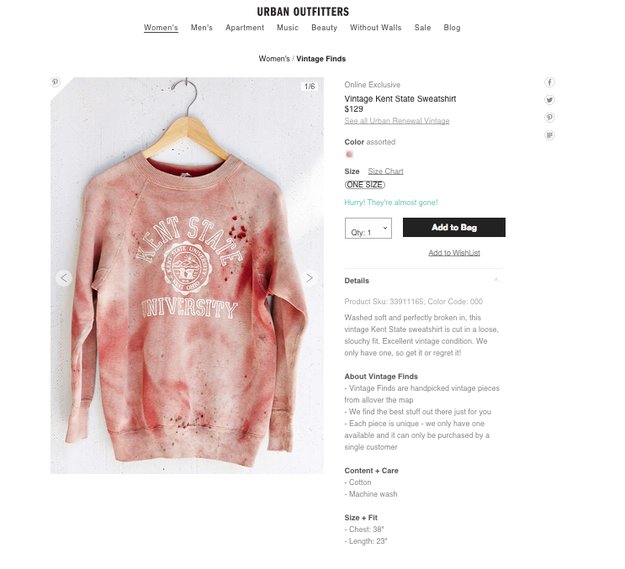
    Urban outfitters must believe there is no such thing as bad press as they appear in the spotlight once again with their controversial “bloody Kent State sweatshirt.” For those who do not know, Kent State University endured a massacre on May 4, 1970, when National Guardsmen killed four students during an anti-war protest. Urban Outfitters seems to think this is the perfect backdrop to release a “vintage” Kent State sweatshirt that seemingly resembled an article of clothing that would have been recovered from the shooting. The description of the sweatshirt reads “Excellent vintage condition. We only have one, so get it or regret it!”
    enhanced-16199-1410759430-11.png

    Unfortunately, this is not Urban Outfitters’ first offense; they seem to enjoy provoking controversy as the company has displayed multiple offensive products, targeting a wide spectrum that covers everything from the Jewish community to those suffering from drug abuse and eating disorders. The sad part is that the Kent State Sweatshirt along with these other offensive products continue to sell. The store claims they had no intention of referencing the shooting and that the “blood stains” were simply faded red dye due to age. Interestingly, Kent State’s colors are navy blue and gold.

    This makes us question, what is the image they are aiming for and how do they expect the public to perceive them? Their website states, “Our goal is to offer a product assortment and an environment so compelling and distinctive that the customer feels an empathetic connection to the brand and is persuaded to buy.” The definition of empathy is to understand and feel the feelings of others. To blatantly advertise and sell products that offend the public and provoke negative reactions does not sound like they understand the meaning of this word. Urban Outfitters is a global brand with thousands of shoppers so how do they continue to get away with this behavior? While striving to connect with the younger generation by generating an edgy and unique look, they seem to have forgotten their own message.
    At times there is image inconsistency between a company and their consumers. It seems that Urban has misunderstood their own image and is possibly trying too hard to maintain the bold identity they believe their customers are looking for. The theory of Looking Glass Self refers to the self image an individual creates based on how they believe others perceive them. Is it possible that Urban Outfitters is just trying to maintain an image they have imagined is expected of them? Is there a chance they will finally cross the line and take this idea too far?

  • From One Brand To Another

    Week to week we commonly see companies in the news whose images are taking a hit (The NFL, Urban Outfitters, etc.) but we rarely hear about the companies who are displaying a positive image. Last week when Chick-fil-A’s founder, S. Truett Cathy, passed away at 93 years old, Moe’s Southwestern Grill posted a touching Facebook post and tweet honoring the inventor of the chicken sandwich.

    Moes2

    The post read “Today we are all Chick-fil-A, Our deepest sympathy for the loss of your founder and our friend, S. Truett Cathy.” These kind words were accompanied by a graphic that combined the two companies’ logos. Thanks to their post, Moe’s has gained a large amount of positive publicity as well as praise from consumers of both Chick-fil-A and Moe’s. This tribute was a simple but genius move on the part of Moe’s. The home of the infamous Joey burrito is now being seen by its target consumers as classy, considerate, and sympathetic. Chick-fil-A even responded to Moe’s, saying “We can’t thank you enough for showing your support as we remember and honor Truett- a friend and so much more to us all.”

    Moes

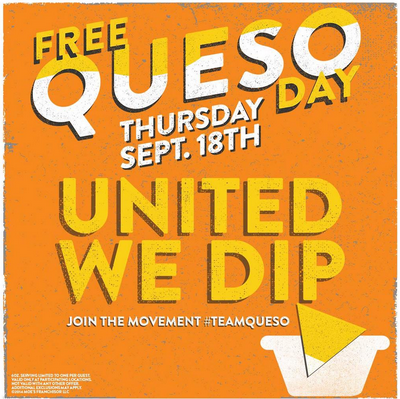
    While still in the public’s good graces, Moe’s is coasting right into their highlight event of the year, free queso day. On Thursday, September 18th, Moe’s will be providing free cups of queso and chips to all customers that ask. The company has been advertising the event heavily on their Twitter page, which has been a popular URL thanks to their post addressing Chick-fil-A’s loss of their founder. Whether they intended for the tweet to improve their image or not, their business will definitely reap the benefits of it this Thursday.

    united we dip

    Moe’s wasn’t the only one tweeting its condolences to Chick-fil-A last week; Zaxby’s, Thrive Farmers, and even country singer Brad Paisley also posted to let Chick-fil-A know that Truett Cathy will be missed. Brad Paisley’s industry is far from the production of food, and Thrive Farmers is Chick-fil-A’s new coffee supply company, but Zaxby’s is one of Chick-fil-A’s main competitors. As witnessed in 2011 with Microsoft when Steve Jobs passed away, the public admires a company who can stop to sympathize with one of its competitors in a time of hardship.

    So the question behind all of this friendly tweeting is: What is each company’s true motive? Certainly each of these companies has a trained PR professional running its Twitter account, so chances are they knew that sending their condolences towards Chick-fil-A would be well received by onlookers and the media. But it seems wrong to assume that “image boosting” is the only reason one of those companies might want to make a kind gesture.

    A company’s identity is carefully designed and constructed by the company themselves, but their image is defined by the public’s perception of them. Some scholars even say that “It may be difficult to judge whether corporate identity determines corporate image or vice versa.” (Christensen & Askegaard,1999) So what do you think? Is creating a positive image as simple as posting some kind words at the right time and place, or is positive image a byproduct of the delicate maintenance of a company’s self identity?

    Christensen, L.T. , & Askegaard, S. (1999). Corporate identity and corporate image revisited: A semiotic perspective. European Journal of Marketing, 35, 292-315.