Blog

  • Costume Service? Oh Wait You Meant Customer Service

    The merger between cable providers Comcast and Time Warner Cable in New York City is currently up in the air, as a vote to approve the merger is being delayed. The New York Public Service Commission (NYPSC) was set to vote on a 45 billion dollar transaction last Wednesday, but the vote was pushed back until November 13th. Why are regulators against the merger of two successful companies? The answer is an often-ignored part of business deals, the quality of customer service.  The reputation of both Time Warner Cable’s and Comcast’s customer service is so poor that the NYPSC are unsure if they want to go through with the merging. Outrage over the customer service of these companies has gone as far as anti-Time Warner Cable groups on Facebook dedicated to fuming customers reaching thousands of likes.

    download

    According to Kalb (2013), a writer for the Business Insider, Time Warner Cable lost 140,000 subscribers to other competitive businesses due to their reputation of poor customer service. The writers of this post have also had bad experiences with TWC and Comcast respectively so it’s understandable that NYC is not in a hurry to merge the companies. This is explained by Homans (1958) in his Social Exchange Theory, which is weighing the costs and benefits of relationships. There are many economic benefits of merging of companies, but there are also severe costs, such as a potential unsatisfied customer base. This theory entails that the New York Public Service Commission is the main decider who is dealing with the cost and benefits of this situation. They must go through a process that will show that the benefits of this merge will outweigh the costs of what could happen if these companies meshed together. However, due to the commission rescheduling the vote, they clearly have not seen that the benefits of this merge will outweigh the costs that could affect a numerous amount of viewers as a whole.

    How is this damaging to Time Warner Cable’s and Comcast’s individual brands?  The fact that a potential expansion of their companies’ reach is being challenged due to consumer’s opinion is a colossal issue. When a company has a poor reputation in relation to the way they handle clients it damages their overall credibility as a brand. Based on the idea of commodity culture, as consumers we identify and define ourselves with the brands we join and part take in. With TWC’s and Comcast’s poor reputations of not dedicating their employees to helping their customers to their full abilities, why would new and upcoming consumers want to join its brand and organization?

    -Margaret Cafasso, Kierstin Geary, Connor Gold, Olivia Sadler, Hannah Zeskind

  • “Raise your hand if you’ve ever been personally victimized by Regina George.”

    Looking back at our time in high school we are all reminded of the various groups and friendships we observed or engaged in, and in every high school there is a group of girls we associate with being “mean girls”. You might have loved them, envied them, hated them, dated one of them or been one of them. The movie Mean Girls has influenced our view of female friendships and gender roles for the past 10 years and doesn’t look like it’s slowing down anytime soon. Exploring this movie through the lens of social cognitive theory we uncover just how strong the influence of teen movies can be on our beliefs and views long after we have left the concrete hallways of high school.

    The University of Twente identifies that the social cognitive theory “explains how people acquire and maintain certain behavioral patterns, while also providing the basis for intervention strategies”. Social cognitive theory also deals with aspects of behavior for understanding behavioral change, as well as, cognitive and emotional aspects. Even if you have not seen Mean Girls you have most certainly been exposed to the vocabulary that has made up countless iconic references men and women use everyday: “On Wednesday’s we wear pink”, “Go Glen Coco”, “She doesn’t even go here”, “It’s like I have ESPN, or something”, and “It’s October 3rd”. Mean Girls, loosely based on the book Queen Bees and Wannabees, has lead the pack of teen movies for the last decade in the characterization of female friendships and gender roles in a high school setting, guiding our views on the dominant female role and the true nature of female interaction.

    Elizabeth Behm-Morawitz and Dana E. Mastro explore the effects of teen movies and the influence of our exposure to the storylines portrayed on “gender-based beliefs about friendships, social aggression and roles of women in society”. The two part exploratory study investigates 20 grossing U.S teen movies released between 1995 and 2005. In regards to socially aggressive behaviors, there were 337 incidents recorded which found that “female characters were significantly more likely to engage in socially aggressive behaviors than males”. To gain a better understanding we look at direct scenes from Mean Girls; throughout most of the movie, no matter how horrible or catty the group of mean girls is to their peers they continue to be idolized and envied. These types of images and themes reinforce the belief that we will receive positive consequences with the enactment of socially aggressive behaviors. Results of the study showed, “females were significantly more likely to be rewarded for socially aggressive behaviors than were their males counterparts” indicating that “female characters are significantly more likely to engage in and be rewarded for socially aggressive behaviors than are male characters in teen movies”.

    Based on social cognitive theory, Behm-Morawitz and Mastro’s results conclude that “it would be expected that exposure to such messages among the appropriate audience could potentially result in the development of unfavorable beliefs about female friendships and negative attitudes toward women in general”. Modeling these types of socially aggressive behaviors through an admired medium lays the foundation for how teen girls view themselves and their peers and how they choose to design their pursuit for higher status. The findings of Behm-Morawitz and Mastro’s research reinforces the idea that being a “mean girl” will get you father in life and that being one of the many victimized is just a normality. Even as an adult Mean Girls resonates with many experiences from the past, making this movie one of the most influential on our pop culture to date.

    -Angelica DiPaolo, Morganne McIntyre, Anderson McNaull, Madeline O’Connor, Rachel White

  • “You’re Gonna Need A Bigger Boat”

    Few films have transcended generational lines and influenced culture. One movie that has effected our behavior on a grand scale is the  terrifying 1975 blockbuster, Jaws. The iconic theme song is among the most recognizable sounds that exists in our society and immediately evokes a feeling of fear of water…. any water. One way to explain how this movie has created a slightly irrational fear of what lies below the surface would be the  Cultivation Theory, which is described as  how media effects viewers and convinces us their messages are valid. The theory connects to how television is able to change our behavior so strongly that it can move through generations of viewers. We have been trained to fear something that is statistically less likely to kill us than being struck by lightning, but the film worked so well that we disregard logic.


    Just mentioning the film while visiting the beach can be enough to keep someone from going in past their knees. The iconic dunnn-nun dunnn-nun is recognizable to most people no matter their age and immediately triggers a reaction. Despite the fact that you do not see the actual shark until the last scene of the movie, the music is enough to make people afraid. After the success of Jaws, many others in the film industry continued to repackage the same concept encouraging fear of the deep dark ocean. Some of the movies that came out shortly after were Orca, The Deep and Piranha in an attempt to feed off this idea of unknown waters. This movie was so effective that sharks (especially Great White Sharks) remain feared and misunderstood forty years after its release.

    Jaws helped create a new genre of horrors films that continues to be used even today. By cultivating a long-term fear of the water and what lies below, society continues to play into this Hollywood created concept. This film took an animal that very little was known about and created a demon that will forever terrorize our beaches.


    -Bobby Huckabee,  Savanna Mitchell, Danielle Salas

  • Legally Blonde: Communication in Film

    In order to understand Legally Blonde through the Muted Group Theory, it is important to first acknowledge what the Muted Group Theory says. It starts with the assumption that language creates power. When a more powerful group has control over the language in a society, other groups have to alter their communication in order to be understood by the dominant group. It says that because our language was created by men, there aren’t words for women to use to describe their thoughts and ideas.

    This theory is often viewed in terms of men being the dominant group, and women being the “muted group.” This means that unless women adopt the words and language of the men in their society, their thoughts and ideas will be ignored. There are several examples of how this works in Legally Blonde.


    Legally_blonde

    Before Elle goes to law school, she seems to be the stereotypical sorority girl. However, once she gets to law school, it is clear that she will not be taken seriously unless she adapts the way that she communicates. There is another character, Vivian, who is a much more serious counterpart to Elle. Vivian displays more masculine qualities, resulting in the people at Harvard taking her seriously. Elle has to change herself in order to fit in with, and be taken seriously by, her peers.


    Another example of how this can help us understand the movie is in the scene where Elle’s internship advisor, Callahan, make sexual advances on her. After telling her that he was impressed by her performance in the courtroom, he encourages her to pursue her dreams. However, it is clear that he is only interested in her, not because of her intelligence, but because she looks good. Muted Group Theory helps us understand this encounter by demonstrating that in a male-dominated profession, even intelligent, thoughtful women are ignored and silenced. The men assert their power and this leaves women as a muted group.

    -Morgan McCleaf

  • Emilio’s Confession

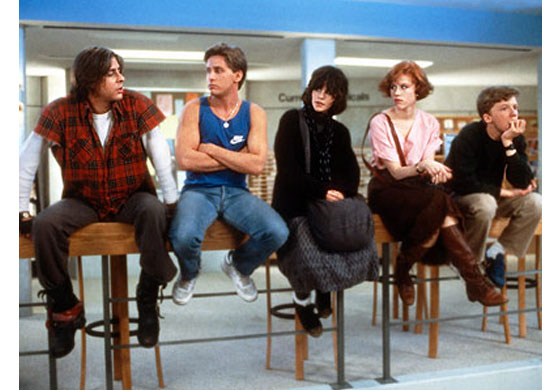
    The Breakfast Club is undoubtedly one of the most iconic and classic movies of the ‘80s. Five mismatched students, the athlete; the brain; the princess; the criminal; and the basket case are forced to spend the day together in Saturday detention.

    Breakfast Club

    The Social Penetration Theory explains how individuals grow closer to one another in their relationships. There is a public layer of a person that everybody has access to. It is simple things that can be told in the early-stages of relationships, like favorite food or their college major. However, as the relationship begins to progress, the layers of an individual progressively get deeper. This is typically illustrated as peeling back the layers of an onion, each layer revealing more information. At the very core of an individual is their most deeply held beliefs and convictions.

    The theory states that in a normal process of building relationships, people begin at the top layer then slowly dig deeper and uncover more layers of an individual. The law of reciprocity creates equity in a developing relationship. One person is open which leads the other person to be open as well. Reciprocity is a give-and-take exchange which allows people to progress equally as they reveal more personal information.

    There is a famous scene in the Breakfast Club where this band of misfits use the Social Penetration theory to learn more about each other and build unlikely friendships. In this scene, all five students are sitting in the library talking to one another. They have learned a lot of peripheral facts about one another throughout the day and this scene really shows the wedge being driven into the onion. The students are having a light-hearted conversation when one of them asks Emilio “How are you bizarre?”.

    Emilio, who is a star athlete, begins to tell everybody why he was in detention that day. He begins with some basic facts about how he ended up in detention. However, as his story progresses, the topic quickly switches to a serious tone as he explains why he did what he did and it reveals personal information about his relationship with his father. As he is telling his story, he is slowly peeling away the layers of onion as he self-discloses more information. By the end of the story, he is almost in tears and the others are silenced by the depth of penetration that has been reached. Emilio’s story allows the other members to be open with him and also reveal personal information about family relations. When Emilio ends his story, Judd, the criminal kid with a bad background, comments that “I think that your old man and my old man should get together and go bowling”. This reciprocity opens the door for Judd to reveal personal information about his relationship with his father.

    The social penetration theory helps us to understand how the scenes in the Breakfast Club play out and how the relationships develop among the students. By using this theory to understand the behaviors of the students, we can better prepare to determine behaviors in our own relationships.

    – Anna Joy Zima

  • The Dark Symbol Rises

    Hi everyone! This week’s theme is influential movies in pop culture!

    Mead‘s (1937) theory of Symbolic Interactionism explains the process of interaction in the formation of meaning for individuals. This is one of the main reasons why the movie Batman has been so successful.  Not only is the Batman symbol recognized within the context of the movie, it also has become a brand for the audience as well. When the symbol is shown in the sky in the movie, it represents hope.  The audience that follows the Batman series recognizes the symbol as a part of their childhood.  Batman has been a huge part of pop culture due to its wide berth of media touched.  These include comics, cartoons, movies, and more recently, a new television series. By interacting with the Batman brand in a multitude of ways, viewers create meaning related to the image.

    Marketing practices make or break a brand.  Due to the fact that Batman is able to be marketed to children, adolescents, adults, and parents, it has a wide range of influence. The meaning we attribute to things, according to the theory of Symbolic Interactionism, is a product of our social environment. By parents sharing what Batman means to them with their children, it formulates their perspective towards the brand.  The generational aspect of Batman along with continued popularity contribute to its meaning and explains why people view it in different ways depending on their experience.

    batman3

    However, since we live in an individualistic society, people, no matter what age, seem to create their own perceived meanings of objects and symbols in life. Through this perception, we carry out certain behaviors when we are faced or encountered by these objects or symbols. In this case, the behavior desired by those who create and promote Batman movies is that that people continue to want to see them and share them with others.

    If the symbolic interactionism wasn’t so easily defined, do you think the Batman legacy would not have reached the degree that it has?

    -Margaret Cafasso, Kierstin Geary, Connor Gold, Olivia Sadler, Hannah Zeskind

  • “Are you excited to see The Obesity Clinic play?”

    Flower headbands, Indian headdresses, body paint, and glowing hula-hoops. What do all of these things have in common? As interest in music festivals has skyrocketed over the last decade, these are some of the common stereotypical trends that now characterize music festival culture. Every year people from all over the world will travel hundreds to thousands of miles just for the chance to listen to good music, make new friends and create life-long memories. This phenomenon can be described through the exploration of the Communication Accommodation Theory.

    Coachella_outfits_web_t540Fifty years ago the world became consumed with the ideas of free love, peace, and the common bond over music. Woodstock redefined the way we looked at social interaction and the evolution of trends. As the desire for individuality and self-expression has moved to the forefront on modern day culture, festivalgoers have now been defined as modern day hippies. According to Howard Giles’ Communication Accommodation Theory, “people in intercultural encounters who see themselves as unique individuals will adjust their speech style and content to mesh with others whose approval they seek. People who want to reinforce a strong group identification will interact with those outside the group in a way that accentuates their differences”. While many people who attend music festivals are actual “die-hard” fans, others seem only to join the masses for the sheer desire of experiencing the culture. The communication accommodation theory is evident in these interactions and is accentuated through media portrayals of the stereotypical pseudo-fan like in the video below.

    Video clips such as this show how the communication accommodation theory is so heavily applied in the music festival culture today. When people attend music festivals they want to integrate themselves in the modern day culture, whether this remains in line with their true individual identities, or not. While the Woodstock generation came together through music festival culture as a united front to fight undesirable political tastes and symbolized freedom and idealism, music festivals today have become the runway for fashion statements, social inclusion and non-conformist attitudes. The unfortunate reality of identifying music festival culture through the communication accommodation theory is that this once safe-haven for eccentric outfits, unconventional personalities, and atypical tastes in music, has become a popular breeding ground for socialites looking for the opportunity to convert themselves into modern day hippies, even if just for one weekend. So are you excited to see the Obesity Clinic?

    pitchfork

    -Angelica DiPaolo, Morganne McIntyre, Anderson McNaull, Madeline O’Connor, Rachel White