Category: Political communication

  • The IMC War: Balancing Power and Values

    The aim of college courses is to prepare students for their professional lives.  In our IMC class we have been assigned books that teach us ideas, facts, values, and more.  To teach us more about the importance of values in business we read Niccolo Machiavelli’s The Prince.

    This book is Machiavelli’s guide to holding and seizing power.  The Prince was written in 1513 for Lorenzo de’ Medici, the prince of Florence.  Despite its age, this book remains popular and important for those involved in government, politics, and positions of power.  Machiavelli uses the book as a way to give calculated advice backed up by examples.  Throughout the book, Machiavelli sets morals aside and focuses on how to attain goals of power.  He teaches readers how to use violence, lies, abilities, and luck to force others under your control.

    How does this book teach us values?  After reading The Prince we wrote a memo to our chancellor to either recommend or not recommend Machiavelli as an IMC consultant based off of his ideas within the book.  We had to decide if we were willing to risk our values and beliefs to accomplish our goals as a university. 

    Machiavelli makes decisions based off of research, forms consistent messages, and knows how to accomplish goals in the most direct, efficient way.  This may seem like the way to go if his suggestions fit the company’s mission and vision.  In other cases, this drive to complete a goal without respecting values could ultimately lead to the demise of the company’s image.  We should ask ourselves if the product really is great or if that is just a claim to get more money?  If being great is just a claim the next question is: is it worth it to be dishonest and ignore values to get what we want?  This decision between honesty and power is something many professionals have to face and we were able to learn this lesson with help from Machiavelli’s The Prince.

    – Carissa Niederkorn, Deji Adeleke, Anna Kate Babnik, Tiffany Evans, & Katie Eagle

  • The White House Appoints A Man To Do A “Woman’s Job”

    The White House is breaking social norms by appointing the first male social secretary.  Not only is he male, but he is also gay.  Jeremy Bernard will be in charge of planning seamless social functions for the White House.  Bernard was previously the United States ambassador to France and was chosen because of his view that the White House is the “People’s House”.

    His sense of humor and infectious laugh reinforces the Obama’s vision of how they want the White House to be portrayed.  Not only this, but the liberal ideals of Obama match up with Bernard’s homosexuality and involvement in homosexual rights efforts.  Obama has also been called a “groundbreaking president”, and this reinforces that title.

    Bernard’s duties include reporting to Michelle Obama, although most decisions are trusted to the social secretary.  Event planning is often thought of as a woman’s job and requires diplomatic skills and a sense of production.  Even so, people close to the White House think that a man in the position is perfectly acceptable and that Bernard can do everything that previous women have done.  This position is said to be one of the most important in the White House because social secretary’s report to the president and first lady and is one of the best jobs someone could have in Washington, D.C.

    It may seem that President Obama is trying to rebrand the White House image to make it very gay-friendly to increase his votes for the reelection.  It can also be seen as stereotypical that a gay man would be appointed as an event planner, especially since men in the position is already uncommon.  Regardless, the Obama’s have stated that Bernard is most qualified for the job and that he will enhance the young, modern image of the White House that our first family represents.

    bernard454.jpg

    Bernard, left, and his recent ex-partner.

    -Brie Golden

  • Social Networking- A dictator’s worst enemy

    At this point, social networking sites are no new phenomena in the United States. Facebook gets more hits daily than even Google, and Twitter is becoming more and more popular by the day.  With the ability to follow, like, and friend people from around the world, news outlets have learned to use the social media sites of people involved in the recent revolutions to get minute to minute updates about protests around the world. Because of these quick updates, in both Egypt and more recently Libya, dictators clinging to power have quickly tried to shut down the country’s internet access in order to slow down anti- government protest information.

    In Egypt, Wael Ghonim, the marketing manager for Google in the Middle East and North Africa tweeted about different protests by the hour which eventually led to his arrest by the Egyptian government.  This only furthered his following and helped spread the word faster about his anti- Mubarak movements.  In the United States, Secretary of State Hillary Clinton participated in an online discussion with young Egyptians who were involved in the riots.  By answering their questions in an online interview which were eventually posted on an Egyptian social networking site, Clinton assured the citizens that the United States supported their democratic ideals.

    One of the many western journalists who have been following the chaos in the Middle East and Africa, National Public Radio’s Andy Carvin has been updating his twitter page constantly to keep people around the world up to date of current protests and government decisions. 

    With millions of people around the world participating and actively using several different social media sites, it allows information to be passed around at a greater rate than ever before. With the capabilities to follow sites from smart phones, laptops etc. it will be hard for any dictators over staying there welcome to keep ahead of the actions of their irritated citizens.

    -Chad Graves

  • Catch more Libyans with sugar than with gunfire

    Tripoli, Libya. (Abdel Meguid al-Fergany/Associated Press)

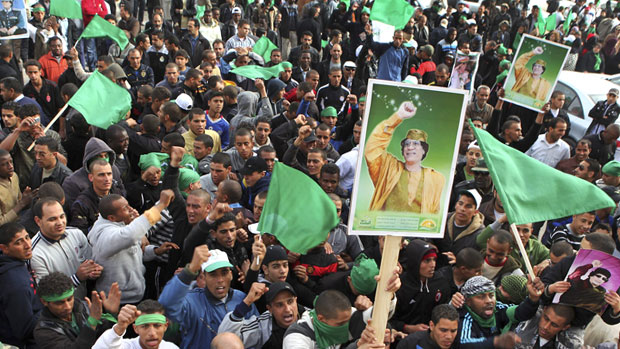
    Around the world it seems that there are few who have not heard about the latest wave of protests going on in Africa, the most recent being the widely covered being in Egypt. The latest wave of protests have come to the Libyan front, where citizens have been fueling a need for freedom and asserting their displeasure with the high unemployment problem as well as their support for the Libyan people, not for Gadhafi. The Central Intelligence Agency estimates about one-third of Libyans are currently living in poverty despite being an oil-rich country.

    However, Gadhafi, the current leader of Libya, is not willing to budge. He even went so far as to vow that the only way that he would step down from his position would be to die “a martyr” in his country and according to CNN, he blames the unrest on “rats” who are “agents” of foreign intelligence services and that people found to be cooperating with said services will be executed. Human Rights Watch stated earlier this week that at least 233 people have been killed during the unrest from random open fire by Libyan forces.

    It seems that although Gadhafi has vowed to stand strong in his position, he has still lost support in a large portion of eastern Libya. Even the Interior Minister, Abdul Fattah Younis al Abidi, has resigned, aligning his support with the Libyan people’s revolt. It is becoming clearer daily that the brand that Gadhafi has created for Libya and for himself is one that is being morphed by the people into a whole new concept. The current brand associated with Gadhafi’s politics is that of regime and repression, including an iron fist on outgoing communications within the country.

    We will have to stay tuned to see if Gadhafi steps down, and takes with him his regimented governmental identity and/or what new identity that the Libyans will create for themselves with or without his leadership in the future.

    -Heather Cornman

  • On Wisconsin! The Protest Continues

    Starting last week, up to 25,000 peaceful protestors have surrounded the Capitol building in Madison, Wisconsin.  It isn’t a matter of what they want, but what they don’t want.  Republican Governor, Scott Walker, proposed a bill that many union members are viewing as anti-union.  The bill requires state employees to pay a larger share of health care costs and pensions.  It also diminishes some of their collective bargaining rights and no longer would require state workers to join unions or pay membership dues.

    With Democratic State Senators fleeing Wisconsin to avoid voting on the bill, doctors writing sick notes for teachers to protest, and President Obama calling the bill an “assault on unions,” Madison’s liberal brand and activist reputation are giving the Governor a run for his money.  So why are other states watching the clash anxiously?

    Wisconsin is not the only state dealing with an extreme budget deficit.  With no easy way to fix the problem, they must consider some very tough budget cuts, many of which are opposed by organized labor.  Unions across the nation have successfully rallied and won many such battles, such as in Oregon and Arizona last year.  However, as seen in New Jersey and New York, governors from both political parties have reached out to business groups to form political action committees to advertise and put out messages to counteract unions.  If Governor Walker is also successful, he will be paving the road for many more states to stand up against government employee unions.

    These unions get their power by charging dues, these dues are used to run their daily operations and support political campaigns or individuals for elected office.  For example, in the 2008 elections, $400 million dollars were given by unions to elect Obama and other Democrats.  With Wisconsin threatening to remove unions’ rights to require state workers to join and pay dues, the unions’ relationships with members and political figures will no longer be one offering as much financial reciprocity. 

    How does this relate to IMC?  Government employee unions have large budgets to advertise their political views on bills, candidates, campaigns, etc.  They also survive knowing their membership will not diminish and their relationships with members and elected officials will remain productive.  However, if Wisconsin approves this bill it has the potential to reduce the financial power and sets up a pattern that could be followed by other states.  

    To learn more, click here to view a video on the protests:

    http://www.youtube.com/watch?v=IFU7mn9pOhA

    -Carissa Niederkorn, Tiffany Evans, Deji Adeleke, Anna Kate Babnik, Katie Eagle

  • Alaska’s sweetheart or America’s nightmare?

    Seeing as today is Presidents Day, where the nation comes together to honor our past great leaders, we see it fitting to look at the latest political figure and “reality superstar”, Sarah Palin.

    This self-titled “maverick”, at first branded herself as a strong political influence with ties to family values, motherhood, main street U.S.A, and conservatism. After her failed run as Vice President during the 2008 Presidential election, she has since morphed into a celebrity.

    With her daughter partaking in Dancing With the Stars, and herself being the star of TLC’S Sarah Palin’s Alaska, she has been capitalizing on her celebrity status with a book tour, speech engagements, and recently, Fox News contributor. Do politics even play a role in her brand anymore?

    While her views haven’t changed about how the government should be run (if she even can even articulate her views without having to beat around the bush), she has basically destroyed her political brand. In several interviews, she has lost her credibility by not being able to answer simple political questions.

    Here is an example of her failing to brand herself as a knowledgeable politician.

    Below is a video of her dropping the ball in Politics 101.

    According to The Huffington Post, her reality show received $1.2 million in tax credits, a third of what it took to film the series. While other series filmed in Alaska do take advantage of the tax credit, Palin’s show profited the most, angering many citizens. With her stance on outrageous government spending, it is odd that she would partake in something that takes advantage of government funding This further harms her political credibility because she is profiting off the government that she previously lead.

    So what’s your take on her brand? Will this affect her future in politics, with a possible 2012 Presidential run? Is she still a positive political figure or simply a public nuisance?

    -Allison Day, Jessica Berinson, Megan Canny, Melissa Gagliardi, Scott Burgess

  • Corporate Communication Wrap Up

    As our time in the Corporate Communication classroom comes to a close, the information and knowledge that we have gained will continue with us as we each venture out after graduation into our desired career field.  Among the class of communication majors are students interested in event planning, public relations, integrated marketing communication and advertising, just to name a few.  Corporate communication is involved in all of these industries.  As stated in Corporate Communication: a guide to theory and practice by Joep Cornelissen, one of our required readings for the course, “Corporate communication is a management function that offers a framework for the effective coordination of all internal and external communication with the overall purpose of establishing and maintaining favorable reputations with stakeholder groups upon which the organization is dependent.”

    When the course first started back in August, not a single student in the class knew what the definition of corporate communication was.  Even though everyone registered to take the class, no one really had an idea of what it entailed.  Today, every student in the class has a definition of corporate communication, as well as plenty of detailed and background information that will give people a better understanding of the topic.  A big improvement from three months ago, wouldn’t you agree?

    We have covered a variety of forms of corporate communication that take place in sports, music, movies, politics, crisis management and careers this semester.  We have learned that communication is essential when it comes to an organization’s corporate image and identity, reputation, stakeholders and shareholders.  We have learned what makes a company go from good to great, the characteristics of a great company and why every company should strive to become one.  We hope we have left everyone with a better understanding of corporate communication.

    REMINDER! This week is NBC’s Green Week!  Green Week runs from November 14-21.  All this week, green topics will be featured into news and your favorite shows on the NBC network, such as 30 Rock and The Office, as well as special reports, fundraisers and documentaries.  Join NBC in celebrating the numerous ways that you can make a difference in the environment.

    -Danielle Dorantich