Category: Crisis Communication

  • Gone, but never forgotten: Joe Paterno

    Fact: Joe Paterno is and will always be a legend in the sport of college football.

    Fact: Joe Paterno is the winningest coach in top-level college football.

    Fact: After 46 years as head coach, Joe Paterno is no longer the leader of the Nittany Lions.

    Previous to this week, Joe Paterno was considered the most respected man in college football. He is small in physical stature, greying, wears outdated glasses, and has a soothing-yet rough voice; basically, he fits the description of a typical grandfather. To his fans, the thousands upon thousands of Nittany Lions across the nation, he is their grandfather. His abrupt and unexpected departure from his long-held post as leader of Penn State Football has left his fans in a state of hysteria.

    Students at the university are outraged over the board of trustees’ decision to fire Paterno. These students fully support their beloved coach, regardless of this situation, but why? How can anyone support a person who was aware of such wrongdoing and allowed it to go unreported? Penn State students are different. On Wednesday night, students hit the streets voicing their love for “Joe Pa”, knocking down sign posts, yelling at police, shattering car windows, and turning over trash cans and newspaper boxes. Students even overturned a television news van in an attempt to illustrate their infuriation with the media, which they largely blame for the boot of the beloved coach.

    Under Paterno’s leadership, and motto of “success with honor,” a program was able to defy records and challenge teams across the nation. Although ‘Joe Pa’ was an amazing coach on the field, it takes more than Saturday games and weekly practices to make a good coach. Because Paterno neglected to consider the other duties of being a leader, a man was allowed to repeatedly desecrate innocent young children. In a 15-year period, 8 boys were sexually abused by one man, Jerry Sandusky. This one man has been charged with 40 counts of child abuse, 21 of which are felonies; however, because of him a powerhouse program has been forced to start all over.

    Paterno had announced Wednesday morning that he would step down as coach at the end of the season. But amid the outrage, Penn’s State’s Board of Trustees held an executive session late Wednesday night and fired him and the schools President Graham Spanier, triggering the protests and media frenzy.

    The Penn State story has been a lesson in what not to do in terms of crisis management from a public relations perspective. In a world filled with social media and news happening 24/7, companies, and in this case a university, cannot afford to mishandle a major crisis. It requires preparation and nurturing. One cannot just announce the events in such a manner that Penn State did.  They waited too long to address the allegations after the story had gone live-online, and began being broadcast on news outlets. Not only this, the university cancelled Paterno’s weekly-football press conference, which then caused chaos among the media. If anything good can come out of this, it will be that horrific instances such as this, and men such as Jerry Sandusky, never happen again.

    – Jordan Hill, Michela Noreski, Ashley Nelson

  • The Deepwater Horizon One Year Later: A Brief IMC Analysis

    Today marks the one year anniversary of the BP, Deepwater Horizon disaster that leached millions of barrels of oil into the in the Gulf of Mexico, greatly impacting the Gulf Coast.  In the few days following the Deepwater Horizon incident BP came under tremendous scrutiny for the way they chose to address, or not really address, the media.    The former CEO, Tony Hayward, received the brunt of criticism for comments he made, including telling a photographer to get out during a photo-op on the shores of Louisiana.

    Following the PR nightmare BP created for itself, the oil company had to get to work repairing their image.  How else were they going to keep selling gas to pay for all the damage the oil leak was causing?  The marketing department sprang to action, launching a campaign that touted their commitment to cleaning up the oil spill in the Gulf.  In order to do this they employed tactics and used several channels for delivering their message of being compassionate and concerned about the residents of the Gulf Coast who were affected by the oil spill. Fishermen, hospitality workers, and any others harmed by the Deepwater Horizon accident were going to be reimbursed by BP for the income they were loosing from the impact.  They created jobs in a recession for workers willing to clean up the oil.

    In order to let the public know about all of the things they were doing to combat the oil spill BP aired several television commercials, utilized Facebook, and attempted to use twitter, but were parodied.  They utilized Search Engine Optimization (SEO) and spent millions in advertising on Google and several other search engines each month.  Every time anybody searched for anything remotely connected with oil, a spill, the Deepwater Horizon, BP, the Gulf…you get the picture, BP was pulled up.

    One year after the Deepwater Horizon disaster, BP’s marketing focus has changed.  Yes, they want you to know about their efforts in the Gulf, however they have shifted their efforts to focusing on BP’s efforts to foster sustainability and utilize renewable resources.  Despite the fact that BP’s marketing message has changed they still are employing a synergistic method to get it out there.  This synergistic technique is synonymous with IMC.

    -Eliza Wadson

  • Catch more Libyans with sugar than with gunfire

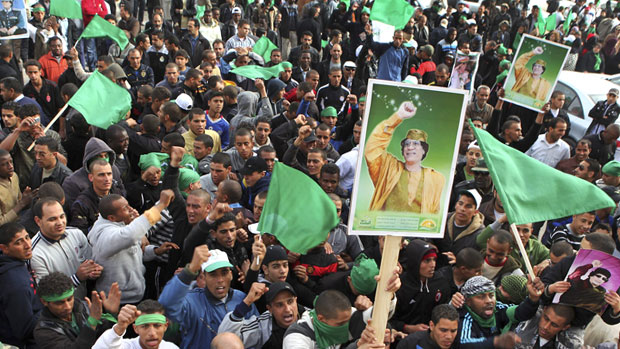
    Tripoli, Libya. (Abdel Meguid al-Fergany/Associated Press)

    Around the world it seems that there are few who have not heard about the latest wave of protests going on in Africa, the most recent being the widely covered being in Egypt. The latest wave of protests have come to the Libyan front, where citizens have been fueling a need for freedom and asserting their displeasure with the high unemployment problem as well as their support for the Libyan people, not for Gadhafi. The Central Intelligence Agency estimates about one-third of Libyans are currently living in poverty despite being an oil-rich country.

    However, Gadhafi, the current leader of Libya, is not willing to budge. He even went so far as to vow that the only way that he would step down from his position would be to die “a martyr” in his country and according to CNN, he blames the unrest on “rats” who are “agents” of foreign intelligence services and that people found to be cooperating with said services will be executed. Human Rights Watch stated earlier this week that at least 233 people have been killed during the unrest from random open fire by Libyan forces.

    It seems that although Gadhafi has vowed to stand strong in his position, he has still lost support in a large portion of eastern Libya. Even the Interior Minister, Abdul Fattah Younis al Abidi, has resigned, aligning his support with the Libyan people’s revolt. It is becoming clearer daily that the brand that Gadhafi has created for Libya and for himself is one that is being morphed by the people into a whole new concept. The current brand associated with Gadhafi’s politics is that of regime and repression, including an iron fist on outgoing communications within the country.

    We will have to stay tuned to see if Gadhafi steps down, and takes with him his regimented governmental identity and/or what new identity that the Libyans will create for themselves with or without his leadership in the future.

    -Heather Cornman

  • Price Tag on a Super Bowl Ticket? Not for these fans.

    It seems fans whose plans were altered by seating issues at this years Super Bowl have filed a lawsuit against the NFL. Go figure. The lawsuit also targets specifically the Dallas Cowboys and owner Jerry Jones and alleges a breach of contract, fraud, and deceptive sales practices. The massive group of fans, as many as a thousand people, are pushing for a collective gain up to $5 million from the NFL. While some of these fans pushing for the lawsuit are legit (400 fans did not even get a seat for the game), others seem to be coming off as a bit forced such as season-ticket holders who weren’t aware that they would be in “temporary seats”.

    Perhaps the NFL’s biggest problem stemmed from an inadequate offer that would have given the displaced fans $2,400 and even a ticket to next year’s Super Bowl, airfare and hotel included. But clearly this just is not good enough for these fans who felt gipped out of their paid-for seats. Apparently the NFL should have made these fans an offer they couldn’t refuse, at least up front, and now they will really have to pay for it. Clearly, the NFL cannot afford to get into a legal battle with these angry fans as it would lead to nothing more than a public relations disaster and a huge blow to the brand. It is no secret now that the league is to blame for the seating fiasco. So now in order to evade future damage to sales efforts and brand integrity and credibility, the NFL needs to do whatever it now takes to keep its faithful customers.

    Apparently there is no price tag on a Super Bowl ticket for these fans and they show no signs of dropping the issue. It seems at this point, the main hope for the NFL is that this story gets out of the media as fast as possible, and without further damage to the brand and future marketing and sales efforts and profits.

    -Eric Holtzman, Chad Graves, Ryan Kelley, Maxann Keller, Katelyn Truss

  • Corporate Communication Wrap Up

    As our time in the Corporate Communication classroom comes to a close, the information and knowledge that we have gained will continue with us as we each venture out after graduation into our desired career field.  Among the class of communication majors are students interested in event planning, public relations, integrated marketing communication and advertising, just to name a few.  Corporate communication is involved in all of these industries.  As stated in Corporate Communication: a guide to theory and practice by Joep Cornelissen, one of our required readings for the course, “Corporate communication is a management function that offers a framework for the effective coordination of all internal and external communication with the overall purpose of establishing and maintaining favorable reputations with stakeholder groups upon which the organization is dependent.”

    When the course first started back in August, not a single student in the class knew what the definition of corporate communication was.  Even though everyone registered to take the class, no one really had an idea of what it entailed.  Today, every student in the class has a definition of corporate communication, as well as plenty of detailed and background information that will give people a better understanding of the topic.  A big improvement from three months ago, wouldn’t you agree?

    We have covered a variety of forms of corporate communication that take place in sports, music, movies, politics, crisis management and careers this semester.  We have learned that communication is essential when it comes to an organization’s corporate image and identity, reputation, stakeholders and shareholders.  We have learned what makes a company go from good to great, the characteristics of a great company and why every company should strive to become one.  We hope we have left everyone with a better understanding of corporate communication.

    REMINDER! This week is NBC’s Green Week!  Green Week runs from November 14-21.  All this week, green topics will be featured into news and your favorite shows on the NBC network, such as 30 Rock and The Office, as well as special reports, fundraisers and documentaries.  Join NBC in celebrating the numerous ways that you can make a difference in the environment.

    -Danielle Dorantich

  • Crisis Averted? A Quick Lesson in Crisis Communication from Toyota

    2010 has not been the best of years for Japanese automaker, Toyota. Once known for its reliability and safety, Toyota’s brand image has taken a major hit due to several recalls over the past year. At the beginning of 2010 the car manufacturer was forced to recall millions of vehicles due to a sticking accelerator pedal that led to accidents, and even deaths in severe cases. Just last week, Toyota announced another recall on over 1 million Toyota and Lexus models due to faulty brake master cylinder seals and fuel pumps. The defective seals could cause break fluid to leak onto the break pads, causing them to deteriorate and become spongy, thus making them less effective and even dangerous.

    First, their cars accelerated on their own, now their cars can’t stop? Yikes! These two major recalls don’t exactly speak to Toyota’s image of being reliable and safe. Because of this, the automaker has had to step up and do some major crisis communication. Luckily, Toyota gained some valuable experience with their first major recall, making last week’s recall seem minor in comparison.

    Unlike the first recall of the year, where Toyota supposedly knew about the flawed accelerator long before they decided to alert the public, this time the company quickly addressed the defective seals and issued a voluntary recall. In any crisis it is important for a company to make the public aware of the issue before it is leaked to the media. If this is done properly, the company can save face. If they try to hide the issue it may appear as if they do not care about the safety of consumers, which has the potential to create even bigger problems.

    The way the crisis is addressed by the company also has a major impact on how well it is received by the public. Toyota’s January recall is a prime example of what not to do when handling a crisis. Their lackluster crisis communication left a lot to be desired, but with October’s recall the company has done a much better job. Recall information is readily available on Toyota’s website, however, what is more noticeable are Toyota’s “Safety First” advertisements at the top of the recall page. Because of all of the issues plaguing the Japanese carmaker, their crisis communication team has gone in to overdrive in attempt to repair the brand’s tarnished image, hence the reason all of the Toyota commercials you see today are centered around safety and reliability.

    All in all, Toyota has done a much better job handling its second major recall of the year, but issuing two major recalls does not do wonders for the brand’s image. Thanks to some help from their crisis communication team, we have seen the company recover a little, but it is still going to feel the effects from the issues it has faced this year. We’ll have to wait and see how good their PR is in the upcoming months to see if they can regain their position as one of the top auto brands in America.

    Sarah McIntosh, Sean O’Connell, Eliza Wadson, Jocelyn Walson

  • It Takes Two to Tango

    Crisis communication is one aspect of the corporate and professional world that is regarded with hesitation and stress. Just as in everyday life, most people prefer to avoid conflict at all cost. However, when faced with conflict or crisis it is those who handle the situations in the most effective and fair manner that exemplify great corporate communication and leadership skills.

    An example of crisis and conflict in the corporate world was the tire recall and conflict between Ford Motor Company and Firestone tires. After expressing concerns that Firestone had manufactured defective tires, which had been used on Fords Explorer model vehicles, John Lampe CEO of Firestone tires caused business relationships to quickly end between the two companies. The next day Ford announced that it would have to recall over 13 million tires that had not been previously included in the 6.5 million tire recall. Discrepancies on the safety of the Explorer tires generated heated debates between Firestone and Ford. Though Firestone admitted the tires were unsafe in its first 6.5 million recalls, it denied any knowledge that the alleged 13 million defective tires Ford was recalling, were not safe. Ford’s boss, Jacques Nasser, stated “We simply do not have enough confidence in the future performance of these tires keeping our customers safe.” The companies began the blame game, accusing each other for the defective tires and as injuries and fatalities increased, the conflict and arguments intensified.

    As the conflict continued between Ford and Firestone, the incident was being called the most deadly auto crisis in America. By October 16, 2000, over 119 deaths had occurred from the defective tires. In the end, over 250 deaths were reported and attributed to this crisis and over 3,000 serious injuries. While the companies were blaming each other, their consumers were being hurt, and in this case, not figuratively but literally.

    The importance of handling crisis communication in an effective and timely manner is essential to corporate business. If the Ford/Firestone conflict had been resolved quickly, with both parties recognizing that it takes “two to tango” and that both parties were responsible for the defective tires, then they could have protected their profit losses, their own employees, reputations, and ultimately ensured the safety of their consumers and thus branding their companies as trustworthy and reliable. Instead, both parties chose to blame the other instead of focusing on a solution and the best possible resolution and thus exemplified very, very poor crisis communication skills which the consumer ultimately paid for, both out of pocket and even their lives.

    Breanna Alexander
    Lauren Dehart
    Lauren Smith
    Kelly Wiley