Author: imcclass

  • Google AdWords

    Our favorite search engine Google has put on a competition for AdWords.  Most likely when you go to search something on the Internet you are going to go to the search engine Google, right? The fast and simple webpage seems to be most accurate and effective for what we are looking for. Imagine how many people search using Google, and imagine how much response you would get if your ad for your business were to show up on Google?

    To sum this up simply, Google AdWords is putting on a global competition for anyone to create their own ads to stick up on Google. Each team chooses a business to focus on and to create an ad for. Each team must have permission from the business in which they choose. For our case, we have recently been involved in a renaming project within our Professional Education branch for Communication Studies at UNCW. Using the information we gather from our pre-competition strategy paper and from our company we create AdWords that we believe encompass the purpose of the company and we place those into Google AdWords. Whoever receives the most response from their business AdWords wins the competition.

    Many things are important to do this job effectively. We had to learn much of the brand personality that our company is trying to portray to their public. Our challenge will be choosing words that work as a summary for the business, but also choosing appealing words that people will choose to search on Google. Our professor is challenging us to not only simulate real job projects, but placing us into situations where our group is team that relies on each other to “get the job done”. We are gaining true knowledge in what it is like to be within the IMC job market.

    Alissa Lockwood
  • CFCI 10th Anniversary Planning Project

    Our class group has assumed the responsibility of planning the event celebrating Cape Fear Center for Inquiry’s ten years of education. Upon meeting with representatives from the local charter school, we established a budget, a venue, food, supplies, and guest speakers. Our client’s motive is to provide a friendly atmosphere for the current students, alumni, and their families, thus a local arboretum on a Sunday afternoon in April seemed appropriate. Our next step was to make a decision about food. Taking budget into consideration and acknowledging that food is usually the single most expensive item at any event, we have begun asking for donations from local restaurants and establishments. Supplies will include tables, beverages, T-shirts, raffle prizes, seating, a tent and podium for guest speakers and special recognitions.

    Contacting the public and media is crucial in the planning of any event, so we have a media kit in the works. Our client would like for any and all alumni to attend and since most of them may not be in direct communication with the school, we are utilizing all of our resources through the local media as an outreach tool. Awards for the three founders will be presented that afternoon as well.

    We have planned to meet with our client exactly one month before the event to make sure all arrangements have been made, invitations and media kits sent, and that thank you letters for donations have been written.

    Mandy Baker

  • IMC Conference

    At the beginning of the semester, Dr. Persuit gave our class an outline foreshadowing our semester’s assignments.  As mentioned on Monday’s and Tuesday’s blog, we dove into a great book setting the framework for our perspective on social capital in relation to IMC and had the wonderful opportunity to learn the appropriate research and instruction to rebrand and rename an organization.  Although our first two assignments were interesting, informative and fun, we have all been anxiously awaiting our last and final assignment, which we are now getting into.

    The last two months of this semester are being devoted to three different projects taking place simultaneously distributed among three different groups of five students.  All of the projects aim to generate social capital and utilize IMC strategies to the fullest.  The next few blogs will be describing each project in detail starting today with the IMC Conference Due Diligence project.

    Conferences are a big part of the communication world.  They allow the opportunity for students, faculty and practitioners to come together to share the newest research and information regarding a specialized field in communication.  These fields can be as broad as general communication studies to the more specific area of integrated marketing communication.  Conferences typically last a few days with many panels and presentations taking place, generate the excuse to eat several meals, and a allow time to hear a great speaker elaborate on the theme related to the conference.  The IMC Conference group has the challenge to research the necessary areas behind the scenes (due diligence) of a potential IMC Conference to take place in the summer of 2011 at UNCW.

    The bulk of our research focuses on the logistics and beginning planning stages of the conference.  The research includes learning about similar conferences, possible conference themes, ideas for conference tangibles, IMC literature, appropriate outlets for promotion of the conference, graduate programs in IMC, a potential key-note speaker, and a reasonable location/size to then finalize the conference details (food, entertainment, etc.).  We will also learn the steps for writing the call for papers for the conference as well as begin the preliminary budget and conference development.

    At the end of the semester, our final exam will be in the form of a presentation, presenting the findings and proposal for our project.  Our clients who we will be pitching our information to are our instructor, Dr. Persuit, and our department chair, Dr. Olsen.

    We are currently in the largest research stage of our project as the majority of our assignment relies on information from other conferences and outlets.  All five of us working on the project are very excited to come together after spring break to sync our research and discover what we have found.  This assignment is definitely our biggest challenge to date, and we are excited to be a part of the ground work for a bi-annual conference at UNCW.  As the semester ends, we will keep you posted on project updates.

    If you have any ideas for what you may like to see at such a conference, feel free to leave a comment as we are open to suggestions!

    -Allyson Corbin

  • IMC Identity Project

    Over the first few months of the semester, our IMC class was given the opportunity to name and develop an identity for the UNCW Professional Education. We were asked by the organization’s leaders to help them re-name the name so that it would be better understood and accessed by possible clients.  As a class we were able to walk through the actual process IMC teams in the professional world use to develop a corporate identity. Our process was broken down into four phases, and our resources included the organization’s IMC plan, personal contact with the client, primary and secondary research, as well as the ability to work together as a team to achieve our goal.

    In the first phase, our main objective was to do as much research as possible in the allocated time in order to learn and understand more about UNCW Professional Education. Specific parts we explored the most included the industry’s definition, management, competitors, competencies, and the culture or character or the organization. This primary research was helpful to us to comprehend more about what exactly the client’s organization did on a day-to-day basis as well as the personality the organization chose to represent. We next compiled secondary research which provided more insight than the primary research did based on outside factors which molded UNCW Professional Education.  We discovered information on the audience and what they responded to, how other similar organizations characterized themselves, if the clients were brand loyal and whether or not the audience wanted services or products. Based on this primary and secondary research we compiled questions to ask the client in our interview through positioning statements. 

    During the second phase, the initial step was in interview the client, which in our case was Allison Rankin. She was in charge of the UNCW Professional Education and their efforts to reinvent themselves. In our interview we used our research to ask questions and to understand more about the organization in order to be able to create an image of their responsibly and roles. Next we made a master list of possible names to use and split them up into several genres or categories. Some of the categories include Latin, Greek, Cultural and Concierge. Once our lists were made and filled with possible words to use, we split up into 5 teams and moved onto the third phase.

    The third phase was where each of the 5 teams created a name based on the master list developed. Once the name was chosen in each group, we made position statements for each name using the same steps as we used in phase one. In the positioning statement, we had to explain our name, what it meant and how it accurately represented the UNCW Professional Education. The names that the five teams came up with included: AptusAlliance, UNCW COD, UNCWOPT, Accompass and NavInsight.

    The final phase was our presentation to the client, Allison. Allison came into our class and listened to each group present their name and positioning statement. Each team did a great job in first creating and name, and second showing why that name should be the new brand name for UNCW Professional Education. Allison was very pleased at all of our hard work and expressed how hard it was going to be to choose the new name for her organization.

    -Shannon Meadows

  • IMC… Why does is matter?

    Now that our class has been blogging about various aspects of IMC and social media for several weeks, we would like to take a step back and tell you a little bit about who we are and why we are here. Our class, like we’ve mentioned before, is Advanced Integrated Marketing Communications at UNCW. The idea of IMC is to integrate all marketing, public relations, advertising, promotional, community relations, event planning and more within an organization. The purpose of combining the different aspects of an organization’s efforts is to formulate a single strategic message that is delivered to each public, specifically focusing on the customer.

    Our class has also spent a considerable amount of time discussing the concept of social capital. As explained in Robert Putnam’s book Bowling Alone, social capital is a good produced by communities that are socially and civically engaged. It is a good that he argues has been declining in recent years, blaming a variety of distractions that keep people from truly engaging each other. Putnam believes, “The touchstone of social capital is the principle of generalized reciprocity.” Basically, social capital depends on the level of trust among members of a community and the number of good deeds done without the expectation of anything in return, except the basic understanding that it will come back to them.

    So, how does this blog relate to IMC and social capital? The purpose of this blog is to discuss the different aspects of IMC that we see every day through advertising, social media, promotions and more. The blog is run by a class of 15 juniors and seniors with certain guidelines set forth by our amazing professor, Dr. Jeanne Persuit. We have to communicate daily to meet these guidelines, and we have to trust each other to follow through and not let the others down.

    There you have it – a blog that is both furthering the study and exploration of IMC while also fostering social capital.

    -Nicole Doherty

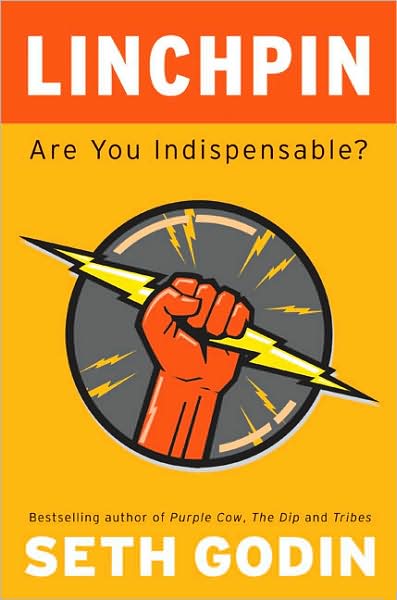
  • Are you indispensable?

    Are you indispensable?

    Seth Godin asks this question in his new book, Linchpin.  And one response is “no, I’m not indispensable, I’m part of a bigger story that will go on without me.”

    But this is not what Godin is saying. He’s not waiting for you to be deemed indispensable by others. He’s asking you to see how acting as a linchpin makes you inherently indispensable, not because of who you are but what you do.

    Full disclosure: I require my Intro to IMC class to follow Seth’s Blog. I don’t do this because I’m a blind Seth Godin parroter who thinks every word he utters is chocolate-covered goodness.  I require my IMC class to follow him so that they are introduced to a new way of thinking, to see the possibilities of a productive, virtue-driven life. Agreeing or disagreeing with Seth is not the issue. What is the issue is that he makes plain what he believes, and he tries to deliver on that every day. This coherence between word and deed is what makes him worth following and reading. Of course you should question what Seth says. I would think he’d be disappointed if you didn’t.

    Back to Linchpin. Reading it is like reading his blog; it’s brimming with short, manageable bites of observation.  He observes that being a cog in a machine is what we’ve been trained to do through school society, culture – what he calls “the industrial machine” (6). Being a linchpin, however, is a process through which we can break free from mediocrity.

    The most applicable parts of this book for undergraduate students are when he talks about how to become a linchpin while in college.  Getting passing grades, finding the easy way through school, and partying all the time are not – surprise!- the ways through which you become a linchpin.

    However, Godin gets a little heavy-handed when he talks about teachers who do nothing more than keep students quiet and unquestioning. I’m sure there are teachers who fit this profile, but I personally don’t know any. I’d like to offer a different perspective – and students, take note: most of the teachers and professors I know are trying to stimulate their students’ intellectual curiosity in every way possible.

    Every academic conference I attend offers formal and informal spaces for sharing teaching ideas that encourage active and engaged learning. We are officially assessed by our institutions in performance reviews for teaching capability, and we are unofficially assessed by students every day, online and off.  We have Centers for Teaching Excellence on campus whose staff offer us training, inspiration, and encouragement to teach, delight, and move our students. I have met faculty at other universities who promote the theory and practice of our field through their online presence. My colleagues in my department and my professors in my graduate program model this commitment to helping students become linchpins. Godin got it almost right in Linchpin; I thought I’d offer a more textured account of what is going on in the academy from a front-row seat.

    To conclude IMC-Hawks Book Week, I’d like to recommend everyone – especially students – read Linchpin and the other four books we’ve reviewed this week. Keep demonstrating the intellectual curiosity that will help you become a linchpin in a productive life.

    Jeanne Persuit, Ph.D.

  • Tired of Bowling Alone?

    Have you ever felt like you were bowling alone? Don’t worry, this isn’t a how-to article on making friends in a bowling league…it’s a brief look at Robert Putnam’s book Bowling Alone: The Collapse and Revival of American Community. Putnam, a professor of public policy at Harvard University, claims Americans are experiencing a decline in reciprocity. Through mounds and mounds of empirical evidence (yes, charts and graphs!), Putnam identifies what he believes are reasons for the decline and offers his opinion on how we can improve our social capital in the future.

    First off, it is relatively hard to understand this book if you don’t know what social capital is. Now, I know when you all read this, you’re going to have an “aha” moment and realize you actually encounter social capital everyday. The term has gone through numerous phases and definition, but Putnam defines social capital as “connections among individuals—social networks and the norms of reciprocity and trustworthiness that arise from them” (Pg. 19). Putnam’s main argument in the book is that America has experienced a decline in reciprocity.

    I would definitely recommend this book to others, because I do think Putnam presents an interesting argument that is stimulating. I believe Putnam’s work needs to be updated and re-evaluated for the current age, considering this book was released in 2000.  Many could, and do argue that we are simply engaged in social capital in new ways, which is actually a question Putnam poses in his work.

    Social capital plays an interesting role in the study of IMC. We can maximize positive social capital through IMC, and yes, there is negative social capital. With the recent focus on social networking in the marketing world, a whole new bowling alley has opened up for social capital. We have shifted from a mass media public to a more specialized media, and IMC plays a large role in identifying target audiences, and building social capital through these networks. Perhaps we must refer back to the question, are we engaged in social capital in new ways? Putnam emphasizes that the Internet has contributed to the decline in social capital, but many feel their social networks have grown because of these platforms.

    We have referenced Putnam many times in our blog, and I encourage you to read back on the previous subjects discussed. His overall argument is generally convincing and resonates with many people. It is certainly a thought provoking read and makes you think about your own personal social capital and reciprocity.

    Some of our other blog posts that discuss social capital:

    Integrating Social Capital, The Court, and Beyond

    Is “Doing For” a Form of Social Capital After All?

    – Rachel Kaylor