
Tag: UNCW

  • Donald Trump: An IMC Approach

    Donald Trump: An IMC Approach

    Donald Trump

    By Daniel Dawson

    The race for our next presidential candidates has been nothing short of entertaining this year, to say the least. The Republican Party’s posterchild, Donald J. Trump, is currently the frontrunner in polls. When Trump announced his presidential campaign, our nation couldn’t help but look incredulously at the millionaire mogul who’s already built his successful brand through business, franchises and TV networks. Despite bluntness, controversial statements and even discrepancies in political speeches, Trump has garnered the support of thousands of Republicans and the praise of being one of the most candid, or “authentic” candidates—but how and why?

    Perceptions of Authenticity

    Can a political candidate, or anyone for the matter, be authentic? In short, no. Or at least this is what Andrew Potter argues, author of The Authenticity Hoax, a 2010 book that criticizes the modern individual’s search for an ultimately unattainable “authentic” self.

    In his chapter titled “Vote for me, I’m Authentic” Potter delves into the issue of voter apathy in democratic societies and how political campaigning and the media affect this. Most of us are used to manufactured speeches and the all-talk-no-results perception of politicians—and there’s been a trend of voter apathy, or the choice to not vote, in developed countries.

    Trumps political extremism manufactures a perception of authenticity which could motivate U.S. citizens to vote who may consider themselves apathetic. He delivers seemingly uncensored and extemporaneous speeches—however questionable they may be—that echo his results-oriented business background. Why does he have a larger following than, say, Carly Fiorina, former CEO of HP and businesswoman alike?

    The Media Controls It

    Agenda-setting theory, anyone? This communication theory says that the media manipulates what the public thinks is important. Basically, whatever stories have the most coverage in the news become the “important” issues—the flavor of the week. Trump, for a variety of reasons, has been covered practically every day by some type of media outlet since he announced his participation in the race. You probably have read a story or two about Trump, even if you didn’t want to.

    In a recent example of agenda setting not involving Trump—who won the first Democratic debate? Major media reports that Hillary Clinton was the clear winner when, according to online polls, Bernie Sanders was voted the winner by viewers. Is this a disparity of choice or opinion? Potter writes, “The media’s pundit class feeds this gladiatorial conception of political debates by treating them as a boxing match, with the post-debate analysis invariably focused on who scored what points, and whether any of the candidates was able to strike the mythical “knockout blow” (p. 172). While the media like to sensationalize, there are other factors involving what the media cover. In short, the media, across multiple outlets, can report that Hillary Clinton won when voters disagree.  How do we evaluate the ways we receive our news?

    Trump’s Brand

    Like all political candidates, Trump is a brand. Donald Trump is a symbol, a message and a vehicle for his message. Trump is a business icon and has built an empire over many years, but why is Trump running for president, too? Political IMC is integral to the success or failure of a candidate’s campaign—establishing ethos, effective marketing, political advertising, event planning and speech writing are just some components that go into the branding of a politician.

    “‘’Some people think this will be good for my brand,’ Trump concluded, as deep as he probes. ‘I think it’s irrelevant for my brand.’” This blasé quote came from Trump himself in a feature written by Mark Leibovich in the New York Times Magazine.

    I disagree with Mr. Trump. For public figures, every extension of oneself, every action, participation, speech, statement, declaration affects one’s brand. One’s brand is the essence and the story of who they are. While Trump will probably only gain revenue and face time with his campaign, to say that it doesn’t affect his brand is nonsense. Whether it’s good or bad is a value judgment, but it’s fair to say that is not now, Trump’s brand will see the effects of this year’s political campaign.

  • Intern Spotlight: HR in Communication Studies

    HR-ImageThe way Human Resources ties IMC into their organization is rather unique. In Human Resources, the objective is not to sell the organization’s brand, but instead to help each individual in an organization focus on their personal branding. Individuals can continuously improve their communication skills and concurrently be efficient in their work together.

    Julia George is a senior at UNCW, graduating in December with a Bachelor of Arts in Communication Studies. During the months of May-August 2015, she completed a Human Resources internship through the Communication Studies Department.

    Interviewer: What were the steps you took when applying for an internship through the Communication Studies Department?

    Julia: During the Summer 2015 semester, I applied through the Communication Studies Internship Program for a position in Human Resources. This was incidental to my career, given my past and present course load made it clear my future was in this field. A Communication Studies internship entails researching a desired position and agency, interviewing with the targeted agency and supervisor, and approving this internship through Dr. Bulger- the faculty member in charge. My internship through the Communication Studies Department enabled me to complete a three-credit course, completing the correct amount of hours at the desired agency.

    Interviewer: What were your duties as an intern?

    Julia: The internship gave me glimpses into the everyday tasks of the Human Resources. During my time at UNCW’s Human Resources Department, I practiced co-facilitating retreats, managing social media, and marketing aspects of HR. After I completed my internship with the Human Resources Department, I was offered a part-time job. The experience I gained through the internship program and courses at UNCW, I am now able to practice those skills as a part-time employee at Human Resources.

    Julia came across the Human Resources internship during a Communication Studies course, taught by Dr. Brunson. The Intercultural Dialogue course required students to complete an out-of-class facilitation. Molly Nece, the Professional Development Coordinator in HR at UNCW spoke to Julia’s class about facilitation. Julia used her interpersonal skills and networking capabilities to learn about and purse the HR internship, through Molly Nece.


    535934_410333185791421_6763646625442744694_nJulia’s daily tasks as a staff member in Human Resources include: development of job aids for facilitations, assistance with retreats, attendance of all meetings, research and collection of data, and marketing HR through social media channels. She manages the social media channels for the Employee Training and Professional Development program called Dare to Learn Academy. This task correlates to the Professional Development Program and markets the five important factors for strengthening one’s personal brand – serving, leading, innovating, being resourceful, and growing. This program focuses on helping the faculty and administration across campus tap into their strengths and weaknesses, through group practices and self-evaluations, for a better understanding of how to interact in the office. The five factors of Dare to Learn Academy are marketed through Facebook and the Dare to Learn catalogue.

    Interviewer: What have you learned as an employee vs. an intern?

    Julia: When you are an intern, you are at a transitional phase from applying what you’ve learned at UNCW to a professional workplace. You start with smaller tasks, which help you learn how important every detail is in projects. It is okay if you make a mistake, your supervisors understand you are in a learning process. As an employee, you are trained for the position; deadlines are more serious and making mistakes are not an option. Having the practice from an internship prepares you for this mindset and decreases the stress of whether you are completing a project correctly or incorrectly.

    10479958_10153111690567474_8095338665732746440_nThe interview with Julia clearly shows the benefits and advantages from completing an internship during a college career. Not only is there personal growth and development, there is a clear correlation to success in future career endeavors. The opportunity to develop one’s personal brand and create network connections with professionals in the desired field, is invaluable.

    To find more information about internships visit: Career Center

    -Jonathan Callahan, Erin Fouhy, Julia George, Joseph Hines, and Sarah Suggs

  • Cucalorus: How to Brand an Independent Film Festival

    Cucalorus: How to Brand an Independent Film Festival

    By Daniel Dawson

    Cucalorus is Wilmywood’s premiere quirky film festival, showcasing independent films from local, national and international artists. Film connoisseurs sporting chunky glasses, artsy students in their thrift-store best and less interesting folk like you and I file into Thalian Hall (or one of the many other venues), settle down and wait for the lights to dim. This November will be the 21st year this little slice of art and culture draws people to downtown Wilmington.

    I could barely convince people to keep coming after my twelfth birthday party, so how does Cucalorus garner a big crowd each consecutive year? A cohesive brand narrative, that’s how. And Cucalorus’ brand narrative is nothing short of weird—but in the good way. Let’s explore what makes Cucalorus cool.

    1. It’s in the copy

    While none of these factors are ranked in any specific order of importance, I am a word person and always like to read and evaluate the voice of an organization. Many organizations forget about this, not capitalizing its subtle importance. Bad organizations.

    Cucalorus, on the other hand, has got its copy down pat. The copy, whether it’s online, in print or broadcasted on the radio, is how an organization communicates not only its news or events, but its personality, its voice and its image.  Here’s a snippet of copy from Cucalorus’ donation page on their website:

    “Hey Cucalorians!!! Do you need to get rid of unwanted cash? Make a donation and we’ll send you a tax deduction letter to send your fuzzy little friends at the IRS (they don’t need your money and clearly don’t know what to do with it!!). We do know what to do with it – we’re already plotting and scheming for the 21st annual Cucalorus Film Festival – taking place November 11-15, 2015!!! Help us fund the dreams and visions of artists all over the world by making a donation today.
    Dreaming of eggnog omelettes!
    Cucalorius.
    The Cucalorus Film Foundation is a 501c3 non-profit and your donation is tax deductible to the fullest extent of the law.”


    On first glance this might sound unprofessional and not the voice an organization would want to convey. The context, though, is important. Cucalorus’ audience is mostly the aforementioned artists, hipsters and independent film connoisseurs and Cucalorians. These types of people generally like funny, creative and quirky things (like Cucalorus). These types of people also tend to be skeptical of the IRS—not to mention the state cutting NC’s film incentive last year.  So yes, it might be OK for Cucalorus to be a bit irreverent, and it’s their creative risk.

    1. Digital presence, dude

    If your business doesn’t have some sort of online presence (an email address counts), I would like you to write to me immediately by carrier pigeon and explain how you’re still surviving. An online presence is increasingly important each year, and now just having a website and Facebook isn’t cutting it. Brand cohesion across appropriate social media networks and inter-connectivity between them is vital.

    Cucalorus not only has a website, Facebook, Twitter, Pinterest, and Instagram but their own blog and—drum roll—they are all updated. Bravo, Cucalorus. Content creation and audience engagement are essential to a successful IMC strategy.

    1. Creepily consistent image

    This one is tandem with the digital presence. IMC consists of advertising, public relations, marketing and every other single communication an organization can perform with its publics. Consistency in corporate communication allows the organization and its audiences to construct a narrative and image of the brand. This is what people can relate to. This is how we can see the quirkiness, irreverence and artsy personality of Cucalorus as if it were that weird kid in your English class who would always have some snappy reference to an obscure book even your professor hadn’t read. But less annoying.

    Take a look at Cucalorus’ official website:

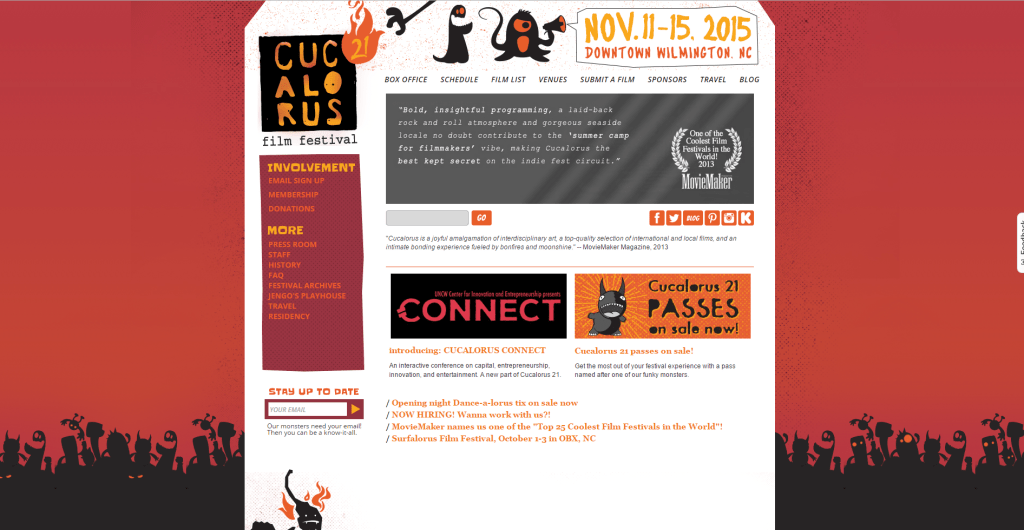
    Cucalorus Home Page - Wilmington, NC
    Ooh, warm fall colors. Where’s my PSL?!

    The color scheme and design is consistent. The font-faces, graphics and little cartoon dudes are consistent. There’s well-organized navigation and that copy I was talking about earlier. The social media pages follow suit. There’s an article on this if you’re into academic papers. Basically, the author, Simon Torp from Odense University in Denmark, says that as an organization your communication through all channels must be consistent, accessible and in line with your self-image, public image and meta-image for people to take you seriously.

    1. Zany staff workers

    When I said all channels of communication, I meant all of them. Even the staff workers and volunteers need to be carefully selected and even briefed on an organization’s code of conduct. One time I went to a screening of a Cucalorus film at Thalian Hall and, not to get into too much detail, I, with the rest of the audience, was sternly asked by staff to partake in a ritual involving whipped cream, button pins and our tongues. Was I offended? No, but I could have been if I had been misguided by thinking Cucalorus was actually a convention for neo-Puritans. Because their self-branding and self-image don’t suggest that, I could expect something out of the ordinary. It’s the risk that Cucalorus takes to maintain its image and appeal to its target audience.

    1. High-quality product

    When it comes down to it, a business or organization is only as good as its product. Silly brand narrative and image aside, Cucalorus does a good job at what it does. It recruits and selects excellent film talent from around the world and showcases it in quality and entertaining venues. This is where word-of-mouth comes into play. Word-of-mouth marketing or WOM is an organic and invaluable means of public relations, advertising and marketing. Have you ever read a positive news story about an organization you love? Or has a good friend of yours recommended a product or service they favor? These are examples of WOM that can make or break an organization depending on whether they are in favor or against it.  Maintaining the balance between brand narrative, professionalism and good business sense is how an organization thrives. While Cucalorus does an outstanding job of its own branding and controlled media, its reputation for quality and intrigue reign in filmmakers and spectators every year.

    I am no way affiliated with the Cucalorus film festival professionally, nor do I represent it. I recognize good IMC in organizations and talk about it here. But, if you are tired of what the local theaters are playing, check out a showing of something interesting between November 11 and 15 downtown at Cucalorus.

  • Behind the Scenes in Wilmington, NC

    For the past 30 years while the film industry was taking root in Wilmington, NC a brand was also growing. Wilmington became “Wilmywood.” With a well established tie to the film industry where does this brand identity go now that major productions like “Under The Dome” are heading farther south to Atlanta? Is Wilmington still “Hollywood East?” The NC Department of Revenue reported 10,500 film industry jobs in 2011. The UNCW Film Studies webpage promotes the department as a vital link to a “thriving film production center.” Students are often excited to see UNCW featured in these movies and shows, with hits like ‘The Conjuring’ and ‘One Tree Hill’ shooting scenes on campus. UNCW student Jackie L. says, “I took the opportunity to be an extra in Nicholas Sparks film at Dockside Bar & Restaurant because this was an easy way for me to break into the industry and help gain some exposure.” Incoming students, and industry professionals aren’t the only ones drawn to this exposure. Wilmington tourists are promised not only sandy beaches but film location walking tours from The North Carolina Travel and Tourism Board. It’s undeniable that Wilmington’s film industry has been at the forefront of establishing the city’s brand equity, attracting loyalty and awareness through the implications of its name branding “Hollywood East.” Will “Hollywood East”  still be an accurate picture of the Wilmington brand?

    film-equals-jobs-banner-600x150

    When North Carolina cut film industry tax incentives in half in 2014, production companies moved productions but the studio they used is still here. EUE/Screen Gems Studio is the local film industry power player having provided an operational base for over 400 film and television productions since 1985, and the 50 acre soundstage is still in business. With the film industry starting to move out of Wilmington while a major studio complex remains this puts Wilmington and its brand in an interesting situation. Is it ethical to keep advertising Wilmington as “Hollywood East?” Or should Wilmington and the UNCW community take this opportunity to revisit their dominant selling point and establish a new standard for connecting the film industry with their brands?

    EUE-Screen-Gems-in-NC

    The democratic ethical approach put emphasis on the habit of justice which calls for factual accuracy, and the habit of search which supports openness to new ideas. According to this, the city cannot market itself as Hollywood East, and let potential students and new residents believe that they will spot Robert Downey Jr. on the street or will sit down across from Jennifer Aniston Front Street Brewery. The reality is that the movie industry is largely moving out. We can still talk about the film that has happened in Wilmington and market that for all its worth, but we should be factual about the changes occurring.Wilmington and UNCW should open up to new branding possibilities and creating a new way to market themselves without needing to rely on “Hollywood East.”

    We know that the film incentives have brought controversy among Wilmington citizens. What are your opinions on Wilmington’s next step should be?
    -Aki Suzuki, Lexie Trimnal, Carey Shetterley, June Wilkinson, Carey Poniewaz

  • Falling in Love with Pumpkin Spice Lattes

    psl-starbucks.0.0Pumpkin is the flavor of fall. Products that offer limited edition seasonal pumpkin flavors and scents include pumpkin beer, pumpkin M&Ms, pumpkin spice marshmallows, pumpkin candles, pumpkin scented shampoo… and according to testers at the TODAY Show pumpkin spice Oreo’s are “especially tasty”.

    But no one does it better than Starbucks and the Pumpkin Spice Latte.

    Pumpkin Spice Lattes first appeared on the Starbucks menu in the fall of 2004. This is the beverage that kicks off their holiday seasonal drinks, even though it comes out in late August. The creamy pumpkin pie sensation mixed with a subdued coffee flavor created a taste that consumers immediately latched on to. One sip can bring you down memory lane, sharing an evening with your family, exchanging laughs and stuffing your bellies.

    Along with scarves and sweaters, sipping on a Pumpkin Spice Latte has become a new fall accessory. The drink option reminded loyal customers why Starbucks was their brand of choice and offered incentive for potential new customers to engage in their products.

    Seattlemet.com states that in October 2004, just one month after releasing the Pumpkin Spice Latte,  Starbucks noted an 11 percent spike in their company sales compared to the previous year. It was official…the brand had struck orange.

    In 2013, forbes.com reported that Starbucks has sold over 200 million pumpkin spice lattes and generated a revenue of over 80 million dollars.

    But popularity has a price. The seasonal drink got so popular that it seemed to reach a tipping point. Last year in 2014, some consumers were losing their sense of identity from feeling too conformed by the Starbucks pumpkin spice fad. Customers became critical of the product and and found some weak spots to pick on. The beverage’s ingredients did not actually include pumpkin and did include caramel coloring. These two things were enough to start an anti-PSL movement. This movement grew to such a size that Starbucks revisited its IMC plan.

    tumblr_nu0dm5sSD81tg0kfio1_500After 11 years with the same successful recipe, Starbucks reformulated to accommodate disgruntled customers. In addition to adding real pumpkin, the company devoted a large IMC effort towards branding this product. They have created a tumblr, an instagram, a twitter, and an entire brand identity just for one drink. The real Pumpkin Spice Latte now takes selfies and interacts with its audiences. Starbucks Efforts include having its own trending hashtag (#PSL), offering an iced version for warmer weather, and even a password that allows people to buy the drink earlier than it is official release date.

    Will Starbucks be able to revive the pumpkin spice latte trend once again? Or will the PLS critics find some other problem to cling to?

    Love Pumpkin Spice Lattes? Use the #PSL on Twitter, Instagram, or Facebook to gush about your love for this hot beverage. Or leave us a comment below and let us know what you think!
    Watch Starbucks 2015 Campaign here: https://www.youtube.com/watch?t=112&v=la-h1sE3igs

    -Aki Suzuki, Lexie Trimnal, Carey Shetterley, June Wilkinson, Carey Poniewaz

  • (A)Broadening Your Horizons

    10156134_880936395269873_65763143285790249_nThe study abroad program is one of the leading assets provided through majors at UNCW. Students and faculty/staff can take advantage of the chance to study in a foreign country. The university does a wonderful job promoting this opportunity given to all. Through the use of IMC with the Study Abroad Ambassadors, the program continues to grow each semester.

    According to the Institute of International Education 290,000 university students studied abroad for academic credit in 2012-2013. At UNCW, more than 500 programs in over 50 countries are offered, with many academic majors requiring students to gain credits abroad.

    Similar to other universities with enrichment programs, UNC Wilmington allows study abroad returnees, who are passionate about their experiences, to join the Study Abroad Ambassador program. Ambassadors assist the Office of International Programs with promoting and marketing their study abroad experiences through on-campus events and social media portals.

    Walking down Chancellors can be chaotic for most students and faculty members. Many ignore organizations passing out pamphlets and stickers to never noticing the chalk from Wag to Randall. The variety of outlets the Study Abroad Ambassadors utilize to promote opportunities helps reach a broader audience.

    • Study Abroad Fair
    • On-Campus Tabling
    • Banners
    • Intercultural Festival
    • Pre-Departure Organization
    • Classroom Presentations
    • Individual Meetings/Guest Speaker Events

    The Ambassadors at UNC Wilmington are passionate about study abroad programs and helping others gain access to any information, making dreams of studying abroad become a reality. The Study Abroad Fair and the Intercultural Festival are two prime examples of promotional events with on-campus marketing techniques. The Ambassadors who attend these events significantly contribute to the brand of the program. They generate content for various on-campus events and serve as a face for the organization. Through their donation of time, they add credibility to the organization, showing fellow students their passion for the program. Walk into Fisher Student Center or Randall and notice organizations tabling? Most student organizations at UNC Wilmington use that technique to market their purpose and mission. The study abroad program uses Ambassadors to promote the idea of traveling across the world, from freshman to seniors.

    Recently, the Office of International Programs released the Study Abroad Online Magazine– containing pictures and testimonies from Ambassadors and study abroad returnees. Offering easy access to information and keeping up-to-date with today’s marketing techniques. Similar to other on-campus organizations, the study abroad program has up-to-date social media accounts. On Facebook, Twitter, and Instagram, students and faculty/staff are informed on informational sessions, scholarship opportunities, and photo contests.

    -Jonathan Callahan, Erin Fouhy, Julia George, Joseph Hines, and Sarah Suggs

  • A.C.E. – Your Source for Campus Entertainment

    Please nod your head if you have ever taken another route to class pretending to be on your cell phone or completely ignoring someone who was trying to give you an event flyer. If you give your computer screen a nod, we applaud you.  However, if you are like 99% of the student population at UNCW and nodded your head–we understand.

    There are over 250 student organizations vying for our attention, membership and time so how do we pick what to attend? Our choices depend on how, or if, we hear about the event and how creative the marketing is. The Association for Campus Entertainment is the university’s student programming board Did you enjoy Hoddie Allen last year? That was ACE. What about when Maci Bookout from Teen Mom was here in the spring? That was ACE too.

    In the midst of everything college kids have going on, ACE provides an outlet for free entrainment. But just like every other student organization, they have to compete for your time as well. Integrated Marketing Communication, IMC,  allows us to diversify the means by which we achieve our marketing goals. A public relations campaign? Check. Social media presence? Also check. Cool and engaging advertising? Also IMC.

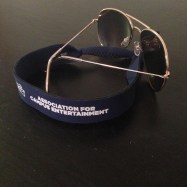
    ACE does this through an array of promotional tools each year, the first being through giveaways what college student doesn’t like free things? This year ACE gave phone wallets, Croakies, car USB adapters and staplers. This may seem like a mishmash of items but each one served a purpose: to be seen and get the ACE name known. Whether it is letting a classmate use the ACE braded stapler, or paying for food in Wag as you pull your OneCard out of your ACE branded phone wallet, ACE is marketing their brand. The goal is to increase the number of times a student sees a brand and how they associate it—hopefully in a positive light.

    image1

    There is more to promotions than simply getting a name out; ACE must also promote their events. There are the standard campus marketing methods such as banner, chalking and flyers, but in order to infiltrate the calendars of college students, you must take efforts farther. ACE is a brand that thrives on creative promotions, whether this be acting out a scene from an upcoming movie in the campus theatre or handing out paint brushes across campus for a Cheerwine and Design event. There is always something being passed out.

    A successful marketing campaign goes beyond creating and implementing the campaign. The ultimate goal of IMC, is to not only change one’s beliefs, but to change his or her actions. Whether this be successfully convincing students to change their plans and attend an event or sign up for ACE, we want them to act on our suggestions. So how do you think ACE stacks up, do you hear about their events through traditional means of advertising or through creative promotions across campus? Furthermore – how do you prefer to be wooed into coming to an organization’s event or do you organically decide to attend? Let us hear your thoughts and comments blow!

    -Amanda, Daniel, Kendall, Meleah and Luke