Tag: Twitter

  • The “Instructional” Campaign

    According to the calendar, Spring has officially sprung. And while we are still experiencing some chilly days, it’s undeniable most of us are ready to shed our winter gear for shorts and sandals. As with all season changes, clothing companies are eager to help you exchange your wardrobe.

    Recently, clothing company Lands’ End launched their new “How to Spring” advertising campaign, showcasing, “How fun and fashionable it is to add bright colors, graphic prints and floral patterns with a few perfect pieces from the women’s spring collection”. It could be argued that every spring campaign that will launch this season will have a similar goal; however, Lands’ End decided to do something a little different this season by adding a sweepstake to its promotional and marketing strategy.

    The sweepstakes works by first connecting with Facebook or entering your email. Once you’ve connected, you are asked to fill out your name, email, and zip code. Filling out this information unlocks the game. The rules are simple, select an outfit and click “spin”. If the outfit that the player selected matches the three tumblers, the player automatically wins a gift card with a balance of $25, $50, or $1,000. That’s it! Simple right? Not to mention, everyone is eligible to enter every day for the grand prize of $1,000 shopping spree. You can view the official rules of the sweepstakes here.

    While we like to think that games, contests, and sweepstakes’ only motives are for fun and entertainment, they are actually a smart marketing move – encouraging consumption of the product by creating consumer involvement. This involvement builds fan base, engages the audience, and enables consumers to do your marketing for you. Not to mention, user generated content often provides quality, innovative, and creative ads for free.

    In addition to promoting brand visibility, contest and sweepstakes are strategies that provide valuable quantifiable benefits for companies as well. They are cost effective, they help build search engine optimization (SEO), and increasingly important, they provide a rich source of consumer data for the company about existing and potential customers – emails, product preferences, location, etc.

    With every click essentially producing some sort of user information, online contests are growing in use on websites and especially on social media. The most popular initiatives include: photo and video contests, tagging contest, hashtag giveaways, and website raffles.

    Top Rank, an online marketing blog, named some of their picks of the best contest use on social media.
    Facebook: When Frito-Lay began their campaign for searching for new potato chips flavors, the company bypassed focus groups and turned to Facebook to connect directly with the customers who would be eating them.
    Pinterest: AMC Theaters have an entire Pinterest board, AMC Giveaways, where all users have to do is follow the board to stay up to date on the latest AMC contests. The basics are simple, when users see a prize they want, clicking on the image takes them to a landing page that collects their information.
    Twitter: In a “retweet to win” twitter contest, Doritos tweeted a message that simply asked followers to retweet for a chance to win. The tweet was retweeted over 500 times in a day with winners snagging products that ranged from Doritos to widescreen tvs.
    Instagram: As many clothing company are starting to do, Vera Bradely’s instagram contest asked users to post pictures of them and their favorite Vera Bradley bag using the hashtag #VBStyleShare. At the end of the contest, winners received a wrislet, followers of the hashtag could receive fashion inspiration, and staff could see how consumers were pairing their products.

    The benefits contests can provide seem like an almost no-brainer for companies to increase brand awareness while also gaining consumer data, but as they start to trend they are also subject to overuse. To combat becoming another form of clutter, companies will have to make sure their contest are increasingly interactive, engaging, creative, or lucrative.

    Have you ever participated in an online contest? Did you win? Did it make you feel more favorable towards the brand? Scrolling through your social media feeds have you seen brands using contests similar to the ones above? What are some of the best/most creative ones you have seen?

    Elizabeth Harrington, Caroline Robinson, Savannah Valade

  • Out With The Old, In With The New: Technology Decides It All

    Everyday you as a consumer are exposed to hundreds of thousands of brands. Over the decades the shopping industry has exploded with most brands disappearing at the same rate new ones appear, yet some brands have stood the cluttered test of time – one of those is Macy’s.

    Created in 1858 by Rowland Hussy Macy the Macy’s store was originally a dry goods store. Macy’s started to gain notable recognition in the 1900s with its holiday window displays and the hiring of Santa Claus for the stores. In 1924 the store moved to its current NYC location, on the corner of Broadway and 34th Street. This year was also the first Macy’s Day Parade, which was organized to celebrate immigrant employees new American Heritage.

    macys6n-2-web

    In 1944, Macy’s became apart of the Federated Department Stores, Inc., renamed Macy’s Inc. creating the world’s largest department store. Today, Macy’s has 800 stores in the United States and sells merchandise online.

    Macy’s isn’t the only iconic retailer – Sears Roebuck ring a bell? Starting in 1886, the mail order company prospered as it was able to provide low cost alternative to farmers. As mail order plants transitioned into stores, Sears found their place in city life and the retailer soon became a retailer giant. Today the store owns 863 mall-based operations and 1200 other locations including hardware, outlet, tire, and battery stores.

    sears catalogue

    Nowadays Macy’s and Sears are direct competitors, but it seems Sears, the company who invented mail order, can’t quite figure out online order.

    Holiday sales account for a large indicator of profit margins and often depict the health of a company. Sears seems to be in critical condition – US stores suffered a 9.2 percent drop. In decline for some time now, and with little to no improvement, some speculate the store could be gone by 2017.

    The history of an iconic brand is something that should be cultivated in your identity – it induces credibility, shows longevity, and prompts nostalgia. Yet being historic isn’t merely enough to remain vibrant. Iconic companies remain iconic because they are able to cultivate lasting relationships with consumers – at all time periods – and that means evolving.

    Looking at each retailers attempt to reach customers during the holiday seasons could explain Sears 9.2 percent drop in sales. Both have social media accounts, yet social media presence is widely disproportionate. Macy’s Instagram account has 150,00 followers while Sears has two Instagram accounts – “Sears” and “Sears Style” – yet both of the followers combined don’t even reach 8,000. A huge missed opportunity for Sears – Instagram is leading the way in social media, growing faster than Facebook, Twitter, and Pinterest combined.

    According to Gary Vaynerchuk’s article “The Road to Black Friday: Macy’s vs. Sears”, the use of social media by Sears is lazy. Choosing to ignore the social media culture they have posted irrelevant and uninteresting content such as a link to one of their commercials and an original YouTube video. While Macy’s post content that is culturally relevant, trendy, and formed around pop culture.

    Our culture today has switched, as James Twitchell describes it, “In the last generation we have almost completely reversed the poles of shame so that where we were once ashamed of consuming too much (religious shame), we are now often ashamed of consuming the wrong brands (shoppers’ shame)”. In this day in age a brand establishes and remains relevance by relationship cultivation, reinforcement, and engagement forged through technology – the Internet and social media. It seems Sear’s inability to adapt to technology has prevented them being able to participate in the younger crowds culture leading in profit and brand influence. As an American brand we hope Sears can get back into the groove but as they stand now they are the weakest link.

    In what other ways do old brands stay new? Can you think of any others that have had a hard time capturing new generations of shoppers? Or others that have done well?

    Caroline Robinson, Savannah Valade, Elizabeth Harrington

  • Dogfish Disaster Averted

    As we have gravitated towards becoming a society submerged in technology, in recent years, outlets of social media have become essential marketing tools for many companies and organizations.Facebook, Twitter, Instagram and Vine are few forms of social media utilized by most. While social media can strongly influence consumer behaviors and increase consumer awareness it can also be detrimental to a company’s image. In some cases social media can be the cause of a PR crisis. Crisis management is the process by which an organization deals with this major event that threatens to harm the organization.

    The American Red Cross is a prime example of an organization who exemplifies strong crisis management skills. This honorable humanitarian organization managed to dodge-a-bullet back in 2011 when an intern fired off a personal tweet on the company’s twitter account. The tweet read “Ryan found two more 4 bottle packs of Dogfish Head’s Midas Touch beer…when we drink we do it right #gettingslizzerd”.

    red cross

    This uniquely unorthodox and unprofessional tweet received a lot of negative attention from the general public. In this particular circumstance social media proved to be the cause of the crisis. When responding to the tweet the Red Cross avoided disaster by acknowledging that the tweet went out, deleting it, and explaining with humor that is was a mistake. This is an example of crisis management where the Red Cross turned a potentially harmful tweet in to an opportunity for engagement.

    Thankfully, the Red Cross realized the potential of social media and understood the power that it has to bring down a major organization. Now, other companies can look at this experience and utilize it to learn for themselves. After understanding the Red Cross’s response it is easy to break down their post-crisis steps and keep them in mind for other emergency situations. First, they were able to assess the situation. They realized the crisis was a major problem but they came to the conclusion that they could handle it which brought them to their second step, adapting their message. They considered their stakeholders and created a strong message to appeal to them. Lastly, they were able to analyze and learn from the situation post-crisis. Although this could have led to a horrific downfall for one of the greatest humanitarian organizations, everyone was able to benefit, understand, and learn from this experience.

    red cross 2

    -Parker Farfour, Caitlin Ford, Alex Corrigan, Kaitlin Batson

  • “Did I do that??”

    With a week full of fails, I imagine that readers will display a facepalm or two. Ad fails are fairly common and many are laughed off and explained through the phrase, “Everyone makes mistakes.” While ad fails often hit us in our funny bones, some offend readers far more than expected. This past year, AT&T and Esquire Magazine produced some facepalm-worthy ads that hit our country in one of its most sensitive spots: 9/11.

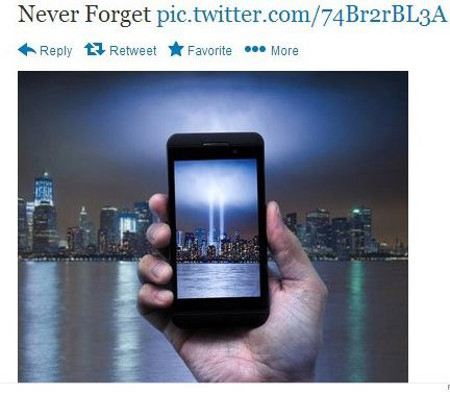
    What was supposed to be an anniversary tribute to those who died in the Twin Towers turned into an outrageous ad for AT&T. The company tweeted the below photo as a 13th anniversary mark of respect to 9/11. The tweet immediately went viral, leading to hundreds of angry comments within minutes that claimed the ad was “tacky” and “tasteless”. The image was pulled from Twitter within an hour, followed by a tweet from the carrier saying, “We apologize to anyone who felt our post was in poor taste. The image was solely meant to pay respect to those affected by the 9/11 tragedy.”

    Image

    It seems that in this situation, AT&T just can’t do anything right. Users of Twitter still were not happy with the apology, admitting that it’s insincerity somehow made the situation worse. Some consumers were so outraged that they threatened to change phone carriers, all because of this ad. In today’s market, finding new customers costs six to seven times more money than it would cost to maintain them. Finding new customers can’t be easy, especially after the bad media attention that AT&T received once the photo was released. If the Twitter comments live up to their words, AT&T could be out a lot of cash by the end of this year.

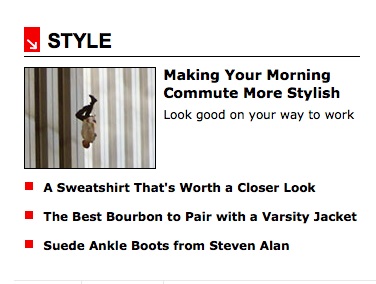
    AT&T was not the only company to bring the facepalms this past 9/11. Esquire Magazine’s online server accidentally posted an iconic photo next to a headline for another article. Instead of describing it, here’s an example of “a picture is worth a thousand words” :

    Image

    Following the post, Esquire tweeted a half-hearted apology saying, “Relax, everybody. There was a stupid technical glitch on our “Falling Man” story and it was fixed asap. We’re sorry for the confusion.” I imagine that Esquire did not consider their Return on Investments (ROI) when posting this tweet. While such outrage over a glitch may seem silly, taking the time to post a genuine apology would secure their consumers and perhaps draw in more. Because the Huffington Post reported on the incident, consumers from all over the world could unsubscribe from the magazine, causing a bad ROI for Esquire. It seems that a genuine “I’m sorry” tweet from the magazine would be far worth the investment it takes to produce the post. Instead, they received a negative return in response to their unenthusiastic efforts.

    #fail #facepalm

    -Dylan Fowler

  • PR Disaster in Wake of Natural Disaster

    It has been exactly one year since Hurricane Sandy first hit the coastline of the United States. Much of the news media last October covered Hurricane Sandy and the damage that it caused. With all the focus on such a serious event it was important that brands and companies remained sensitive to the issue at hand. However this is exactly what several brands, including American Apparel, did not do. American Apparel was criticized for their promotion of their “Sandy Sale” during the storm. The ad stated, “In case you’re bored during the storm just Enter SANDYSALE at Checkout.” The sale was only available in the states that were most impacted by the storm, which included Connecticut, Delaware, Massachusetts, North Carolina, New Jersey, New York, Pennsylvania, Virginia, and Maryland.

    Image

    During this disaster consumers were most likely expecting to see messages that were heartfelt and encouraging, not promotional social media ads for clothing companies. This violation of expectancies caused by American Apparel created negative backlash from not only their consumers, but also the public. The Expectancy Violation Theory states that the outcome of negative communication may result in uncertainty in people’s behavior. A consumer replied to American Apparel’s ad by tweeting that she will forever boycott their stores. This consumer, along with many others, probably became uncertain if they wanted to purchase from this brand in the future.

    Image

    Another aspect of the Expectancy Violations Theory explains that reward from the violation can be either negative or positive.  In American Apparel’s case, the ‘reward’ was negative.  In most cases, a negative reward is met by socially acceptable behavior in attempt to correct any violation, but the CEO of American Apparel did the exact opposite.  In response to the unfavorable backlash,  he stated that, “I don’t think our marketing guys made a mistake. Part of what you want to do in these events is keep the wheels of commerce going,” he told Business Week. “People shopped on it. We generated tens of thousands of dollars from the sale, but we’ll probably lose a million dollars from this (storm) event at a minimum. We’re here to sell clothing. I’m sleeping well at night knowing this was not a serious matter.”

    Over the years, “Made in the U.S.A.” has become American Apparel’s trademark marketing approach, but in this particular situation, nothing could be less depicting of American ideals and morals than this failed attempt to generate income.  This and other failed public relations ventures should be seen as an example of what not to do during a national crisis.  The way we see it, during crises, PR specialists and media relations professionals should proceed in one of two ways.  Either stray away from social media, or only produce messages that do not promote one’s brand.  In the long run, this situation did not make a lasting impact on American Apparel, but if you were the CEO, how would you have responded to this negative feedback? When have other brands violated your expectancies in a positive or negative way?

    -Aaron Love, Kara Zimmerman, Rachel Clay, Rebecca Hobbs

  • The Top 5 Personal Brand Fails To Avoid In A World Of Cyber-Everything

    Presentations are everything in life, and in a sense, we are always marketing ourselves to the public with our voices and actions. These components work together to create a brand image for each person as an individual. James Twitchell claims that a brand “is the application of a story to a product or service,” so it is important to realize what stories your life is telling and what images you are portraying. Many people tend to forget that online communication can be extremely harmful to a personal brand, and often diminish their brand images with common mistakes. The top 5 personal brand fails to avoid have been listed to help strengthen and build who you are as a brand.

    # 1 – Oversharing

    Although the tailgating and partying of your undergraduate days may be over for the most part, many forget that the pictures and posts that documented all those nights have not. Not only do people look at all of the bits of information people say and share, but posts remain in cyber space long after they are forgotten, and are easily and readily available for anyone and everyone to see.

    Susan Adams wrote an article on managing online reputation, one of her key points was this: “Keep private things private, while assuming nothing is truly private.”

    Everything about you on the Internet comes together to form a picture of your personality, even if you feel this picture may not be true to who you are. Think treating the Internet as a diary doesn’t matter? Oversharing has been linked to: self-incrimination, break-ins, loss of employment, and failed relationships.

    Having trouble entering the workforce? You may need to examine what’s on your social media sites. Employers routinely search applicants to see what type of information, pictures, and statuses pop up. Besides not being able to land you a job, oversharing can also get you fired from one. Monster.com shared how an employee took the day off from work, telling his boss he had a funeral, however, later that day the employee posted pictures of himself at a party. His boss found out, and naturally he got fired.

    Every time you go to post something whether it be as a status, tweet, wall post, share, picture, whatever- think to yourself, “Is this TMI? Would I want my employer to see this? Would I be proud of this years from now?”

    # 2 – Underestimating Technology

    We’ve all heard of Snapchat , the application that allows you and your friends to take ridiculous photos that once viewed, are immediately deleted… until recently. Not only can people screenshot your snap, but a counter-application called Snaphack has brought into question whether or not the photos you are sending are truly being deleted. Snaphack allows users to save screenshots of snapchats. Once saved, these photos can be uploaded to social media outlets such as Facebook or Twitter. One of Snapchat’s original uses was for sending racy photos, and Snaphack could easily lead to some very personal pictures being published for all to see.

    Snapchat is just one of the many applications that at face value seems harmless and fun, but could easily affect employment opportunities. Being aware and responsible for everything you send via any technology medium is essential to keeping your personal image a good one. So next time you think it might be funny to send a Snapchat of you and your friends doing something questionable, make sure you would be okay with seeing it on the Internet the next day. What you might think is funny during the time, won’t be funny if it is found on your employer’s desk the next morning.

    # 3 – Not Staying Up-to-Date With the Latest Social Media Sites and Apps

    Facebook, Twitter, Pinterest, Vine, Instagram, LinkedIn, -the list is constantly growing and evolving when it comes to social media sites and apps available for public use. One of the biggest PR fails that people tend to overlook is not taking advantage of these social media techniques as a way to catch employer’s eyes, and to network.

    Understanding and taking advantage of social media sites is essential in a world that is each day growing more reliant on technology. Where in the past employers only had a resume and a portfolio to judge a candidate for a job position, now the possibilities for judgment are endless. So why not take advantage of it? Take for example LinkedIn, a social media site that caters specifically to people to network professionally and allows users to connect with one another and build and maintain a broader network of professionals you can trust. It is a smart way of getting your personal name and brand out there for employers to see.

    The website is helping people get jobs, so make a great move for yourself and join if you haven’t already!

    # 4 -Talking Badly About Your Boss… Or Anyone For That Matter

    In order for anyone to be happy with his or her job there must be a positive work environment. Most of us have had that one job we hated because of co-workers, company standards, the work itself, or the boss. In these sort of situations, trash talking seem to come with the business. So, for future and recent graduates we want to warn you, one of the biggest fails you can make in your career is talking trash about your boss, company, or coworkers online.

    Recently, this video, featuring Marina Shifrin quitting her job, went viral on YouTube. You have probably seen it, but please feel free to watch it again and laugh.

    Funny right? Except for the fact that her past boss knows how she really feels about him and her future employers will undoubtedly see her as unprofessional. So, as a rule of thumb, always save your rantings and trash talkings for your parents and close friends because if you share your personal (and most likely unprofessional) opinions and the wrong person sees it , you can kiss recommendations good-bye, as well as turn your personal brand image into that of a spiteful person.

    (Also, take a look at her ex-boss’s response.) 

    # 5 – Poor Grammar

    Poor grammar can affect your brand and your career. Anna Underhill, a consultant for a HR firm, said poor spelling and grammar has become a serious issue for employers. Writing is the main way communication takes place via employers and employees and clients. Having poor correspondence in writing undermines the professionalism of yourself as well as your company.

    Communication skills are consistently rated in the top 10 things employers look for. Knowing the difference between affect/effect, their/there, its/it’s, should be common sense not consistent mistakes. While shorthand and abbreviations are the norm in social media, that type of writing should never be integrated into business composition.

     Erik Deckers asks for you to think of it this way: If you receive a cover letter from a perspective employee filled with errors, would you hire that person? What sort of message are you sending to potential business partners when your initial email is riddled with mistakes?

    Make your personal brand an effective one that highlights all of your best qualities. Don’t be afraid to jump into the cyber world to “sound [your] barbaric yawp,” but be cognizant of the do’s and don’t when it comes to establishing and maintaining a great image.

    Savannah Valade, Jade Lester, Caroline Robinson, Morgan Jones, Meghan Carey

  • Social Media to Help Others

    The invention of social media has changed the way we communicate as individuals. Today we are constantly connected to one another whether or not we prefer to be. Social media has not only been used to keep individuals in contact with other individuals, but as a way for businesses to communicate and connect with their consumers. Social media interactions focus on building customer relations and fulfilling the expectation “that customers expect brands and businesses to be there for them everywhere, across mobile and social media.” 

    While for-profit businesses try to drive consumerism behavior, non-profits try to drive behavior towards volunteering, donating, rallying, etc. Social media offers an inexpensive but powerful way to recognize and encourage desired behavior. Social networking sites allow non-profits to quickly announce, update, or reiterate the needs or goals of the organization itself or the publics they are trying to help, to vast numbers of people. This becomes largely helpful in raising awareness of time sensitive or unexpected events, in particular during times of crisis. Whether natural or humanitarian, social media can allow to-the-minute updates of the severity of the situation and the needs of the victims. One recent event in Kenya has proven just how successful a non-profits needs can be filled when using social media.

    On September 21, 2013 terrorists with the Islamist militant group Shabab in Somalia (linked to Al Queda) invaded a Kenyan mall. Westgate Mall is a 5-story upscale mall that represents the country’s growth and prosperity. A little before noon the Shabab conducted a double attack on the mall with heavily armed attackers storming into the mall from two different entrances and opening fire on shoppers. The shooting rampage soon turned into a hostage situation as many of the shoppers were trapped inside. As night fell, two special units moved in to try and rescue hostages and stop the attackers. The situation lasted for four days and concluded with over 60 deaths and 175 people injured.

    During the Westgate crisis the Kenya Red Cross (KRC) stepped up their game and became a prominent first responding unit. Performing the normal duties of any Red Cross organization they helped to alleviate those involved in the Westgate disaster by holding blood drives, setting up triages, and creating missing persons list, but what the Kenya Red Cross did the best during this crisis was communication.

    From the start of the shoot out the KRC began sharing information about the crisis through the social media platform Twitter. As the events unfolded their tweets consisted of calls for blood donations, updates to where people could report and find the status of missing persons, and updates on changing traffic patterns.

    example of info & blood tweets

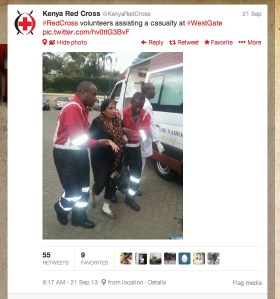
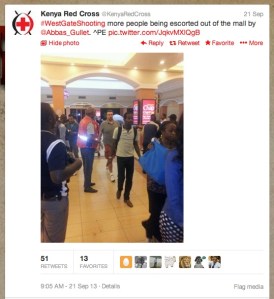
    They even tweeted pictures giving Kenyans and people around the world a first look at the crisis.

    KRC helping victims people being escorted out of mall

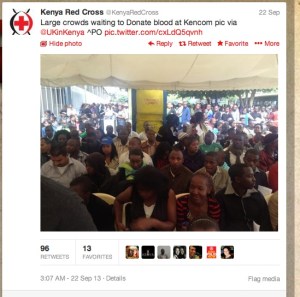
    Using Twitter was a way the KRC could not only rally support and share information, but show their role as a non-profit to the world. Unifying the people of Kenya in this moment of crisis was their biggest accomplishment. This success was shown in the turnouts of volunteers and blood donors they received in the following days of the ordeal.

    large crowd turnout

    Even though the terrorist attack ended days ago the Kenya Red Cross is continuing their efforts to help those affected through the social media platform. They have collected 11,293 units of blood and are reporting the money raised and what it is being used for to the public – all through tweets. Their ability to reconnect people after disaster through Twitter makes them a shining star in non-profit social media use.

    The Kenya Red Cross used social media to inform people all over the web of an important issue, as well as what solutions could be offered to help. This represents agenda setting, the theory that the media have the ability to tell people what issues are important around the world. This also involves controlling the topics people discuss and become concerned with, so by using Twitter, the Kenyan Red Cross regulated the conversation of many people who were directly affected by the disaster. An awareness of the situation was presented, therefore the crisis was held at a higher level of importance because of the media outlet that was used.

    It is clear through the Westgate Crisis that social media can be used successfully by non-profits that respond and work through disasters.  Social media will prove again and again to be a useful medium to help victims, bring together volunteers and unite the world in times of crisis.

    Caroline Robinson, Jade Lester, Meghan Carey, Morgan Jones, Savannah Valade.