Tag: Sports

  • UNCWAthletics: Selection Sunday

    As Spring Break winds down and the ashes begin to settle in many vacation locations, a new fire is kindling in Trask Coliseum.With their win over Hoffstra UNCW Men’s Basketball has clinched their 5th CAA title and a ticket to the NCAA Tournament for the first time in 10 years.

    CAAMBBChampionsSplashPage.png

    As a result, UNCW is holding a Selection Sunday Celebration in Trask Coliseum on Sunday March 13th, which just so happens the Sunday directly after Spring Break. The UNCW Men’s Basketball team has been a hit sensation this year, for good reason, and as always it’s the fans that drive the team’s spirit. There’s nothing more comforting than a coliseum full of students cheering for you right?

    YNMVSSPYSWDDNHA.20140310120433

    The great thing about UNCW Athletics is their level of interaction with their fans. Selection Sunday will be the first time the Seahawks will know who they’re facing in the first round of the NCAA tournament and inviting fans to join in with them encourages a sense of school pride and school spirit that can often seem lacking here. UNCW Athletics goes for the kind of inclusiveness you don’t see at a lot of other schools and always looks out for players and fans.

    passthru_imagecredit_selection.jpg

    Looking for something to do now? Come out to Selection Sunday and support our Seahawks as they prepare for the next step in their journey. The schedule is as follows:

    4:30 p.m. – Doors open
    4:45 p.m. – Entertainment
    5:10 p.m. – Team Introduction
    5:15 p.m. – 2015-16 Highlights
    5:30 p.m. – Selection Show

    There will also be an autograph session and a “selfie station” with the CAA championship trophy and the sign that goes with it. Have you been following the explosive Seahawk season? Who do you think UNCW will be up against? Are we going to take home another trophy this season? Let us know what you think in the comments below!

    Oh, and did I mention the leading scorer Chris Flemmings is a Communication Studies major? #COMLovesAthletics

    -2OVISSp

    -Allen, Austin, and Lane

  • The UNCW Tradition That Misses the Mark

    If you attend UNCW then there are many traditions that you are probably aware of. Wagsgiving, Ooze Ball, and maybe even Hawk it Out. There is one that you might not be aware of, and that would be Homecoming. Wait, what? Shouldn’t Homecoming be one of the biggest events of the year? Well you would be right if it were any other school. For various reasons our Homecoming is not as big as other universities. Some blame the lack of a football team, others say it is our overall school attitude, while others claim there is a gap between awareness and motivation to attend.

    For UNCW, Homecoming can be an opportunity to strengthen the sense of community among current students, alumni, and the surrounding populace. Uniting for the same purpose, to support the same school and cheer for the same team, instills a firm sense of pride. Pride can be a powerful tool. Think of UNC Chapel Hill. UNC students, alumni, and even fans have a strong sense of pride in their school and in their team. Most everybody knows who the Tar Heels are and a large number of people want to be part of their team in one way or another. Through this, the students, alumni, and fans are creating awareness. This is called Word of Mouth Marketing and allows for the marketing campaign to basically run itself. It is a necessary tool in creating a lasting tradition and instilling a strong sense of pride. So what pride essentially does, is ensure that no matter what, the school will always have a market for new students and an ever-lasting fan base. 

    CHFB

    The question is, how can Homecoming become a successful tradition? It is a common assumption that our Homecoming participation is low because we do not have a football team, which is also why our Homecoming is in the spring. However, if we stay with the example of UNC Chapel Hill, we see that a football team is not what makes the Homecoming event successful. Their fan base lies largely in their basketball team just like UNCW’s. The issue comes in the form of getting people motivated. Motivation begins with awareness and bridging the gap between the two starts with promoting involvement opportunities. People care more about events if they have a hand in creating them.

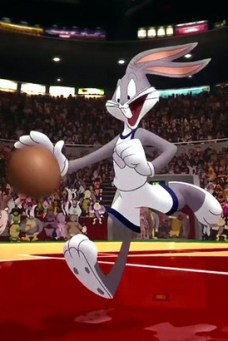
    rs_560x415-140221174341-1024.LeBron-James-Space-Jam-Bugs-Bunny-Basketball.ms.022114_copy

    There are ways for students and student organizations to be involved in Homecoming. Some include participating in the annual banner contest, the Intercultural Fest (iFest), and by competing for Homecoming King and Queen. One of the most successfully advertised Homecoming event is Dub Idol. This is one of the first traditions that many freshmen hear about even before they arrive. If every event were advertised and instilled into the students as much as Dub Idol then the level of involvement could potentially increase. Implementing some new advertising techniques could be a start so the lesser known events become a staple. There is already an emphasis on reaching alumni, but in order to target the students, utilizing Social Media is one of the best options.

    Overall, Homecoming is a tradition that every UNCW affiliate could participate in and has the potential to create an environment that allows students, past and present, to market their spirit and their pride. It is difficult to change a mindset, but Homecoming is moving in the right direction and with a little help from students it can become one of the most anticipated events of the year. One thing is for sure, we will be out this weekend participating in any events we can in order to increase student involvement and show our support for UNCW’s Homecoming. 

    HomecomingGrid

    -Austin, Jonathan, & Kaela

  • The Phenomenon of Dub Hockey

    hockey team pictureUNC Wilmington, a university that many students have characterized as “chill”, gets surprisingly heated when comes to ice hockey. When one thinks of college and ice hockey, they typically imagine it being played competitively in northern states. The same states where devoted hockey fans can be seen sporting the logos of their favorite hockey team on their snow-covered winter jackets. At UNC Wilmington, however, students can spend a Friday afternoon relaxing on the beach, sporting their Dub Hockey t-shirts, then spend the night getting rowdy at the local ice rink.

    Since its creation in 2004, UNC Wilmington’s club ice hockey team has become something of a phenomenon. Not only would it surprise an outsider to find a successful ice hockey team within the warm climate of the Carolina shoreline, but they would be in for an even bigger surprise when they showed up to the Wilmington Ice House. They would find it packed with a sold out crowd, a crowd consisting of excited and enthusiastic supporters loudly cheering on the their beloved team. After reaching the ACHA Division III national tournament in 2014, the unlikely ice hockey team has shown they are a force to be taken seriously.IMG_1338So where does all the energy surrounding the hockey team come from? Largely, it is generated by the team itself. It is hard for UNCW students not to notice the team when they lace up their skates to roll up and down the ever crowded Chancellor’s Walk, in uniform, carrying sirens and horns, while shouting about the upcoming game. The players display an enthusiasm that is, simply put, infectious. They broadcast the same high energy level they hope to receive from the fans. They actively create the brand of Dub Hockey. With the team’s outgoing advertising, as well as their social media presence on Twitter and Facebook, not only do they regularly reach max capacity at games, but those fans who manage to get inside are always full of spirit as they cheer, chant, and pound away at the glass separating them from the ice, demonstrating the level of their support.

    “It’s incredible how rowdy our fans are. We don’t see anything like it at any of the other rinks we go to,” remarked Kevin Mullaney, the team president during the successful 2014 season, in an interview with WRAL.

    The first game of the 2015 season was played last Friday against Elon University. They put on a show as they fought for a 6-4 win against the Phoenixes in front of a max capacity crowd. It would seem that this unlikely group of hockey players will continue to cause UNC Wilmington to lose their chill at the Wilmington Ice house for another season of Dub Hockey.

    Sold out game

    – Austin Moody, Griffin Weidele, Allen Wooten, Scott Uraro, Luci Keefer

  • Are you ready for some football? Tom Brady is!

    With the NFL’s first regular season game on Thursday, sports fan across the nation anticipate returning to their fantasy football leagues, their favorite team’s bar, or even just their living room couches every Sunday to watch professional football. The NFL will dominate the American sports and entertainment industry for the next seven months, especially the TV ratings, and will continue to rake in a massive financial profit. As the NFL and its fans prepare for the new season, they continue to deal with incidents from last season and question if the commissioner of the NFL, Roger Goodell, will be able to retain his position much longer.

    The NFL has been involved with a plethora of negative PR instances in recent years and the organization does not always handle these situations appropriately, which only leads to backlash from the various publics and football community. Commissioner Roger Goodell’s decision to suspend New England Patriot’s quarterback, Tom Brady, for four games at the start of this season was overturned last Thursday by Judge Richard Berman. Tom Brady’s suspension was over the highly publicized “Deflategate” scandal, concerning his potential involvement in the incident that occurred before the Patriots win over the Seahawks earlier this year in Super Bowl XLIX. After the federal judge’s decision to overturn the suspension, the NFL is once again in a terrible position as the season is about to get under way and as reporter Bob Kravitz put it, “leaves the NFL with ‘egg on their face’”.

    It is clear that Commissioner Goodell picked the wrong fight with NFL poster-boy, four-time Super Bowl champion Tom Brady and there are few actions the current commissioner can take to rebuild his image. He has already lost the trust of players, has a dreadful win-loss record in court, has displayed awful values of the NFL, and lost his credibility. For example, Ray Rice was initially only suspended two games for punching a woman, a charge much more serious than a couple footballs being slightly deflated. However, the NFL ultimately suspended him indefinitely, which was eventually overturned in court through an appeal by Rice.

    In addition to Ray Rice, Adrian Peterson, Greg Hardy, CJ Spillman, Ray McDonald, and even Jameis Winston are no longer just incidents dealing with violence or domestic abuse. These negative occurrences are all actively shaping the NFL community and the image that the NFL portrays. It tends to show that the NFL does not maintain outstanding values and they prioritize morals a bit differently from the American public. All of the players previously mentioned are all still eligible to play in the NFL at this current moment, yet Tom Brady was nearly suspended for four games for his knowledge of footballs being deflated, making one question the values of the NFL even more intently.

    Following the Ray Rice incident last year, polls showed that the American public was already calling for his resignation. If Goodell is to maintain his role as commissioner and face of the organization for the foreseeable future, he needs to try to recreate his image since it is viewed so negatively. He needs to speak openly about the instance, consider relinquishing his disciplinary rule, hold a press conference, or use the NFL’s PR department to the best of their ability. As the rest of American society prepares for what is the highly coveted and entertaining NFL season, the NFL organization will attempt to wipe some of the ‘egg off their face’ that the Deflategate deliberation left on.

    – Griffin Weidele, Austin Moody, Luci Keefer, Allen Wooten, Scott Uraro

  • Banking on Bracketology

    Even if you’re not a fan of college basketball, you’ve likely heard friends and colleagues exclaim about their “busted brackets” as of late. The NCAA Division I men’s basketball tournament, billed as “March Madness” runs throughout the month of March and is one of the most popular spring sporting events. The tournament begins with 64 teams and ends with the championship game in April. Part of the fun of March Madness, is Bracketology, the science of pitting teams against each other to predict the outcome of the tournament. It gets pretty serious–billionaire Warren Buffett of Berkshire Hathaway even offered $1 billion to whoever fills out the perfect bracket.

    Where does Bracketology intersect with IMC? The answer lies in the “good hands” of Allstate. 2014 is the insurance company’s third year as official sponsor of the NCAA tournament. This year, Allstate’s antagonistic character, Mayhem, is breaking brackets in a series of Tweets, Facebook updates, and Vines. While Mayhem is infamously known for causing car wrecks and burglaries, the Leo Burnett-created “March Mayhem” campaign makes light of Bracketology. Watch as Mayhem breaks, bends, and even blends busted brackets.

    March is Mayhem

    “March Mayhem” is Allstate’s social media component of its NCAA tournament campaign. During TV coverage of the tournament, the company sponsors the “Good Hands Play of the Game” and is rolling out increased advertising for its homeowners insurance. Pam Hollander, Allstate’s senior IMC director, points out that the campaign goes on as the tournament progresses, taking into account how different teams perform in the tournament. She says the campaign features direct engagement with fans. Mayhem acts as a direct engagement tool to connect and learn more about Allstate’s social media-savvy audience. With Mayhem, interpersonal communication takes place in an ad campaign, personifying the brand’s relationship with the consumer.

    Mayhem isn’t the only insurance character with social media presence. Representing insurance companies big and small: the Gecko, Flo, Jake, and J.J. Hightail each interact with their Twitter followers. One of the strong points of the March Mayhem campaign is how it takes advantage of the Bracketology phenomenon to establish a connection with the consumer. Using a popular social trend in a social media campaign exemplifies the personification of brands.

    Do you believe using Bracketology in advertising is effective? How have you seen other brands use social phenomena in their advertising?

    Nathan Evers

  • Ambush Marketing, Rule 40, and the Sochi Controversy You Aren’t Hearing About

    Have Olympic advertising partnerships gotten too big? Have rules and restrictions protecting these “official sponsors” gone too far?

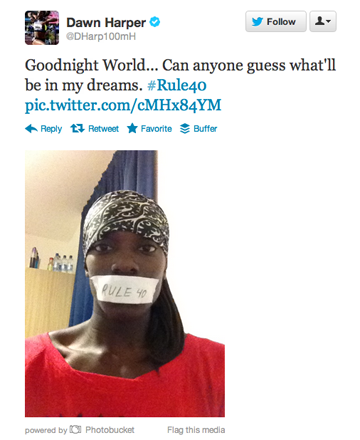
    Dawn Harper Tweets her Opinion of Olympic Rule 40
    Dawn Harper Tweets her Opinion of Olympic Rule 40

    Two-time track and field medalist Dawn Harper thinks so.  That’s why she posted this tweet with #Rule40 in protest of the IOC’s infamous Rule 40 during the 2012 Olympics in London.

    If you aren’t yet familiar with Rule40, it is a total ban on an athlete’s promotion of personal sponsors and their ability to acknowledge those who helped them get where they are today. It is especially focused on social media, where it has become a commonplace for athletes to thank sponsors with pictures and personal statements.

    Harper isn’t the only athlete to voice her displeasure with the effective “gag order” on competitors, but with companies spending upwards of $100,000,000.00 to associate their brands with the Olympics Games, is it really that hard to see why #Rule40 is in effect?

    Some have even gone as far to refer to the situation as a “battle”. Yet, despite the activism surrounding #rule40, without a doubt the biggest threat to the official Olympic sponsors is the ever-pervasive ambush marketers, silently stalking and waiting for their chance to steal some the Olympic brand name.

    These controversial ambush marketing campaigns attempt to capitalize on high-visibility events and locations through brand association without having to pay for the high-cost of officially sponsoring an event. My favorite example of ambush marketing involved the Minnesota Timberwolves selling this advertisement on the side of their stadium, where it happens to only be viewable from inside the nearby Minnesota Twins baseball stadium (where the official sponsor is Target).

    View of Timberwolves basketball stadium from inside the Twins baseball stadium
    View of Timberwolves basketball stadium from inside the Twins baseball stadium

    Ambush marketing may have been around in the advertising world for years, but the Olympics are seen as “the flagship event for ambush marketing”. Creative campaigns by infamous ambush advertisers like Nike often times attract more online buzz and conversation than the actual official sponsors.

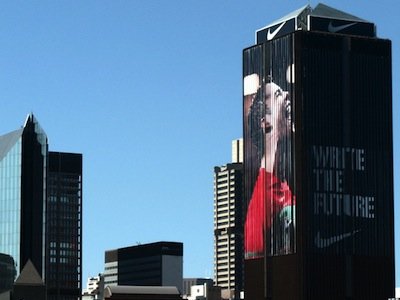
    During the 2010 World Cup in South Africa officially sponsored by Reebok, advertising juggernaut and infamous ambush marketer Nike, placed an eye-catching ad on the fourth tallest building in the entire city of Johannesburg. When paired with a lengthy viral video, many agreed that Nike had effectively hijacked the sponsorship from Reebok and gained closer brand association with the World Cup event.

    Nike ad in Johannesburg during World Cup 2010
    Nike ad in Johannesburg during World Cup 2010

    Another ambush marketing giant, Subway, has already launched its attempt to steal some association from the upcoming Sochi games.  Summer Olympian Michael Phelps and retired speed-skating icon Apollo Ohno both appear in TV commercials for Subway’s “$5 foot long campaign” due to some legal loopholes discovered by Subway.

    So is it reasonable for the IOC to implement Rule 40 to help protect sponsors? Freeskiier David Wise recently commented that, “[he] understand[s] the Olympics are a moneymaking game, but it’s sad for [him] to have all these sponsors who have really taken care of [him]…[he’s] on the biggest stage [he] can possibly be on and [he] can’t give them the representation they deserve.”

    Another athlete and social media enthusiast, Nick Goepper, has stated that he will be completely off of social media for the entirety of the Olympics. “I think it might be safer not to tweet anything,” said Nick, the 19-year-old favorite to win Ski Slopestyle gold. “All I know, it’s pretty much zero tolerance for branding.”

    The Sochi games are only 3 days away, but the media blackout protecting the games’ sponsors has been in effect since January 26. When the final medal is awarded and the closing ceremonies complete, which brands will you associate with the games? Which advertisements and commercials will be the most talked about and discussed? Is $100,000,000 too much to pay for a loose association with the Olympic rings?

    Will the “ambushers” steal the spotlight once again?

    – Greg Rothman

  • Name Changer

    Tailgating, body paint, jerseys, good luck rituals, and an unparalleled fraternity all exist as part of sports fandom. People love their teams – and love anyone else who also loves their team. Such loyalty has become an integrated part of sports culture sociology.

    Social Identity Theory states that by wearing team colors, attending games, knowing the players’ names, positions and stats, a fan begins to feel as if they are an integral part of the team – they connect with the team as if they were playing the game themselves. This connection explains why even poor performing teams have avid supporters. However, it is ultimately marketing that fosters fan identity. After all teams are brands; encompassing colors, logos, and mascots.

    fans, blog 3

    Fan loyalty has elevated sports to become part of our commodity culture; a product to be bought and sold, meaning big bucks for team owners. High-level sport has been transformed into a commercialized, commodified, and massified phenomenon. Therefore, fan identification and brand commitment become two key factors in managing and marketing a team. Building a brand is hard, but building and maintaining a culture of fans is much harder.

    As we transition into fall, we know that means one thing in sports,  football is king. With the NFL season in bloom, one team in particular, the Washington Redskins, are off to a rough start. The return of RG III has been very anti-climactic and on top of the team’s poor performance, a greater worry looms in the background: the franchise is under pressure to change the team name.

    Many believe the team’s name, “redskins”, is derogatory and racist due to its historical connotation and use to alienate and belittle Native Americans. The acclaimed Peter King from sports illustrated has even decided to stop using the name, saying, “I don’t want to add to the offensiveness.” Pressure to change the team’s name has been mounting for years and this past spring 10 congress members sent letters to the team owner and NFL requesting them to change the name. One Native American group, the Oneida Indian Nation, has started to take action and run ads in D.C. about the offensive name in hopes of rallying up support.
    rs logo, blog 3

    Whether you are an avid supporter for the name change, an avid supporter of the Redskins, or just don’t care, you can’t deny that team names mean a lot in the sports industry. Which leads us to the question: does a new name mean a new team? Does the team culture change when a team redesigns?

    These are exactly the questions the NBA juggled this past summer when they chose to revert the Charlotte Bobcats back to their former team name, the Charlotte Hornets. Coming onto the basketball scene in the ’90s, the Charlotte Hornets created a unique culture. With Hugo the Hornet as the mascot and teal uniforms, the Charlotte Hornets were a recognizable brand. So when the NBA decided to change the team name it was a hard transition for many loyal and devoted fans. Unable to identify with the new team and culture the fans gave up support and the fall of the Bobcat brand ensued.

    Reverting back to the original team name rejuvenated Charlotte fans. There was an immediate increase in the amount of ticket sales; quantitative proof that the Hornet name had been sorely missed. By keeping the team name consistent with what the fans wanted, the Charlotte basketball team re-strengthened their brand significantly.

    However, Washington, unlike the Bobcats, doesn’t have a sorely missed brand. In fact, the Redskins name is so beloved the proposition of changing the team’s name is being met with great opposition. Owner Daniel Snyder commented he would never change the name saying, “the Redskins’ fans understand the great tradition and what it’s all about and what it means.” Even NFL Commissioner, Roger Goodell, described the team name as a “unifying force that stands for strength, courage, pride, and respect.”

    Even if Snyder wanted to change the name it would be hard to change the minds of brand followers who have spent years identifying with the team, purchasing the merchandise, rooting for the players, and most importantly making memories. Ditching the derogatory name may ultimately come to a forced decision but the implications involved are massive. It boils down to a relatively simple equation: fan identification and brand commitment work together to produce the main goal in sport commodity, revenue. So the most important factor to ponder: the fans. How is the team going to remarket and rebrand to get fans to commit to a team they may no longer identify with?

    Savannah Valade, Caroline Robinson, Meghan Carey, Morgan Jones