Tag: Politics

  • Ron Paul, Who?

    Over the past eight years, the media coverage regarding Ron Paul has been very lackluster to say the least. Although most of the coverage he has received has been positive, the overall amount is significantly lower than the other candidates running. The messages he supports are often considered the most accurate and truthful by any candidate and many believe him to be the most qualified for the political office. However, the media seems to have its own agenda, and seem to have a different idea on who should be the frontrunner.

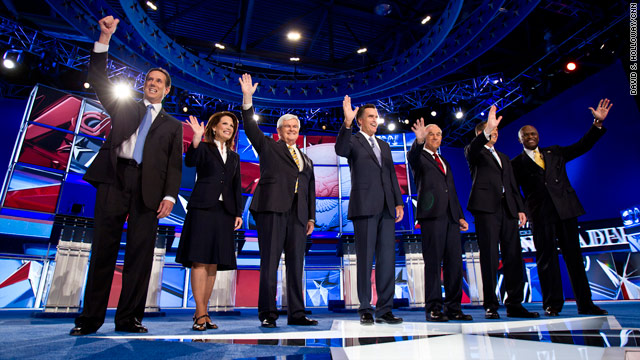
    Although there are four candidates, CNN seems to believe that only three are relevant. Missing from this photo is Ron Paul, sitting just left of candidate Santorum.

    Both CNN and Fox News are partially to blame for this so-called “media blackout”, and have not been giving fair coverage to Congressman Paul. When it comes to debates or discussion, Ron Paul seems to mysteriously disappear from the subject and is often overlooked. In a recent interview with Fox News, he states that he has observed that the amount of coverage on himself post-debate has a ratio of about 90:1 in favor of his opponents. This shows a tendency that the media does not believe that Ron Paul has the ability to win the candidacy and therefore neglects to give him adequate coverage.

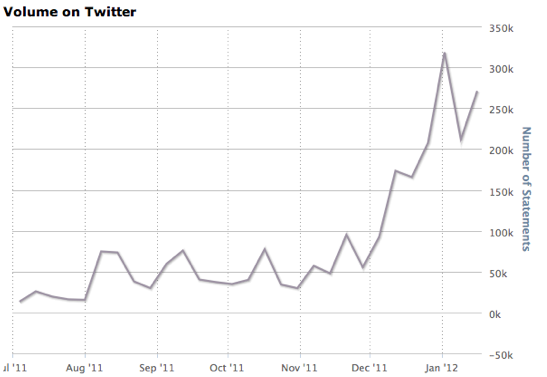
    Although the media coverage on Ron Paul is largely absent from television and news broadcasting channels, he receives overwhelming support on major social media networks. Seeing as the majority of his supporters are those of a younger generation, Twitter plays a large part of his support and communication between his fans. During a recent poll, the Washington Post found that from July of 2011 to January of 2012 that the amount of mentions on Twitter significantly increased from about 30,000 to almost 260,000. Compared to Newt Gingrich who had 294,000 mentions, Ron Paul still comes in second. Luckily, thanks to his many loyal supporters there is still a good chance for him to succeed despite the media’s lack of belief.
    Leslie Tyler, Leanna Marshall, Bryce Koonts, Julius Roberts

  • Why did you vote for THEM?

    The strength of political party’s brand largely depends on knowledgeable voting consumers who understand what the brand has to offer.  However, no matter what a person thinks about a particular party, everyone tends to come to an agreement that the strength of a brand can quickly collapse. If the party is viewed as divided or sending incompatible messages, their voter’s perception of the cohesiveness breaks down and credibility is lost.  Although, if the party is perceived as being more “exciting” and innovative the voters are more likely to pardon their misdoings.  According to Gareth Smith and Alan French, “as all political brands try to appear trustworthy and honest, transgressions pose a clear threat to political brand relationships.”  They also stress that the overall brand must satisfy their needs when it comes to “the competitive nature of the political market, the credibility, attractiveness and personality of its leaders, and the party’s perceived salience and credibility in fulfilling its promises.”

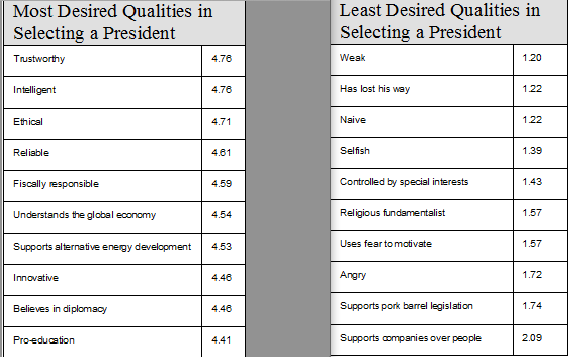
    A politician’s campaign for the Presidency is no different than a company marketing a product or service to a target audience.  Just like in marketing, it’s important for politicians to conduct research and gain knowledge about what their target audience perceives to be important and credible.  During the 2008 election, Brad VanAuken, author of Brand Aid, developed, conducted and analyzed a survey given to 100 people from 29 states on political branding strategies.  He hoped to gain insight into the personality traits often associated with strong and powerful political brands.  Through his research, he established two lists; the most desirable and the least desirable qualities for potential Presidential candidates.  Two of the most desired qualities for a potential President include trustworthiness and intelligence. On the other hand, two of the least desired qualities include using fear to motivate and supporting companies over people.  Political candidates should integrate these characteristics into their brand to appeal to their target audience.


    With the upcoming elections, politicians can take this study into consideration when developing a campaign to promote their personal brand.  It’s important to remember that consumers can make or break a political candidates’ chances of becoming our next President.  Candidates should do whatever they can to connect to their audience.  People feel more of a connection with a political brand if there is access to online interactions. Obama successfully created an online community to establish social networks to recruit and fund-raise among the local community. The Internet has become a means of relationships with its voters and will be of importance for the future political brands.

    “Political brands clearly face a challenging future with the only certainty being that old strategies such as the occasional re-branding and change of leader will be insufficient to address the core concerns that consumers have of them. As the world becomes more interrelated, nation states are increasingly unable to deliver on their promises to electors; electors who are increasingly aware of the brand’s attempt to influence them and less prepared to accept their right to do so.” –Gareth Smith and Alan French


    -Kelsey Bendig, Andrea Blanton, Brooke Keller, Brian Burch


  • Today’s Politics in the Internet Age.

    With the Republican Primaries and Caucuses well underway, the candidates are narrowed down to the four main contestants. Mitt Romney, Rick Santorum, Newt Gingrich, and Ron Paul are campaigning across the nation and participating in debates to convince voters that they are what the nation needs in a candidate. How do the general public learn information about the candidates though, if they aren’t campaigning in their state? The answer is found on the candidates’ websites.

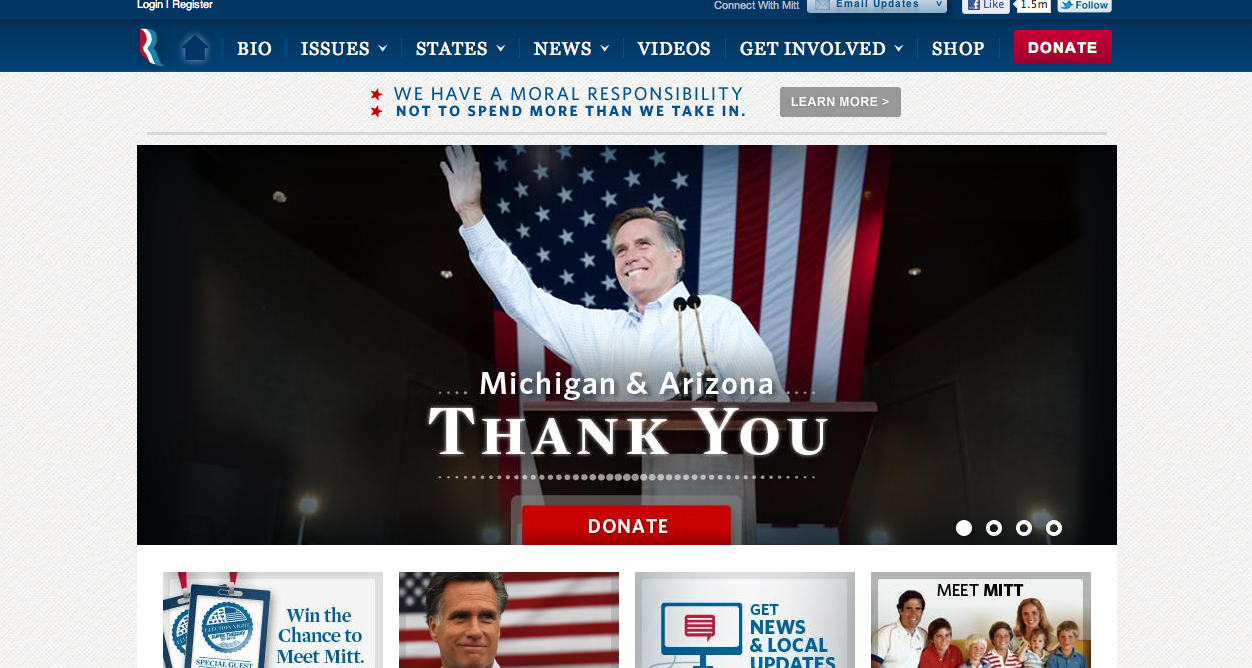
    Mitt Romney uses his website to thank the voters in the states in which he was victorious.

    Each candidate has their own website, run by their political team and volunteers that keep their information (like interviews, media, photographs and messages) up to date. On these sites are direct links to the candidate’s social media outlets, such as Facebook and Twitter, and their Youtube channels to watch ads that have been produced.

    Rick Santorum's website has his beliefs and campaign strategy on the main page.

    Something you will notice on each candidate’s page are donation links, most notable on candidate Ron Paul’s page who needs the money to continue his campaign. For those who want to support their favorite candidates, there is no better way than to go online and donate to their campaign using links found on each site.

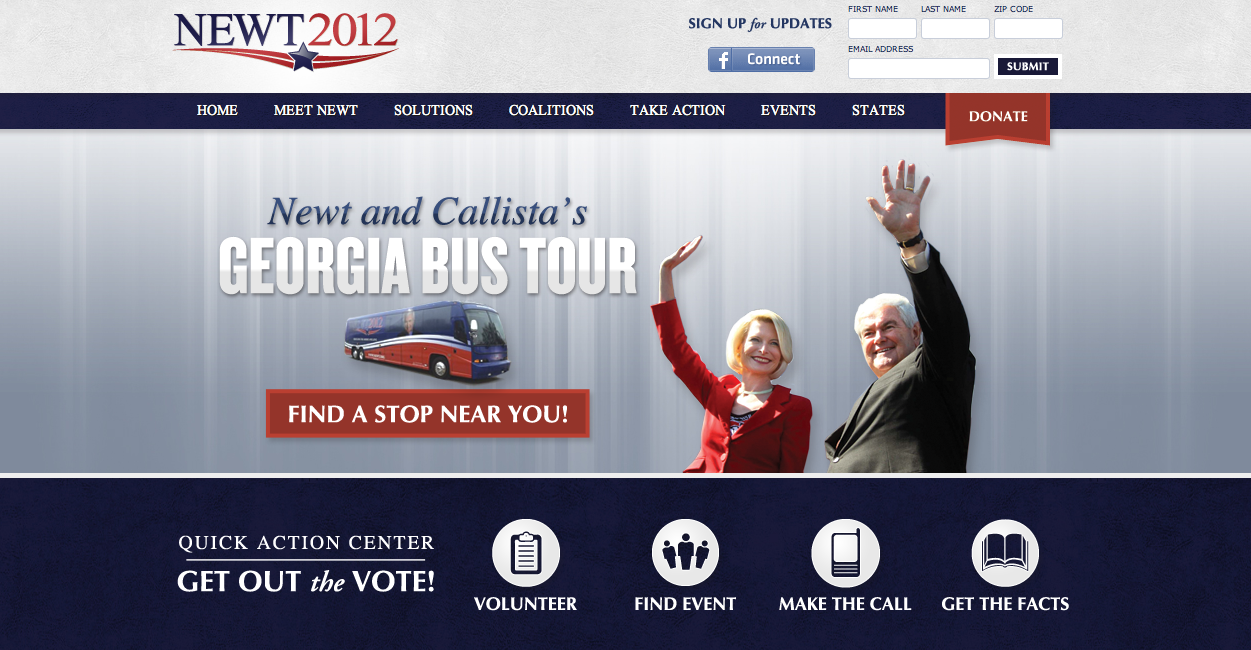
    Newt Gingrich uses his homepage to let supporters know where he will be next and how to contact him.

    These websites are also excellent outlets to connect to mass groups of people at once, without having to pay to run advertisements or receive television or print media coverage.  For candidates who don’t receive as much media coverage as they feel they deserve, this can be a vital part of their campaign. Since so much information is traded on the internet now, much of the general population is turning to the internet to learn more about the potential leaders of the United States.

    Ron Paul's main page takes you directly to his donation totals to try to get more support for his campaign.

    Joshua Vester, Molly Jacques, Ashley Oliver, and Hunter Wilson.

  • Scandalicious

    The ‘jelly’ to politics’ ‘peanut butter’ is without a doubt,
    scandal; they go together hand-in-hand. It seems you can’t have one without the other. From John Edwards’ love-baby, to Bill Clinton’s “I did not have relations with that woman,” Anthony Weiner’s sexually-charged social media, to the more recent Herman Cain allegations of sexual harassment, politics and Capitol hill know scandal.

    The first step each of these political figures made when
    their scandals broke was to deny any involvement. John Edwards said “that’s not my baby,” Bill Clinton said “no way,” Anthony Weiner said the pictures were not him, and currently Herman Cain is claiming the allegations are smear campaign created by his opponents. But, is denying involvement the best move? What ever happened to honesty is the best policy? Is this the way political figures should market themselves and market the United States?

    It’s tough when public figures behave badly for they are scrutinized more than the average Joe. One celebrity feeling the impact of his actions is Former California Governor Arnold Schwarzenegger. In case you missed the story, he recently admitted to his wife, Maria Shriver and his entire family, that ten years ago he fathered a love child with the maid.

    Being a former celebrity turned politician Arnold
    understands the importance of “spin” and “damage control.” These are two words
    that needed to act upon now more than ever, in addition to hiring a top-notch
    crisis management PR firm.

    This is not the first time a celebrity or politician has
    fathered a love child, or had a sexual harassment suit filed on them and it
    won’t be the last. In time, Arnold will gain back his stature as well as his
    credibility and integrity like Clinton has over the years, Weiner will learn
    that social media is not a toy to mess with; in all situations time heals all
    wounds.  If political leaders took this much energy to trot around the scandals, and not just come clean when a true incident arises and own up to it, then there would be no need for PR managers to enforce crisis control  and society would have more trust in these leaders we elected. Just like peanut butter and jelly, these scandals are sticky, messy, and oh so good to read about, but it is how these leaders will market themselves in the future to clean up their muddy messes. Time
    will tell, until then another scandal will arise.

    — Michela Noreski, Jordan Hill, Ashley Nelson

  • Do campaign ads sway your vote?

    In just under two months, we will celebrate the arrival of a new year. There will be plenty of things to anticipate in the coming year: the optimists will make their resolutions striving to reach them by the year’s end and the pessimists will continue to raise their voices about the end of the world. But 2012 also brings another event with it: the presidential election.

                As the presidential campaigns begin to get into full swing, our television sets once mainly confirmed to the usual commercial advertisement bombardment will face another kind—the political advertisements. Every four years we are exposed to the constant cycle of emotional ads, attack ads, biographical ads, issue ads, and on and on and on. And the reason is simple: the person who spends the most money in the races is usually the victor. This was demonstrated in the 2008 presidential election with Barack Obama outspending John McCain 3 to 1 on political advertisements on television. In the 2008 congressional campaigns, in the 426 House races, the person who spent the most money won 397 of those races. Also in the races for seats in the Senate, the biggest spender won 30 out of 32 races.

                This does not necessarily mean that if a candidate spends more money on advertising that they will win. However, it could be an indicator of just how much influence advertising has on our election process.  We are inundated with ads and messages about political candidates from TV to radio to simple guerilla marketing tactics and it obviously impacts our voting decision. So take a step back and think about it as you begin to listen to these ads. Are you voting for this person because you truly feel they are the best candidate or are you voting because the candidate’s ad campaign was great?


    For a closer look at how much politicians are spending on political advertising, head over to http://www.opensecrets.org/pres08/

      -Jessica Kingman, Alaethea Hensley, Lauren Phelps

  • Political Bias in the Media

    Campaigning for the 2012 presidential election has begun.  Republican hopefuls are working to convince voters that they are the right choice to defeat President Obama, while the president is trying to convince everyone that he should remain in office.  In 2008, the Democratic and Republican parties shared some of the same beliefs on certain issues, but had opposing viewpoint on others.  Democrats were in favor of requirements to hire more women and minorities, repealing tax breaks for the wealthiest Americans, and removing troops from Iraq.  Republicans were in favor of three strikes sentencing laws, taking steps to strengthen the economy and more anti-drug initiatives.  Both parties were in favor of limits on political campaign funds, and a path to citizenship for illegal immigrants.  The sentences above about the different parties were straightforward and un-biased, but it is difficult to find such information from one source.  You must be very careful in 2012 while selecting the information you are going to consider, regarding the candidates.  Beware of the agenda setters!

    Certain types of media will tell you that the Republicans are money hungry classists who are only in favor of appeasing the rich, with the intent to modify tax laws in order to behoove large corporations.  Then, that same media outlet will likely show a documentary on the sub-prime mortgage crisis, featuring interviews with families in middle America who lost everything.  There will be a lot of content promoting public programs for the under-served, and illustrating the Democrats as the humanitarian party.  That media outlet selectively left out good points about the Republican party on purpose.  It is called agenda setting, and it is when the media controls the amount of exposure certain news gets.  The more exposure people get to certain types of news, the more important it becomes.  If messages about middle Americans losing everything reach you every day, it will become important to you because it will inadvertently be on your mind.  There could be a more pressing issue out there, but if it is not prominent in the media, how will you know?
    You may be fooled into thinking that all Republicans are overly conservative and old-fashioned, and that Democrats are big spending and incautious if you don’t investigate for yourself. With regards to IMC, each party tends to portray the opposing side negatively. This poor image can potentially end a candidate’s campaign. With this in mind, it is up to the people to figure out which issues are important and research them from both angles. Ultimately,  politics can be quite biased, filled with false information and one-sided opinions. When you vote in this upcoming election remember: you cannot believe everything you hear or see.

    -Stephanie Bakolia, Claire Outlaw, David Glaubach

  • Trending Topics: Political Campaigns

    With the next presidential elections only one year away, political campaigns are in full swing. The republican candidates have met multiple times to debate various topics of high concern to the American people in an attempt to pull voters early. With Obama having only one more year of his term in office, he is also working to attract voters to support him to another four years of Presidency. In fact, his recent announcement of a new college loan plan seems to be another attempt of attracting young voters; the voters who most popularly voted him into office in 2008. However, debating and new Presidential plans are not the only ways these candidates can depend on to win American voters in November of 2012; they also are in need of intensive marketing of the brand they want to represent via various strategies.
    The use of traditional and non-traditional marketing tactics will be the primary difference between this election in comparison to those historically. The typical running of television, magazine, radio advertisements will most certainly be used; however these candidates will also need to perfect the art of social media if they are looking to appeal to the younger generational voters. These candidates will only stand out among the competition if they can look savvy to all generations while still maintaining consistency in their messages and vision for our country. The use of social media and non-traditional marketing tactics will not only bring attention to these candidates, but will also give a positive indirect message that they are embracing the advancement of social and technological advancements around them. Building an image, brand through these tactics will be a huge change in comparison to campaigns in the past, allowing their messages to gain momentum faster and build a following of all audiences successfully.

    – Jared Sales, Sally Shupe, Oliver Evans