Tag: Marketing

  • You can’t have your Coke and drink it too

    It’s one of the pillars of successful marketing, target your audience. Individualizing ads to particulars groups or regions of consumers ensure that messages have the most impact. But what happens when a company features a controversial scene in a spot, then removes it for some audiences and not others? Good marketing move or failure to take a stance?

    In its newest global campaign, “Reasons to Believe” Coca-Cola set out to inspire consumers that no matter what happens in life, it’s those small happy moments that make life worth living.

    Check out the commercial below.

    In most European countries the ad contains a scene of two gay men holding hands in front of their wedding party. However, in the Irish version (the video below) the scene has been replaced to feature a bride and groom.

    The Irish LGBT publication, EILE Magazine, brought attention to the issue, calling the removal an “inexplicable move”. In response to the criticism, Coca-Cola said that the advertisement had been tailored to individual markets so that the ad resonates with the people in each country where it is shown. The company defends the decisions saying that grooms were excluded from the Irish version because gay marriage is not legal in the country. EILE Magazine claims the Coca-Cola reasoning moot. The footage of the two grooms is known to be a video clip from a same-sex union ceremony in Australia – equivalent to a civil partnership in Ireland. Yet gay marriage is also illegal in Australia, but shown there. EILE claims the spot should have been suitable for Ireland as well.

    Coca-Cola has unequivocally made public their supporting stance on same sex marriage. Since 2006, the Human Rights Campaign continues to award Coca-Cola with a 100 percent ranking of their company polices and practices regarding LGBT. The Coca-Cola Company notes on their website, “To achieve a perfect score, companies must have fully inclusive equal employment opportunity policies, provide equal employment benefits, demonstrate their commitment to equality publicly and exercise responsible citizenship”

    Many are saying that Coca-Cola’s recent actions were hypocritical. Coca-Cola claims to support gay marriage, but their choice to remove a gay marriage scene from a commercial in Ireland, in which law does not prohibit such imagery, is misleading of the company’s values. Similarly, another beverage icon, Starbucks, has also gained attention for their hypocritical actions.

    Bryant Simon discusses the company Starbucks in his book Everything But the Coffee. Through his research he comes to discover that Starbucks isn’t delivering what they are promising in their brand – good coffee with little environmental impact. Claiming to buy fair-trade coffee from Rwanda and Nicaragua farmers, Starbucks was actually buying from bigger farmers and only buying 5-6 percent of fair-trade out of all the total coffee purchases.

    Much like Starbucks claiming to be environmentally friendly yet not taking the necessary steps in order to be green, Coca-Cola’s actions were just as misleading; claiming to support gay marriage yet removing a scene from one version of a commercial for the sole purpose of trying to please everyone.

    As future and current brand ambassadors we have to remember that every decision we make, including company policy decisions, become an integral part of brand, and when decisions are made that contradicts that it hurts the brand.

    On the other side of things, as consumers (and as Simon states in his book) we have to remember pursuing “solutions to highly complex social problems through buying and buying alone” doesn’t fix the problem or change the ideology. We have to stop relying and believing that buying certain brands is going to change a social issue.

    So, does Coke’s decision to take out the gay marriage scene hurt its brand identity? Should companies take stances on social issues? What practices do you follow to make sure this brand conflict doesn’t occur in your company or with your clients?

    Savannah Valade, Caroline Robinson, Elizabeth Harrington

  • “How REAL Will American Idol Get This Season?”

    It’s that time of year again! All our favorite shows are returning, after a seemingly long-awaited hiatus. The longest running singing competition, American Idol, has returned for its thirteenth season. But this season, Idol has been forced to change things up. The show is taking on a fresh, new approach to increase the amount of viewers by revamping their marketing schemes.

    In previous seasons, the show directed promotions towards the judges, featured cities, and upcoming drama. The initial aspirations of the show to seek out raw talent has slipped within the past seasons and in return, turned away viewers. At the shows peak, American Idol attracted 30.4 million viewers in season eight. Since then, viewer ratings have only decreased and reached an all time low with 14.3 million viewers for season twelve. As a result, Fox has decided to rebrand the show by bringing in a new team of producers, less drama-filled judges, and a more heartwarming advertising campaign.

    Within the past seasons, focuses of promoting the show featured drama among the judging panel rather than the actual talent of the contestants. Producers recently have realized the show has drifted away from the heart and original purpose of the show–discovering real people with real talent around the country. In an effort to rebrand their image, season thirteen marketers began focusing on the background stories of the contestants in hopes to return Idol to its initial purpose.
    American-Idol-2014-spoilers-480x265

    American Idol

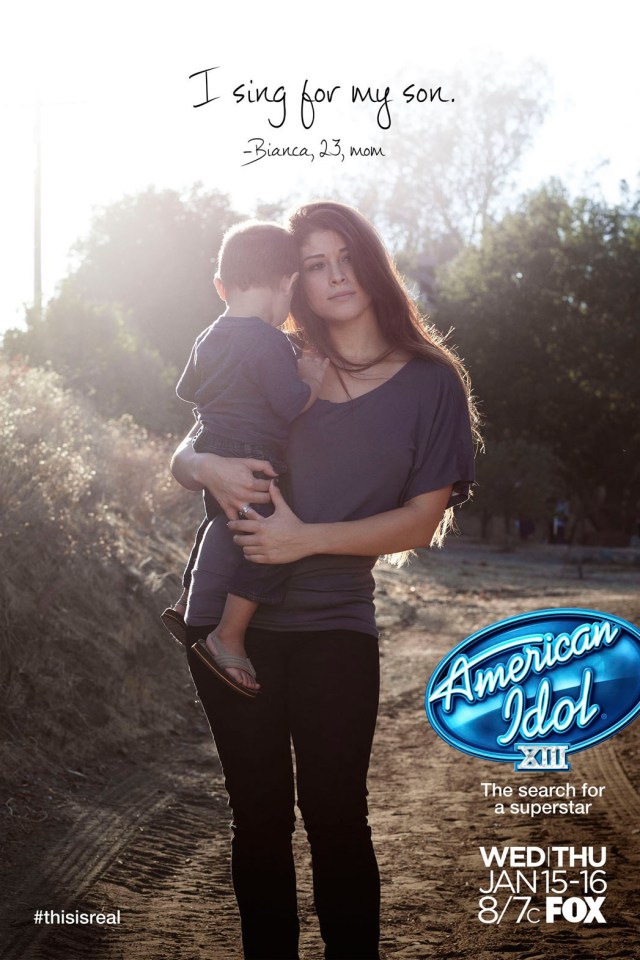
    One component of the new advertising campaign features eight contestants in their hometowns sharing their personal motivations as to why they sing. Producers felt this new type of advertisement would help viewers identify with the stories and be able to relate to the contestants. Viewers are invited to participate in the hopeful journey of the “average Joe’s” transformation into a superstar.

    American Idol’s new video promotion of the upcoming season also focuses on introducing new contestants and excluding any drama or glamour of the judges (hallelujah). In addition to highlighting real contestants, marketers have incorporated social media by producing a new tag line for the show, #ThisIsReal, to encourage audience conversations on Twitter. Producers hope that the incorporation of social media marketing will increase the show’s ratings and reputation. The advertising of real people and their real aspirations are designed to appeal to a variety of audiences on social media platforms, especially the younger demographics.

    By incorporating a variety of platforms such as television, print and social media, American Idol hopes to attract a wide array of audiences through this new and improved IMC campaign. Do you think this new campaign will be effective in increasing and engaging audiences? Or will American Idol continue its downward spiral?

    -Briana McWhirter, Emily Foulke, Hannah Turner

  • The Tassle’s Worth the Hassle

    As of late, I have been so consumed with final papers, projects, preparing for final exams and getting everything in order to graduate that I pretty much haven’t had any time to breathe. These assignments combined with forethoughts of graduation and what will become of my life in the days, months and years following graduation have been drastically weighing down on me, and quite honestly stressing me out. These past few weeks I have been keeping a running countdown until graduation day. I am currently 8 days and 12 hours away from putting my time as an undergrad in the rearview mirror. I am constantly reminding myself that this is my final semester and to “finish up strong”. This has proven to be my motivation over the duration of the semester. Perhaps this briefly illustrates how anxious I am to make the next-step transitions in my life or how ready I am to be done with school forever.

    Nonetheless, in my time spent cursing assignments and longing to graduate this semester I neglected to appreciate what the University of North Carolina Wilmington has done for me. It wasn’t until earlier this week that I had the time to clear and categorize all of my thoughts and emotions. It was in this instance that I had the opportunity to reflect and reminisce on my past four and a half years here at UNCW. After navigating through such significant memories I immediately kicked myself for being so quick to want to forget about them all. In my time here, I have established numerous relationships, friendships and have truly learned a great deal of information…and also forgot a lot. Whoops.

    Image

    After bouncing around a few different majors my Freshman and Sophomore years I found the perfect fit when my advisor recommended that The Department of Communication Studies may be an appropriate pathway for me. I was hooked from the first day of COM 105 when Dr. Weber announced that a “Communication Studies major is fit/qualified for nearly any profession he/she desires”. This notion reassured me that a field in marketing wasn’t entirely out of the question seeing how I initially did not meet the GPA requirements for the Cameron School of Business.

    I am grateful for all of the COM faculty here at UNCW. They have helped make my college experience informative and memorable while keeping things fun. Dr. Olsen’s COM 200 course taught me quantitative research methods which are essential skills to master as a marketing specialist and an effective communicator. Dr. Persuit’s Integrated Marketing Communication courses not only increased my awareness of the prevalence of brands in the world around us but also ensured me that a field in marketing is appropriate for me. The decision to take COM 400 (the Capstone Course) with professor Trimble, proved to be the most beneficial in helping me prepare for my professional track after college. Professor Trimble helped me get out of my comfort zone when it came to interviewing and in regards to the job application process. With these professors, and all other professors efforts I consider myself a truly well-rounded communication specialist. I wouldn’t have been able to do it without them!

    The communication studies department not only provided me with a “home away from home” in Wilmington but also furnished me with the knowledge that will allow me to excel in any of my next step endeavors. For that I am extremely grateful and excited to spread my wings, take flight and soar like a seahawk!

    -Parker Farfour

  • Persuasion Through Customization: Moto X

    “If you wish to persuade me, you must think my thoughts, feel my feelings, and speak my words. -Cicero

    Spoken nearly 2000 years ago, this statement still rings true today. Philosophizing rhetoric and the art of persuasion, Cicero understood the importance of connecting with an audience at the mental and emotional level.

    The above quote points out three of his main claims. To persuade an audience one must “think their thoughts”.  People are more likely to be persuaded when the rhetorician communicates in a way that embraces the individual’s own point of view. Focusing solely on changing point of view results in discomfort and suspicion. Rhetoricians must also “feel their feelings”. To do so, one must ask themselves what the deep-seated feelings are that drive the listeners. Asking this question and reflecting on the answers is an essential part in the pathway to connecting. Finally, according to Cicero, to persuade an audience, one must “speak their words”.  People need to understand what you have to say in order to care about it.  If they don’t care, they won’t do the ultimate goal – act.

    In the age of advertising, these classical concepts are still prevalent as we transcend into the postmodern era. In postmodernity the “self” becomes the ultimate selling point. Marketers strive to persuade their audience that their product does more than whatever its mechanical purpose – the pitching point becomes that their product is an extension of oneself. As a result, individualization and customization are reigning themes. Furthermore, because individuals are immersing themselves as an object, consumers become an actual participant in customization. Products are increasingly less of a finished object, allowing consumers to provide direct input – ultimately and simultaneously becoming a producer as well.

    Therefore, it is no coincidence products today are increasingly individualized. An example of this is the new Motorola Moto X phone. Check out it’s commercial, Customize below.

    After watching this how do you feel? This is a pretty cool phone, right? You can make it however you want! Notice how this commercial mentions nothing about tech specs, mobile web speed, or how the phone will be used in your every day life. Its persuasion strategy focuses on “you” – “your ride”, “your pet”, “your body” and now “your phone” – the idea that you can be in charge of customizing your phone, just as you do everything else, as an expression of your self. You are the producer. No longer are the only options either black and white. Your options are whatever you think brands yourself best.

    This commercial is the essence of Cicero’s idea of persuasion combined with post-modernism ideals. By knowing what its postmodern consumers think and feel about individualization, Motorola has created a product that speaks to every thing you as a consumer expects and wants – customization. Not only do you become a buyer of the Moto X, but a producer of it. Their persuasion hook is that you can directly produce their product as a means of your own expression.

    Has this commercial persuaded you? What other brands and products use customization and self-expression as a persuasion tool?

    Savannah Valade, Caroline Robinson

  • Hyundai’s “Suicidal” Marketing Crisis

    In April of 2013, Hyundai released a commercial known as “Pipe Job” that left many people in the UK confused and shocked. The commercial’s primary goal was to illustrate the car’s new water engine emissions in a humorous way. However, due to this very commercial, Hyundai soon found itself in a potentially “suicidal” PR and marketing crisis.

    Image

    The ad was written about a topic that should clearly never be joked about and is very personal for many people across the world. The ad shows a man who is attempting suicide through inhaling harmful emissions, but fails due to the company’s new water engine emissions. Obviously, Hyundai released this ad in hopes that their audience would find humor in the failure of his attempt at suicide because of their water engine emissions. The company soon found that the ad produced the opposite effect. One of the main people who caused the uproar regarding this commercial was blogger Holly Brockwell. Holly wrote an emotional post regarding this poor taste in marketing.

    Image

    Unfortunately for Hyundai, this entire crisis could have been somewhat avoided. While of course it could have been completely avoided by simply never allowing the commercial to air, it could have also been avoided if the company had a crisis management plan implemented. Instead, Hyundai was slow in their apologies and even ignored reporters when they reached out for answers. This lack of communication for those with questions is what ultimately left Hyundai in a PR crisis that was nearly impossible to overcome. While Hyundai finally released apologies and statements, the damage that has been done is immeasurable. In the end, companies must be proactive when dealing with crises that involve their products to have a chance at managing them before they have a chance to become something larger.

    -Ryan Nagy

  • Sexy Drunk Candy Day

    A blog featured by our IMC predecessors two years ago touched on the roots of Halloween, evidently for informational purposes. But if we look at the origin of the holiday, and compare it to the simple consumer monster it is today, what does it say about our culture? How did it transform from a festival rooted in serious meaning to whatever it’s supposed to be today?

    Halloween started with the Celts many moons ago, over time it was adapted and changed by the Romans, and became what we know it as today in the 1900s. None of that is really important. What is important is how we cannibalized the traditions and passed them along, while turning the holiday into nothing more than a consumption animal party.

    The phenomenon that explains this is Social Construction of Reality, but how did it get to this? It seems that most traditions were forged in some pretty substantial fires, but American culture has a way of reducing the importance of history to make some money. The idea behind the tradition is not communicated to growing generations, and the meaning gets lost behind the ways we celebrate. Then the Americans who grow up and pay money to be a part of the “tradition” end up satisfied with their part in the whole ordeal while walking away a little poorer, and just as ignorant.

    A Google Search of “Halloween Sales 2013” turns up a link to coupons from retailers pushing to sell costumes, candy, and other Halloween-related things. A short list of the companies offering these discounts are Aeropostale, The Popcorn Factory, Party City, Amazon, Toys R Us, the Disney store, Babies R Us, Walgreens, Land’s End, Pier 1 Imports, Petco, Hot Topic, The Home Depot, Urban Outfitters, Williams-Sonoma, Cotton On, Sears, Roaman’s, and Target. Apparently Tide is also in on the Halloween action (from my colleagues’ Monday post).

    None of the companies’ ads say anything about the Celts or the Romans.

    One Halloween participant properly respecting the Celts.
    One Halloween participant properly respecting the Celts.

    Nobody ever told me what Halloween was about. I just learned to associate it with costumes and candy from my mom. It’s kind of like St. Patrick’s Day, which (you would think) is not too relevant to Americans that lack origins in Ireland, but is extensively used to increase sales and get people drunk. The fact is, today, that all Halloween really is about are costumes, candy, and partying. Most holidays end up being just another reason to party in America, but Halloween is the most notorious for partying being its sole purpose.

    Ask around, especially on campus, and people will have a whole slew of methods for celebrating the holiday. If a person has kids, they will dress their kids up and walk around to get candy on Halloween. Some folks may stay inside and hand out candy to other people’s kids if they feel up to it. Those who don’t have kids will probably dress up and get drunk.

    That’s about it.

    I could talk about the implications of the most prevalent American Halloween costumes featured in our local costume shops (which are perfectly in tune with the holiday’s roots), but everyone knows that it all pretty much ranges from “sexy nurse,” to “sexy M&M”  or “sexy pirate” for women, and “pirate,” to “caveman” for men. Most Halloween emphasis is placed on the costume. The rest is on the party or the candy.

    It doesn’t have anything to do with any of the reasons it was created. Sure, there’re Jack-O-Lanterns that have survived in homage to ol’ Stingy Jack, but does anybody reading this know about him (assuming that any one of the extremely cool tales about him is the one responsible for the tradition)?

    I say, since Halloween seems to just be an arbitrary holiday nowadays, that we change the name completely, maybe to “Sexy Drunk Candy Day.” Let’s reconstruct the reality of Halloween. Why not?

    – Chad Darrah

  • Holiday Shopping at Risk from Government Shutdown

    The current shutdown marks the first time in 17 years that the government has come to a halt, as both political parties remain at a standstill. With no sort of compromise in sight, a chain reaction with numerous consequences could follow. Currently, one of the main concerns is the increase in number of furloughed government workers who are grouped into two categories: essential and nonessential jobs. However, if the shutdown continues, retailers of public businesses may also take a hit creating potential conflict during the holiday season.

    Image

    As the upcoming holiday season quickly approaches, retailers are actively predicting whether or not the federal government shutdown will impact sales. According to The National Retail Federation, sales are expected to increase 3.9 percent for November and December. However, these calculations were based on past holiday sales that had no interference of a government shutdown. Depending on how long the shutdown lasts, retailers may have to alter their marketing strategies to maintain their predicted sales for the holidays.

    As the government shutdown enters its second week, no substantial progress has been made to give retailers an accurate sense as to what will come in the next few months. Some sources believe that the shutdown could not be more perfectly timed because, “…the back-to-school rush has quieted, and despite the best efforts of some retailers, the holiday shopping season is still many weeks away from being in full swing.” On the other hand, “…some marketers may find that because consumers are spending less money, their holiday marketing may need to be tweaked at the last minute this year.”  These two outlooks lead us to wonder if a rippling effect will take place. NBC News has created possible scenarios that would occur if the shutdown lasted for over a month. One possible scenario on November 17th, according to The National Retail Federation, would indicate the “make-or-break” of the holiday shopping season. Consumer confidence in retailers will diminish as the shutdown continues, which will create devastating effects for retail stores and the overall economy.

    Image

    With Halloween quickly approaching, it will be interesting to see how the government shutdown could impact sales in terms of consumer behavior. Do you think that the shutdown will have an effect on holiday spending? How will retailers respond if the shutdown looms on in terms of marketing strategies?

    – Aaron Love, Kara Zimmerman, Rachel Clay, Rebecca Hobbs