Tag: London

  • PlayStation Lights Up the UK

    If one were to look at the Oxo Tower in London at night over the past few days, they might notice a striking difference in the lighting of the prominent building.  Covering the side of the tower are the famous control buttons of the PlayStation brand that replaced the usual OXO that can be seen on the tower.  In regards to the holiday season and the release of their newest PlayStation 4 product, the brand decided to take their advertising to new heights. Sony paired with Manning Gottlieb OMD media agency to change the letters for the first time in the building’s eighty-five year history.

    Image

    When relating this recent event to Kenneth Burke’s Theory of Identification, we can see a clear connection between the consumer’s ability to recognize the PlayStation symbols, and the persuasive technique used by the brand.  Burke’s theory states that persuasion can only be communicated effectively when the two parties (the consumer and the brand sharing the product) have something in common. This means that only people who know what the symbols represent will be able to understand that this is an advertisement for one of the largest gaming systems in the world.

    This form of brand advertising seeks to create excitement and anticipation for the upcoming PS4 release on November 28th in the United Kingdom. Consumers are unconsciously motivated to have the PlayStation product on their minds when they see the symbols lit up every night.  This could lead to consumers talking about the product to friends or on social media or even purchasing the product when it is released.  In fact, 14.3 million people had tweeted about the lights within the first 24 hours that they were used.

    Image

    Overall the strategy used by PlayStation to advertise and motivate their publics to think about this new product was a creative and original way to reach potential customers.  This is a method not commonly used and created a large amount of social media buzz that was beneficial to the brand.  What are some original and uncommon ways that you have seen brands advertise? Have you seen any brands advertise in uncommon places?

    -Aaron Love, Kara Zimmerman, Rachel Clay, Rebecca Hobbs
  • Paul McCartney’s NEW Publicity Stunt

    The digital world of iTunes and social media has given the music industry both high and low notes. While the Internet offers accessibility, it also caters to specificity. Most predominantly, the Internet offers an array of platforms for artists to upload, share, and send their music.  However, while music junkies may be constantly searching for new digs, most people eventually acquire a particular taste for what they choose to send through their ear buds.  Internet music services such as Pandora, Spotify, and iHeartRadio allow users to handpick and listen to an endless variety of artists and genres. This narrowcasting of music leaves artists waging campaigns to try to reach listeners. As a result, clutter prevails.

    Like in advertising, clutter has become a big problem in music promotion. As Douglas Rushkoff pointed out in The Persuaders, “The more messages they create, the more they have to create to reach us.”

    The more opportunity social media platforms – YouTube, MySpace Music, and most recently Vine – offer artist to share their music, the more competitive and important promotion of music and musician become.

    So how does a music artist break through all the online music clutter without breaking budget? The answer is: great music, a little luck, and a publicity stunt.

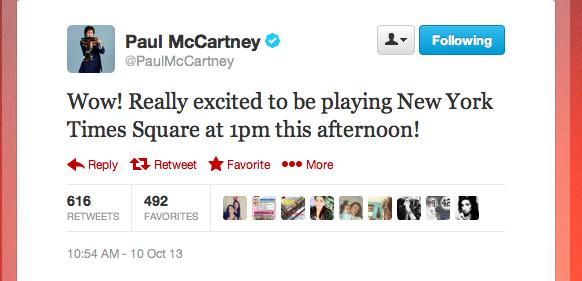
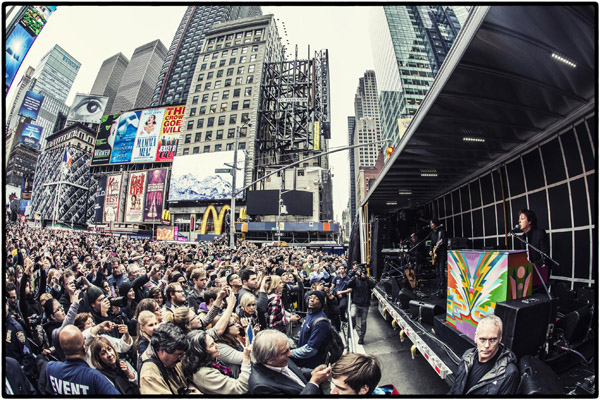
    Not new to the music arena are surprise gigs on rooftops or buses in the middle of big cities, events known in the public relations world as a publicity stunts. This past October, music legend Sir Paul McCartney promoted his recently released album, NEW, by doing just such a thing – performing a surprise concert in the middle of Times Square.

    Paul McCartney at performs at the Times SquareTelling fans only hours before – via Twitter – he played a 15-minute long show featuring the single “New”, as well as music from the (not at the time released) album. McCartney was not only able to give NYC fans a concert, but fans from around the world could tune in through Times Square live webcast and watch the performance.

    pm tweet nyThe surprise gig resulted in social media buzz and major news coverage, all promoting the NEW album for free. The stunt was so successful; exactly a week later he performed another surprise concert in London.

    pm tweet loSir Paul McCartney proved how to conquer the masses. Not only did he succeed in making his fans happy, but also he succeeded in executing a publicity stunt that generated both word of mouth and media coverage that ended up promoting his music at no cost to him.

    Caroline Robinson, Savannah Valade