Tag: IMC

  • For the Cure: Breast Cancer Awareness or Bank Account Awareness?

    57e514ad84f3780932dff41d5c63ee2cDid you know one in eight women in the United States will develop invasive breast cancer? And that every two minutes in the United States a woman is diagnosed? Cancer is one of the most feared words in American culture. We focus a whole month to supporting one specific type of cancer. Breast cancer awareness month is an incredible way our nation unites through multiple organizations, to support a good cause. The process is extremely easy for anyone to donate and feel like their money is going to a good cause…or is it?

    Susan G. Komen for the Cure is a widely known non-profit organization that supports breast cancer research. The purpose behind this organization appears to be transparent- but has it gotten to the point where it is just money hungry? Only 20% of the money raised or donated goes directly to breast cancer research. Although this is not out of the ordinary compared to other widely known non-profit organizations, it is misleading how their partnerships also support “for the cure.” Susan G. Komen partnered with KFC to create “buckets for the cure.” KFC’s diet aids to cancer cell growth and the main reason for partnering was to, “reach out to millions of woman they might not otherwise reach…” But, Breast Cancer Action claims, if you want to reach communities that are underserved, then the Susan G. Komen organization needs to reach out to the community health clinics. Clearly from this example of their partnership tactics, there are suspect business practices within the organization. The list of controversial issues that the Susan G. Komen organization has accrued over time is actually surprising considering the foundation started with a good cause in mind.

    Pink-RibbonFor the better part of the last decade, the popular breast cancer charity Susan G. Komen has been racked by controversy. Things began to go awry in 2012 when they pulled support for Planned Parenthood, amid pressure from Republican lawmakers. The non-profit responded to accusations that its actions were, “anti-woman,” saying that the funds were not pulled because of ideological conflicts, but because planned parenthood was under investigation by congress. This is a questionable statement, as the corporate structure of Susan G. Komen has strong ties to pro-life entities. Among other accusations, the organization has taken heat for using donor money to sue other non-profits for infringing on their various trademarks. Notably the phrase “For the Cure,” which has been the subject of many cease-and desist orders, even when the organization had nothing to do with breast cancer. After all of the hits the company took, rather than step down, the CEO took a huge page raise.
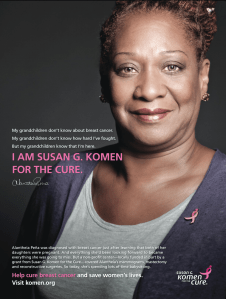
    susangkomenFollowing Susan G. Komen’s changes in grant rules, barring Planned Parenthood’s funds, supporters increased on Planned Parenthood’s side. According to Politico, Planned Parenthood’s Facebook page increased by 10,000 in a few days. Anti-Susan G. Komen for the Cure Facebook pages increased- with titles similar to “De-fund the Komen foundation.” As the news broke regarding Susan G. Komen’s course, Planned Parenthood and #PlannedParenthood started trending on social media and became a topic of interest in mainstream media. Susan G. Komen for the Cure did not convey its message well in response to the crisis. After the crisis, the Komen foundation used storytelling as a way to reconnect with the community- starting a print and television advertising campaign, “I Am Susan G. Komen“. This campaign spotlighted four-breast cancer survivors- using their stories to market Susan G. Komen for the Cure.

    An important thing for organizations, especially nonprofits, to remember is their brand identity and their actions need to match up. Cognitive Dissonance is when someone experiences a feeling of tension when their beliefs do not align with their actions. This theory states that when someone experiences this inconsistency, they will do what they can to reduce this uncomfortable feeling. The Susan G. Komen organization received backlash after developing a perfume “Promise Me”, which contains toxic and hazardous chemicals. Breast Cancer Action exposed the use of Toluene, banned by the International Fragrance Association as well as Coumarin, banned by the Food and Drug Administration.

    People donate to Susan G. Komen, which presents itself as a non-profit organization donating its funds to breast cancer research. When those who donate hear about Susan G. Komen partnering with organizations, which do not promote health, such as KFC, creating harmful fragrances for sale, and giving only a small amount of money to breast cancer research, cognitive dissonance occurs. They may feel uncomfortable because of the inconsistency in what the organization presents itself as doing and what it is actually doing. Those who donate will oftentimes choose to reduce this feeling by stopping their donations to the organization altogether. If a non-profit organization wants to thrive financially, they need to ensure that their actions align with how they present themselves and their original intent.

    breastcancerawarenesslogo1

    Reading the information on Susan G. Komen for the Cure, one might expect all nonprofit organizations follow their guidelines. Here are other foundations and organizations supporting breast cancer research and finding a cure:

    It is easy to show how significant the topic of breast cancer is within the United States. There are countless statistics about the impact breast cancer makes- that would shock any reader. So, hearing that one of the most well-known organizations, whose existence is centralized around breast cancer research and finding a cure- may not be the hero it has portrayed itself to be, is concerning.

    We, as the American public, have a duty to be alert to the aspects that make up our charities and nonprofit organizations, and be diligent in how we distribute our donations. As a reader, what are your opinions on Susan G. Komen for the Cure? Would you donate your time and money to this organization?

    -Jonathan Callahan, Erin Fouhy, Julia George, Joseph Hines, and Sarah Suggs

  • Pink-Trash: Raising Awareness From The Ground Up

    9754PinkTrashJJ08
    wilmingtonbiz.com

    It’s an effective  grassroots campaign with a unique selling proposition…but it really starts in your garage. Pink-Trash is a locally owned recycling and trash collection service with a philanthropic edge to it. Founder and president of Pink-Trash Kelly Buffalino got the initiative to start up the company after noticing the unpredictable and varying monthly trash collection rates her husband paid to a national provider for his local business.  Taking things local Pink-Trash established itself in a partnership with Inman Septic in late 2011 and began servicing the Wilmington community’s residents, contractors and commercial businesses with a cost effective, flat rate and no fee trash and recycling service. But Pink-Trash is more than just an innovative color to line the streets on trash day. Through non-traditional marketing strategies the company’s pink trash can and ribbon brand image serve to represent and promote Breast Cancer Awareness and specifically North Carolina’s Pretty in Pink Foundation (PIPF).

    pink-trash.com
    pink-trash.com

    The Pretty in Pink Foundation was founded in May of 2004 by Dr. Lisa Tolnitch, a breast cancer surgeon, with the purpose to serve women in North Carolina. They aim to help those who do not have the funds to pay for their breast cancer treatment, often women without medical insurance.  Almost 20% of women living in North Carolina do not have any health insurance, and around 14% of those women are also living below the poverty line.  Through fundraising and sponsors, the goal of the Pretty in Pink Foundation is to ensure that North Carolina women have the treatment they need for their breast cancer, regardless of their funds.  Aside from donations, Pretty in Pink Foundation has a variety of fundraisers to invite the community to get involved.  Some of these include free exercise classes for women going through chemotherapy, fashion shows, 5k races, and a golf tournament, and of course their unique partnership with a local trash company.

    People may not intentionally go searching to get involved in the PIPF’s movement to support cancer survivors and patients, but the trash cans function as an undeniable reminder that the non-profit and its cause are a relevant presence in the community. The trashcans represent a source for the Pretty in Pink Foundation to be recalled as the dominant local breast cancer  awareness support system and at the very least to gain recognition in association to breast cancer awareness.  Beyond just promoting the PIPF through aesthetic recall and recognition methods, Pink-Trash also donates 1 percent of all its proceeds to the Pretty in Pink Foundation’s cause raising a whopping $502,000 in contributions for the PIPF in the year 2014.

    pink dumpster
    pink-trash.com

    Pink-Trash’s commitment to breast cancer awareness and the PIPF harnesses a grassroots business approach. As the name implies, a grassroots marketing campaign starts at the bottom and works its way up. Starting on a local level with a small dedicated group, a grassroots movement appears to spontaneously spring into action. Involving the community in raising awareness and funds also makes an organization and its initiative more accessible, and what is more accessible than a trash service. Having a pink trashcan isn’t a symbol of status rather a quiet call to action. While Pink-Trash’s grassroots campaign is increasing in size and support, they are also strengthening the communities they reach. Friends and neighbors can feel they are part of something bigger than themselves by simply taking out the trash. Although there are many recycling options Wilmington locals can choose from, Pink-Trash set itself apart from their competition with their unique selling proposition. They convey to consumers that recycling with Pink-Trash will help benefit Pretty In Pink Foundation’s vision is to eliminate financial barriers and to provide assistance/ resources to any breast cancer patient with financial needs for both treatment and surgery.

    The Pretty in Pink Foundation and Pink-Trash have created a mutually beneficial partnership knowing one organization will lead to awareness of the other. These local takes on waste and philanthropy combine to give back and service New Hanover County and surrounding areas proving that collaboration is at the core of any strong marketing plan. Who would have thought a trash company could do so much for a cancer foundation? Imagine the possibilities of unusual partnerships, and the effect it would have on marketing!

    What unusual marketing strategies are your favorite?  How effective do you think trashcans are as a promotion method for the Pretty in Pink Foundation?

    http://www.wect.com/story/16202490/think-pink-trash-collection-service-gives-back-to-breast-cancer-research

    https://www.prettyinpinkfoundation.org/index.aspx

    • Aki Suzuki, Alexis Trimnal, Carey Poniewaz, Carey Shetterley, and June Wilkinson
  • Intern Spotlight: HR in Communication Studies

    HR-ImageThe way Human Resources ties IMC into their organization is rather unique. In Human Resources, the objective is not to sell the organization’s brand, but instead to help each individual in an organization focus on their personal branding. Individuals can continuously improve their communication skills and concurrently be efficient in their work together.

    Julia George is a senior at UNCW, graduating in December with a Bachelor of Arts in Communication Studies. During the months of May-August 2015, she completed a Human Resources internship through the Communication Studies Department.

    Interviewer: What were the steps you took when applying for an internship through the Communication Studies Department?

    Julia: During the Summer 2015 semester, I applied through the Communication Studies Internship Program for a position in Human Resources. This was incidental to my career, given my past and present course load made it clear my future was in this field. A Communication Studies internship entails researching a desired position and agency, interviewing with the targeted agency and supervisor, and approving this internship through Dr. Bulger- the faculty member in charge. My internship through the Communication Studies Department enabled me to complete a three-credit course, completing the correct amount of hours at the desired agency.

    Interviewer: What were your duties as an intern?

    Julia: The internship gave me glimpses into the everyday tasks of the Human Resources. During my time at UNCW’s Human Resources Department, I practiced co-facilitating retreats, managing social media, and marketing aspects of HR. After I completed my internship with the Human Resources Department, I was offered a part-time job. The experience I gained through the internship program and courses at UNCW, I am now able to practice those skills as a part-time employee at Human Resources.

    Julia came across the Human Resources internship during a Communication Studies course, taught by Dr. Brunson. The Intercultural Dialogue course required students to complete an out-of-class facilitation. Molly Nece, the Professional Development Coordinator in HR at UNCW spoke to Julia’s class about facilitation. Julia used her interpersonal skills and networking capabilities to learn about and purse the HR internship, through Molly Nece.


    535934_410333185791421_6763646625442744694_nJulia’s daily tasks as a staff member in Human Resources include: development of job aids for facilitations, assistance with retreats, attendance of all meetings, research and collection of data, and marketing HR through social media channels. She manages the social media channels for the Employee Training and Professional Development program called Dare to Learn Academy. This task correlates to the Professional Development Program and markets the five important factors for strengthening one’s personal brand – serving, leading, innovating, being resourceful, and growing. This program focuses on helping the faculty and administration across campus tap into their strengths and weaknesses, through group practices and self-evaluations, for a better understanding of how to interact in the office. The five factors of Dare to Learn Academy are marketed through Facebook and the Dare to Learn catalogue.

    Interviewer: What have you learned as an employee vs. an intern?

    Julia: When you are an intern, you are at a transitional phase from applying what you’ve learned at UNCW to a professional workplace. You start with smaller tasks, which help you learn how important every detail is in projects. It is okay if you make a mistake, your supervisors understand you are in a learning process. As an employee, you are trained for the position; deadlines are more serious and making mistakes are not an option. Having the practice from an internship prepares you for this mindset and decreases the stress of whether you are completing a project correctly or incorrectly.

    10479958_10153111690567474_8095338665732746440_nThe interview with Julia clearly shows the benefits and advantages from completing an internship during a college career. Not only is there personal growth and development, there is a clear correlation to success in future career endeavors. The opportunity to develop one’s personal brand and create network connections with professionals in the desired field, is invaluable.

    To find more information about internships visit: Career Center

    -Jonathan Callahan, Erin Fouhy, Julia George, Joseph Hines, and Sarah Suggs

  • Communication Studies At Work

    College students are told time and time again just how important it is to have an internship while in college. UNCW student Aki Suzuki, a senior Communication Studies major, offered to speak with us about her Marketing internship at Live Oak Bank, a Small Business Association lender  here in Wilmington, NC.

    liveoakbankInterviewer: What are your daily tasks?

    Aki: Videography: Helping set up shoots with lighting and camera equipment, taking photos, organizing footage, editing photos and videos, and creating simple title graphics.

    Interviewer: What do you want to gain from this experience?

    Aki: I hope to gain professional videography skills and the ability to thrive and adapt to an adult work environment. Finally I hope to gain the knowledge to competently function as part of an organization/ corporations marketing team to enhance a brand and use my creative resources to continue advancing it.

    Interviewer:  What coursework is relevant to your internship?

    Aki: As I am interning in the marketing department and helping create promotional materials for Live Oak, the IMC related classes are relevant to my experience. Integrated Marketing theories, as well as course projects and discussions have prepared me to understand how the bank approaches attracting borrowers to each of its verticals. The videography department is responsible for video and photography related products. Videography centered courses like COM 380 have also been instrumental to my understanding of cameras, the elements of lighting and also editing techniques.

    Internships are an excellent way for students to engage in applied learning but also a way to get their brand out into the real world. Aki has learned the importance of a consistent brand identity, especially when looking for jobs and internships. Aki demonstrated this during our interview.

    akisuzuki_000Interviewer: What can you offer to Live Oak Bank?

    Aki: I can offer Live Oak Bank a willing and open mind. Although I do not possess any outstanding skills, as a young and determined student I am engaged in learning and committed to contributing in any way that I can. My youth allows me to maintain a fresh perspective and enthusiastic attitude for any opportunities they allow me.

    Interviewer: How does your brand as a Communication Studies major compare with other interns at Live Oak?

    Aki: I find that I fit well into my niche in the marketing department because Communication Studies deals overwhelmingly with how to effectively incorporate messages being sent  through various channels which is precisely what any company’s marketing department hopes to cover.  I do find myself at a slight disadvantage when it comes to understanding the financial ins and outs of the bank; but like any communication studies major I am well versed in being an assertive researcher and curious verbal investigator to understand anything I do not immediately understand.

    Aside from some unnecessary modesty, Aki has aligned the stories she communicates about herself, the way she sees herself and reality so closely that there are minimal discrepancies. If you have the opportunity to work with Aki, you would find this statement proves true. Branding is not just for businesses anymore. Every communication you put out into the world will contribute to your personal brand and when your band is as consistent as Aki’s it becomes a holophrasm, expressing your brand in a single nucleus. Aki has achieved such a level of brand coherence that her name now acts as a holophrasm.

    What strategies do you use when defining your personal brand?

    What are some examples you can share about personal brand coherence?

    – Alexis Trimnal, Carey Shetterley, June Wilkinson, and Carey Poniewaz

    -Interviewee: Aki Suzuki

  • Cucalorus: How to Brand an Independent Film Festival

    Cucalorus: How to Brand an Independent Film Festival

    By Daniel Dawson

    Cucalorus is Wilmywood’s premiere quirky film festival, showcasing independent films from local, national and international artists. Film connoisseurs sporting chunky glasses, artsy students in their thrift-store best and less interesting folk like you and I file into Thalian Hall (or one of the many other venues), settle down and wait for the lights to dim. This November will be the 21st year this little slice of art and culture draws people to downtown Wilmington.

    I could barely convince people to keep coming after my twelfth birthday party, so how does Cucalorus garner a big crowd each consecutive year? A cohesive brand narrative, that’s how. And Cucalorus’ brand narrative is nothing short of weird—but in the good way. Let’s explore what makes Cucalorus cool.

    1. It’s in the copy

    While none of these factors are ranked in any specific order of importance, I am a word person and always like to read and evaluate the voice of an organization. Many organizations forget about this, not capitalizing its subtle importance. Bad organizations.

    Cucalorus, on the other hand, has got its copy down pat. The copy, whether it’s online, in print or broadcasted on the radio, is how an organization communicates not only its news or events, but its personality, its voice and its image.  Here’s a snippet of copy from Cucalorus’ donation page on their website:

    “Hey Cucalorians!!! Do you need to get rid of unwanted cash? Make a donation and we’ll send you a tax deduction letter to send your fuzzy little friends at the IRS (they don’t need your money and clearly don’t know what to do with it!!). We do know what to do with it – we’re already plotting and scheming for the 21st annual Cucalorus Film Festival – taking place November 11-15, 2015!!! Help us fund the dreams and visions of artists all over the world by making a donation today.
    Dreaming of eggnog omelettes!
    Cucalorius.
    The Cucalorus Film Foundation is a 501c3 non-profit and your donation is tax deductible to the fullest extent of the law.”


    On first glance this might sound unprofessional and not the voice an organization would want to convey. The context, though, is important. Cucalorus’ audience is mostly the aforementioned artists, hipsters and independent film connoisseurs and Cucalorians. These types of people generally like funny, creative and quirky things (like Cucalorus). These types of people also tend to be skeptical of the IRS—not to mention the state cutting NC’s film incentive last year.  So yes, it might be OK for Cucalorus to be a bit irreverent, and it’s their creative risk.

    1. Digital presence, dude

    If your business doesn’t have some sort of online presence (an email address counts), I would like you to write to me immediately by carrier pigeon and explain how you’re still surviving. An online presence is increasingly important each year, and now just having a website and Facebook isn’t cutting it. Brand cohesion across appropriate social media networks and inter-connectivity between them is vital.

    Cucalorus not only has a website, Facebook, Twitter, Pinterest, and Instagram but their own blog and—drum roll—they are all updated. Bravo, Cucalorus. Content creation and audience engagement are essential to a successful IMC strategy.

    1. Creepily consistent image

    This one is tandem with the digital presence. IMC consists of advertising, public relations, marketing and every other single communication an organization can perform with its publics. Consistency in corporate communication allows the organization and its audiences to construct a narrative and image of the brand. This is what people can relate to. This is how we can see the quirkiness, irreverence and artsy personality of Cucalorus as if it were that weird kid in your English class who would always have some snappy reference to an obscure book even your professor hadn’t read. But less annoying.

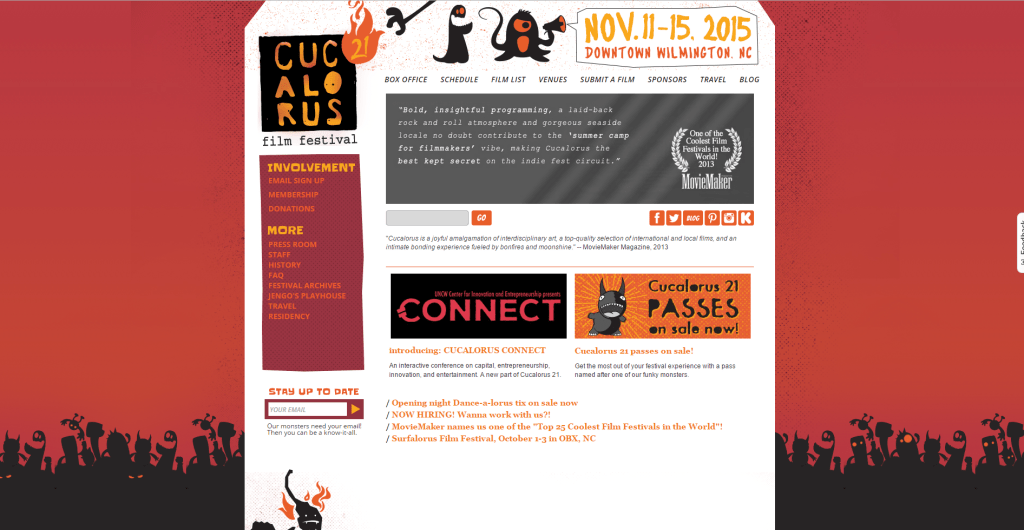
    Take a look at Cucalorus’ official website:

    Cucalorus Home Page - Wilmington, NC
    Ooh, warm fall colors. Where’s my PSL?!

    The color scheme and design is consistent. The font-faces, graphics and little cartoon dudes are consistent. There’s well-organized navigation and that copy I was talking about earlier. The social media pages follow suit. There’s an article on this if you’re into academic papers. Basically, the author, Simon Torp from Odense University in Denmark, says that as an organization your communication through all channels must be consistent, accessible and in line with your self-image, public image and meta-image for people to take you seriously.

    1. Zany staff workers

    When I said all channels of communication, I meant all of them. Even the staff workers and volunteers need to be carefully selected and even briefed on an organization’s code of conduct. One time I went to a screening of a Cucalorus film at Thalian Hall and, not to get into too much detail, I, with the rest of the audience, was sternly asked by staff to partake in a ritual involving whipped cream, button pins and our tongues. Was I offended? No, but I could have been if I had been misguided by thinking Cucalorus was actually a convention for neo-Puritans. Because their self-branding and self-image don’t suggest that, I could expect something out of the ordinary. It’s the risk that Cucalorus takes to maintain its image and appeal to its target audience.

    1. High-quality product

    When it comes down to it, a business or organization is only as good as its product. Silly brand narrative and image aside, Cucalorus does a good job at what it does. It recruits and selects excellent film talent from around the world and showcases it in quality and entertaining venues. This is where word-of-mouth comes into play. Word-of-mouth marketing or WOM is an organic and invaluable means of public relations, advertising and marketing. Have you ever read a positive news story about an organization you love? Or has a good friend of yours recommended a product or service they favor? These are examples of WOM that can make or break an organization depending on whether they are in favor or against it.  Maintaining the balance between brand narrative, professionalism and good business sense is how an organization thrives. While Cucalorus does an outstanding job of its own branding and controlled media, its reputation for quality and intrigue reign in filmmakers and spectators every year.

    I am no way affiliated with the Cucalorus film festival professionally, nor do I represent it. I recognize good IMC in organizations and talk about it here. But, if you are tired of what the local theaters are playing, check out a showing of something interesting between November 11 and 15 downtown at Cucalorus.

  • Hopping Into Fall

    LHBW_Fest_CC_web-662x1024

    With beers like Belgian Triples, Indian Pale Ales, Oatmeal Stouts- one can get lost in the logistical nightmare of creating an individual brand. Dogfish Head and Flying Dog breweries created slogans, “off-centered ales for off-centered people since 1995” and “good people drink good beer”. Fortunately for local Lighthouse Beer and Wine, the hard part is no longer the beer, but bringing individuals together.

    This year’s 14th Annual Lighthouse Beer and Wine Festival will continue uniting breweries with beer-loving consumers- overlooking beautiful Downtown Wilmington. According to NC Beer Guys, more than 120 breweries will be present on October 24. The festival runs from 1pm-5pm, with the option to purchase VIP tickets, allowing for early entry. Paired with craft beer and wine, the event will host local food trucks and live music, featuring Greensboro natives, Holy Ghost Tent. The festival does not stop there! A portion of proceeds are donated to The Carousel Center, “a non-profit organization committed to assisting victims of child abuse, providing critical care services throughout Southeastern North Carolina”. The combined thirteen Beer and Wine Festivals, donated $150,000 to the cause.

    Screen shot 2015-09-23 at 12.43.30 PM

    Lighthouse takes to social media, outreaching to communities and consumers, past Wrightsville Beach. Promoting the 14th Annual Festival through the normal social media contenders:Facebook, Twitter, and Instagram– as well as a websiteEach outlet allows Lighthouse to reach their consumer base and audience- with obvious overlap. The seamless flow from platform to platform, and from consumer to provider, bolsters the brand immensely. The identity that Lighthouse Beer and Wine has developed, is the result of careful social media management- and dedication to a specific brand image.

    Screen shot 2015-09-23 at 8.45.35 PM

    Lighthouse Beer and Wine Festival has been at the top of every beer-lover’s fall to-do list for nearly a decade and a half, it has done a great job at remaining relevant with the new ways of integrated marketing. When one explores their social media accounts along with its website and blog, their identity is consistent and tailored to their audience. Lighthouse beer and Wine is very active on social media, especially so on their Instagram account. They share regular updates about:

    • New craft beers, wine, and sake
    • Information about the festival
    • Friendly reminders to purchase festival ticket(s).

    Lighthouse promotes the festival within the store itself. It provides the opportunity to walk into the store, purchase a case of beer or bottle of wine and grab a ticket to the festival. How easy is that! 

    “The traditional marketing plan can do no more than give us a snapshot of a point in time. It doesn’t help us make the right decisions as we move forward in a complex and constantly changing marketplace” (Shiffman, 2008). The Engagement Theory discusses the importance of moving away from the traditional marketing approach, which only focused on profit of the business, and on toward the bigger picture: building the brand and engaging with your publics. As long as Lighthouse Beer and Wine Festival continues to keep this outlook at the forefront of their marketing strategy, they will remain a trademark of fall in Wilmington! 

    Now that you have heard what we have to say, what do you think? Does Lighthouse Beer and Wine reach their fullest potential with their approach to social media and customer interactions? Or does it leave something to be desired?

    -Jonathan Callahan, Erin Fouhy, Julia George, Joseph Hines, and Sarah Suggs

  • Pumpkin $pice

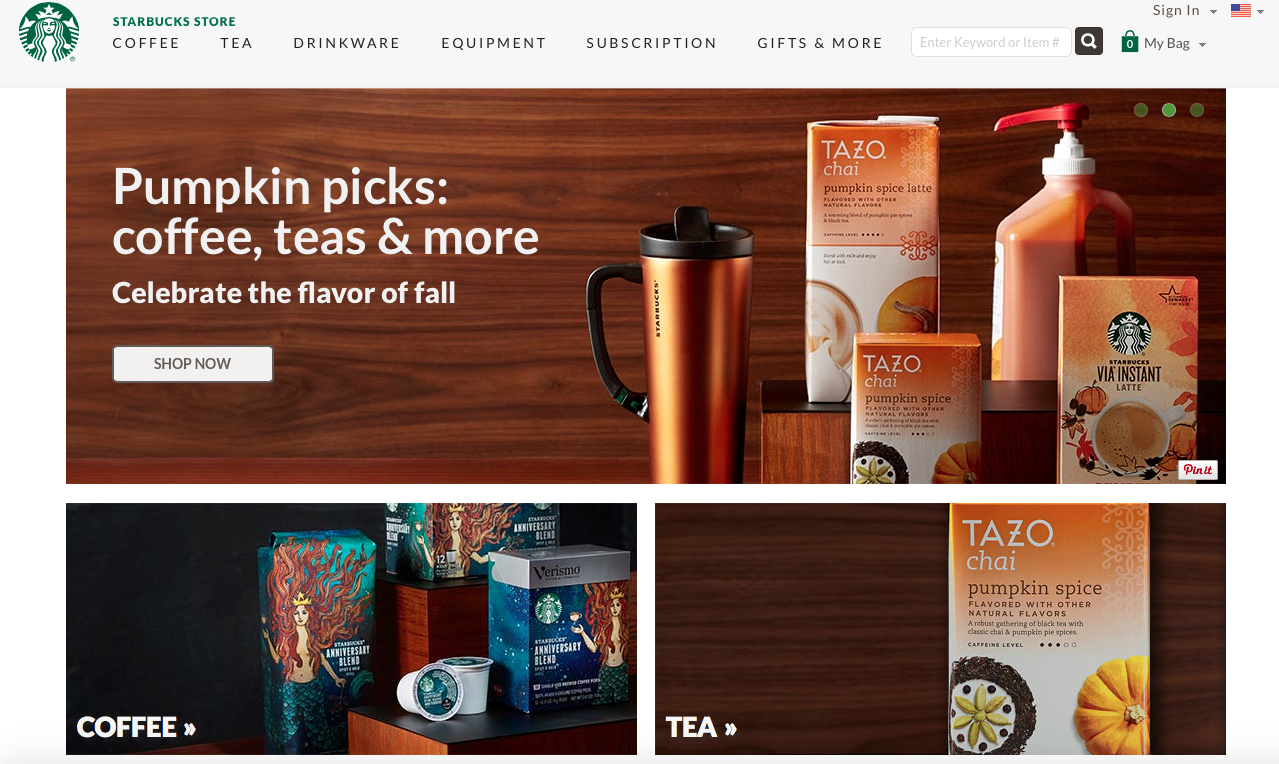
    Although today is the official first day of fall, pumpkin flavored lattes and #sweaterweather advertisements have filled our newsfeeds for weeks.  Preparation for America’s “favorite season” is a prime example of strategic planning when it comes to IMC.  Companies, such as Starbucks, take no mercy on branding fall for a profit.  Take a look at the Starbucks home page:

    Screen Shot 2015-09-21 at 1.45.54 PM

    “Celebrate the flavor of fall” with pumpkin spiced teas and pump bottles of artificial pumpkin flavor.  Starbucks goes above and beyond by defining fall and reminding us it is time to put a dent in the pumpkin population and enjoy this fantastic, fall sensation.  Keep scrolling and you will find the “Fall Drinkware” section of their website, offering a variety of different orange coffee mugs for about 20 bucks a piece.

    Screen Shot 2015-09-21 at 1.45.42 PM

    A little much?  Well, according to Fortune Magazine, Starbucks reported a 10% increase in the fiscal fourth-quarter sales in 2014.  Evidently pumpkin spice does come at a price.  The company is reportedly brewing up more ideas and plan to add to the recipe by creating a “fall flavored” line of sodas, smoothies, and yogurts.  Limiting the availability of these fall treats help build upon the chic image Starbucks maintains to its publics.  Though some may gasp at the thought of paying over 5 dollars for one of these sought after lattes, to many, fall just wouldn’t “be in the air” without them.

    S. Alyssa Groom wrote in her article, Integrated Marketing Communication Anticipating the “Age of Engage”, that it is now impossible to create a marketing plan to follow at the beginning of the year.  Starbucks’ creation of this fall line is a prime example of Groom’s theory.  The company has broken the marketing year into segments and focuses on specific aspects of what is popular and “hip” during that market period.  Groom also mentions that “marketing can no longer stand alone” and the importance of customer engagement.  Through social media pages dedicated to this fall line and the creation of hashtags, Starbucks makes purchasing one of their fall items interactive.  Allowing for customers to post pictures, tag the company, generate new hashtags and register for giveaways.  These strategies get the customer excited about going out and buying Starbucks products.  Customers now “buy into” the Starbucks brand, going beyond a simple cup of coffee.

    -Luke, Dan, Amanda, Meleah and Kendall