Tag: Global Marketing

  • P&G Sochi Countdown Ends Today!

    Grab your patriotic gear and set your TV recordings—the 2014 Winter Olympics begin today! While the official opening ceremony will not be held until tomorrow, the first five events of the Olympics are being held today. As the world has anxiously been awaiting the kickoff to the winter games, official sponsors have been preparing promotional material for months in order to promote their brand in conjunction with the Olympics.

    One of the Olympics’ worldwide partners, Procter & Gamble, created an entire “Thank You Mom” advertising campaign for the 2012 London Olympics, thanking moms for their hard work and dedication in assisting their children to become Olympic athletes. Whether it was waking their children up for early practices, or simply driving them to training sessions, the campaign highlighted the mother’s supportive role of the athlete’s journey to worldwide success.

    This year, P&G won over the hearts of many with an emotional second chapter to the campaign, titled “Pick Them Back Up”, specially crafted to promote this years Winter Olympics. Check out the video below.

    Tear-jerking, right? Since its premiere during the Golden Globes, the video has gone viral and has been viewed over 13 million times on YouTube. With the slogan, “For teaching us that falling only makes us stronger,” the commercial effectively hits America’s soft spot by thanking mothers for encouraging their children to pick themselves up after they fall and keep working towards their dreams.

    In addition to the heart-warming tribute to moms, P&G also created feature videos on specific 2014 Winter Olympic athletes and their mothers. Each video gives the world insight on the athlete’s unique journey to the Olympics, and the backbone behind their success—their mom.

    P&G strategically incorporated pathos into their campaign in order to entice and persuade viewers using an emotional appeal. By inviting the world into the Olympian’s lives and sharing their stories, P&G gives viewers the chance to connect and relate to the athletes on an emotional level before the games begin. We watch as the future Olympians stumble, fall, get back up and push forward on their journey to become professional athletes.
    untitled

     The commercial gives the audience an opportunity to join and follow this year’s Olympians on their path to success by utilizing elements of pathos. The story has all of the warm and fuzzy emotions people typically like to see: smiling babies, determined children, great triumphs and most importantly, supportive mothers. After viewing the video and witnessing the athlete’s triumph over hardships, we feel the emotional obligation to follow the stories of the current Olympic athletes.

    “A mom’s love of a young child who is an athlete is a universal emotion,” Vice President of P&G said about the advertisement, “These commercials create positive feelings. When consumers think about the brand, the feelings will transfer over.”

    With the special “thank you” being directed at moms everywhere, the idea is that parents and children will want to immediately run to one another and share a misty-eyed hug. P&G  wants to associate themselves with the inspiration that accompanies the supportive relationship between a mother and child, as well as provide an opportunity for the viewer to join in on this feeling.

    P&G has done an incredible job  branding themselves as a family-valuing company. Through the newly released commercial for the “Thank you, Mom” campaign, that began back in October 2013, P&G has reinforced consumers that they believe in family and are devoted to all of the hard working mothers in the world. In the first video in the campaign P&G stated, “The hardest job in the world, is the best job in the world. Thank you, Mom.” This campaign has become one of the largest multi-brand activations in the company’s history. P&G is delivering their brand message for the Sochi Olympics through a variety of media channels globally.

    Marc Pritchard,P&G CMO, states that the focus of their marketing tactics have shifted predominantly to the internet. “I really think about it as digital first. We think of search and social and video and display as the first focus. That’s where our consumers are spending their time” stated Pritchard. The campaign has already been a huge success through its emotional components accompanying the Olympics to market its products’ relationships with consumers, especially to the mothers of the world.

    By incorporating pathos and reinforcing their family brand image using mothers as a focal point, P&G aims to increase brand propensity within their target audience. They hope that connecting to the audience on an emotional level, and in conjunction with the Olympics, will persuade consumers to chose their brand over their competitors. Do you think this ad worked? Does this campaign make you want to watch the Olympics?

    -Briana McWhirter, Emily Foulke, Hannah Turner
  • Ambush Marketing, Rule 40, and the Sochi Controversy You Aren’t Hearing About

    Have Olympic advertising partnerships gotten too big? Have rules and restrictions protecting these “official sponsors” gone too far?

    Dawn Harper Tweets her Opinion of Olympic Rule 40
    Dawn Harper Tweets her Opinion of Olympic Rule 40

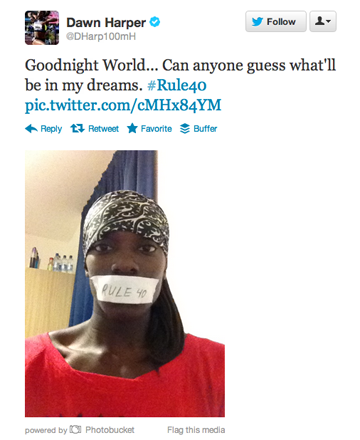
    Two-time track and field medalist Dawn Harper thinks so.  That’s why she posted this tweet with #Rule40 in protest of the IOC’s infamous Rule 40 during the 2012 Olympics in London.

    If you aren’t yet familiar with Rule40, it is a total ban on an athlete’s promotion of personal sponsors and their ability to acknowledge those who helped them get where they are today. It is especially focused on social media, where it has become a commonplace for athletes to thank sponsors with pictures and personal statements.

    Harper isn’t the only athlete to voice her displeasure with the effective “gag order” on competitors, but with companies spending upwards of $100,000,000.00 to associate their brands with the Olympics Games, is it really that hard to see why #Rule40 is in effect?

    Some have even gone as far to refer to the situation as a “battle”. Yet, despite the activism surrounding #rule40, without a doubt the biggest threat to the official Olympic sponsors is the ever-pervasive ambush marketers, silently stalking and waiting for their chance to steal some the Olympic brand name.

    These controversial ambush marketing campaigns attempt to capitalize on high-visibility events and locations through brand association without having to pay for the high-cost of officially sponsoring an event. My favorite example of ambush marketing involved the Minnesota Timberwolves selling this advertisement on the side of their stadium, where it happens to only be viewable from inside the nearby Minnesota Twins baseball stadium (where the official sponsor is Target).

    View of Timberwolves basketball stadium from inside the Twins baseball stadium
    View of Timberwolves basketball stadium from inside the Twins baseball stadium

    Ambush marketing may have been around in the advertising world for years, but the Olympics are seen as “the flagship event for ambush marketing”. Creative campaigns by infamous ambush advertisers like Nike often times attract more online buzz and conversation than the actual official sponsors.

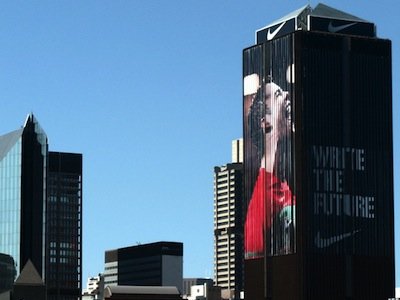
    During the 2010 World Cup in South Africa officially sponsored by Reebok, advertising juggernaut and infamous ambush marketer Nike, placed an eye-catching ad on the fourth tallest building in the entire city of Johannesburg. When paired with a lengthy viral video, many agreed that Nike had effectively hijacked the sponsorship from Reebok and gained closer brand association with the World Cup event.

    Nike ad in Johannesburg during World Cup 2010
    Nike ad in Johannesburg during World Cup 2010

    Another ambush marketing giant, Subway, has already launched its attempt to steal some association from the upcoming Sochi games.  Summer Olympian Michael Phelps and retired speed-skating icon Apollo Ohno both appear in TV commercials for Subway’s “$5 foot long campaign” due to some legal loopholes discovered by Subway.

    So is it reasonable for the IOC to implement Rule 40 to help protect sponsors? Freeskiier David Wise recently commented that, “[he] understand[s] the Olympics are a moneymaking game, but it’s sad for [him] to have all these sponsors who have really taken care of [him]…[he’s] on the biggest stage [he] can possibly be on and [he] can’t give them the representation they deserve.”

    Another athlete and social media enthusiast, Nick Goepper, has stated that he will be completely off of social media for the entirety of the Olympics. “I think it might be safer not to tweet anything,” said Nick, the 19-year-old favorite to win Ski Slopestyle gold. “All I know, it’s pretty much zero tolerance for branding.”

    The Sochi games are only 3 days away, but the media blackout protecting the games’ sponsors has been in effect since January 26. When the final medal is awarded and the closing ceremonies complete, which brands will you associate with the games? Which advertisements and commercials will be the most talked about and discussed? Is $100,000,000 too much to pay for a loose association with the Olympic rings?

    Will the “ambushers” steal the spotlight once again?

    – Greg Rothman

  • Going Green, Brings Green

    Brands can promote themselves through almost any medium nowadays. Pens, stickers, posters, billboards, you name it, you can put your brand on it. Planet Earth Promotions is a company that is designed to help brands promote themselves in an eco-friendly way. There is constantly increasing awareness about environmental protection and a greater consciousness about how important it is to protect these environmental and natural resources. Planet Earth Promotions is leading the way for this “EcoSmart” promotional item trend.

    Planet Earth Promotions’ mission statement indicates that their “goal is to help companies and corporations around the nation proactively enhance their brand through the use of environmentally conscious and educational promotional items”. They have certainly delivered in this respect. This company has been ranked #1 in promotional advertising for the past ten consecutive years. Not only are they paving the way for other companies, they have become a greatly successful brand that is little to no impact on the environment. Planet Earth Promotions has built a successful brand on a trend that is becoming increasingly important as time goes on. This brand is very strong considering they have remained at the top of the list from Arizona Magazine for the last ten years and they are here to help other brands.

    They are able to offer many alternatives for companies to help cut back on environmental damage by providing recycled goods, information about recycling and environmental days in the USA and tips to bring pollution down. With so many companies shifting focus to being the “EcoSmart” companies and LEED (Low-energy electron diffraction) certified, it is a challenge to stay on top. Planet Earth Promotions has paired up with other environment-friendly companies such as AWEA (American Wind Energy Association) and Women’s Business Enterprise to built a very powerful and successful brand and continue to pave the way for other companies looking to create environment-friendly products and solutions for all varieties of businesses.

    – Julius Roberts, Leanna Marshall, Leslie Tyler and Bryce Koonts

  • Barefoot? Not with TOMS Shoes!


    Many of us are familiar with the shoe brand TOMS. The company, started by Blake Mycoskie, commits itself to donating one pair of shoes to a child living in poor conditions for every pair of shoes it sells. TOMS’s program of giving was the result of its owner traveling to South America and finding that many children were contracting diseases through their bare feet, as they were unable to afford or obtain shoes. Mycoskie decided to manufacture his company’s shoes in an eco-friendly and vegan manner. TOMS are made using supplies from an organization, Livity, specializing in “low environment impact materials” (information based on a 2008 interview between Mycoskie and San Diego Loves Green reporter Allie Bullock Kagamaster).

    Not only does TOMS market their product as a philanthropic exercise, but it also markets itself as an organization dedicated to environmentally sound products. The company is able to create establish integrity for its product among potential customers who are concerned with social and environmental issues. Partnering social and environmental values, allows TOMS products to stand out amongst competitors.

    TOMS has gone a step further than its usual shoe donation program; by implements its “One Day Without Shoes” campaign. This campaign is meant to raise awareness of the dangers faced by individuals who do not have shoes to walk in, in areas where environmental conditions, such as chemical contamination and littering of glass, syringes and debris, can cause multiple diseases. “One Day Without Shoes” also encourages individuals to buy shoes from the company so that TOMS can donate shoes to these individuals.

    The “One Day Without Shoes” campaign is designed in a way that the company’s customers and followers can actively participate in it. When going to the company’s website, a person can email the page to their friends and family, post it on Facebook, or follow the campaign on Twitter. This implementation of social media shows that TOMS Shoes is aware of the powerful impact individuals can have when marketing a message, just by sharing information with friends on social media they are already using, and that can be viewed by mass numbers of friends and peers.

    Also on the campaign’s website, TOMS Shoes encourages individuals to share videos and photos of themselves without shoes and an explanation of what the experience meant to them. Followers can find their own marketing devices to spread the word of the campaign on the website. Rally signs, street stencils, pocket info cards, stickers, profile pins and banners, DIY t-shirts, and displays can be downloaded from the campaign’s website for the event.

    “One Day Without Shoes” has also found many corporate partners to participate in its campaign. These partners are Aol., Discovery, essie, flickr, just wink by American Greetings, Kiehl’s, Kind Healthy Snacks, and SIMS. The “One Day Without Shoes” campaign shows the ways in which organizations rely on various societal values and corporate marketing techniques to draw attention to their brand or promotion.

    -Ashley Oliver,Hunter Wilson, Josh Vester, Molly Jacques

  • 30 Seconds to Impress.

    Super Bowl XLVI, hosted in Indianapolis, Indiana. February 5th, 2012.

    As the big game is just days away, people are gearing up for Sunday and preparing themselves for the largest televised game in all of sports. With an estimated 90-100 million people forecasted to watch, Sunday isn’t a big day just for the Giants and the Patriots; Sunday is the day where the nation’s most popular companies spend up to 10% of their yearly advertising budgets.

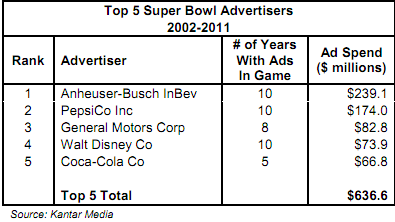
    Projecting an increase in viewership, it is to be expected that an increase in the price of advertising on the nation’s biggest stage, with this year’s price tag for 30 seconds of screen time reaching $3.5 million dollars, an increase from last year’s $3.1 million. Keep in mind that $3.5 million dollars will get you ONE 30-second advertisement, where it will be competing for viewership in an estimated 47 total minutes of commercial time. It’s no surprise that companies like Anheuser-Busch and PepsiCo are willing to shell out nearly a quarter of a billion dollars to run upwards of 10 ads, with some lasting over the 60-second mark.

    It has also been reported that Swedish company H&M will be airing their first ever Super Bowl advertisement, starring the LA Galaxy and former EPL Soccer star David Beckham. While this isn’t the first time that a global company has advertised during the big game, it is certainly a sign that retailers globally are starting to incorporate the Super Bowl into its scheduling of product launches, as H&M is set to reveal their new line during the ad that will be in stores soon after. It is obvious that while football is an American sport, there is no better way of getting attention during the most watched event of the year.

    But when it comes down to it, is it really worth it? Many experts agree that, yes it is. It has been reported that nearly 50% of the audience tunes into watch just the commercials alone. The main draw of these commercials isn’t necessarily for people to go out right after and buy the product, but just to stir up some buzz around the company. Being known is always the first step to great sales. However, selling the products helps a lot too. Think about Snickers buying a $3 million dollar ad, and then think about how many candy bars they would have to sell in order to pay for that ad. Don’t worry. Randle D. Raggio, a professor at the University of Richmond in Virginia already did it. You’d have to sell 6,329,406 bars. If 100+ million people see your ad during the commercials though, you probably have a pretty good shot, I’d say.

  • Will The Force Be With You?

          It’s Super Bowl season and we, as viewers, are ready for the stream of entertaining advertisements that keep us occupied between breaks. I’m sure everyone remembers last years buzz worthy Star Wars inspired Volkswagen commercial. How can one not be enamored with a little boy in a movie quality Darth Vader suit that genuinely startles himself by using “the force” to turn on his dad’s new Volkswagen? Beyond all the cuteness, the commercial relays the push-to-start feature that the affordable (and apparently fun) German car has to offer.
         To top its success from the last Super Bowl, Volkswagen has returned with yet another Star Wars inspired ad and the entertainment factor is undeniable. Yet what do barking dogs and Star Wars really have to do with the German automobile company?
         Advertisers take full advantage of the hype surrounding the Super Bowl to create innovative, touching, and entertaining commercials. Companies will pay extraordinary amounts of money to ensure that their commercial is seen by the millions of viewers watching the game. After all, this one time of the year advertisers can assume that almost every single American is tuning in. What company wouldn’t want their product showcased at this time? It’s like a black Friday Christmas sale for advertisers. These companies want to bring attention to their product in anyway possible, even if that means their product isn’t even mentioned until the last three seconds.
         In the Volkswagen ad, the viewer is unaware of the association between Volkswagen and Star Wars until the very end. This proved to be a very strategic move on VW’s part. Last year, companies were able to monitor which commercials made the biggest impact on viewers via Twitter, FaceBook and other popular social platforms. They measured the ad’s success by the number of times it was mentioned in the digital realm and were able to realize what struck a chord with the vast audience. What once seemed to be a hail marry concept of integrating marketing, advertising, and social media, is now an easy field goal for the IMC commercial championship. Volkswagen is betting that we will remember how fond we were of last year’s Star Wars theme and associate those same feelings with their brand this year as well. You can’t go wrong with puppies and kids, right?
    -Alexis Kapczynski, Kacy Cox, Sara Kaloudis, Josh Bowman
  • What’s all the fuss about?

             So what’s all the fuss about on Wall Street? Oh wait, you haven’t heard? Not surprising. The major media outlets have all but ignored the events taking place in their own back yard. For almost three weeks, thousands of people have converged on this eight-block-long stretch of asphalt and skyscrapers in lower Manhattan. For what purpose, you ask? That answer remains a bit unclear. Some explanations offered by the media include: the downfall of capitalism, an end to corporate tax incentives, world peace, racial justice, freedom for prisoners, and a slew of others issues boldly displayed on signs and posters covering every inch of usable space.

                                     Image: Occupy Dallas protest

            Only in the last few days have  the demands from the protestors have become somewhat understood, although their presence in the city has cost Mayor Bloomberg two million dollars in police overtime alone. When you consider the damage to local businesses from lack of access, the burden of cleaning up behind thousands of unruly campers, the inevitable strain on the judicial system from the ever-growing number of arrests, and a multitude of other factors the price of these shenanigans is certain to be staggering. So where is the media coverage? Just now are we beginning to see headlines addressing this controversy. With the addition of several powerful workers unions and a handful of celebrities taking up the cause, we are beginning to formulate a picture of the reason for the last three weeks of frustration. A decade of costly foreign war, millions of Americans out of work, skyrocketing foreclosure rates, and the disappearance of stock portfolios and pension plans galore are all contributing factors. Americans are angry and apparently it’s time to show it. But why go through the trouble of protesting if you are not even marketing your purpose?
           No one is blind to the problems we face as a nation, yet the solution seems beyond reach. Take to the streets or take to the polls? No matter what you choose, if no one knows what you are fighting for, you are wasting your time. You could have the best idea or the most sensible solution, but ultimately it’s about marketing your idea clearly that determines if you will make any difference at all.

    -Claire Dillard, LaPuasa, Reinhardt