Tag: Dove

  • The Transparency Angle

    What’s even real these days? It may or may not be a question that’s crossed your mind recently, but it is causing a stir in companies and ad agencies.  Transparency and authenticity are in, and flashy propaganda is on its way out.  It’s no surprise that businesses continue to refine the concept of authenticity for the purpose of marketing strategy.  What could be more lucrative than to convince consumers that a product can bridge the disconnect between modern civilization and reality, especially in a society constantly seeking meaning?

    Chick-fil-A is one company that is now taking the advertising approach of transparency, inviting customers for behind-the-counter tours at all of their locations.  This blazes the path for their upcoming menu improvements, such as salads with more nutrient-rich ingredients focused on harnessing the concept of authenticity in their food offerings.

    However, restaurant chains aren’t the only ones using this strategy.  Dove, a brand owned by Unilever, started the “real beauty” campaign in 2004 in the hopes of expanding the definition of beauty and promoting self-esteem in women of all shapes and sizes.  This week the company released a video to tell women “you’re more beautiful than you think” by comparing how women view their own beauty with how strangers view them.  This type of advertising goes beyond showing the consumer how authentic a product is; it makes the audience consider the authenticity behind their own self-image.

    The Authenticity Hoax, a book by Andrew Potter, takes apart the ideal of the “authenticity” that we’re all striving for.  He looks at the areas of our lives where we feel connected to experiences, the world, and nature, and how society has lost the true meaning of authenticity in the process of seeking it out.  In his conclusion he says, “we are trying to find at least one sliver of the world, one fragment of experience, that is innocent, spontaneous, genuine, and creative, and not tainted by commercialization, calculation, and self-interest.”

    The minute authenticity became a brand in and of itself, people wanted to have it, and companies are more than happy to sell it.  Dove may highlight the reality of the average woman versus the size zero models in many other ads, but that doesn’t mean they’re not capitalizing on some other ideal.  Authenticity is the new thing to have.  The problem is, just as Potter points out, authenticity is pretty much a false goal.  Chick-fil-A can show its customers where they make the food, but that doesn’t mean anyone’s life is more real because they ate a chicken sandwich that wasn’t frozen.

    Ally Walton

  • True Life: We Live in a Barbie World

    The Barbie Doll is an icon in American history.  Young girls have been playing with Barbie since 1959 when the doll was first introduced.  Jill Barad president of Mattel, which manufactures Barbie said, “99% of girls ages 3 to 10 own at least one Barbie doll.”  Though Barbie has been considered anatomically incorrect, teens and women everywhere consider Barbie to have the perfect body.  According to the Media Awareness Network, “Researchers generating a computer model of a woman with Barbie-doll proportions found that her back would be too weak to support the weight of her upper body, and her body would be too narrow to contain more than half a liver and a few centimeters of bowel.”  Even with realizations such as those mentioned above and professional opinions, teens and women are continuously looking for ways to get the “perfect” body that clearly doesn’t exist.

    With the media’s portrayal of skinny bodies, tiny waists, and big busts, beauty products and diet plans are constantly growing and becoming more profitable by the day. Women become insecure with their body image because they are surrounded by the unattainable beauty presented in the media.  This overwhelming presence of thinness presented in the media can easily bruise women’s confidence and self-esteem. Living in the culture of thinness can ultimately lead to self-destruction. However, some marketing companies, such as Dove, are fighting against this stereotype and defining what real beauty truly is.

    The Dove® Campaign for Real Beauty was created in September 2004 to encourage women to voice their opinions on the issue of the definition of beauty. Through these discussions, it was obvious that the definition of beauty that the women knew was extremely limiting and virtually unattainable. The Real Truth About Beauty: A Global Report found that “among the study’s findings was the statistic that only 2% of women around the world would describe themselves as beautiful.” Since these horrifying findings, Dove has put forth amazing effort to break beauty stereotypes and make people realize that beauty is not what the media portrays. The first jab at the media came when Dove aired a commercial that featured real women whose appearances were not of the norm. Dove asked their viewers to judge the women’s looks and vote at their website. The options for the voting consisted of questions such as “oversized or outstanding?” and “wrinkled or wonderful?” Since the campaign was created, these commercials have made an impact on women around the world. Dove has seen an increase in the percentage of women who can describe themselves as beautiful.

    -Kelsey Bendig, Andrea Blanton, Brooke Keller, Brian Burch

  • All The Single Ladies

    Valentine’s Day is a holiday dreaded by a great deal of people, both male and female, for various reasons. There is pressure on both genders to perform, declare emotions, and out-do previous years or expectations. Those who fail at this task of grandstanding may in fact find themselves without a date for next year. Okay, so there’s a ton of pressure on people in relationships, but what about those of us who are single? While some take pride in their solitude, others wish they had someone to be their valentine, and a few twitch at the mere thought of being in a relationship.

    According to an article in the New York Times, being single is a prevalent occurrence these days with 59.9 million single women in America. This staggering rate may surprise some, but companies like Dove chocolate see these table-for-one ladies as a prime marketing demographic. They hope to strike a chord with this growing independent group by catering their advertising to the women who are without companions. That is why this year Dove has made a campaign to remind women Valentine’s Day isn’t just about romance.

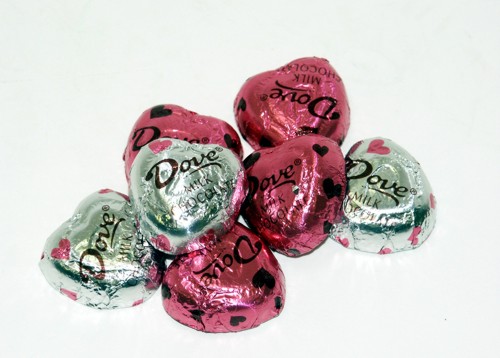
    Dove is banking on the stereotype that single women will turn to chocolate this year on Valentine’s Day. Instead of the standard “Call me” or “I’m yours” found on the candy hearts we used to share with our playground crush, Dove has created a host of witty comments and placed them on the inside of their chocolate wrappers. Some of the best include, “You’re gorgeous,” “Sometimes I buy flowers for myself,” “My flaws are fabulous” and even the ever so uplifting, “Love yourself in a moment.” The new commercial features women sharing their Dove chocolates with everyone from their barista to their neighbor, and most importantly, themselves. Is this a message of independence for the strong woman? Or rather, a cheap ploy based upon the assumption that women alone on Valentine’s Day will inevitably console themselves with chocolate? Either way it’s hard to dislike chocolate, especially when it’s making single girls smile and promising not to judge if we have more than one.

    By: Alexis Kapczynski, Kacy Cox, Josh Bowman, and Sara Kaloudis