Tag: Cause Marketing

  • Yoplait USA: Friends in the Fight

    For more than fifteen years, Yoplait USA, the popular yogurt brand, has raised both money and awareness for breast cancer. Since 1998, Yoplait USA has supported breast cancer in conjunction with the Susan G. Komen® through cause marketing, which involves commercial activities that aligns a brand with a cause in order to create benefits for both. In this case, cause marketing helps Yoplait promote and market their products to consumers while raising funds to donate to Susan G. Komen®.

    This year, according to Susan G. Komen ‘s website, Yoplait’s cause marketing program is entitled “Friends in the Fight.”  From October 1, 2014 until November 15, 2014, “Yoplait Original and Greek products will feature pink lids. The lids will carry a code that consumers can redeem, through April 1, 2015, at www.Yoplait.com/friendsinthefight and choose to direct their 10 cents donation to Susan G. Komen.” Past cause marketing campaigns between Susan G. Komen® and Yoplait, such as “Save Lids to Save Lives,” have continued to be similar in effect. This year’s title, “Friends in the Fight,” seeks to to demonstrate that Yoplait and its consumers can come together to make the fight against breast cancer more manageable.

    Through this program, Yoplait is encouraging consumers to actively participate in their cause marketing campaign by having them physically go online to donate their lid’s ten cents code. This year’s options include Susan G. Komen, Bright Pink and Living Beyond Breast Cancer, all of which help those who are or have been diagnosed with breast cancer. Yoplait’s cause marketing agreement is to make a minimal $350,000 donation split among the organizations.

    Video shows how to donate to one of three breast cancer foundations

    By actively engaging consumer participation via cause marketing, Yoplait says on its website that their efforts represent their “brand persona” and exemplified their consumers.  Cause marketing is a tactic that can not only be beneficial for both parties, but also positively shape the brand’s image by associating said brand with a cause that affects everyday people, such as breast cancer. Creating a positive brand persona that illustrates a commitment to a cause, Yoplait has continually been a popular brand that consumers love.

    -Kaitlyn Russell
  • Tackling Consumers

    A round of applause for the Seattle Seahawks as the champions of the Super Bowl XLVIII. Even if you were not a fan of either the Broncos or the Seahawks, it almost a sure bet you tuned into the game. Every year over 100 million people observe what is arguably the sporting event of the year.

    The Super Bowl, however, is known for more than a fierce round of football – it’s known for the commercials. Here is time where advertisers pull out all the stops. Audiences expect commercials of both artistic and humorous grandeur. Prices for spots annually rise, this year topping at $4 million for a 30 second spot.

    Yet companies don’t spend millions for spots merely to entertain viewers. Unlike in decades past, advertisers are no longer in the business of explaining, but in the business of convincing and reinforcing. This is often the purpose of commercials we see every day. So, other than the guaranteed viewership, what is the worth of a Super Bowl spot?

    Credibility, claims Joe Glennon, assistant professor of advertising at Temple’s School of Media and Mass Communication. In an article for the Philadelphia Business Journal, Glennon explains that many advertisers walk away from the exorbitant price tag due to the simple financial standpoint that $4 million for 30 seconds is a largely impossible return on investment. He explains that of those who do justify the expense there are two primary advertisers – large, well known, companies who use the spots to reinforce brand propensities among current users, and smaller companies who use the spot as a means to launch into the market by gaining notoriety.

    So, in the myriad of last night’s entertainment, we have selected four commercials that beautifully represent the two credibility building categories Glennon noted; some attempting cut into, or further into the market, others reinforcing brand attitudes.

    Squarespace

    Squarespace created a spot that was a humorous, but accurate depiction of what the Internet is like – cluttered. Personifying memes, obnoxious advertisements, and the “duck face”, Squarespace offered to consumers that when using their services for website building and maintenance, the company could alleviate such distraction. So, why did Squarespace make it onto the list today? Simple, the Squarespace commercial introduced the company values and brand in a creative, weird, funny, and somewhat true way. Justifying the $4 million dollar expenditure seems to working so far – we are talking about – there’s probably a good chance other people are too.

    WeatherTech

    Although the ad was neither humorous nor heart-warming, WeatherTech’s commercial built on a sacred theme in the Super Bowl: American pride. Their slogan, “American Factories, American Raw Materials, and American Workers”, was enough to draw people’s interest and introduce their company as a defying the odds, sticking with their gut, and overcoming obstacles many American companies have faced. During a time when many gripe about US jobs becoming outsourced, it’s hard to say that WeatherTech didn’t prove their credibility with their national pride.

    Cheerios

    Yes, the adorable little girl is back and this time she is getting a brother. This 30-second ad wraps up what all of us remember of Cheerios and what the Cheerios brand wants us to remember about them; families coming together over love. Here Cheerios is showing how they are continuing to be a hearty and healthy part of growing families.

    Bank of America/(RED)/U2

    What does this commercial not do? It introduces U2’s new song “Invisible” (there is still time to get your free download if you haven’t done it), it highlights and raises money for the charity (RED), increases knowledge of AIDS/HIV, and shows Bank of America’s humanitarian efforts. Reinforcing their slogan, “Life is better when your connected”, Bank of America is giving a chance for its customers and the world to connect by helping to end an epidemic.

    What is your opinion? Do you think these commercials deserve a spot in these categories? What other commercials did you see that introduce the brand or reinforce existing brand propensities?

    Caroline Robinson, Savannah Valade

  • The Hunger Games are…Real?

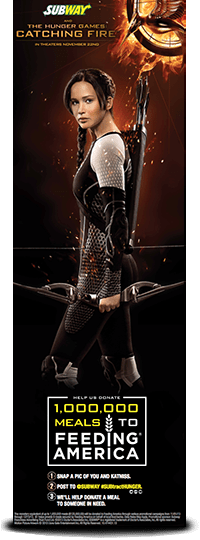
    The Hunger Games: Catching Fire, opened on November 22, 2013 as a sequel to the Hunger Games. What started as a series of books by Suzanne Collins has been turned into a hit soon-to-be trilogy. Catching Fire made an estimated $158,074,286.00 on its opening night in the United States alone, according to IMDB. The blockbuster film partnered with many companies, including Subway and Feeding America. This trio has combined forces to also include Twitter in an effort to end hunger.

    As a result of Subway and Catching Fire being partners, Subway is currently using the tributes of the Games to encourage people to eat in the restaurant. This type of celebrity endorsement brings in people who might not normally eat there. “Oh, if Peeta eats Subway, I should too!” Granted, this behavior might come more from children but they, in turn, will ask their parents to take them to Subway. I’ve seen this time and time again with my younger siblings. This also works for the older crowd, however, because a partnership of this nature often includes promotional items or sales/deals that someone may anticipate being offered. Subway has transformed their marketing strategies and dining areas, with concepts like “Where Victors Eat” and “Win your own Victory Tour,” with the latter being a sweepstakes in conjunction with their collectible Catching Fire drink cups.r_kat1

    In the third and final facet of this trio of partners, Feeding America has jumped in and put their cause directly in the middle. Subway has placed cardboard cutouts of tributes Katniss, Peeta, and Finnick in the dining areas of Subways. A patron, after eating “What Victors Eat,” can take a photo with the cutouts and post it to the Subway Twitter, with the hashtag of #SUBtractHunger. Each time a hashtag is used, it is counted towards the 1,000,000 meals that Subway will buy for Feeding America. In the fine print, it says that Subway will donate up to $125,000, as each dollar makes about nine meals. However, this linkage will only exist until 11:59pm on December 15, 2013. The meals will be provided from Feeding America through local food banks in areas in need.

    This celebrity endorsement effectively ties in cause marketing in order to create an environment in which Subway patrons are encouraged to aid Feeding America. Though there is no mention of patrons being able to donate money directly to Feeding America via Subway and Catching Fire, the Feeding America website has a donation area, as well as a hyperlink to a Hunger Games site, where a large “Ignite the Fight Against Hunger” plea is proudly displayed under a Mockingjay and above a photo of the tributes stoically ready to win the real-world Hunger Games. The number of families that go hungry over the holidays is continuously growing. With Feeding America, Subway, and the Hunger Games movie series teaming up to feed families, alongside many other organizations attempting to end hunger, do you think the odds are in are their favor?

    -Hilary Hall

  • Marketing for a Cause: One Pair of Shoes at a Time

    Whether or not you know what cause marketing is, there is a good chance that you have participated in it in one way or another.  Since cause marketing is the collaboration of a company with a specific organization or cause, which is something that many brands participate in, we have decided to focus on one particular well known company that uses this tactic. The specific brand that many people, maybe even you, have supported through cause marketing is TOMS.  TOMS is a shoe company that provides a pair of shoes to a child in need around the world every time that a pair is purchased.

    TOMS

    The idea of TOMS shoes came about when founder, Blake Mycoskie, visited Argentina and discovered children within the village were walking around barefoot. Determined to help, Mycoskie created the campaign “One for One,” that would “match every pair of shoes purchased with a pair of new shoes given to a child in need.” The company has had outstanding success, becoming nationally appraised and known for their good deeds. According to their website, TOMS has given 10 million pairs of shoes spanning over 60 countries. A motivating factor behind the TOMS brand is their demonstration of corporate responsibility through their desire to help others in need.

    The Theory of Reasoned Action makes a good connection with TOMS and cause marketing because it states that attitude drives intention which overall drives the desired behavior. The Theory of Reasoned Action also states that, “If the outcome seems beneficial to the individual, he or she may then intend to or actually participate in a particular behavior.” TOMS’ mission drives consumers to have a positive attitude towards the brand and an inclination to purchase their products because the outcome is helping children in need.  Peer groups, friends, family, role models, and celebrities also play an active role in influencing consumers to participate in a desired behavior. Consumers who have a positive attitude about a celebrity that advocates TOMS may in turn have a positive attitude about TOMS, which will increase their intention and actual behavior of purchasing their products.
    What are some other instances where you have seen companies and brands use cause marketing to sell their products?  Do you think people’s motivation to purchase TOMS shoes is more for the fashion statement and to look like a good person or to genuinely donate?

    -Aaron Love, Kara Zimmerman, Rachel Clay, Rebecca Hobbs