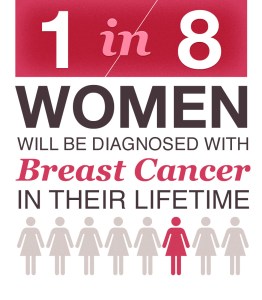
 Did you know one in eight women in the United States will develop invasive breast cancer? And that every two minutes in the United States a woman is diagnosed? Cancer is one of the most feared words in American culture. We focus a whole month to supporting one specific type of cancer. Breast cancer awareness month is an incredible way our nation unites through multiple organizations, to support a good cause. The process is extremely easy for anyone to donate and feel like their money is going to a good cause…or is it?
Susan G. Komen for the Cure is a widely known non-profit organization that supports breast cancer research. The purpose behind this organization appears to be transparent- but has it gotten to the point where it is just money hungry? Only 20% of the money raised or donated goes directly to breast cancer research. Although this is not out of the ordinary compared to other widely known non-profit organizations, it is misleading how their partnerships also support “for the cure.” Susan G. Komen partnered with KFC to create “buckets for the cure.” KFC’s diet aids to cancer cell growth and the main reason for partnering was to, “reach out to millions of woman they might not otherwise reach…” But, Breast Cancer Action claims, if you want to reach communities that are underserved, then the Susan G. Komen organization needs to reach out to the community health clinics. Clearly from this example of their partnership tactics, there are suspect business practices within the organization. The list of controversial issues that the Susan G. Komen organization has accrued over time is actually surprising considering the foundation started with a good cause in mind.
 For the better part of the last decade, the popular breast cancer charity Susan G. Komen has been racked by controversy. Things began to go awry in 2012 when they pulled support for Planned Parenthood, amid pressure from Republican lawmakers. The non-profit responded to accusations that its actions were, “anti-woman,” saying that the funds were not pulled because of ideological conflicts, but because planned parenthood was under investigation by congress. This is a questionable statement, as the corporate structure of Susan G. Komen has strong ties to pro-life entities. Among other accusations, the organization has taken heat for using donor money to sue other non-profits for infringing on their various trademarks. Notably the phrase “For the Cure,” which has been the subject of many cease-and desist orders, even when the organization had nothing to do with breast cancer. After all of the hits the company took, rather than step down, the CEO took a huge page raise.
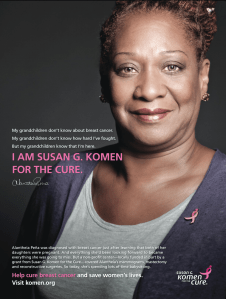 Following Susan G. Komen’s changes in grant rules, barring Planned Parenthood’s funds, supporters increased on Planned Parenthood’s side. According to Politico, Planned Parenthood’s Facebook page increased by 10,000 in a few days. Anti-Susan G. Komen for the Cure Facebook pages increased- with titles similar to “De-fund the Komen foundation.” As the news broke regarding Susan G. Komen’s course, Planned Parenthood and #PlannedParenthood started trending on social media and became a topic of interest in mainstream media. Susan G. Komen for the Cure did not convey its message well in response to the crisis. After the crisis, the Komen foundation used storytelling as a way to reconnect with the community- starting a print and television advertising campaign, “I Am Susan G. Komen“. This campaign spotlighted four-breast cancer survivors- using their stories to market Susan G. Komen for the Cure.
An important thing for organizations, especially nonprofits, to remember is their brand identity and their actions need to match up. Cognitive Dissonance is when someone experiences a feeling of tension when their beliefs do not align with their actions. This theory states that when someone experiences this inconsistency, they will do what they can to reduce this uncomfortable feeling. The Susan G. Komen organization received backlash after developing a perfume “Promise Me”, which contains toxic and hazardous chemicals. Breast Cancer Action exposed the use of Toluene, banned by the International Fragrance Association as well as Coumarin, banned by the Food and Drug Administration.
People donate to Susan G. Komen, which presents itself as a non-profit organization donating its funds to breast cancer research. When those who donate hear about Susan G. Komen partnering with organizations, which do not promote health, such as KFC, creating harmful fragrances for sale, and giving only a small amount of money to breast cancer research, cognitive dissonance occurs. They may feel uncomfortable because of the inconsistency in what the organization presents itself as doing and what it is actually doing. Those who donate will oftentimes choose to reduce this feeling by stopping their donations to the organization altogether. If a non-profit organization wants to thrive financially, they need to ensure that their actions align with how they present themselves and their original intent.

Reading the information on Susan G. Komen for the Cure, one might expect all nonprofit organizations follow their guidelines. Here are other foundations and organizations supporting breast cancer research and finding a cure:
- Breast Cancer Research Foundation
- Dana-Farber Cancer Institue
- Breast-Cancer Awareness Campaign- Estee Lauder
- Avon Foundation
- Bright Pink
- Save the Tatas
It is easy to show how significant the topic of breast cancer is within the United States. There are countless statistics about the impact breast cancer makes- that would shock any reader. So, hearing that one of the most well-known organizations, whose existence is centralized around breast cancer research and finding a cure- may not be the hero it has portrayed itself to be, is concerning.
We, as the American public, have a duty to be alert to the aspects that make up our charities and nonprofit organizations, and be diligent in how we distribute our donations. As a reader, what are your opinions on Susan G. Komen for the Cure? Would you donate your time and money to this organization?
-Jonathan Callahan, Erin Fouhy, Julia George, Joseph Hines, and Sarah Suggs



 IMC Hawks Blog