Beginning last summer, the City of Wilmington along with New Hanover County and the surrounding beach towns have attempted to develop a brand for Wilmington. Various groups within the community might have different perspectives on what this southeastern North Carolina town is all about, but officials involved believe there must be a common theme amongst the groups. They also have mentioned that the goal is not to “re-brand.” They have clearly stated that it is a first time effort to create an effective message of what Wilmington is to outsiders.
Beth Schrader, strategy and policy manager for the county believes that branding the town gives you an initiative you can sell. Once there is an established brand, outsiders will know what exactly sets Wilmington apart from other southern historic towns.
UNCW business and marketing students and professors have played a huge role in this process. They have aided in research and surveys, which has been an exciting opportunity for them to engage in applied learning.
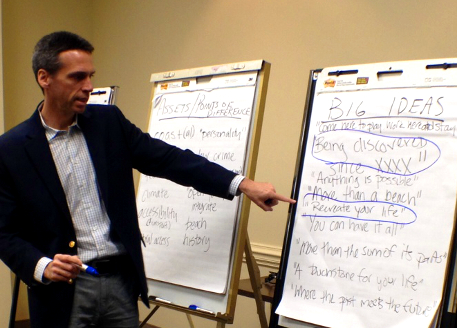
Recently, the Brand Identity Leadership Team met to continue the mission of branding the Wilmington area. Newer ideas include Wilmington being a place to “discover” as well as the idea to market Wilmington as a “hidden treasure.”
Tom Porter, chairman of the marketing department at the UNCW Cameron School of Business, presents rough ideas for the mission to brand Wilmington. (Photo from PortCityDaily.com)
The idea of attempting to brand an entire town might seem strange at first glance. But according to CEOs for Cities article, “Branding Your City,” cities have always been brands. When you think of our globalized world, every place has to compete with every other place for attention, which creates the need for a brand identity. Cities need to set themselves apart from other cities in order to attract the world to that city. Branding is a tool cities can use to define themselves, which is necessary to have a long-lasting impact. The brand will influence and shape the world’s perception of a town.
Branding a city is an important and commonly used tool, but the question that remains is does Wilmington already have a brand? Will the initiative be able to successfully brand something that has already existed for so long?
What is the Wilmington brand to you? Comment and let us know!
We are now in the transitional time of year when all the bitterness of the cold winter is transferring into the sunny, light-hearted feel that spring brings. One particular brand that has always been known for its spring-like characteristics is easily that of Perry Ellis and they are bringing forth their positively electric style to match the approaching season. For the upcoming spring/summer 2014 campaign, Perry Ellis is delivering a new, creative way to show men that style can be a fun experience. The campaign was released back in the month of January which was titled, “A Very Perry Spring: We’ll Put a Spring in your Step”. The foundational idea for this campaign is to assist men on the breakdown of fashion (patterns, prints, how to dress in suits and even undress) and to extend the message that men’s fashion does not have to be too serious and that style can be unpretentious and fun.
Perry Ellis launched his first line back in the year 1976 with the philosophy of levity being his legacy. The company is a distributor of a broad line of high quality men’s and women’s apparel, accessories, and children’s apparel. He believed that clothing should not be taken too seriously and should be fun. Perry Ellis redefined the fashion industry. Perry Ellis has coined the term that one could be labeled as, “very Perry Ellis”. This means customers of this brand are innovating their own unique style, instead of going with the fashion flow, and still looking chic.
For the Very Perry Spring 2014 campaign, Perry Ellis reunited with photographer Daniel Jackson and the label top models, Jason Cameron and Albert Reed. The advertisements incorporated the foundation of levity in the brand by fashioning vibrantly colored imagery showing the models in various confident and playful poses. Showing that style can be a fun experience, the images seem to leap out of the frame. Whether it is a hand or a hat, the meaning of this photographic placement is meant to contrast with the brand’s iconic “time to defy convention” attitude.
Not only has the campaign mastered the traditional advertisements representing the brand’s legacy, but has also incorporated a new media strategy to reach consumers in the digital world. Matt Cronin, Vice President of marketing at Perry Ellis discusses the new media tactics will include “a series of engaging and witty videos which will bring the Very Perry attitude to life”. These videos consist of style tutorials for men and how to dress modernly. The style tutorials are entertaining, easy-going, and show men that dressing up is a lesson in laid-back attitude and breaking the rules.
Perry Ellis utilizes these media channels to promote its brand and for users to stay connected:
Perry Ellis’ spring campaign is also holding a “March to a Million Facebook Fans” with incentives for contenders to win prizes by helping the company reach 1,000,000 fans.
The Very Perry Spring 2014 platform delivers a fundamental point of view from which the brand operates and incorporates everything the company is built off of into this new direction of marketing.The campaign will include digital campaigns featuring both still and video assets advertising the versatility of outlets the line is offering.
Nike, the leader in manufacturing footwear and apparel has been building and strengthening their brand since their first advertisement in 1982. Currently, Nike has become a household name and can be easily recognized by consumers by their iconic swoosh logo. Before running advertisements on television, Nike promoted their brand based on sponsorships and celebrity endorsements, both professional and college athletes. In order to differentiate their company from their biggest competitor, Reebok, Nike chose to promote their shoes as fashion accessories to consumers. They also began to focus their advertisements on the stories of the people wearing the product, instead of solely on the product.
As their brand was quickly growing, Nike employees decided to sign on with Wieden and Kennedy (an advertising agency) to help promote their brand. The “Just Do It” tagline was created while in a meeting when Dan Wieden (one of the founders) said to the Nike employees, “You Nike guys, you just do it.” With just that one phrase, the history of Nike advertising changed.
When the famous tagline, “Just Do It”, was first brought into their marketing scheme, Nike was trying to regain its position as the industry leader. During the 1980s the aerobics industry climaxed giving competitors an open range of new business development within the sportswear industry. In order to show consumers that Nike was different from its competitors, Nike held a major product and marketing campaign in 1987. The campaign was supported by a memorable TV ad whose soundtrack was the original Beatles’ recording of ‘Revolution.’ From the “Revolution” campaign, Nike then launched a broad yet empowering series of ads with the tagline “Just Do It.” The beginning of the “Just Do It” ads was in 1988 when a commercial airing Walt Stack, an 80 year-old running legend, jogging across the Golden Gate Bridge stating that he runs 17 miles every day. In 1989, Nike’s cross-training business peaked and the brand slogan had regained the position as the industry leader back to its rightful owner and has held this title since.
Nike entered the 1990s decade with a focus on sports players and designing national team uniforms around the world. In the past, Nike has designed apparel and footwear for golf and soccer. Nike decided to expand their sports designs to various sports including basketball, tennis, and football. Nike signed the World Cup winning Brazilian National Team as their uniform designing brand in 1995. Also they signed for the US men’s and women’s national soccer teams as well as many others. Nike also branded its company with by using iconic athletes in their commercials like Michael Jordan, Bo Jackson, Charles Barkley, Andre Agassi, Pete Sampras, and Tiger Woods. In 1996, Nike sponsored the young Tiger Woods a gracious amount of $5 million per year. Tiger Woods proved his golfing abilities to doubtful critics in the 1997 Masters after winning by 12 strokes. “I’ve heard I’m not ready for you. Are you ready for me?” are the final lines of Nike’s obstinate introduction of Tiger Woods. In the 1996 ad titled, “Hello World”, Nike foreshadowed the future dominance the golfing world was about to encounter.
Nike boomed into the 20th century with the introduction of Nike Shox, which was a whole new type of shoe. Shox provide groups of small hollow columns in the middle of the shoe soles. These columns were designed to add an extra comfort factor to the shoe, as well as a spring that gives more power to an athlete. Shox have been one of Nike’s most successful products throughout their history. They also reinforced the idea that Nike truly cares about the comfort of the athlete. Throughout the 2000s Nike continued to improve their products and put time and effort into the advertising of the products. In 2003 Nike was named “Advertiser of the Year” by Cannes Advertising Festival, making it the first company to hold that title twice (the first time was in 1994). The following year their annual revenues exceeded $13 billion. Their obvious hard work was paying off.
Within the past 10 years, Nike has introduced several new types of shoes such as the Air Jordan XX and their eco-friendly Nike Considered line. Currently Nike has developed a 5 year plan with their goal being to reach a $36 billion revenue by 2017. They plan to reach this goal by focusing on the growth of the brand and giving extra attention to their women’s apparel. If there is one thing that Nike has successfully done over the last 25 years, it’s expanded and branded their products effectively.
Nike is a brand that never stops growing and developing. They continuously create goals for themselves as a company and seem know exactly how to keep reaching those goals. What do you remember most about the Nike brand over the past few decades?
Everyday you as a consumer are exposed to hundreds of thousands of brands. Over the decades the shopping industry has exploded with most brands disappearing at the same rate new ones appear, yet some brands have stood the cluttered test of time – one of those is Macy’s.
Created in 1858 by Rowland Hussy Macy the Macy’s store was originally a dry goods store. Macy’s started to gain notable recognition in the 1900s with its holiday window displays and the hiring of Santa Claus for the stores. In 1924 the store moved to its current NYC location, on the corner of Broadway and 34th Street. This year was also the first Macy’s Day Parade, which was organized to celebrate immigrant employees new American Heritage.
In 1944, Macy’s became apart of the Federated Department Stores, Inc., renamed Macy’s Inc. creating the world’s largest department store. Today, Macy’s has 800 stores in the United States and sells merchandise online.
Macy’s isn’t the only iconic retailer – Sears Roebuck ring a bell? Starting in 1886, the mail order company prospered as it was able to provide low cost alternative to farmers. As mail order plants transitioned into stores, Sears found their place in city life and the retailer soon became a retailer giant. Today the store owns 863 mall-based operations and 1200 other locations including hardware, outlet, tire, and battery stores.
Nowadays Macy’s and Sears are direct competitors, but it seems Sears, the company who invented mail order, can’t quite figure out online order.
Holiday sales account for a large indicator of profit margins and often depict the health of a company. Sears seems to be in critical condition – US stores suffered a 9.2 percent drop. In decline for some time now, and with little to no improvement, some speculate the store could be gone by 2017.
The history of an iconic brand is something that should be cultivated in your identity – it induces credibility, shows longevity, and prompts nostalgia. Yet being historic isn’t merely enough to remain vibrant. Iconic companies remain iconic because they are able to cultivate lasting relationships with consumers – at all time periods – and that means evolving.
Looking at each retailers attempt to reach customers during the holiday seasons could explain Sears 9.2 percent drop in sales. Both have social media accounts, yet social media presence is widely disproportionate. Macy’s Instagram account has 150,00 followers while Sears has two Instagram accounts – “Sears” and “Sears Style” – yet both of the followers combined don’t even reach 8,000. A huge missed opportunity for Sears – Instagram is leading the way in social media, growing faster than Facebook, Twitter, and Pinterest combined.
According to Gary Vaynerchuk’s article “The Road to Black Friday: Macy’s vs. Sears”, the use of social media by Sears is lazy. Choosing to ignore the social media culture they have posted irrelevant and uninteresting content such as a link to one of their commercials and an original YouTube video. While Macy’s post content that is culturally relevant, trendy, and formed around pop culture.
Our culture today has switched, as James Twitchell describes it, “In the last generation we have almost completely reversed the poles of shame so that where we were once ashamed of consuming too much (religious shame), we are now often ashamed of consuming the wrong brands (shoppers’ shame)”. In this day in age a brand establishes and remains relevance by relationship cultivation, reinforcement, and engagement forged through technology – the Internet and social media. It seems Sear’s inability to adapt to technology has prevented them being able to participate in the younger crowds culture leading in profit and brand influence. As an American brand we hope Sears can get back into the groove but as they stand now they are the weakest link.
In what other ways do old brands stay new? Can you think of any others that have had a hard time capturing new generations of shoppers? Or others that have done well?
Grab your patriotic gear and set your TV recordings—the 2014 Winter Olympics begin today! While the official opening ceremony will not be held until tomorrow, the first five events of the Olympics are being held today. As the world has anxiously been awaiting the kickoff to the winter games, official sponsors have been preparing promotional material for months in order to promote their brand in conjunction with the Olympics.
One of the Olympics’ worldwide partners, Procter & Gamble, created an entire “Thank You Mom” advertising campaign for the 2012 London Olympics, thanking moms for their hard work and dedication in assisting their children to become Olympic athletes. Whether it was waking their children up for early practices, or simply driving them to training sessions, the campaign highlighted the mother’s supportive role of the athlete’s journey to worldwide success.
This year, P&G won over the hearts of many with an emotional second chapter to the campaign, titled “Pick Them Back Up”, specially crafted to promote this years Winter Olympics. Check out the video below.
Tear-jerking, right? Since its premiere during the Golden Globes, the video has gone viral and has been viewed over 13 million times on YouTube. With the slogan, “For teaching us that falling only makes us stronger,” the commercial effectively hits America’s soft spot by thanking mothers for encouraging their children to pick themselves up after they fall and keep working towards their dreams.
In addition to the heart-warming tribute to moms, P&G also created feature videos on specific 2014 Winter Olympic athletes and their mothers. Each video gives the world insight on the athlete’s unique journey to the Olympics, and the backbone behind their success—their mom.
P&G strategically incorporated pathos into their campaign in order to entice and persuade viewers using an emotional appeal. By inviting the world into the Olympian’s lives and sharing their stories, P&G gives viewers the chance to connect and relate to the athletes on an emotional level before the games begin. We watch as the future Olympians stumble, fall, get back up and push forward on their journey to become professional athletes.
The commercial gives the audience an opportunity to join and follow this year’s Olympians on their path to success by utilizing elements of pathos. The story has all of the warm and fuzzy emotions people typically like to see: smiling babies, determined children, great triumphs and most importantly, supportive mothers. After viewing the video and witnessing the athlete’s triumph over hardships, we feel the emotional obligation to follow the stories of the current Olympic athletes.
“A mom’s love of a young child who is an athlete is a universal emotion,” Vice President of P&G said about the advertisement, “These commercials create positive feelings. When consumers think about the brand, the feelings will transfer over.”
With the special “thank you” being directed at moms everywhere, the idea is that parents and children will want to immediately run to one another and share a misty-eyed hug. P&G wants to associate themselves with the inspiration that accompanies the supportive relationship between a mother and child, as well as provide an opportunity for the viewer to join in on this feeling.
P&G has done an incredible job branding themselves as a family-valuing company. Through the newly released commercial for the “Thank you, Mom” campaign, that began back in October 2013, P&G has reinforced consumers that they believe in family and are devoted to all of the hard working mothers in the world. In the first video in the campaign P&G stated, “The hardest job in the world, is the best job in the world. Thank you, Mom.” This campaign has become one of the largest multi-brand activations in the company’s history. P&G is delivering their brand message for the Sochi Olympics through a variety of media channels globally.
Marc Pritchard,P&G CMO, states that the focus of their marketing tactics have shifted predominantly to the internet. “I really think about it as digital first. We think of search and social and video and display as the first focus. That’s where our consumers are spending their time” stated Pritchard. The campaign has already been a huge success through its emotional components accompanying the Olympics to market its products’ relationships with consumers, especially to the mothers of the world.
By incorporating pathos and reinforcing their family brand image using mothers as a focal point, P&G aims to increase brand propensity within their target audience. They hope that connecting to the audience on an emotional level, and in conjunction with the Olympics, will persuade consumers to chose their brand over their competitors. Do you think this ad worked? Does this campaign make you want to watch the Olympics?
Have Olympic advertising partnerships gotten too big? Have rules and restrictions protecting these “official sponsors” gone too far?
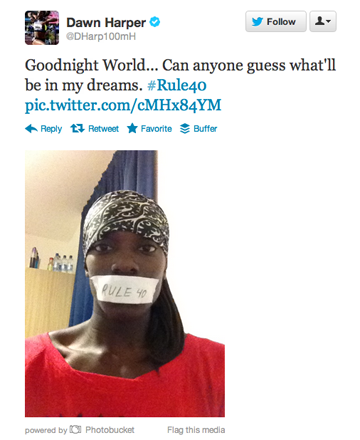
Dawn Harper Tweets her Opinion of Olympic Rule 40
Two-time track and field medalist Dawn Harper thinks so. That’s why she posted this tweet with #Rule40 in protest of the IOC’s infamous Rule 40 during the 2012 Olympics in London.
If you aren’t yet familiar with Rule40, it is a total ban on an athlete’s promotion of personal sponsors and their ability to acknowledge those who helped them get where they are today. It is especially focused on social media, where it has become a commonplace for athletes to thank sponsors with pictures and personal statements.
Harper isn’t the only athlete to voice her displeasure with the effective “gag order” on competitors, but with companies spending upwards of $100,000,000.00 to associate their brands with the Olympics Games, is it really that hard to see why #Rule40 is in effect?
Some have even gone as far to refer to the situation as a “battle”. Yet, despite the activism surrounding #rule40, without a doubt the biggest threat to the official Olympic sponsors is the ever-pervasive ambush marketers, silently stalking and waiting for their chance to steal some the Olympic brand name.
These controversial ambush marketing campaigns attempt to capitalize on high-visibility events and locations through brand association without having to pay for the high-cost of officially sponsoring an event. My favorite example of ambush marketing involved the Minnesota Timberwolves selling this advertisement on the side of their stadium, where it happens to only be viewable from inside the nearby Minnesota Twins baseball stadium (where the official sponsor is Target).
View of Timberwolves basketball stadium from inside the Twins baseball stadium
Ambush marketing may have been around in the advertising world for years, but the Olympics are seen as “the flagship event for ambush marketing”. Creative campaigns by infamous ambush advertisers like Nike often times attract more online buzz and conversation than the actual official sponsors.
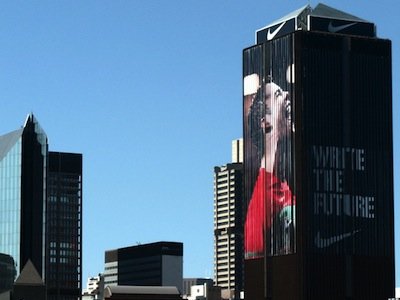
During the 2010 World Cup in South Africa officially sponsored by Reebok, advertising juggernaut and infamous ambush marketer Nike, placed an eye-catching ad on the fourth tallest building in the entire city of Johannesburg. When paired with a lengthy viral video, many agreed that Nike had effectively hijacked the sponsorship from Reebok and gained closer brand association with the World Cup event.
Nike ad in Johannesburg during World Cup 2010
Another ambush marketing giant, Subway, has already launched its attempt to steal some association from the upcoming Sochi games. Summer Olympian Michael Phelps and retired speed-skating icon Apollo Ohno both appear in TV commercials for Subway’s “$5 foot long campaign” due to some legal loopholes discovered by Subway.
So is it reasonable for the IOC to implement Rule 40 to help protect sponsors? Freeskiier David Wise recently commented that, “[he] understand[s] the Olympics are a moneymaking game, but it’s sad for [him] to have all these sponsors who have really taken care of [him]…[he’s] on the biggest stage [he] can possibly be on and [he] can’t give them the representation they deserve.”
Another athlete and social media enthusiast, Nick Goepper, has stated that he will be completely off of social media for the entirety of the Olympics. “I think it might be safer not to tweet anything,” said Nick, the 19-year-old favorite to win Ski Slopestyle gold. “All I know, it’s pretty much zero tolerance for branding.”
The Sochi games are only 3 days away, but the media blackout protecting the games’ sponsors has been in effect since January 26. When the final medal is awarded and the closing ceremonies complete, which brands will you associate with the games? Which advertisements and commercials will be the most talked about and discussed? Is $100,000,000 too much to pay for a loose association with the Olympic rings?
Will the “ambushers” steal the spotlight once again?
It’s that time of year again! All our favorite shows are returning, after a seemingly long-awaited hiatus. The longest running singing competition, American Idol, has returned for its thirteenth season. But this season, Idol has been forced to change things up. The show is taking on a fresh, new approach to increase the amount of viewers by revamping their marketing schemes.
In previous seasons, the show directed promotions towards the judges, featured cities, and upcoming drama. The initial aspirations of the show to seek out raw talent has slipped within the past seasons and in return, turned away viewers. At the shows peak, American Idol attracted 30.4 million viewers in season eight. Since then, viewer ratings have only decreased and reached an all time low with 14.3 million viewers for season twelve. As a result, Fox has decided to rebrand the show by bringing in a new team of producers, less drama-filled judges, and a more heartwarming advertising campaign.
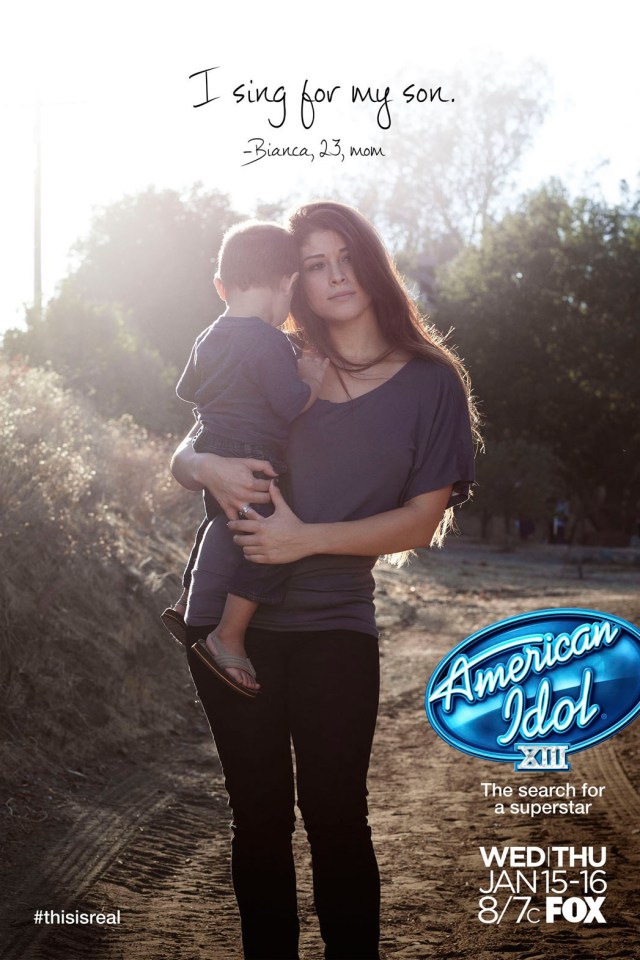
Within the past seasons, focuses of promoting the show featured drama among the judging panel rather than the actual talent of the contestants. Producers recently have realized the show has drifted away from the heart and original purpose of the show–discovering real people with real talent around the country. In an effort to rebrand their image, season thirteen marketers began focusing on the background stories of the contestants in hopes to return Idol to its initial purpose.
One component of the new advertising campaign features eight contestants in their hometowns sharing their personal motivations as to why they sing. Producers felt this new type of advertisement would help viewers identify with the stories and be able to relate to the contestants. Viewers are invited to participate in the hopeful journey of the “average Joe’s” transformation into a superstar.
American Idol’s new video promotion of the upcoming season also focuses on introducing new contestants and excluding any drama or glamour of the judges (hallelujah). In addition to highlighting real contestants, marketers have incorporated social media by producing a new tag line for the show, #ThisIsReal, to encourage audience conversations on Twitter. Producers hope that the incorporation of social media marketing will increase the show’s ratings and reputation. The advertising of real people and their real aspirations are designed to appeal to a variety of audiences on social media platforms, especially the younger demographics.
By incorporating a variety of platforms such as television, print and social media, American Idol hopes to attract a wide array of audiences through this new and improved IMC campaign. Do you think this new campaign will be effective in increasing and engaging audiences? Or will American Idol continue its downward spiral?






 IMC Hawks Blog