Tag: Brand Identity

  • So If I Make A YouTube Video Will I Get Famous Too?

    pewdiepie

    Felix Kjellberg aka PewDiePie

    “Creativity out of necessity.” In 2005 the most successful free video streaming site was created by three college graduates who had a major dilemma…

    …They couldn’t find footage of the famous Janet Jackson “wardrobe malfunction” during the 2015 Super Bowl halftime show….

    And so YouTube was born.

    YouTube has evolved to so much more than a free and easy way to see inappropriate videos of celebrities. Now it’s so sophisticated that people can earn their livings video blogging, or vlogging, about anything they want. The site started with one unfortunate (or maybe fortunate, depends on how you look at it…) celebrity “wardrobe malfunction,” and now YouTube is making a whole new category of celebrities; self-made vloggers.

    bilde

    Jenna Mourey aka Jenna Marbles: YouTube personality, vlogger, comedian, and actress

    Just as YouTube has changed over the years, the vloggers that scramble to be the next big internet sensation have started to move from computer screens to larger ones. Jenna Mourey or Jenna Marbles as she is known on YouTube is the top female vlogger with well over 15 million subscribers which ranks her channel seventh overall. Mourey now can be seen in episodes of Epic Rap Battles in History, Fake n’ Bacon, and Ridiculousness. Hannah Hart who rose to fame with My Drunk Kitchen, and hosting cameos on Mental Floss sat down with People last week to promote her upcoming TV mini-series Electra Woman & Dyna Girl airing in 2016. Then there is PewDiePie, with 40 million subscribers and over 6 billion views Felix Kjellberg has raised YouTube vlogging to an art form. By basically inviting the world into his living room to watch him play video games, Kjellberg makes $12 million dollars a year and is helping to shape the indie gamer market. Like the Oprah effect, when Kjellberg mentions a game it sees a spike in sales.

    According to People.com, these YouTube blogger channels make the most money:

    1. Felix Kjellberg

    – $12 Million a Year

    Channel: PewDiePie

    Subscribers: 40 million

    Shtick: Playing video games and making jokes

    2. Ian Hecox and Anthony Padilla

    – $8.5 Million a Year

    Channel: Smosh

    Subscribers: 21 million

    Shtick: Live-action comedy sketches

    3. Benny and Rafi Fine

    – $8.5 Million a Year

    Channel: Fine Brothers Entertainment

    Subscribers: 13 million

    Shtick: Reacting to things
    Screen-Shot-2014-07-01-at-11.40.44-AM

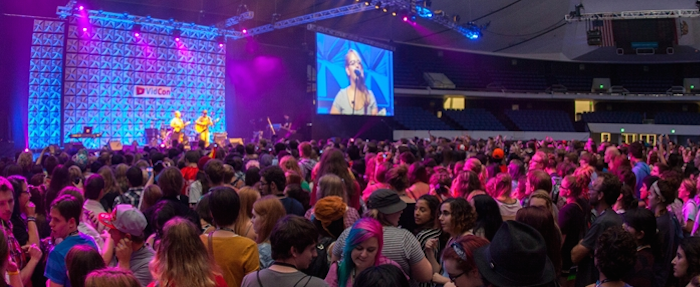
    2014 VidCon Youtuber Convention

    YouTube has become so popular that they have dedicated a whole convention, VidCon, to the videos and YouTube “stars”.  VidCon features workshops and speeches on how to launch your own YouTube career, video highlights, and YouTube celebrities waiting to meet their fans.  For a few hundred dollars fans can attend the three-day conference, with varying levels of entry to events.  Tickets range from general entry at only $100 for the “Super Early Birds”, to $750 for the Industry Standard Price.  For those interested in the online video industry beyond basic video production the industry ticket is the way to go.VIdCon offers a variety of events for industry professionals including: seminars, keynote speakers, and helpful tips on how to use online video to promote your company.

    There are many benefits for marketing your brand via YouTube:

    1. Capturing attention: Posting creative content on YouTube is an easy way to catch viewer’s attention.
    2. High Traffic Volumes: There are over 1 billion users on YouTube which is an excellent platform to reach people all over the world.
    3. Viral Marketing: YouTube videos are easily shared between friends and family members and can be shared with others, thus creating a ripple effect.
    4. Multiple Video Marketing Channels: Creating and posting videos to YouTube is a powerful and recognizable way for users to view your content.
    5. Search Engine Rankings: Google owns YouTube, which why it is so highly ranked when you search for videos on Google’s page.
    6. Social Media Marketing Integration: YouTube videos can be shared via email, Facebook, Twitter, Linkedin, Reddit and other social media platforms.
    7. World-Wide Accessibility: Posting content on YouTube can be seen in 75 different countries, since YouTube is available in 61 languages. This is one the most effective marketing strategies since YouTube is available 24/7.

    Who are your favorite YouTube stars? Do you have your own YouTube channel? Share with us in the comments below!

    Aki Suzuki, Carey Poniewaz, Carey Shetterley, Lexie Trimnal, June Wilkinson
  • Communication Studies At Work

    College students are told time and time again just how important it is to have an internship while in college. UNCW student Aki Suzuki, a senior Communication Studies major, offered to speak with us about her Marketing internship at Live Oak Bank, a Small Business Association lender  here in Wilmington, NC.

    liveoakbankInterviewer: What are your daily tasks?

    Aki: Videography: Helping set up shoots with lighting and camera equipment, taking photos, organizing footage, editing photos and videos, and creating simple title graphics.

    Interviewer: What do you want to gain from this experience?

    Aki: I hope to gain professional videography skills and the ability to thrive and adapt to an adult work environment. Finally I hope to gain the knowledge to competently function as part of an organization/ corporations marketing team to enhance a brand and use my creative resources to continue advancing it.

    Interviewer:  What coursework is relevant to your internship?

    Aki: As I am interning in the marketing department and helping create promotional materials for Live Oak, the IMC related classes are relevant to my experience. Integrated Marketing theories, as well as course projects and discussions have prepared me to understand how the bank approaches attracting borrowers to each of its verticals. The videography department is responsible for video and photography related products. Videography centered courses like COM 380 have also been instrumental to my understanding of cameras, the elements of lighting and also editing techniques.

    Internships are an excellent way for students to engage in applied learning but also a way to get their brand out into the real world. Aki has learned the importance of a consistent brand identity, especially when looking for jobs and internships. Aki demonstrated this during our interview.

    akisuzuki_000Interviewer: What can you offer to Live Oak Bank?

    Aki: I can offer Live Oak Bank a willing and open mind. Although I do not possess any outstanding skills, as a young and determined student I am engaged in learning and committed to contributing in any way that I can. My youth allows me to maintain a fresh perspective and enthusiastic attitude for any opportunities they allow me.

    Interviewer: How does your brand as a Communication Studies major compare with other interns at Live Oak?

    Aki: I find that I fit well into my niche in the marketing department because Communication Studies deals overwhelmingly with how to effectively incorporate messages being sent  through various channels which is precisely what any company’s marketing department hopes to cover.  I do find myself at a slight disadvantage when it comes to understanding the financial ins and outs of the bank; but like any communication studies major I am well versed in being an assertive researcher and curious verbal investigator to understand anything I do not immediately understand.

    Aside from some unnecessary modesty, Aki has aligned the stories she communicates about herself, the way she sees herself and reality so closely that there are minimal discrepancies. If you have the opportunity to work with Aki, you would find this statement proves true. Branding is not just for businesses anymore. Every communication you put out into the world will contribute to your personal brand and when your band is as consistent as Aki’s it becomes a holophrasm, expressing your brand in a single nucleus. Aki has achieved such a level of brand coherence that her name now acts as a holophrasm.

    What strategies do you use when defining your personal brand?

    What are some examples you can share about personal brand coherence?

    – Alexis Trimnal, Carey Shetterley, June Wilkinson, and Carey Poniewaz

    -Interviewee: Aki Suzuki

  • The Personality Behind PETA

    “Animals are not ours to eat, wear, experiment on, use for entertainment, or abuse in any way,” is the brand proposition of the world’s largest animal rights organization, PETA. The acronym PETA stands for People for the Ethical Treatment of Animals, and is known for their extreme stance on the treatment of animals.  This non-profit organization is based in Norfolk, Virginia and has over 3 million supporters who avidly believe in it’s mission.  The four main areas that PETA focuses on where animals suffer the most are factory farms, clothing industries, laboratories, and the entertainment industry.  There are many reasons for PETA’s success as a non-profit organization since its founding in 1980.  One main reason for the organization’s success is how they have fostered their strong brand personality.

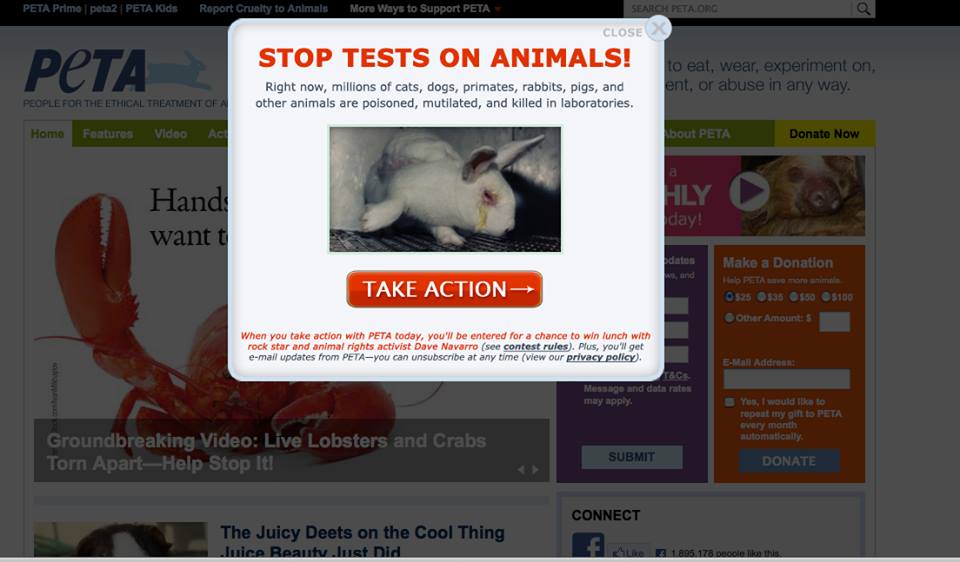
    PETA’s brand personality can be described as aggressive, emotional, and persuasive.  These characteristics can be seen in their advertisements, commercials, endorsements, and website.  Aggressiveness can be seen on the organization’s website through its use of language and tone.  The language used can be seen as aggressive because it is dramatic and creates a serious, yet sad and drastic tone.  One example from the website (even before you arrive at the main page) is a pop-up that takes up the entire screen.  The pop-up “greets” visitors the first time they view the website and features a graphic image of an ill-treated animal.  Language on the pop-up is bold, red, and uses exclamation points.  The message states, “Right now, millions of cats, dogs, primates, rabbits, pigs and other animals are poisoned, mutilated, and killed in laboratories.”

    Image

    Emotional appeals come into play as you continue onto the main page of the website and see horrific images of distressed or dead animals.  PETA uses this technique to form their brand personality because people’s emotions are triggered when they see either sad photos of animals, or even victory stories of animals that PETA has saved. PETA keeps their promise of saving more animals by having a readily available donation section on the homepage. Supporters who are moved by PETA’s mission are able to fill in their information and donate to save more animals with just one click. This allows supporters to create an emotional attachment because they aspire to create an ideal self by donating to the cause.

    Image

    A large portion of PETA’s success can be attributed to their use of celebrity endorsements as a means of persuasion. Celebrities such as Bob Barker, Carrie Underwood, Simon Cowell, and Audrina Patridge have all teamed up with PETA to support their mission and cause. One campaign in particular that remains consistent with PETA’s brand personality is represented by former Miss USA winners who advocate the idea that they would rather go naked than wear fur. These advertisements are meant to make the viewer feel uncomfortable in an attempt to call people to action. Even Academy Award winner, Joaquin Phoenix, has paired up with the organization to make an influential video that relates to his own personal experience dealing with animal cruelty.

    PETA’s brand personality continues to be strengthened because supporters are able to express their identity by representing the organization.  The combination of these three characteristics create an overall concept of what to expect of PETA, which is both distinctive and enduring.  Other than these three characteristics (aggressive, emotional, and persuasive) what comes to mind when you think of PETA? Do you feel that their brand identity is distinctive and memorable?

    – Aaron Love, Kara Zimmerman, Rachel Clay, Rebecca Hobbs

  • “Saaaay Instagram!”

    Instagram is a mobile social media network. Pictures are the only content users can upload. There are no clickable links. Nor are there special types of profiles for businesses or celebrities. By doing this, Instagram has in a sense leveled the playing field. Brands, as of now, cannot pay to have their content promoted or purchase any sort of advertisements on Instagram.

    So why would a brand be interested in this? There doesn’t seem to be an advantage from a business perspective. How could a brand get the word out about their Instagram without being able to promote within the network? This is where the share ability on Instagram comes into play. Instagram users have the ability to share their Instagram posts on Twitter, Facebook, Tumblr, Flickr, and Foursqaure. Additionally, brands can use relevant hashtags on their pictures to draw Instagram users who may be interested in what they are Instagramming to their business account.

    Now that it is clear how a brand could draw traffic to their Instagram, it is interesting to look at the content brands post on Instagram and how these posts contribute to their brand identity. The content of the posts will vary on the type of brand and each brand’s individual needs. For example, Taylor Swift utilizes Instagram as a way to communicate her thanks to her fans and visually share parts of her life with them. Many celebrities use Instagram in this manner. It is effective in helping fans see celebrities as relatable people, and makes them seem less out of touch with the everyday reality.

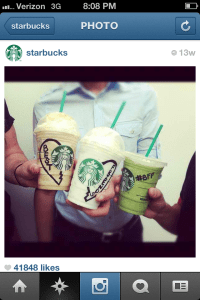
    Larger brands can also use Instagram in a variety of ways. Two of the largest brand accounts on Instagram offer an interesting comparison. Starbucks uses pictures taken of their products by customers that hashtag pictures with “#starbucks.” MTV takes pictures of celebrity visitors, backstage/onstage at awards shows, newly released videos or singles… anything that is happening at MTV is pretty much free game. Is one better than the other? The answer lies in brand identity. Starbucks strives to make a heartfelt connection with their customer base, while MTV relies on sparking their customers interest with the celebrity factor. For Starbucks, trying to make a heartfelt connection works. While they are an international chain, as a brand Starbucks wants to keep that feeling of the neighborhood coffee shop alive yet still provide consistent products globally. By highlighting the existing Starbucks customer base, the brand still appears personal.  MTV takes another route by using Instagram to revive their brand identity of music television. The majority of their Instagram is focused on new songs, videos, and musician sightings. This is a major change from their actual televised programming which ranges from scripted shows such as, Awkward. to reality shows such as the infamous Jersey Shore. By using their Instagram to focus on their musical brand identity, MTV is returning to their roots. Instagram is a way to appease the viewers who prefer the old MTV without all of the television shows.

    Whether it be your average individual using a filter to feel artsy or avid Starbucks drinkers expressing their love for a drink, this social networking site is creating a sense of community through a few simple taps on your smartphone. Brands can use this sense of community to make their customers feel more in touch with their products. Try scrolling down Starbucks’ Instagram feed without having your mouth water! Now where’s my Pumpkin Spice Latte?!

    – Alexandra Huss, Caroline Merrill, Alyssa Morrello, Lauren Van Trigt, Dann Williams

  • Walmart: A Rebranding Genius.

    Consumers all over the world are becoming more savvy and sophisticated with each passing year. In order to survive in today’s marketplace, companies have to update and revitalize their identity while retaining brand equity. This is the unavoidable challenge that companies must face. Brands are struggling to maintain relevance in the eyes of evolving consumers and even the most established companies have to undergo brand re-inventions. Losing loyal customers in an effort to attract new ones is always a pitfall of making a possible change for the worse… but that’s just a risk many brands are willing to take.

    Walmart had one of the most successful rebranding campaigns ever. It is the world’s largest retailer and one of the most distinguishable brands in history. Since its first store opening in 1962, Walmart has evolved from a rural American company to a globally recognized corporation. Historically criticized for having hostile corporate practices, mistreating employers, and being a target for environmentalists, Walmart reconsidered their brand identity and took action in creating a fresh image for their company.

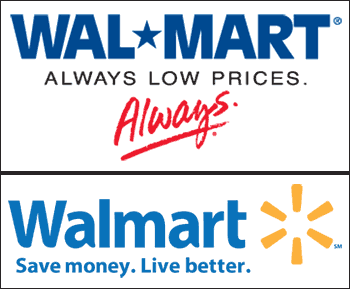
    In 2008, Lippincott brand designers developed a strategy to shift the focus of Walmart from just low prices to an overall positive shopping experience. They unveiled the new tag line “Save money. Live Better.” to highlight the emotional benefits of shopping at Walmart. They hoped to get the message across to consumers that spending less allows people to live better lives, not only save money.

    Image

    A new logo and innovative store design was also implemented. The logo no longer showed a choppy, antiquated Wal-Mart; it now showed a fluid, refreshing Walmart. The star in between all caps was replaced by a bright orange starburst for a finishing touch. The new store design included higher ceiling, lower shelves, wider aisles, and a color palette of vibrant orange, yellow, and green. The signaling of Walmart’s appetizing products in the grocery department and the creation of a more enjoyable and friendly shopping environment was the goal of the new design.

    Image

    This rebranding campaign proved to be a tremendous success for Walmart. The customer ratings for how “clean,” “fast,” and “friendly” Walmart is increased radically between 2008 and 2010. Not even the Walmart haters can deny that in the world of branding, Walmart takes the crown.

    Erin Kiffmeyer, Hannah Eure, Ally Walton, Lauren Habig, Eugene Lee

  • BOBS vs. TOMS

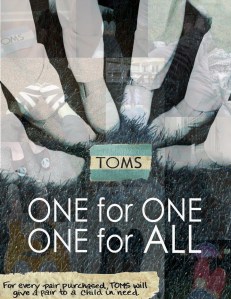
    When discussing brand identity, two important points are the “how” and the “why.” Why a business does what they do, and how they do what they do; the motives and the execution. A brand like TOMS shoes gets consumers hooked with the why. Blake Mycoskie was visiting a village in Argentina when he encountered the effects of poverty. He was forced to confront the number of children without shoes. This inspired him to start a new kind of for-profit business, one that donates as much as it sells. Thus, the TOMS shoe company was born with the slogan, “One for One.” With every pair of shoes purchased, TOMS donates a pair to children in need.

    When the company began it was a risk. One that was not promised to prosper, but had good intent. The company began with three basic colors of the same type of canvas shoe, and has now expanded beyond Mycoskie’s wildest dreams. The brand identity of TOMS is simple: give. As Mycoskie states, “Incorporate giving into everything you do.” So what happens when the giver meets the thief?

    Skechers is infamous for stealing other shoe companies product concepts. For example, in 2009 Reebok launched the “EasyTone.” In 2010, Skechers launched “Shape-Ups.” Both shoes were designed to provide the same benefit of turning everyday activities into an easy way to get fit. Now, Skechers has released a line of canvas shoes called “BOBS.” The shoes are nearly identical to the TOMS design and sport the same promise of donating a pair of shoes to children in need with every pair purchased.

    The problem is the public hasn’t accepted BOBS with the same open arms that TOMS was embraced with. BOBS has stolen the “how,” but lacks a convincing “why.” Has the thief gone too far this time? The reviews on BOBS have been less than satisfactory. The Skechers company has been called everything from fraudulent to mean-spirited. Their brand identity has been tarnished for their latest rip-off which seems to have struck a deeper chord with the American market.

    Does it matter? The kids who need shoes are still getting shoes. Do they care if the label on their shoes reads BOBS or TOMS? Should we?

    Alexandra Huss, Caroline Merrill, Alyssa Morrello, Lauren Van Trigt, Dann Williams