Tag: America

  • What is Sex Really Selling?

    Everywhere you turn, you see it — advertisements that feature models in seductive poses or racy images that entice customers to purchase the product. Advertisers are increasingly utilizing the theory that “sex sells” in order to promote their products. Why? Because it works.

     The link between sex and advertising has been traced back all the way to the beginning of advertising in the 19th century. One of the earliest known advertisements that used sex to sell were trading cards tobacco companies placed into their cigarettes packages. These collectible cards featured women wearing scandalous outfits (for their time) with excessive skin exposure, encouraging men to smoke a specific brand of cigarettes.

     However, the use of erotic images in advertising didn’t stop there. Later in the 19th century, Woodbury’s Facial Soap released an advertisement suggesting intimacy between a man and women. With the tag line, “A Skin You Love to Touch,” the man faces the female model while embracing her, clearly showing the mans desire. It is apparent that the continued use of erotic advertising over the years has stuck, simply because it works.

    The use of sex in advertising has been a long-standing tradition in the history of advertising and continues to increase in today’s society. Researchers conducted a study looking at 3,232 full-page advertisements in popular magazines such as Cosmopolitan, Time, Newsweek and Playboy, published in three different decades –1983, 1993, and 2003. In 1983, 15% of advertisements used sex to promote their products and increased to 27% in 2003.

    Sex appeal could arguably be the leading technique that advertising agencies use in America to attract certain audiences. So it comes to no surprise that Hardees would use attractive females eating a large, oh-so-juicy hamburger in slow motion. So the question being asked is, “Is it ethical for the new Hardees advertisements to set a new standard for sexualizing food by using a sexy woman making love to a burger?”. Objectifying women in advertising is very prominent for the targeting to male audiences. The message Hardees would appear to be establishing is, “Hey, boys, you have next to no chance of ever having sex with a woman who looks like Kate Upton unless you save your money and pay for it. But you can satisfy your hunger with one of these salacious sandwiches she has blessed”.

    untitled

    The burger giant, Carl’s Jr. hired socialite and reality TV star Paris Hilton to star in several commercials and print ads for its Spicy BBQ burger. The advertisements utilizes sex appeal with the famous male anatomy logo “She’ll tell you size doesn’t matter. She’s lying”. The intention of this ad was targeted mainly for men to relate that size really does matter, and to women that fit girls can still indulge a greasy cheeseburgers. But the hair flipping, sliding around on a wet car minute long video was too over sexualized and banned from airing during the Super bowl. Carl’s Jr. did not consider ethical approaches or consider the different audiences that would see this ad as morally wrong, like the Parents Television Council. mqdefault[10]Carl’s Jr. CEO Andy Puzder responded to this threat with, “This isn’t Janet Jackson — there is no nipple in this. There is no nudity, there is no sex acts — it’s a beautiful model in a swimsuit washing a car.” But it’s not just the act of having a woman half-naked in a commercial, it is mostly about the misleading message in the commercial. But, as always, there are people who are going to be offended by this kind of publicity by stating that they are portraying women as sexual objects. What’s your opinion on this?

    Food companies weren’t the only ones using sex as a selling point. Last Fall, Adidas also joined the sex appeal craze. They created a controversial advertisement that essentially showed a woman stripping her clothes purely because she was a fan of his Adidas shoes. The ad is being directed toward younger men who thrive to appear attractive through their style. However, it is questionable whether it is actually selling the shoes, or the idea that a woman is easily convinced to undress for a reason such as one’s appearance. Adidas has continuously presented their brand as one that stands for teamwork and the value of sports. They slightly re-branded themselves in this advertisement as a company that also cares about the style Adidas shoes can bring into your social life. A little re-branding is necessary every now and then to keep a product’s image fresh, however an ad such as this one also represents a gender stereotype that women will strip their clothes as soon as they see a pair of stylish clothes. There is a very thin line between proper sex appeal and the use of offensive gender stereotypes, and it is difficult to tell if Adidas actually crossed this line.

    In today’s culture, audiences are bombarded with advertisements left and right. In order to distinguish themselves from the crowd, some advertisements are using sex appeal to grab the attention of consumers. Is it ethical to use sex appeal as a way to persuade consumers? Have advertisements gone too far?

    -Briana McWhirter, Emily Foulke, Hannah Turner
  • Ready or Not, Here We Come!

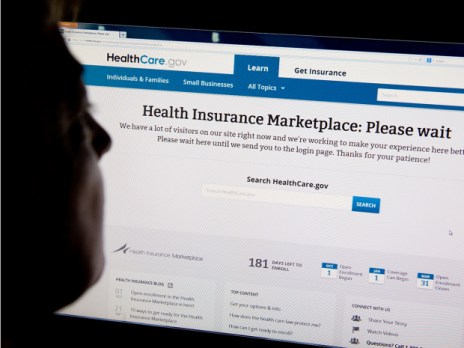
    Well, it wasn’t ready. The Affordable Care Act website, that is. Commonly known as Obamacare by critics, the program officially launched October 1, 2013 and attempts to allow each American the opportunity to have affordable health care. The program was signed into law in 2010, but only just now became part of daily American life. The website experienced technical errors last week, and again this past Tuesday. However, this was unrelated to the government shutdown. Instead, the system experienced a major overload due to mass traffic to the site, claimed those who run it. An estimated 8 million visitors forced the site to send a response of “Please Wait and Be Patient,” CNBC reports. Run by the Department of Health and Human Services, the process to acquire a health care quote is actually quite simple. I myself did it and, just shy of giving my contact information, I was inches from an affordable quote in less than two minutes.

    Page that loads with technical issues, courtesy of MSNBC
    Page that loads with technical issues, courtesy of MSNBC

    Fox News said that the 93 million dollar website was the victim of poor Java Script coding, to the point where, simply put, the site freezes up. It doesn’t know where to go or in which direction to proceed. Yet MSNBC follows the path of the HHS, saying it was simply a matter of visitor overload to the site. MSNBC did not report, as of posting, that there were Java Script coding issues.

    So. Which to believe? It is common knowledge that news stations lean differently towards their side, whether it be right or left. Even CNN, a major world news outlet, leans toward one side. This post is neither liberal nor conservative, and it neither promotes nor discourages the Affordable Care Act. However, it does encourage that American citizens not rely solely on one news outlet for information. Rather, gather your news from a multitude of sources. Otherwise a viewer faces the possibility of being a victim of “Spiral of Silence.” The Spiral of Silence is an instance where an individual, with one opinion differing from that of the majority, is unable to voice said opinion for fear of judgment. For instance, if I believe Theory X, but my neighborhood only watches one news channel that reports solely on Theory Y, the neighborhood will only be educated on Theory Y. If the entirety of the neighborhood, apart from myself, believes in Theory Y, I would be uncomfortable in expressing my opinions and differences. I am lost in the Spiral of Silence. If you support a cause that one news station does not, you are only educated on their belief. In the land of the free, is our free speech being suppressed by the media?

    -Hilary Hall

  • Today’s Politics in the Internet Age.

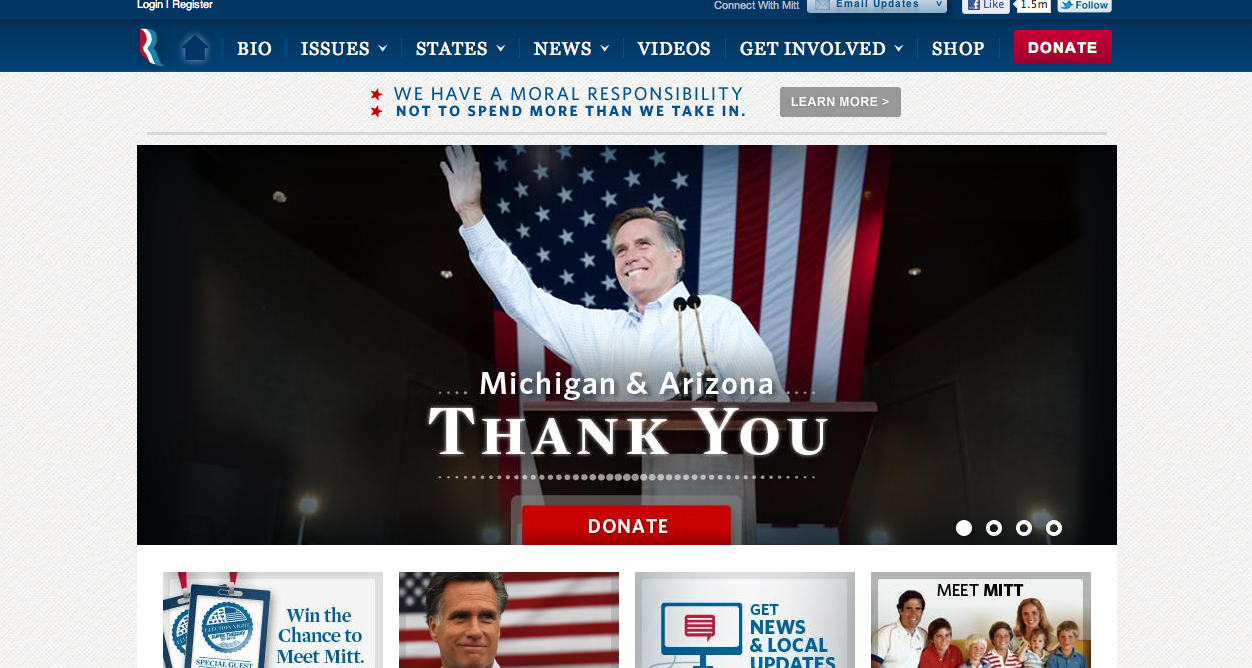
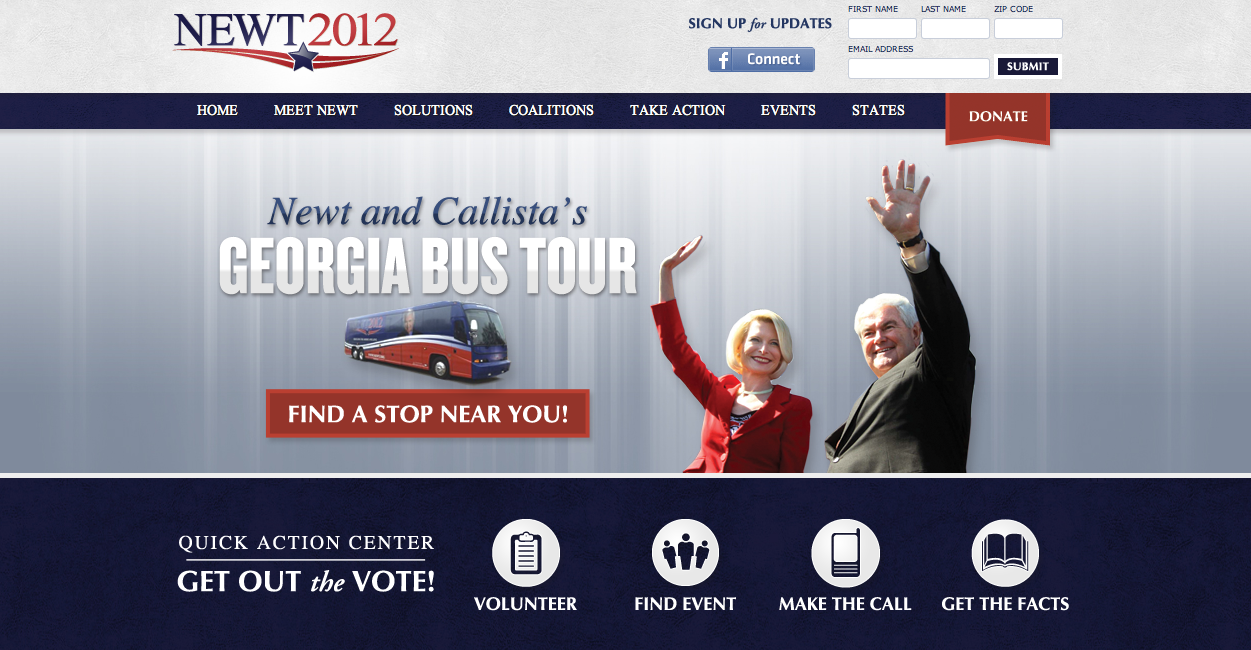
    With the Republican Primaries and Caucuses well underway, the candidates are narrowed down to the four main contestants. Mitt Romney, Rick Santorum, Newt Gingrich, and Ron Paul are campaigning across the nation and participating in debates to convince voters that they are what the nation needs in a candidate. How do the general public learn information about the candidates though, if they aren’t campaigning in their state? The answer is found on the candidates’ websites.

    Mitt Romney uses his website to thank the voters in the states in which he was victorious.

    Each candidate has their own website, run by their political team and volunteers that keep their information (like interviews, media, photographs and messages) up to date. On these sites are direct links to the candidate’s social media outlets, such as Facebook and Twitter, and their Youtube channels to watch ads that have been produced.

    Rick Santorum's website has his beliefs and campaign strategy on the main page.

    Something you will notice on each candidate’s page are donation links, most notable on candidate Ron Paul’s page who needs the money to continue his campaign. For those who want to support their favorite candidates, there is no better way than to go online and donate to their campaign using links found on each site.

    Newt Gingrich uses his homepage to let supporters know where he will be next and how to contact him.

    These websites are also excellent outlets to connect to mass groups of people at once, without having to pay to run advertisements or receive television or print media coverage.  For candidates who don’t receive as much media coverage as they feel they deserve, this can be a vital part of their campaign. Since so much information is traded on the internet now, much of the general population is turning to the internet to learn more about the potential leaders of the United States.

    Ron Paul's main page takes you directly to his donation totals to try to get more support for his campaign.

    Joshua Vester, Molly Jacques, Ashley Oliver, and Hunter Wilson.

  • Alaska’s sweetheart or America’s nightmare?

    Seeing as today is Presidents Day, where the nation comes together to honor our past great leaders, we see it fitting to look at the latest political figure and “reality superstar”, Sarah Palin.

    This self-titled “maverick”, at first branded herself as a strong political influence with ties to family values, motherhood, main street U.S.A, and conservatism. After her failed run as Vice President during the 2008 Presidential election, she has since morphed into a celebrity.

    With her daughter partaking in Dancing With the Stars, and herself being the star of TLC’S Sarah Palin’s Alaska, she has been capitalizing on her celebrity status with a book tour, speech engagements, and recently, Fox News contributor. Do politics even play a role in her brand anymore?

    While her views haven’t changed about how the government should be run (if she even can even articulate her views without having to beat around the bush), she has basically destroyed her political brand. In several interviews, she has lost her credibility by not being able to answer simple political questions.

    Here is an example of her failing to brand herself as a knowledgeable politician.

    Below is a video of her dropping the ball in Politics 101.

    According to The Huffington Post, her reality show received $1.2 million in tax credits, a third of what it took to film the series. While other series filmed in Alaska do take advantage of the tax credit, Palin’s show profited the most, angering many citizens. With her stance on outrageous government spending, it is odd that she would partake in something that takes advantage of government funding This further harms her political credibility because she is profiting off the government that she previously lead.

    So what’s your take on her brand? Will this affect her future in politics, with a possible 2012 Presidential run? Is she still a positive political figure or simply a public nuisance?

    -Allison Day, Jessica Berinson, Megan Canny, Melissa Gagliardi, Scott Burgess