Tag: Advertising

  • Marc’s Makeover: Marc Jacobs’ decision to rebrand… is it the right one?

    Deciding whether or not to rebrand your company is an immense decision. Your brand is the face and personality of your company. It is what viewers connect with. Changing this identity will greatly affect your company, but if done right the market can soar.

    Fashion designer Marc Jacobs has decided it is time for his company, Marc Jacobs International to rebrand. In an interview with David Amsden from W Magazine Jacobs explains the troubles the Marc Jacobs brand had encountered. Describing the brand as having been “diluted” from his lack of creative supervision and merchandisers pushing his design team.

    In order to fix this Jacobs decided to leave his position at Louis Vuitton to grow his company, which includes boutiques, clothing lines such as Marc by Marc Jacobs and Little Marc Jacobs (a children’s clothing line), Bookmarc (a bookstore), and more.

    Some changes have already taken place such as his decision to move his offices from Manhattan to London and his decision to part with longtime campaign photographer Juergen Teller after he creatively disagreed on the Spring 2014 ad campaign which features Miley Cyrus. 

    marcmiley

    So what is Jacobs looking to do? He’s looking to redesign the logo and packaging, to build his shoe and handbag lines, and maybe even change the name, which he told W Magazine that he had always hated.

    Rebranding can be daunting between redefining research, audiences, creative campaigns, and even products, but for those experiencing continuous losses, it is often the best way to launch back into the market.

    In recent years, another clothing line, Burberry, underwent a widely recognized successful rebranding campaign. Over the years, the British line went from being known for its historically iconic outwear, to being associated with cheapest form of high fashion, and even gang wear.

    In 2006, the company hired Angela Ahrendts and in the next six years, she turned the ubiquitous brand back to luxurious. First, Ahrendts did what she called “buying back the company.” Reigning in the 23 licenses Burberry had around the world, control was brought back to the company with centralized executive and creative offices that could maintain product authenticity and exclusivity.

    Secondly, Ahrendts recognized we are in the age of digital consumption and a digital generation – tapping into the resources social media and technology offers. In stores, sale assistants are equipped with iPads, and mirrors transform into screens displaying catwalk images. Online, the company continues to grow its presence, attracting over 16 million fans on Facebook, and over 2 million followers on Twitter. Burberry also uses YouTube to broadcast campaigns, events, music, and even corporate news. 

    However, rebranding is not exclusive to high profile companies, the challenges above are things that can be experienced in all types of companies: personal, mid, or large. So how do you know if you should rebrand your own company? From Katie Morrell’s article “10 Signs You Should/Should not Rebrand” here are some warming signs that your company should rebrand.

    Macro problems

    Maria Ross, author of Branding Basics for Small Business: How to Create an Irresistible Brand on Any Budget (2010, Norlights Press) suggests that if a company notices that their target customers are choosing the competition over their own company and if a decrease in sales is also trending, rebranding should be considered.

    Look and function don’t match

    Another element that should be considered when having a decrease in customers is “From a cosmetic point of view, when you look old and your looks don’t reflect what you are or what you deliver, it may be time to rebrand,” said Susan Betts, senior strategy director for New York-based FutureBrand North America.

    Attracting the wrong customers

    Rebranding is beneficial when a company wants to change their target customers. It gives a company an opportunity to create a new brand identity that the new target audience has the chance to connect too.

    Management change

    When a company changes management, it is normal that policies and values change as well. When a companies values change, rebranding is a good idea.

    Philosophy/function change

    When a company changes it’s direction, rebranding can showcase to customers what they may or may not be aware of concerning this change. Betts also mentions rebranding should be considered when a company has a “New philosophy or a changed philosophy”.

    These signs are great examples to take heed from, but it is important to note rebranding should not be done unless it has been proven your brand identity is the root of your problems. Branding is the largest initial investment for a company, it sets the spring board for your identity, association, and customers. Rebranding is an even bigger investment – an attempt to reintroduce ideas to already established and preconceived perceptions is no easy task, it is one that must be thoroughly strategized. For Burberry, reigning in and refining their identity proved to be the best decision the company has made. For Jacobs, we will see what his creative vision produces.

    What companies do you think have faltered recently or over the years? Who needs to rebrand?
    Caroline Robinson, Savannah Valade, Elizabeth Harrington

  • Ambush Marketing, Rule 40, and the Sochi Controversy You Aren’t Hearing About

    Have Olympic advertising partnerships gotten too big? Have rules and restrictions protecting these “official sponsors” gone too far?

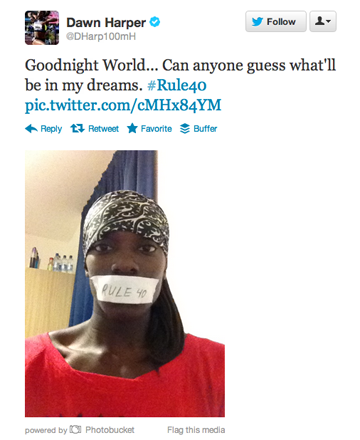
    Dawn Harper Tweets her Opinion of Olympic Rule 40
    Dawn Harper Tweets her Opinion of Olympic Rule 40

    Two-time track and field medalist Dawn Harper thinks so.  That’s why she posted this tweet with #Rule40 in protest of the IOC’s infamous Rule 40 during the 2012 Olympics in London.

    If you aren’t yet familiar with Rule40, it is a total ban on an athlete’s promotion of personal sponsors and their ability to acknowledge those who helped them get where they are today. It is especially focused on social media, where it has become a commonplace for athletes to thank sponsors with pictures and personal statements.

    Harper isn’t the only athlete to voice her displeasure with the effective “gag order” on competitors, but with companies spending upwards of $100,000,000.00 to associate their brands with the Olympics Games, is it really that hard to see why #Rule40 is in effect?

    Some have even gone as far to refer to the situation as a “battle”. Yet, despite the activism surrounding #rule40, without a doubt the biggest threat to the official Olympic sponsors is the ever-pervasive ambush marketers, silently stalking and waiting for their chance to steal some the Olympic brand name.

    These controversial ambush marketing campaigns attempt to capitalize on high-visibility events and locations through brand association without having to pay for the high-cost of officially sponsoring an event. My favorite example of ambush marketing involved the Minnesota Timberwolves selling this advertisement on the side of their stadium, where it happens to only be viewable from inside the nearby Minnesota Twins baseball stadium (where the official sponsor is Target).

    View of Timberwolves basketball stadium from inside the Twins baseball stadium
    View of Timberwolves basketball stadium from inside the Twins baseball stadium

    Ambush marketing may have been around in the advertising world for years, but the Olympics are seen as “the flagship event for ambush marketing”. Creative campaigns by infamous ambush advertisers like Nike often times attract more online buzz and conversation than the actual official sponsors.

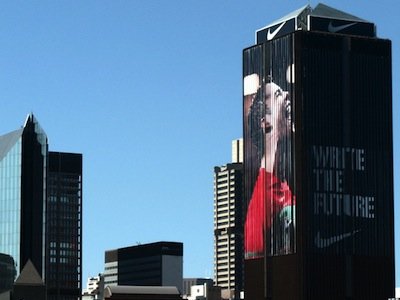
    During the 2010 World Cup in South Africa officially sponsored by Reebok, advertising juggernaut and infamous ambush marketer Nike, placed an eye-catching ad on the fourth tallest building in the entire city of Johannesburg. When paired with a lengthy viral video, many agreed that Nike had effectively hijacked the sponsorship from Reebok and gained closer brand association with the World Cup event.

    Nike ad in Johannesburg during World Cup 2010
    Nike ad in Johannesburg during World Cup 2010

    Another ambush marketing giant, Subway, has already launched its attempt to steal some association from the upcoming Sochi games.  Summer Olympian Michael Phelps and retired speed-skating icon Apollo Ohno both appear in TV commercials for Subway’s “$5 foot long campaign” due to some legal loopholes discovered by Subway.

    So is it reasonable for the IOC to implement Rule 40 to help protect sponsors? Freeskiier David Wise recently commented that, “[he] understand[s] the Olympics are a moneymaking game, but it’s sad for [him] to have all these sponsors who have really taken care of [him]…[he’s] on the biggest stage [he] can possibly be on and [he] can’t give them the representation they deserve.”

    Another athlete and social media enthusiast, Nick Goepper, has stated that he will be completely off of social media for the entirety of the Olympics. “I think it might be safer not to tweet anything,” said Nick, the 19-year-old favorite to win Ski Slopestyle gold. “All I know, it’s pretty much zero tolerance for branding.”

    The Sochi games are only 3 days away, but the media blackout protecting the games’ sponsors has been in effect since January 26. When the final medal is awarded and the closing ceremonies complete, which brands will you associate with the games? Which advertisements and commercials will be the most talked about and discussed? Is $100,000,000 too much to pay for a loose association with the Olympic rings?

    Will the “ambushers” steal the spotlight once again?

    – Greg Rothman

  • Athletes Support Obesity

    For those who tuned in to the one-sided beat down that was Super Bowl XLVIII, it is tough to look past Peyton Manning’s subpar performance throughout the entire game. For someone who had a record-breaking regular season, coming into the game with the #1 ranked offense in the league, he really failed to deliver.  At least his buddies at Papa Johns can still deliver, and hopefully in 15 minutes or less! Peyton Manning has proven himself to be a heavy endorser of Papa John’s, especially after purchasing 21 franchises in Colorado. Riddle me this, how is it that professional athletes are the best endorsers for unhealthy food choices, yet their physiques and life styles are not aligned with their sponsors? Maybe Peyton made the mistake of actually eating some of the delicious pizza before the big game. Let’s face it; a big greasy pizza is not an ideal pregame meal for any sort of competition. Not to mention how slippery it will leave your fingers (which may result in a few interceptions).

    Sponsorships are used in advertising to endorse products through the featured prolific person, whom would assume to be relatable to the product or service. Some people choose their products carefully, whereas others appear to care only about the personal gains. Many sponsorships prove to be for monetary gain when using unrelated people for products. For example, irony is apparent when an athlete endorses an unhealthy food service, such as Anderson Silva, a UFC middleweight champion. Although Anderson also sponsors athletic corporation NIKE, the UFC fighter is a well-known advocate for fast food chain Burger King.

    Just a little over a month ago, on one of the most eagerly awaited UFC rematches of all time, Anderson Silva entered the octagon with his Burger King logo stamped right on his thigh.  For those of you unfamiliar with Silva, he is widely regarded as the pound-for-pound best fighter in the world. However, midway through the second round Silva finished himself by snapping his own shinbone over the side of Chris Weidman’s knee. The type of healthy life style decisions Silva makes in order to be best of the best does not accurately reflect his endorsement for Burger King.

    289035_257179540971054_209999859022356_833217_1849863_o

    Here the athlete presents himself with a fighting glove in one hand, and a triple burger with bacon in the other. Aside from the fact that the burger is full of some sort of protein, which athletes consume to gain muscle, the advertisement demonstrates a winning athlete endorsing an obvious unhealthy meal. This endorsement, like a few others is an ironic match with an arguably more ironic ending. Furthermore, a burger like such may be easily burned off by the strenuous activity and amount of energy exuded by a professional athlete. The everyday average Joe on the other hand, may only burn off the fries that came in the combo with the enormously sized burger. Professional athletes are then supporting and encouraging the very things that cause obesity within America, just not for their own bodies.

    The frequently shown fast food endorsements among some of the most popularly watched professional sports could be an indirect factor and influence of obesity within America right now. If Athletes supported the healthy alternatives instead, perhaps there would be a lesser percentile of overweight and obese diagnoses within the United States. Is fast-food sponsorship among professional athletes problematic, or would sales remain the same among the fast food industry because of the convenience?

    -Austin Johnson, Jade Lester, Jami Rogers, Ty Thomas

  • Tackling Consumers

    A round of applause for the Seattle Seahawks as the champions of the Super Bowl XLVIII. Even if you were not a fan of either the Broncos or the Seahawks, it almost a sure bet you tuned into the game. Every year over 100 million people observe what is arguably the sporting event of the year.

    The Super Bowl, however, is known for more than a fierce round of football – it’s known for the commercials. Here is time where advertisers pull out all the stops. Audiences expect commercials of both artistic and humorous grandeur. Prices for spots annually rise, this year topping at $4 million for a 30 second spot.

    Yet companies don’t spend millions for spots merely to entertain viewers. Unlike in decades past, advertisers are no longer in the business of explaining, but in the business of convincing and reinforcing. This is often the purpose of commercials we see every day. So, other than the guaranteed viewership, what is the worth of a Super Bowl spot?

    Credibility, claims Joe Glennon, assistant professor of advertising at Temple’s School of Media and Mass Communication. In an article for the Philadelphia Business Journal, Glennon explains that many advertisers walk away from the exorbitant price tag due to the simple financial standpoint that $4 million for 30 seconds is a largely impossible return on investment. He explains that of those who do justify the expense there are two primary advertisers – large, well known, companies who use the spots to reinforce brand propensities among current users, and smaller companies who use the spot as a means to launch into the market by gaining notoriety.

    So, in the myriad of last night’s entertainment, we have selected four commercials that beautifully represent the two credibility building categories Glennon noted; some attempting cut into, or further into the market, others reinforcing brand attitudes.

    Squarespace

    Squarespace created a spot that was a humorous, but accurate depiction of what the Internet is like – cluttered. Personifying memes, obnoxious advertisements, and the “duck face”, Squarespace offered to consumers that when using their services for website building and maintenance, the company could alleviate such distraction. So, why did Squarespace make it onto the list today? Simple, the Squarespace commercial introduced the company values and brand in a creative, weird, funny, and somewhat true way. Justifying the $4 million dollar expenditure seems to working so far – we are talking about – there’s probably a good chance other people are too.

    WeatherTech

    Although the ad was neither humorous nor heart-warming, WeatherTech’s commercial built on a sacred theme in the Super Bowl: American pride. Their slogan, “American Factories, American Raw Materials, and American Workers”, was enough to draw people’s interest and introduce their company as a defying the odds, sticking with their gut, and overcoming obstacles many American companies have faced. During a time when many gripe about US jobs becoming outsourced, it’s hard to say that WeatherTech didn’t prove their credibility with their national pride.

    Cheerios

    Yes, the adorable little girl is back and this time she is getting a brother. This 30-second ad wraps up what all of us remember of Cheerios and what the Cheerios brand wants us to remember about them; families coming together over love. Here Cheerios is showing how they are continuing to be a hearty and healthy part of growing families.

    Bank of America/(RED)/U2

    What does this commercial not do? It introduces U2’s new song “Invisible” (there is still time to get your free download if you haven’t done it), it highlights and raises money for the charity (RED), increases knowledge of AIDS/HIV, and shows Bank of America’s humanitarian efforts. Reinforcing their slogan, “Life is better when your connected”, Bank of America is giving a chance for its customers and the world to connect by helping to end an epidemic.

    What is your opinion? Do you think these commercials deserve a spot in these categories? What other commercials did you see that introduce the brand or reinforce existing brand propensities?

    Caroline Robinson, Savannah Valade

  • What is Sex Really Selling?

    Everywhere you turn, you see it — advertisements that feature models in seductive poses or racy images that entice customers to purchase the product. Advertisers are increasingly utilizing the theory that “sex sells” in order to promote their products. Why? Because it works.

     The link between sex and advertising has been traced back all the way to the beginning of advertising in the 19th century. One of the earliest known advertisements that used sex to sell were trading cards tobacco companies placed into their cigarettes packages. These collectible cards featured women wearing scandalous outfits (for their time) with excessive skin exposure, encouraging men to smoke a specific brand of cigarettes.

     However, the use of erotic images in advertising didn’t stop there. Later in the 19th century, Woodbury’s Facial Soap released an advertisement suggesting intimacy between a man and women. With the tag line, “A Skin You Love to Touch,” the man faces the female model while embracing her, clearly showing the mans desire. It is apparent that the continued use of erotic advertising over the years has stuck, simply because it works.

    The use of sex in advertising has been a long-standing tradition in the history of advertising and continues to increase in today’s society. Researchers conducted a study looking at 3,232 full-page advertisements in popular magazines such as Cosmopolitan, Time, Newsweek and Playboy, published in three different decades –1983, 1993, and 2003. In 1983, 15% of advertisements used sex to promote their products and increased to 27% in 2003.

    Sex appeal could arguably be the leading technique that advertising agencies use in America to attract certain audiences. So it comes to no surprise that Hardees would use attractive females eating a large, oh-so-juicy hamburger in slow motion. So the question being asked is, “Is it ethical for the new Hardees advertisements to set a new standard for sexualizing food by using a sexy woman making love to a burger?”. Objectifying women in advertising is very prominent for the targeting to male audiences. The message Hardees would appear to be establishing is, “Hey, boys, you have next to no chance of ever having sex with a woman who looks like Kate Upton unless you save your money and pay for it. But you can satisfy your hunger with one of these salacious sandwiches she has blessed”.

    untitled

    The burger giant, Carl’s Jr. hired socialite and reality TV star Paris Hilton to star in several commercials and print ads for its Spicy BBQ burger. The advertisements utilizes sex appeal with the famous male anatomy logo “She’ll tell you size doesn’t matter. She’s lying”. The intention of this ad was targeted mainly for men to relate that size really does matter, and to women that fit girls can still indulge a greasy cheeseburgers. But the hair flipping, sliding around on a wet car minute long video was too over sexualized and banned from airing during the Super bowl. Carl’s Jr. did not consider ethical approaches or consider the different audiences that would see this ad as morally wrong, like the Parents Television Council. mqdefault[10]Carl’s Jr. CEO Andy Puzder responded to this threat with, “This isn’t Janet Jackson — there is no nipple in this. There is no nudity, there is no sex acts — it’s a beautiful model in a swimsuit washing a car.” But it’s not just the act of having a woman half-naked in a commercial, it is mostly about the misleading message in the commercial. But, as always, there are people who are going to be offended by this kind of publicity by stating that they are portraying women as sexual objects. What’s your opinion on this?
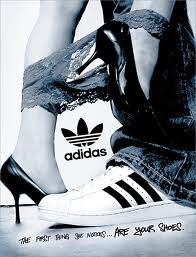
    Food companies weren’t the only ones using sex as a selling point. Last Fall, Adidas also joined the sex appeal craze. They created a controversial advertisement that essentially showed a woman stripping her clothes purely because she was a fan of his Adidas shoes. The ad is being directed toward younger men who thrive to appear attractive through their style. However, it is questionable whether it is actually selling the shoes, or the idea that a woman is easily convinced to undress for a reason such as one’s appearance. Adidas has continuously presented their brand as one that stands for teamwork and the value of sports. They slightly re-branded themselves in this advertisement as a company that also cares about the style Adidas shoes can bring into your social life. A little re-branding is necessary every now and then to keep a product’s image fresh, however an ad such as this one also represents a gender stereotype that women will strip their clothes as soon as they see a pair of stylish clothes. There is a very thin line between proper sex appeal and the use of offensive gender stereotypes, and it is difficult to tell if Adidas actually crossed this line.

    In today’s culture, audiences are bombarded with advertisements left and right. In order to distinguish themselves from the crowd, some advertisements are using sex appeal to grab the attention of consumers. Is it ethical to use sex appeal as a way to persuade consumers? Have advertisements gone too far?

    -Briana McWhirter, Emily Foulke, Hannah Turner

  • Igniting Your Inner Marlboro Man

    Image

    On January 10, Eric Lawson, an actor who played the “Marlboro Man” in print and outdoor advertising for the cigarette brand from 1978 to 1981, died from chronic obstructive pulmonary disease, commonly known as COPD—a disease frequently caused by smoking. Lawson was 72.

    Lawson isn’t the first Marlboro Man to die from a smoking-related disease. At least three other men who acted in the iconic campaign died due to causes linked to smoking cigarettes. David Millar died from emphysema in 1987, Wayne McLaren from lung cancer in 1992, and David McLean from lung cancer in 1995. McLean’s widow sued Philip Morris in 1996, claiming McLean had to smoke up to five packs of cigarettes per TV commercial filming. TV commercials for cigarettes were banned in 1971.

    The rugged, masculine Marlboro Man campaign was introduced in 1955 to market Marlboro to men, because at the time, filter cigarettes were regarded as feminine. The campaign ended in 1999, when the use of humans and cartoons (see Joe Camel) were banned as a result of the 1998 Master Settlement between tobacco companies and the state attorneys general. Today, cigarette advertising is primarily in magazines and retailers.

    Now, the very product the Marlboro Man advertised is ultimately taking away the actors’ lives. After he hung up his hat for Marlboro, Eric Lawson was an anti-smoking advocate, appearing in a public service announcement and a segment on Entertainment Tonight about the negative effects of smoking.

    Image

    Looking back at the cigarette ads of yesteryear, they definitely weren’t ethical, but they sold a lot of cigarettes. The Lucky Strike ad from 1930 claims a pack of Luckies protects against obesity. Today, we are more educated and know the real harm cigarettes cause. The percentage of adult smokers in the U.S. has dropped from 43 percent in 1964 to 18 percent today. (http://www.pbs.org/newshour/bb/health/jan-june14/lushniak_01-12.html)

    With the rising popularity of e-cigarettes, brands such as Blu are taking a “tough and masculine” approach. Does this ad remind you of something?

    Image

    Advertising for e-cigarettes does not fall under the same regulations as tobacco advertising because the product does not contain tobacco. However, e-cigs have not been proven safer than traditional cigarettes. Did Blu make an ethical choice by channeling Marlboro’s now-infamous campaign that made Marlboro the most popular cigarette brand in the country? Blu is a young brand that is advertising in a fashion similar to Marlboro did when it was new. If e-cigs are found to be not at all safer than tobacco cigarettes, should they be subject to the same regulations? What will it take to regulate e-cigarette advertising? These are questions to ask about the ethical implications of cigarette advertising today.

    -Nathan Evers

  • “How REAL Will American Idol Get This Season?”

    It’s that time of year again! All our favorite shows are returning, after a seemingly long-awaited hiatus. The longest running singing competition, American Idol, has returned for its thirteenth season. But this season, Idol has been forced to change things up. The show is taking on a fresh, new approach to increase the amount of viewers by revamping their marketing schemes.

    In previous seasons, the show directed promotions towards the judges, featured cities, and upcoming drama. The initial aspirations of the show to seek out raw talent has slipped within the past seasons and in return, turned away viewers. At the shows peak, American Idol attracted 30.4 million viewers in season eight. Since then, viewer ratings have only decreased and reached an all time low with 14.3 million viewers for season twelve. As a result, Fox has decided to rebrand the show by bringing in a new team of producers, less drama-filled judges, and a more heartwarming advertising campaign.

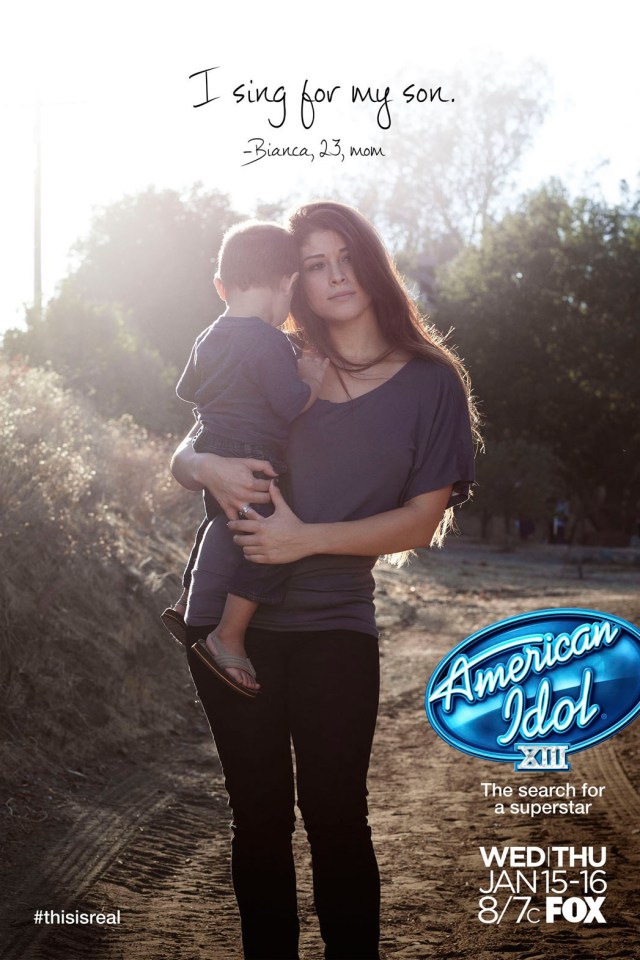
    Within the past seasons, focuses of promoting the show featured drama among the judging panel rather than the actual talent of the contestants. Producers recently have realized the show has drifted away from the heart and original purpose of the show–discovering real people with real talent around the country. In an effort to rebrand their image, season thirteen marketers began focusing on the background stories of the contestants in hopes to return Idol to its initial purpose.
    American-Idol-2014-spoilers-480x265

    American Idol

    One component of the new advertising campaign features eight contestants in their hometowns sharing their personal motivations as to why they sing. Producers felt this new type of advertisement would help viewers identify with the stories and be able to relate to the contestants. Viewers are invited to participate in the hopeful journey of the “average Joe’s” transformation into a superstar.

    American Idol’s new video promotion of the upcoming season also focuses on introducing new contestants and excluding any drama or glamour of the judges (hallelujah). In addition to highlighting real contestants, marketers have incorporated social media by producing a new tag line for the show, #ThisIsReal, to encourage audience conversations on Twitter. Producers hope that the incorporation of social media marketing will increase the show’s ratings and reputation. The advertising of real people and their real aspirations are designed to appeal to a variety of audiences on social media platforms, especially the younger demographics.

    By incorporating a variety of platforms such as television, print and social media, American Idol hopes to attract a wide array of audiences through this new and improved IMC campaign. Do you think this new campaign will be effective in increasing and engaging audiences? Or will American Idol continue its downward spiral?

    -Briana McWhirter, Emily Foulke, Hannah Turner