Tag: Advertising

  • What’s That Doing There?

    After a long day of work or school most of us like to sit down and shut off the batteries. Some people (including myself) do this by
    enjoying a nice beverage and turning on the Netflix. The appeal of a service like
    Netflix is, of course, the elimination of the commercials that disrupt our viewing
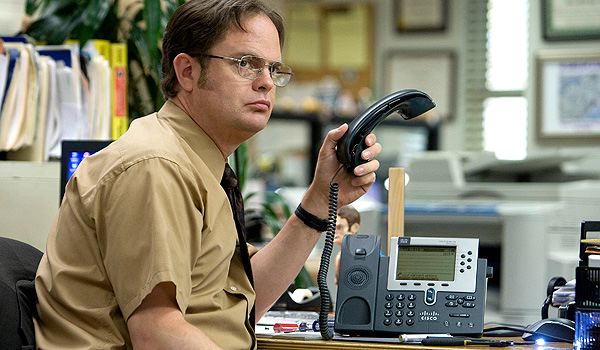
    pleasure on live T.V. One night, I sat down and turned on The Office, I was
    instantly bombarded with company logos and products. As the actors go about
    their typical work day, the camera conveniently focuses on the Cisco Systems
    Telephone on Dwight’s desk and the HP logo on the computer that Pam uses as she
    hides behind her desk. These logos are not in the frame by coincidence, but
    rather they have been carefully positioned by the show’s producers. This discreet
    advertising strategy is known as product placement.
    Business dictionary defines product placement as “an advertising technique used by companies to subtly promote their products through a non-traditional advertising technique, usually through appearances in film, television, or other media.” This form of advertising is initiated through an agreement between a product manufacturer and whichever media company owns the program featuring the product. In the vast majority of product placement agreements the media company receives economic benefit as the manufacturers often pay a fee to have their product (or brand name) used, mentioned, or significantly featured in a program.

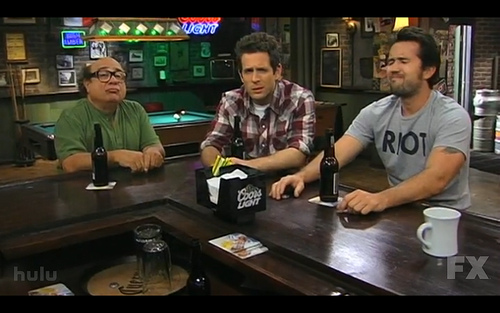
    Product placement is everywhere. A few notable shows that are known proponents of this technique are American Idol (Coca-Cola cups for all judges), It’s Always Sunny in Philadelphia (Coors Light consumption and signs prominently placed in the bar), and 30 Rock (which features multiple Apple products.) This form of advertising has been around for years and will continue to thrive as long as people keep consuming media. In this way, companies continue to ensure that viewers have plenty of exposure to their product, even if certain audience members have learned to maneuver around those pesky commercials.
     

    Michael Nunes, Daniel Schaefer, Lexie Huss, Zach Abramo, Callie FenlonDann Williams, Lauren Habig

  • Have You Experienced the Rainbow?

    If you haven’t been to the Skittles website in a while (or perhaps, ever) now would be a good time to take a peek.  What you might expect to be a typical site, designed to provide advertisement and purchase opportunities, has undergone quite a facelift.  Unlike most sites, the website for Skittles has been reborn as a social media machine disguised as a blog.  Near the top of the page is the familiar Skittles slogan, “Taste the Rainbow.”  Scroll down a bit, and you’ll find an entirely irrelevant tweet from the Skittles Twitter account. @Skittles says, “It’s all fun and games until the chinchillas show up with the karaoke machine.” Next come a few phrases like “lace the train slow,” “trace the vein bro,” and “encase the faint glow,” all with coordinating pictures and all rhyming with the original slogan of “taste the rainbow.” Add a few quirky videos, more interesting tweets from fans, and many opportunities to share things via social media, and  you’ve pretty much summed up Skittles’ entire online marketing tactic.

    The Skittles commercials take on a similar level of oddity as their website.  Whether it’s a teenager catching “Skittles pox” from a “highly infected” friend with the message to “contract the rainbow,” or a guidance counselor eating Skittles out of a student’s unibrow with the message to “pluck the rainbow,” these commercials seem to be getting stranger and more extreme year to year.  So, do these weird messages work to promote their product?  Their 23 million Facebook fans, 47,000 followers on Twitter, and nearly 10 million views on YouTube would suggest that they do.

    As a product that has been a favorite with candy-lovers since their appearance in 1979, Skittles has little need for getting their brand noticed so much as keeping their brand relevant.  That’s exactly the idea behind their weird marketing.  By showcasing their social media followers on their website, and giving fans something different to talk about, Skittles is making people rethink what they already know about Skittles and driving them back to their brand.  The genius behind this tactic is that the product hasn’t changed.  What they are changing is stated right at the top of their site.  “Experience the rainbow.”  Skittles is changing the whole experience associated with their little chewy candies in a colorful shell to be more exciting and hilarious than before.

    What seems to appeal to consumers these days, especially to Skittles’ target market of pre-teens and adolescents, is the eccentric and the humorous.  Skittles has mastered both of these arts.  Not only are they staying relevant, they’re staying interesting.  As advertising trends continue to shift, Skittles will doubtless continue to meet the needs of their consumers and remain a favorite fruity snack to all.  The only question now, is what comes next.

    Ally Walton, Hannah Eure, Gene Lee, Lauren Habig, Erin Kiffmeyer

  • Starburst: A Pack of Contradictions

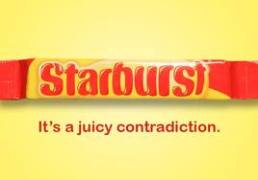
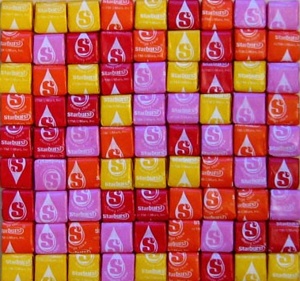
    The latest news on the Starburst brand is that Starburst has launched a new campaign where it focuses on “contradictions.” The most recent Starburst commercial plays on the candy’s “contradiction” of solid, yet with a juicy consistency. The company’s new commercials come off to be very strange, which is exactly the point. With all of the commercials that are constantly played throughout the world, more specifically the United States, it is getting increasingly difficult for advertisements to stand out among the others. In an effort to stand out, companies are creating commercials that seem to be strange but memorable. An example of one of these weird Starburst commercials is the commercial where a Korean man is portrayed as a Scottish man due to the bagpipes and kilt he is wearing. This man is standing with a child who is dressed the same way but eating a Starburst and states, “One contradiction eating another!” Another commercial consists of a screaming mime that is supposed to portray a contradiction. Clearly mimes are not supposed to talk. The most famous of these Starburst commercials though, is a commercial where a dog is riding in the car with a group of men. The dog has its back side sticking out of the window of the moving car, and one guy in the car claims that the dog is a contradiction for doing so, since normal dogs stick their heads out of windows. It is clear that this commercial was effective in at least making a memorable impact on consumers, whether the impact was positive or negative. The commercial’s growing popularity is displayed through the 43,900 results that appear on Google after searching “Starburst your dog is a contradiction”.

    ImageThis Starburst commercial was very successful; however there is much scrutiny that is coming from it. There are many articles and blogs published about how the people shown in these Starburst ­­commercials are not actually a contradiction. One article specifically, titled “Ass-Backwards Starburst Dog Isn’t Really a Contradiction” discusses how the people in these commercials have traits that deem to be opposites, but are not actual contradictions. Author Tim Nudd states, “Now, we get this new spot with a dog who likes to hang his ass out a car window—and he’s called a contradiction. Isn’t he really just a dog with an unusual preference?” There are numerous articles similar to Nudd’s, claiming that these commercials do not actually portray contradictions at all. Therefore, their whole message is distorted and their credibility is in question. Both sides can be argued extensively due to the fact that the word contradiction has many different definitions.
    Under the Dictionary.com definition, a contradiction is a “person, thing, or situation in which inconsistent elements are present”. Based off of this definition, these commercials would correctly portray contradictions. However, under other definitions such as, “a contradiction is two propositions used in combination where one makes the other impossible. It is something that is A and non-A at the same time. A contradiction, therefore, cannot exist in reality, since existence exists” would not consider the people or the dog in the Starburst commercials to be contradictions. These commercials are being closely examined for the accurate or inaccurate usage of the word “contradiction” by many viewers all over the world; however, this brand of candy’s new campaign theme, “Celebrating the contradictions that make life so interesting,” is capturing thousands and thousands of fans daily. The Starburst brand has also created an online “Contradictions Project,” which is seeking to involve fans all around the nation to log on to the Starburst Facebook page and submit common contradictions of their choice. For every contradiction a fan lists, that person will be added to the $250,000 donation, which is partnered with VH1’s Save the Music Foundation, to restore music programs across the country. Whether these new Starburst commercials are considered to be weird, incorrect, humorous, or just plain stupid, the reality of it is, their new theme is making the Starburst brand even more popular than it already was.

    Image

    Sasha De Vecchi, Lindsay Gallagher, Jay Reilly, Cary Welborn

  • Just say anything to win.

    With the 2012 presidential election day right around the corner, the candidates have found themselves in a television battlefield. Each candidate hopes to take his opposition down by firing loaded words weekly. It seems that advertisements to vote for a candidate have instead evolved into advertisements to not vote for their competitor. Both the Obama and Romney campaigns have spent millions on these largely negative commercials that appear to be overflowing our televisions, especially in battleground states. As viewers being constantly bombarded by accusatory messages, are these presidential candidate advertisements doing more harm than good?

    Romney has recently received immense criticism for a misleading television advertisement that aired primarily in Ohio about Obama and the auto industry. The commercial states that Chrysler is moving Jeep production to China because of Obama’s failed policies, a claim that aimed to hit home with the thousands of Ohioans employed in the industry. Although Chrysler does intend on building Jeeps in China, it can be interpreted from the advertisement that Chrysler will stop making Jeeps in the United States and move all production to China. The Democrats’ response to Romney’s claim used blunt terms attacking Romney’s character. The claims were deemed as “outrageous assertions” and Biden even asked of their competitors at a rally in Youngstown, Ohio, “Have they no shame?”

    These responses may have successfully portrayed Romney as a “liar,” but Obama’s auto advertisement used some of the most biting rhetoric yet, according to The Detroit News. It emphasizes Romney’s “wrong-headedness on the auto bailout” (as cited from The Detroit News’ editorial page) but never mentioned the paper’s overall endorsement for Romney in the election.

    Every word in a speech by a presidential candidate is deliberately chosen. Each phrase in a campaign advertisement is carefully crafted. Nothing presidential candidates deliver is accidental, innocent, or meaningless. Politicians are most successful when their campaigning efforts communicate the precise message their audience wants to hear. But what happens when they will say just about anything to win?

    Erin Kiffmeyer, Hannah Eure, Eugene Lee, Ally Walton, Lauren Habig

  • Sandy Shopping Spree?

    As we watch the terrifying coverage of Hurricane Sandy hitting the Northeast, here in North Carolina we are thanking our lucky stars that we managed to escape the worst of it. However, there is one aspect about natural disasters that is challenging to escape: the advertisements. Among all of the advertisements directed towards helping those in need, there is one in particular that stands out all on its own. American Apparel, a clothing company notorious for its no-holds-bar approach to promoting their company, sent out an email blast Monday morning in an attempt to draw in online shoppers who apparently would be “bored” in the storm. This callous disregard of the life-threatening conditions that people are facing quickly went viral.

    Many people have taken to social media like Twitter and Facebook to voice their outrage at the lack of compassion American Apparel has shown for the victims of Sandy. Twitter users were quick to bring up the companies past marketing blunders including an attempt at a plus size model search.

    Needless to say, American Apparel knows how to stir things up. This advertisement was poorly worded at best, and completely ignorant at worst. Regardless, everyone is talking about the “Sandy Sale.” Is this a bad thing for American Apparel in the long run? There is a popular saying in our culture that “there is no such thing as bad publicity.” Part of what our professor, Dr. Persuit, teaches us in Integrated Marketing Communication is how to be thoughtful consumers. In order to do this, the marketing strategies American Apparel employ should have an effect on whether or not we decide to purchase their product. A year from now while you are perusing the mall and finding the perfect piece to complete your closet, will it matter if it happens to be an American Apparel item? Will this advertisement even pop into your memory or will you merely remember hearing something about American Apparel once upon a time?

    – Alexandra HussCaroline MerrillAlyssa MorrelloLauren Van TrigtDann Williams

  • The Power of A Few Words

    In society today, there is an abundance of good slogans relating to the worlds of politics and advertising that adorn and surround our everyday life. Although many of these slogans often seem to be utterly vacuous, as they leave us with nothing, slogans still remain a very powerful example of the power of words and how their influence in motivating people and consumers. Advertising incorporates a series of crucial elements such as images, characters and music in order to further make their slogans even more memorable than the next brand or product.
    These often-superfluous gimmicks play a much larger role than one may expect. In fact, in the increasingly complex and ever-changing world we live in, simplicity counts in the form of communication.
    According to www.SloganPower.com, a powerful and efficient slogan should be able to:
    • Convey the essence of your organization or brand
    • Build your corporate or brand image
    • Establish your unique position in the marketplace
    • Attract and retain customers
    • Boost staff morale
    • Liven up your corporate literature
    • Enhance your competitive advantage

    Here are some examples of the most famous and successful slogans in our society:

    I’m lovin’ it – McDonalds
    What Would You Do For A Klondike Bar? – Klondike
    Yes We Can! – Obama Campaign 2008
    Just do it. – Nike
    Das Auto – Volkswagen
    All the news that’s fit to print. – The New York Times
    Let Your Fingers Do The Walking. – Yellow Pages
    Have it your way. – Burger King
    M’m! M’m! Good! – Campbell Soup
    The Citi Never Sleeps – Citi Bank
    Got Milk? – Milk Campaign
    Have a break. Have a Kit-Kat. – Kit Kat

    All of these examples are very successful slogans that most of us recognize instantaneously. Some of them may even instill sentiment into our hearts for one reason or another. But out of these examples, some stick out more than others. A good example is Nike’s slogan “Just Do It” because it is a very inspirational and successful campaign. The company has turned this slogan into a phenomenon and uses it to brand their products, including everything from t-shirts, to watches, to bracelets, to shorts and shoes, etc. The key is to motivate people to get up and get active, or essentially to go out there and literally “just do it.” These three words are very powerful.

    Today, even our schools have slogans help keep students motivated and give them a sense of community with the school. UNCW recently changed their slogan to “Together We Fly.” A slogan like this not only brands the school well, but it gives the faculty, staff, and students a sense of togetherness. The school then exemplifies a certain image about our university and how well we connect with each other. Bringing a positive image to our school is a huge part of our overall strategic branding. Effective branding will create a greater desire for prospective students to apply here and also help our image overall as an accredited university. Universities all over the world use their slogans to entice prospective applicants to become a part of their alma mater. Everyone in North Carolina knows exactly what school is being discussed when they hear “Tar Heels”.   The University of North Carolina Chapel Hill has established a dominating and elite brand reputation for their school since the 1700’s. When a slogan has motivation combined with pride, it can take the brand to a whole new level of accomplishment.

    Companies and institutions use slogans for a variety of reasons.  There are so many products available today, and consumers are not going to remember each product along with the entire marketing theme associated with such products.  Slogans are easy and catchy ways to grasp the general message that a company is trying to convey.  Just a few words can be extremely powerful in the effort to gain the attention of consumers.

    Sasha De Vecchi, Lindsay Gallagher, Jay Reilly, Cary Welborn

  • Less Cancer, More Birthdays

    “Imagine a world with more birthdays.” Everyone loves a birthday. Birthdays mean parties, presents, cake, maybe a few libations followed by the possible dancing, and just overall merriment. Birthdays celebrate life and represent another year in the world. It is pretty agreeable that birthdays insinuate a good thing and have an overall positive connotation. The American Cancer Society, which hosts Relay for Life-a walking event that is held across the nation and raises millions a year for cancer research and resources, has taken this phrase and integrated it into their marketing campaign to make people rally behind their cause. Now the phrase, “Imagine a world with more birthdays” has an even greater, even tear-jerking message. Imagine a world with less loved ones passing away from cancer and more people being able to be merry and on earth for another year.

    As the designated “Official Sponsor of Birthdays” the American Cancer Society takes hold of the emotional appeal of connecting their cause to everyday life.  The American Cancer Society uses slogans such as “Happy Birthday is a victory song,”  “A world with less cancer is a world with more birthdays” and many others to very effectively draw people into raising funds for the events.  Connecting something scary, like the often terminal illness of cancer, to the happy annual event of celebrating a birthday, something that everyone has, is a very innovative way to put the American Cancer Society’s cause at a relatable level for all.  Everyone may not have cancer, but everyone has a birthday.

    The fact that the American Cancer Society markets their events as a general celebration of life in general makes it appealing to those with cancer or those who have survived cancer because they are fighting and have fought to live and have more birthdays.  It also makes it appealing to those who haven’t had cancer because they get a chance to really celebrate, be grateful for their health, and the fact that they have been able to celebrate their birthdays without fear of them being shorthanded by cancer.  Finally, the message really digs emotionally when it comes to a person who has had a loved one pass away from cancer.  How amazing would it be to be able to celebrate one more birthday with that special person?


    As a society, we understand that messages are being thrown every which way to try to get us to do something.  While the American Cancer Society could use a percentage or amount of money to help get people to support the cause of cancer prevention and awareness, instead they opt to display their organization as one that can bring an immense amount of hope to all audiences.  It’s safe to say the proof is in the pudding.  The American Cancer Society’s Relay for Life had an astonishing 4 million participants and raises about 400 million dollars a year.  With a marketed identity of one that sponsors overall joy, the American Cancer Society has struck a chord causing a strong continued success that many charitable organizations long for.  Happy Birthday must be victory song after all.

    – Alexandra HussCaroline MerrillAlyssa MorrelloLauren Van TrigtDann Williams