My college career has consisted of four different schools. Carson Newman University, Sandhills Community College, Milligan University, and now UNCW. It’s a long story as to why this is a thing, so I won’t get into any details. But, I can say that a big reason for my scenic route through college was that I had trouble finding a school that felt like home to me. The past three schools were great schools, but I did not fall in love with them like I had planned. It wasn’t until I came to Wilmington that I finally was able to call a place “home” and truly mean it. I transferred here the second semester of my junior year and haven’t looked back.
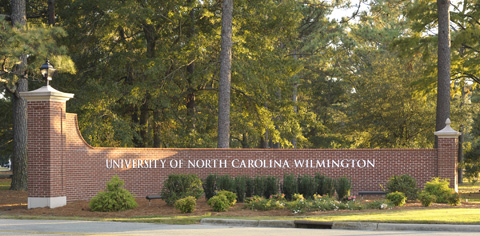
Newly-renovated entrance to the UNC Wilmington campus along South College Road. UNCW / Jamie Moncrief
When I came to UNCW, I was a business major with an emphasis in marketing. Honestly, I was struggling. I had this idea that if I wanted to get into sales and the business field, I needed to be a business major and get a degree in business. This is where I was wrong, and I paid the price for it. I went through that one semester here at UNCW, and I’ll be honest with you, I was not a fan at all. I was struggling in all of my classes, I was stressing about how long it was going to take me to graduate, and I was beginning to tell myself that I was a failure. It wasn’t until the fall semester of my senior year that things started to turn around for me, and that was because of this little thing they call COM.
I came to the conclusion that the road I was going down was not the road for me. I swallowed my pride and went to my advisor’s office in hopes of creating a plan for myself and my future at UNCW. After a small discussion, my advisor brought up communication studies and began to brag about the department here at the dub. After some consideration, pulling some strings, and a bit of prayer, I decided to change my major to COM. I understood that because of all the transferring that I had done in the past, I would have to spend an extra year in college to finish my degree if I switched. At times I had thought of myself as a failure because I did not complete what I had started in my business education. I even thought that I might not be able to have a business career because I was not getting my degree in it anymore. All of these thoughts were completely wrong and I found out very quickly that everything I was telling myself about my decision was completely wrong.
Here I am, in my last semester as a COM major, about to graduate from the great University of North Carolina Wilmington. I currently hold a full time, “grown up” job at Cellular Sales, the number one Verizon retailer, a job that I thought would not be possible at first because I was not getting my degree in business anymore. That was another thing that I quickly learned – COM studies allows you have a wide range of careers to pick from. You can nearly choose whatever you want to do! After learning that COM broadens your horizons instead of minimalizing it, it was like a huge weight being lifted from my shoulders. Here I am, in a sales job, a goal of mine that I had written down for years, all because of COM. Could I have done something completely different to start off my career? Of course! That is the beauty of COM and everything it has to offer.
In days, I’ll be graduating. Because of COM, I’ve improved my skill set more than I could have ever imagined. Because of COM I have new friends who I will be friends with for the rest of my life. Because of COM I have complete control over the rest of my life and the rest of my career. Because of COM, I found my new home in Wilmington and no matter where I go from here, the Dub will always me home to me.
Brady Childers is a May 2021 graduate. His father inspired him to pursue a career in business. Brady loves meeting new people and solving their problems.
If someone would have told me going to UNCW would be the most eventful three years of my life I would have probably rolled my eyes. Eventful is quite an understatement. Between hurricanes, being locked in Randall library in the middle of a COM 200 test because someone got shot in the apartment complex next to campus, and a global pandemic… who would have thought this would be our college career. My roller coaster experience of college started in Fall 2018. I had decided right away Communication Studies was the route I wanted to go; this was decided after taking a public speaking class and learning the many avenues that you could go with a communication studies degree. Because who doesn’t like options? Little did I know COM was one of the largest majors but one of the closest knit communities I would be a part of.
Trust me, walking into Dr. Weber’s COM 105 you wouldn’t think this major would be so close. As the courses go on you start to meet new people, see the same people and learn how to navigate through the major and find your way. My biggest struggle for myself was figuring out which route to take within the major. In the beginning I was just floating. Taking random COM courses here and there. I tried out IMC and felt like I didn’t fit a certain mold, but the more IMC classes I took, I soon realized there isn’t a mold to fit. When you are on campus you can clearly determine who is a nursing major or who is in Cameron. COM has such a wide array of students. You could talk to any person in your class and not feel awkward or feel like you asked a dumb question in COM 301 Rhetorical Theory because no one knew what was going on.
“COM has such a wide array of students”
After dealing with Hurricane Florence and surviving COM 200, I was finally assigned my advisor. Lucky me, I got Professor Rick Olsen as my COM advisor. Though I had him for 200 I would get so nervous to talk to him about advising. Which I learned after our first interaction I was crazy for being nervous. He was always transparent and encouraging whenever we spoke. There was always ‘tough love’ advice. I remember telling Dr. Olsen I wanted to begin my career in Wilmington and he was pretty honest and told me ‘Wilmington is very competitive, good luck.” At first it felt like a dig but as I thought over it several hundred times, I realized because of his transparency I was able to be honest with myself and push my expectations so I could compete in Wilmington. The transparency and tough love is seen throughout COM. Though higher education is seen as professional or refined, the professors in COM have managed to hug the line of professionalism while being themselves which is a blessing. Having professors who are approachable makes a huge difference and I am forever grateful that I got to experience professors who are passionate about their field of study and ensuring COM majors are meeting as well as exceeding the expectations.
As we are inching closer to graduation, I am relieved and sad. I am relieved that we all survived a global pandemic, hurricanes and life and managed to make it to the finish. I am personally relieved because I have been enrolled for a year straight with no break. I am relieved because this hard work has helped me land a position before graduating so I can begin the next phase in my life. I am sad to close this long, eventful chapter out. My time with UNCW and the communication studies department has been amazing. I am thankful for the colleagues, connections and professors I have met during my time. If I was to give any advice to PCOM and current COM majors, please get involved. Whether it is Communication Studies Society, an internship or a club. Take this time to build your portfolio and your network! I am involved with a non profit organization that advocates, unites and builds a community amongst small business owners in Downtown Wilmington and I have built an amazing relationship with Wilmington locals, my mentor has become a guide during the job search and I am currently helping plan an event with a colleague! Make sure you are doing what makes you happy, that will best suit you and your career path!
Nicole Delgado is a May 2021 graduate and is adaptable, intellectually curious, and hungry for great results.
The road to graduation has been a rollercoaster. When I began the ride, I thought I would be graduating four years later in Spring 2020. Little did I know that my path through college would not be the straight line I imagined. That has been my biggest lesson in college; life is not going to go exactly the way you want it to. If all our desires were granted, we would have quite a few more billionaires walking around.
I had to learn how to change my outlook on being successful and motivated, by failing. But now, as I sit here writing this post and reflecting on my past 5 years of school, I can share my lessons learned before I leave UNCW.
Get Organized
First and foremost, learn how to get yourself organized. I used to never plan out anything in regard to my classes but, I learned the hard way, personal organization is a key to success. Buy yourself a planner or a big desk calendar. Sit down for 5 minutes on Sunday night, before the week starts, and plan out the assignment due dates for your classes. I promise you, it will make a world of difference! Having a planner means you won’t be stressed about remembering due dates. You have a source you can refer to anytime you’re wondering when an assignment is due. Simple, effective, and CHEAP!
Roll with the Punches
I made some early mistakes and was academically dismissed from UNCW. I’m sure you’ve heard it before, but college is going to throw a lot at you. Now this doesn’t mean you will instantly be forced into crazy life changes and decisions, but 4 years is a long time and those moments do come and come at you fast – trust me. In my first year in Wilmington, I did not have a solid direction to follow. I put more attention toward my social life than my course and those choices resulted in my dismissal from UNCW. I spent the following year attending Cape Fear Community College and was forced to take a long look at myself and the choices I had made. Assigning blame to outside influences is easy but being introspective and realizing that YOU are the root of the problem is extremely hard. I had to figure out what I needed to cut from my life and what I needed to work on to return to UNCW. That year at Cape Fear CC taught me more than my combined four years at UNCW. I started managing my time effectively and focusing all my attention on my grades. The hardest part of that process was holding on to my motivation to return to UNCW. I was still having hard moments and dealing with feelings of failure that made me want to just give up. Learning to push past those moments and reassure myself that I was doing the right thing made me a stronger person. Learn to not let the low moments get the better of you.
Find Your People (Major)
As cliche as this sounds, find the major you enjoy. In my first year at UNCW, I was initially a finance major but quickly realized it was not the path I wanted to take. After being readmitted, I considered going back to Cameron and majoring in marketing, but my advisor suggested an alternate path. Instead, I could major in communication studies and take courses in integrated marketing communication. I wasn’t sure at first because I didn’t know much about COM Studies. I took COM 301 with Dr. Weber and that was the catalyst that sparked my love for communication studies. The sense of community that was cultivated in his class, and each of my classes afterward, was a breath of fresh air. The faculty in the COM department have been incredibly supportive of me and I never felt as if they did not want me to succeed. Being a member of the COM Studies department allowed me to finish my education surrounded by brilliant professors who all work to prepare their students for success after college. So my advice, go out and experiment with your classes. Your first choice may not be your final choice. The college experience is 10x better when you find a major that interests you.
Liam Abourezk is a May 2021 graduate and believes “failure is the stepping stone for success.”
Multiple channels across social media share messages regarding the ongoing COVID-19 health crisis. Despite the continuous rush of information, most messaging fails to create a common understanding of COVID-19 and what the general public should do about it. Especially with a fairly new vaccination underway, many people are hesitant to trust and participate in vaccination efforts across the country. Klassen et al. (2018) examined the communication efforts made by brands and official health organizations to analyze which methods proved to be effective in creating shared meaning and engagement. As a result, the study determined that each organization must tailor their content toward a specific target audience to create understanding. In other words, certain techniques on particular media channels appeal to specific people.
According to the Journal of Medical Internet Research, health organizations most successful campaigns were found through both online and literary searches (Klassen et al., 2018, p. 3). The data collected explains that health organizations, as opposed to lifestyle or food brands, are less popular on social media channels such as Instagram and Facebook. Considering that information, those channels might not be appropriate when sharing information about the COVID-19 vaccine. Rather, understanding your audience and “tailoring a suitable health message remains important for health promotion design for both traditional and social media campaigns” (Klassen et al., 2018, p. 2). The Institute for Public Relations recognized this disconnect and aims to provide accurate information to those who need it.
The Institute for Public Relations lists a series of resources on their webpage including vaccine communication resources, reasons for vaccine hesitancy, disinformation, vaccine communication strategies, and more. Each section is complimented by articles, studies, and campaigns from a series of different channels. These findings are derived from sources such as the Guardian, UNESCO, and the American Journal of Preventive Medicine. The Institute for Public Relations successfully examines vaccine communication efforts by providing a vast amount of resources. Rather than providing an article per topic, the Institute for Public Relations provides a series of different sources from multiple perspectives, thought processes, and research.
Photo from Ohio Northern University
The channels used include government agency websites, research studies, and news platforms. Like previously stated, health communication was not as effective on social media compared to online and print sources (i.e., newspapers, magazines). Health campaigns that “run via social media have traditionally struggled to reach and engage with large numbers of people” (Klassen et al., 2018, p. 2). A majority of social media users look toward platforms, such as Facebook and Instagram, for entertainment purposes. Most social media communication strategies involve developing relationships and interactions between brands and customers rather than sharing public health knowledge.
Biased and opinionated messages on social media regarding the COVID-19 pandemic and vaccine might be taken too literally and spread misinformation. The plethora of diverse information offered by the Institute for Public Relations aims to debunk common misconceptions spread across social media channels. In a study comparing lifestyle and food brands to health organizations, health organizations “were the only organization type to present statistics or facts in their posts” on social media (Klassen et al., 2018, p. 4). Rather than spreading information across social media regarding the vaccine, brands should amplify the voices of professionals who are providing concrete facts and evidence. Prompting engagement strategies, such as links to health information, are most effective in health communication efforts.
Photo from Toward Data Science
By providing online sources that implement facts, statistics, and research, the Institute for Public Relations successfully builds a strong network of accurate information regarding the COVID-19 vaccine. The Institute for Public Relations also includes information regarding vaccine communication strategies. For example, an Axios article listed on the IPR resource page explains that “certain vocabulary is more effective at getting the public to take the COVID-19 pandemic seriously” (Fischer, 2020, p. 1). With a wide variety of topics, sources, and perspectives relating to the COVID-19 vaccine, the Institute for Public Relations provides users with reliable information that cannot be misconstrued.
Although the general public still lacks a common understanding of the COVID-19 vaccine, the Institute for Public Relations serves as a strategic, functional resource for vaccine information. Data collected from multiple studies find that health communication is most effective when it is produced through online or literature sources. Additionally, this data also argues that in order for information to be properly retained, it must be delivered through the proper channel. Since each individual retains knowledge differently, the Institute for Public Relations provided over 40 sources on seven different topics relating to the vaccine.
About Lily
Personal Brand Statement: Work with intention, purpose, and vibrance. Each experience is valuable and cultivates your sense of self.
Lily is a senior at the University of North Carolina at Wilmington. She will be graduating in May 2021 with a B.A. in Communication Studies and a minor in Entrepreneurship and Innovation Studies. Originally from a small town in New Jersey near Manhattan, Lily appreciates the culture and vibrancy of city life.
Upon graduation, she plans to travel Europe before looking for work in New York City. She hopes to work in the music industry doing promotion or marketing. Lily enjoys a change of scenery and a change of pace. Her experience ranges from interning at Broadcast Music Incorporated in New York City to working as a therapy assistant for children diagnosed with Autism Spectrum Disorder. Currently, Lily works as an Involvement Specialist at UNCW and assists student leaders in running their organizations.
In her free time, you can find Lily cooking vegetarian meals, doing yoga, or going on hikes with friends. Prior to the pandemic, she attended multiple music festivals and live concerts. Her passions include sustainability, music, and social justice.
Klassen, K. M., Borleis, E. S., Brennan, L., Reid, M., McCaffrey, T. A., & Lim, M. S. (2018). What People “Like”: Analysis of Social Media Strategies Used by Food Industry Brands, Lifestyle Brands, and Health Promotion Organizations on Facebook and Instagram. Journal of medical Internet research, 20(6), e10227. https://doi.org/10.2196/10227
Brands have been taking the initiative to market their products on social media platforms and use Influencers to promote their products. In a study done by Balaban, Delia & Racz, Roberta in 2020, with eighty female participants and the brand, Pantene Romania, the researchers tested the differences between the interactions with the brand account and the Influencer’s account. The purpose of the study was to compare the efficiency of social media influencer advertising to brand advertising and take a look at attitudinal and behavioral outcomes. The two groups used were the influencer group and the brand account group. The two groups used the same product on separate accounts on Instagram.
The variables that were tested were brand recall, brand attitude, intention to purchase, and the intention to engage in eWOM. Brand recall is when a customer is more likely to remember the brand after seeing the post. Brand attitude consists of the customer’s attitude towards the brand after seeing the advertisement. Intention to purchase is how likely a customer would be to purchase the product after seeing the ad. Intention to engage in eWOM is when a customer is likely to repost the image or post and share the product with others.
The measurements used were t-tests to see which posts had more engagement. The brand recall for the influencer group was higher than the brand account group by 10%. This proved the first hypothesis, that social media influencer marketing influencer advertising leads to a higher brand recognition than advertising through the brand’s account. There was a significant difference in brand attitude that showed that the use of advertising through influencers leads to a positive attitude towards the brand. There were no significant differences in the purchase intention or the intention to disseminate between the two groups. This may also be because of the small group of participants used for this study or since the researchers only looked at one brand.
These results showed that social media influencer advertising brings a plus to the brand both in terms of the user’s attitude towards the brand and brand recall. The research showed that if a company promotes their brand through people that are well-known and admired by content consumers, it can add value to the brand. Companies are aware of the low-costs that are involved with using social media for marketing and they can increase their followers with the influencers. With these results, companies should be utilizing influencer marketing as an addition to their brand accounts.
Things that need to be considered when searching for an Influencer is how they are perceived, number of followers, post engagement, and if they fit well with your brand. This research contributed to what we know about social media marketing today and how Influencers can increase a brand’s attitude or recall. Since the study was limited to one brand and a small group of participants, the next step would be to test out multiple brands with larger groups. This study was only done with Romanian young consumers, it would be interesting to see the results with different age groups.
About Julia
Julia is a senior at the University of North Carolina at Wilmington and will graduate in May of 2021 with a B.A. in Communication Studies. She plans to work with a local business as a Communication and Marketing Intern. In the future, she hopes to work for a large company where she can pursue her love of Graphic Design and Communication.
Julia has helped smaller brands with their social media platforms since the age of 16. She created content and established an identity for her clients. She knows how to engage the audience and gain a diverse following by using strategies she developed through her experiences.
She enjoys anything that is art-related and going to the beach with her dogs. She is excited to learn more about brand strategy and will use those lessons in her future career.
References
Balaban, Delia & Racz, Roberta. (2020). Social Media Influencer Advertising versus Advertising on Social Media Account of a Brand. Evidence from an Experimental Design. Journal of Media Research. 13. 45-54. 10.24193/jmr.38.3.
The rise of the “social media influencer” has effectively transformed marketing communication, adding an additional dimension to consider that didn’t exist just a few years ago. The name “influencer” implies a level of influence, but do social media influencers actually have the power to affect the attitudes, brand engagement and, ultimately, purchasing behaviors of their loyal audience? A recent study completed in Canada identifies the three aspects of brand engagement that matter and found that social media influencers (SMIs) have the power to influence consumers at each stage of the engagement process.
What is a Social Media Influencer?
According to the study by Delbaere, Michael, and Phillips, social media influencers are “third-party users of social media who have achieved micro‐celebrity status in the form of large followings on social media platforms and who have a position of influence on their audience. This achieved social status can be used to communicate marketing messages for brands and influence consumer opinions” (Delbaere, Michael, and Phillips 2020).
SMIs fall somewhere between a typical social media user and a brand in terms of reach and influence. They have much larger followings than your average user, but they bring more of a human element than most brands can.
Why do people trust what SMIs have to say?
Parasocial interaction theory (PSI) helps explain why social media users see SMIs as trustworthy and value what they have to say. PSI describes the “illusory feeling of friendship with a media personality,” and that concept can be extended to the relationship that forms between SMIs and their followers.
Research shows that the stronger the feeling of friendship a viewer has toward a SMI, the more influential they perceive the SMI to be. This phenomenon makes SMIs valuable thought and opinion leaders with the power to influence attitudes, purchasing patterns, and more. Viewers also generally find user-generated content (UGC) more influential and trustworthy than brand-generated advertising. There has been a growing body of anecdotal evidence of the power of SMIs to influence brand engagement by mentioning and promoting brands on social media, but measuring that impact is slightly more difficult.
How do we measure brand engagement?
Brand engagement is a relatively general term, but in recent years researchers have begun to accept a multifaceted approach to measuring brand engagement focused on three dimensions: cognitive processing, affection, and activation.
Cognitive processing refers to the consumers’ depth of thought about a brand. At its core, how much and how deeply are they thinking about the brand?
Affection describes the consumers’ positive emotions related to the brand. In other words, how passionate are they about the brand?
Activation is the money-maker. This dimension examines the energy, effort, and time spent with the brand. Do viewers go out of their way to engage with the SMI about the brand? Perhaps more importantly, are SMIs able to convert viewers into consumers of the brand?
These three dimensions together provide valuable insight into what exactly SMIs are influencing. Not only are they influencing purchasing behavior, but they also seek to influence general attitudes toward the brand, and, in many cases, they leverage their parasocial relationship with their followers to do it.
Can SMIs actually influence the brand engagement of their followers?
The short answer: yes. The long answer: yes, based on a lot of anecdotal evidence and some limited, but significant, empirical evidence. The study we are discussing only looked at beauty influencers on YouTube and how they drove engagement for the brands they mentioned in their videos. Despite its limitations, the study found that beauty SMIs increased all three dimensions of brand engagement when they mentioned brands in their videos.
Simply by watching a beauty influencer’s video, viewers’ awareness of the brand increases, prompting enhanced cognitive processing surrounding the brand that would not have occurred otherwise.
Researchers found that when SMIs enthusiastically endorse a product or brand, their followers want to maintain their perceived friendship with the SMI by similarly engaging with the product. When they see the SMI’s positive feelings towards the brand, they are likely to emulate those emotions and trust that brand more because of the SMI’s endorsement.
Activation means that the viewer took extra steps to engage with the brand mentioned by the SMI. This may be simply leaving a comment on the video or, to measure activation at the brand level, commenting that they purchased the product because of the SMI’s video. Converting viewers into consumers may be the ultimate measure of activation, as it means that the SMI was able to influence their viewers’ perception of the brand enough to translate into sales.
Photo by Eaters Collective on Unsplash
So, should you make SMIs part of your brand strategy?
Those of us who work in brand management know that a great brand strategy is all about creating relationships. Today’s consumers are in control of their experience and understand when they are being sold to. With access to unlimited purchasing options and opinions about brands, they are social and collaborative in making purchasing decisions. Overall, they are much more interested in building relationships with the brand (and other consumers) than seeing a commercial or reading about a product on the company website.
SMIs provide brands a unique opportunity to give their brand a human touch that resonates with consumers. In the world of social marketing, the opportunities are endless. Brands get to be creative and nurture the relationships that make their brand what it is. Whether you are looking to drive sales or simply increase your brand awareness, incorporating SMIs into your brand strategy may be the perfect option to increase exposure and forge new relationships with your followers that will help your brand grow.
Meet Nicki!
Brand Statement: Helping brands find their voice.
Nicki D’Alessio is a current senior at the University of North Carolina Wilmington graduating in May 2021 with a bachelor’s degree in communication studies and Spanish. She is a member of the Honors College at UNCW and is currently conducting a senior thesis project on the role of news consumption habits on public perception of the Latinx population in North Carolina. Nicki’s specific area of expertise is in branding and social media and she is passionate about helping brands increase their impact and discover their identity. Nicki believes that a brand is about more than just a logo or a catchy slogan. A brand needs to be a well-rounded and holistic representation of a business that includes not only a great logo or slogan, but also consistent color schemes and typefaces, an intentional brand voice, quality visual assets including photos and graphics, and more.
Nicki’s experience ranges from academic work, to extracurricular involvement, to volunteer work, to professional experience. She has taken a wide array of integrated marketing communication courses through the Department of Communication Studies at UNCW, including Essentials of Integrated Marketing Communication, Strategic Writing in IMC, and Message Design. She also completed a marketing internship with UNCW Campus Life for course credit last semester and continues to work with them this semester managing their social media accounts and tracking analytics. Nicki’s current position is Social Media Manager with Drewe & Kate Branding Co., based in Wilmington, NC. In this position, she manages ten social media clients, writing all captions and copy, curating content, creating compelling graphic assets, and monitoring social media analytics for all accounts.
In her spare time, you can find Nicki reading, exploring local shops and restaurants, or loudly singing along to showtunes in her car. She loves living at the beach and has loved enjoying everything Wilmington has to offer over the last four years. After she graduates in May, Nicki hopes to continue to work in branding and social media after spending some time abroad as a teaching assistant in Spain.
Delbaere, M., Michael, B., & Phillips, B. J. (2020). Social media influencers: A route to brand engagement for their followers. Psychology & Marketing, 38(1), 101-112. doi:10.1002/mar.21419
We know the importance and value of selling our products or services, but have you ever considered how branding might play a role in recruiting the best employees? The authors of, “Attracting applicants through the organization’s social media page: Signaling employer brand personality,” Marieke Carpentiera, Greet Van Hoyea, and Bert Weijtersb argue that a brand’s social media presence and employer brand personality ultimately affects the overall attractiveness of the brand to the potential employees. When deciding to apply for a job, prospective employees look at the organizational warmth and attractiveness of the brand.
A brand’s organizational warmth might mean how friendly the brand is perceived. Carpentiera et al. (2019) explains, “Based on signaling theory, an organization’s social media page that portrays higher levels of social presence, might lead people to infer that the organization itself is more friendly, has high morals and good intentions, which results in improved perceptions of organizational warmth” (p. 4). When researching this, Carpentiera et al. (2019) hypothesized that, “…after viewing a social media page higher in social presence, the organization will be perceived as higher in warmth” (p. 4). This indicates that an organization’s social media content matters to not only their consumers, but potential employees as well.
Another component potential employees look at when deciding to apply includes organizational attractiveness. Carpentiera et al. (2019) suggests that “…informativeness will be indirectly positively associated with attraction and word-of-mouth intentions through inferences of organizational competence” (p. 6). When considering the effects social media has on potential employees, Carpentiera et al. (2019) explain, “…research so far indicates that exposure to company information on social media can positively influence corporate reputation, corporate image, employer image, and organizational attractiveness” (3).
Now that we have determined the importance of organizational warmth and attractiveness, you might be wondering how you can increase your brand’s warmth and attractiveness. There are various brand communication techniques one can use to attract new employees who are culturally a “good fit” for the organization. Dan, a content marketing officer with Talkwalker, reviewed strategies for creating positive brand communication in “COVID19 | Positive brand communication techniques.” He recommends nine strategies: adapting your sales model, providing assistance to key workers, providing support to the more vulnerable, creating more digital touchpoints to engage your audience, being transparent in your communications, engaging in relevant community hashtags, putting your employees before your bottom line, offering free trials or usage to meet client needs, and keeping calm and carrying on (Talkwalker, 2020).
Although many of these strategies are geared towards the consumer, they can be applied to potential employees as well. Dan describes that providing assistance to key workers means supporting individuals who are essential during COVID-19, especially individuals such as healthcare employees and grocers. This may increase your brand’s organizational warmth through showing that your brand cares for others. Dan additionally recommends providing support to the more vulnerable. This is quite important for consumers, but showing that you do provide this support will be another way to show that your brand values others’ comfortability and health.
Furthermore, Dan suggests being transparent in your communications. This not only conveys the values of honesty and transparency with your consumers, but with potential employees. Considering your brand’s values and including these values in a job posting and reflecting those values on social media may help with the overall attractiveness of the organization. Finally, Dan recommends putting your employees before your bottom line. There are many ways you can show your employees that you care. This may include shout-outs on social media, and targeted messages to show you care. In his article, Dan provides an example from Starbucks with a graphic that reads, “We’re in this together. Caring for our community is our top priority,” and claims that Starbucks is providing free therapy for their employees due to the circumstances regarding COVID-19.
Ultimately, social media presence is vital for a brand in 2021. Carpentiera et al. (2019) “…propose that perceived organizational warmth and competence induced by exposure to social media page[s] will positively relate to increased organizational attractiveness and word-of-mouth intentions” (2). If you are looking for the best employees, consider adjusting your job postings and reevaluating your social media content with a potential employee perspective in mind.
ABOUT THE AUTHOR
Personal Brand Statement: Alignment. Good Energy. Full Potential.
Caroline is a senior at UNC Wilmington majoring in Communication Studies with a focus in
Integrated Marketing Communication. She is interested in Communication Studies because
she enjoys having the opportunity to create and collaborate. In her free time, Caroline enjoys
going for runs, spending time with friends and family, and going to the beach.
After graduation, she plans to apply for the university’s IMC graduate program. She hopes to
work for a social media marketing agency where she can help brands meet goals and reach
their full potential. As a social media marketer, she would also help brands align their values
and mission with the overall cohesiveness of their brand.







 IMC Hawks Blog