Blog

  • Government Shutdown affects Nonprofits

    On Tuesday October 1st, the United States government shutdown for the first time in 17 years. Who is out of work? With exceptions, most agencies without any funding from outside the federal government are forced to send “non essential” workers home, and “essential ” workers will have delayed pay checks. So what does this mean for the numerous nonprofit organizations who receive government funding? It looks like many nonprofit organizations are just going to have to wait it out. The interesting thing is, a time of a government shutdown leads to high demand for nonprofit organizations to help the community; but how the nonprofit organization is affected as a whole will depend on how long this period lasts.image

    In the Huffington Post, Tim Delaney, president and CEO of the National Council of Nonprofits response to the public states, “While business as usual in Washington focuses on partisan posturing and personal positioning, the business of serving communities doesn’t stop. Indeed, the needs of the people have escalated due to the all-too-steady stream of actual and threatened government slowdowns, shutdowns, and meltdowns. That’s why charitable nonprofits do all they can to keep their doors open to serve local communities across America”.

    Feeding America  addresses that depending on how long the shutdown lasts, programs like Supplemental Nutrition Assistance Program (SNAP- formally known as food stamps) and Women, Infants and Children (WIC) could be in danger as they currently only have enough funding to make it through October. If this persists, people who currently get assistance from these programs will seek alternative non profit solutions. Areawide Aging Agency , in Oklahoma, is one nonprofit organization receiving federal funding that could be affected soon. In an article on NewsOK, Marnie Taylor, executive director of the Oklahoma Center for Nonprofits states, “While in Washington they’re fighting to close doors, here we’re fighting to keep them open”.

    image
    Other organizations don’t have until the end of October. Meals on Wheels is getting hit by the government shutdown hard. In an article on mlive, Meals on Wheels executive director Alison Foreman states, “We get about $250k from the federal government so it’s more than half of our budget. If they don’t reach an agreement by Friday we won’t be getting any money on Monday to pay for the food.”

    Each of these organizations are now faced with handling this situation in a way that they’re reputation will not be a stake. The Situational Crisis Communication Theory by W. Timothy Coombs states that when an organization is threatened they need to react with a communication media strategy. How they are framed in the media will persuade the views of the organization to their publics. Not communicating possible threats is the worst thing they can do. After all, this is all that nonprofit organizations can do in a crisis like this while they wait for a government decision.

    -Kelsey Raskob
  • It’s Fun to Stay at The YMCA

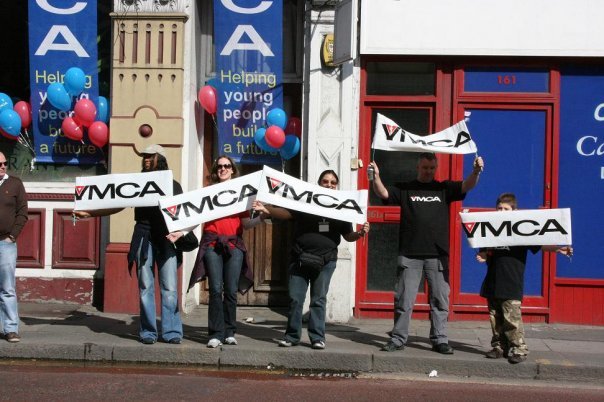
    The Young Men’s Christian Association, better known as the YMCA, is indisputably one of the most prestigious nonprofit organizations to date in American history. With locations found in upward of 10,000 neighborhoods ranging across the nation, it is nearly impossible to miss this large organization.

    Today, the YMCA is often referred to as a “community-centered” organization that brings people together connecting individuals of all ages and backgrounds. This nonprofit places a major emphasis on community enhancement and the idea of giving equal opportunities for people to learn, grow, and thrive as active members of a society. Some of the YMCA’s central focuses are; promoting youth development, healthy living, and social responsibility. Although, most importantly, it serves as an institution for diverse communities to come together with the intentions of engaging in social interactions inside of a healthy and public atmosphere.

    Initially, during the emergence of the YMCA, in the mid 1800’s, this organization served as an outlet for young men to gather and escape the harsh realities and hazards produced by daily life on the streets. At this particular time the organization provided an environment for young men to come together to socialize, discuss commonalities and engage in religious practices such as Bible study and prayer. This “refuge” played a critical role in how men established and developed diverse interpersonal relationships.

    Image

    Over the YMCA’S long-lived history, the ideals and aspirations of the organization have developed and undergone significant changes. Although the primary influence is to create personal and social success is still clearly evident, enhancing interpersonal communication is a newly found goal of the Young Men’s Christian Association.

    Thinking about the success of this organization can be attributed to many things. While interpersonal communication is a major factor, we urge you to also consider the social penetration theory. This theory explains that as relationships develop, interpersonal communication shifts from relatively shallow conversations to deeper and more intimate ones.

    So how does this play a role in the success of the YMCA as a major organization? As they continue to create programs such as group exercise classes, bible studies, after school child care opportunities, they also work to increase their participation within the organization. More and more people join and without realizing it, they begin to contribute to and participate in the social penetration theory and the success of the YMCA. What starts as coincidental run-ins and superficial exchanges of conversation soon transforms into meaningful dialogue and a true sense of community.

    As the YCMA continues to expand their organization through the creation of more locations and the implementation of programs and opportunities, they will also increase their ability to stay a top non-profit organization in America today. So, next time you walk into the YMCA to go to a workout class, dance lesson, or bible study remember what you are contributing too – the success of a great organization.

    Visit these links to learn more about The YMCA and how to become involved in your community:

     http://www.ymca.net/about-us

    http://www.huffingtonpost.com/2012/11/07/new-study-nonprofit-times-top-100_n_2083998.html#slide=1726078

    -Alex Corrigan, Kaitlin Batson, Parker Farfour, Caitlin Ford


  • The Invisible Children Are Not So Invisible

    In 2004 the nonprofit organization Invisible Children was founded, and released their first documentary. For those of you who don’t know, their goal is to stop the Lord’s Resistance Army (LRA) conflicts happening in Uganda by making awareness videos, creating rehabilitation centers and traveling around the country to spread the word. Almost two years ago they created a video, “Kony 2012,” which was a 30-minute documentary about Ugandan rebel leader Joseph Kony. According to Samantha Grossman from TIME NewsFeed, “This video was viewed more than 100 million times in just under a week, making it the most viral video in history.” Visible Measures is an analytics company that researched the short film and has found that it is now on YouTube translated into multiple languages such as Spanish, Italian, French and Chinese. The Cross-cultural adaption theory explains how people may adjust to new information in an environment, which in this case are the LRA conflicts. By watching and sharing this video on YouTube people have integrated themselves in this culture just by participating.

    You may be wondering how one video could become viral so quickly. The answer is that the organization had already been extremely active on social media sites such as Twitter and Facebook with thousands of followers. The idea was to share the video and have people pass it onto friends and family until everyone on the internet had seen it. This is an example of grassroots marketing, where you target your efforts to a small group and hope the group will spread your message to a much larger audience. The organization’s efforts were successful since celebrities such as Oprah Winfrey and Justin Bieber found these videos and posted them on their own profiles, encouraging millions more to view it.

    Bieber retweeted an Invisible Children message and then looped the link to the video to his 18 million-plus followers several times, saying, “it is time to make him known. Im calling on ALL MY FANS, FRIENDS, and FAMILY to come together and #STOPKONY.”

    Oprah referenced Kony’s Lord’s Resistance Army, saying, “Thanks tweeps for sending me info about ending #LRAviolence. I am aware. Have supported with $’s and voice and will not stop. #KONY2012.”


    kony2012-195x300


    Even after all of the positive feedback, there are still many that believe this video was misleading propaganda. Jee from J Student Reporters states, “The Invisible Children have been criticized for over dramatizing and oversimplifying this issue, which is a past problem in Uganda.” The article also goes on to talk about how the Ugandan government believes the LRA is no longer active because of expulsion by the Ugandan Peoples Defense Forces in mid-2006. After reading this information I started to wonder why an organization with so much power would want to bring back an old issue. I do believe that the Invisible Children have stuck with their mission through all the negative comments about what they are fighting for, so there must be a good reason for it.

    Another problem people seem to have with the organization is that the money they receive does not all go to Uganda, but to make films just like this one. Cathy Curran from CBS states, “According to their financial statements, 20% is spent on management expenses and overhead. Last year $1.7 million were spent on travel, $3. 8 million were used for the film, advocacy and spreading their message and $3.3 million went to programs in Central Africa.” Even though every cent has not directly gone to Uganda, it is still being spent to help make people more aware of the situations there.

    The Kony video was an eye opener for everyone, and encouraged people to care about an issue that was not even heard of before it. Without this video not only would people not know about the problems in Uganda, past or present, but there would be $3.3 million less going towards programs in Africa. They are also using a smart tactic by making their followers their own PR people. This makes them feel more involved in the company and really feel like they’re making a difference.

    -Ashley Creps, Rachel Edwards, Chad Darrah, Dylan Fowler, and Ryan Nagy

  • The Personality Behind PETA

    “Animals are not ours to eat, wear, experiment on, use for entertainment, or abuse in any way,” is the brand proposition of the world’s largest animal rights organization, PETA. The acronym PETA stands for People for the Ethical Treatment of Animals, and is known for their extreme stance on the treatment of animals.  This non-profit organization is based in Norfolk, Virginia and has over 3 million supporters who avidly believe in it’s mission.  The four main areas that PETA focuses on where animals suffer the most are factory farms, clothing industries, laboratories, and the entertainment industry.  There are many reasons for PETA’s success as a non-profit organization since its founding in 1980.  One main reason for the organization’s success is how they have fostered their strong brand personality.

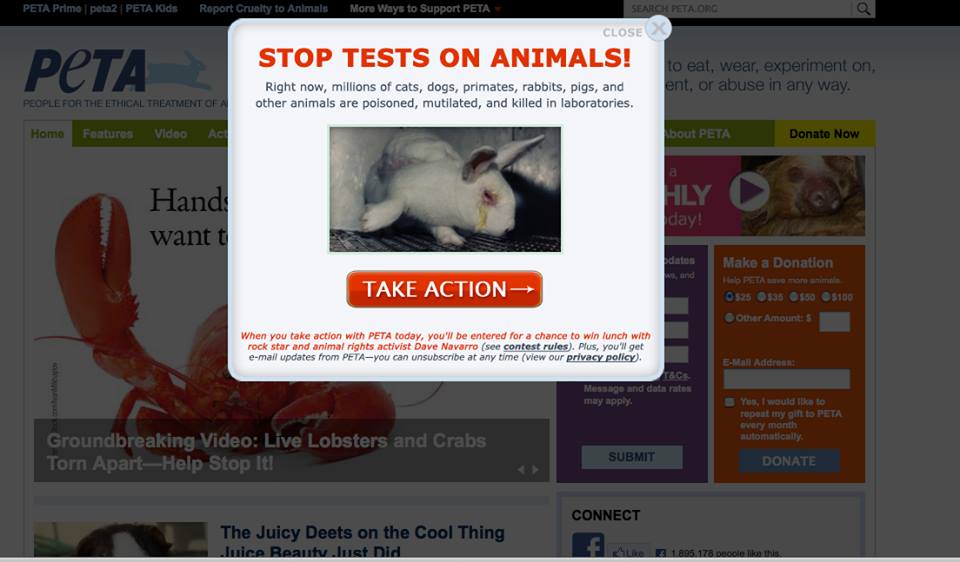
    PETA’s brand personality can be described as aggressive, emotional, and persuasive.  These characteristics can be seen in their advertisements, commercials, endorsements, and website.  Aggressiveness can be seen on the organization’s website through its use of language and tone.  The language used can be seen as aggressive because it is dramatic and creates a serious, yet sad and drastic tone.  One example from the website (even before you arrive at the main page) is a pop-up that takes up the entire screen.  The pop-up “greets” visitors the first time they view the website and features a graphic image of an ill-treated animal.  Language on the pop-up is bold, red, and uses exclamation points.  The message states, “Right now, millions of cats, dogs, primates, rabbits, pigs and other animals are poisoned, mutilated, and killed in laboratories.”

    Image

    Emotional appeals come into play as you continue onto the main page of the website and see horrific images of distressed or dead animals.  PETA uses this technique to form their brand personality because people’s emotions are triggered when they see either sad photos of animals, or even victory stories of animals that PETA has saved. PETA keeps their promise of saving more animals by having a readily available donation section on the homepage. Supporters who are moved by PETA’s mission are able to fill in their information and donate to save more animals with just one click. This allows supporters to create an emotional attachment because they aspire to create an ideal self by donating to the cause.

    Image

    A large portion of PETA’s success can be attributed to their use of celebrity endorsements as a means of persuasion. Celebrities such as Bob Barker, Carrie Underwood, Simon Cowell, and Audrina Patridge have all teamed up with PETA to support their mission and cause. One campaign in particular that remains consistent with PETA’s brand personality is represented by former Miss USA winners who advocate the idea that they would rather go naked than wear fur. These advertisements are meant to make the viewer feel uncomfortable in an attempt to call people to action. Even Academy Award winner, Joaquin Phoenix, has paired up with the organization to make an influential video that relates to his own personal experience dealing with animal cruelty.

    PETA’s brand personality continues to be strengthened because supporters are able to express their identity by representing the organization.  The combination of these three characteristics create an overall concept of what to expect of PETA, which is both distinctive and enduring.  Other than these three characteristics (aggressive, emotional, and persuasive) what comes to mind when you think of PETA? Do you feel that their brand identity is distinctive and memorable?

    – Aaron Love, Kara Zimmerman, Rachel Clay, Rebecca Hobbs

  • Social Media to Help Others

    The invention of social media has changed the way we communicate as individuals. Today we are constantly connected to one another whether or not we prefer to be. Social media has not only been used to keep individuals in contact with other individuals, but as a way for businesses to communicate and connect with their consumers. Social media interactions focus on building customer relations and fulfilling the expectation “that customers expect brands and businesses to be there for them everywhere, across mobile and social media.” 

    While for-profit businesses try to drive consumerism behavior, non-profits try to drive behavior towards volunteering, donating, rallying, etc. Social media offers an inexpensive but powerful way to recognize and encourage desired behavior. Social networking sites allow non-profits to quickly announce, update, or reiterate the needs or goals of the organization itself or the publics they are trying to help, to vast numbers of people. This becomes largely helpful in raising awareness of time sensitive or unexpected events, in particular during times of crisis. Whether natural or humanitarian, social media can allow to-the-minute updates of the severity of the situation and the needs of the victims. One recent event in Kenya has proven just how successful a non-profits needs can be filled when using social media.

    On September 21, 2013 terrorists with the Islamist militant group Shabab in Somalia (linked to Al Queda) invaded a Kenyan mall. Westgate Mall is a 5-story upscale mall that represents the country’s growth and prosperity. A little before noon the Shabab conducted a double attack on the mall with heavily armed attackers storming into the mall from two different entrances and opening fire on shoppers. The shooting rampage soon turned into a hostage situation as many of the shoppers were trapped inside. As night fell, two special units moved in to try and rescue hostages and stop the attackers. The situation lasted for four days and concluded with over 60 deaths and 175 people injured.

    During the Westgate crisis the Kenya Red Cross (KRC) stepped up their game and became a prominent first responding unit. Performing the normal duties of any Red Cross organization they helped to alleviate those involved in the Westgate disaster by holding blood drives, setting up triages, and creating missing persons list, but what the Kenya Red Cross did the best during this crisis was communication.

    From the start of the shoot out the KRC began sharing information about the crisis through the social media platform Twitter. As the events unfolded their tweets consisted of calls for blood donations, updates to where people could report and find the status of missing persons, and updates on changing traffic patterns.

    example of info & blood tweets

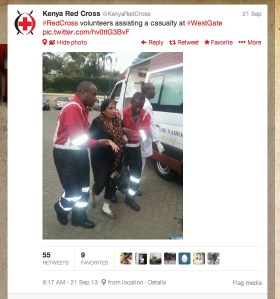
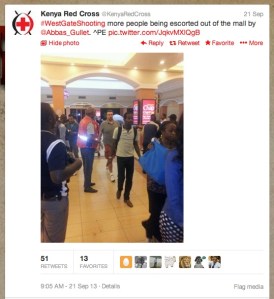
    They even tweeted pictures giving Kenyans and people around the world a first look at the crisis.

    KRC helping victims people being escorted out of mall

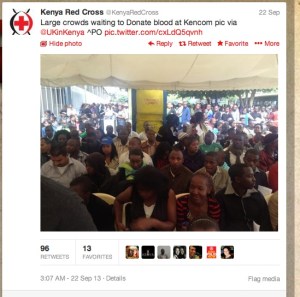
    Using Twitter was a way the KRC could not only rally support and share information, but show their role as a non-profit to the world. Unifying the people of Kenya in this moment of crisis was their biggest accomplishment. This success was shown in the turnouts of volunteers and blood donors they received in the following days of the ordeal.

    large crowd turnout

    Even though the terrorist attack ended days ago the Kenya Red Cross is continuing their efforts to help those affected through the social media platform. They have collected 11,293 units of blood and are reporting the money raised and what it is being used for to the public – all through tweets. Their ability to reconnect people after disaster through Twitter makes them a shining star in non-profit social media use.

    The Kenya Red Cross used social media to inform people all over the web of an important issue, as well as what solutions could be offered to help. This represents agenda setting, the theory that the media have the ability to tell people what issues are important around the world. This also involves controlling the topics people discuss and become concerned with, so by using Twitter, the Kenyan Red Cross regulated the conversation of many people who were directly affected by the disaster. An awareness of the situation was presented, therefore the crisis was held at a higher level of importance because of the media outlet that was used.

    It is clear through the Westgate Crisis that social media can be used successfully by non-profits that respond and work through disasters.  Social media will prove again and again to be a useful medium to help victims, bring together volunteers and unite the world in times of crisis.

    Caroline Robinson, Jade Lester, Meghan Carey, Morgan Jones, Savannah Valade.

  • “Together We Make Football” and Community

    When I think about the NFL, or football in general, my mind immediately goes to large men with helmets running into each other; granted, I am not a big sports fan.  Most people’s minds wouldn’t imagine a little girl as the face of a major NFL ad campaign.  However, tiny Samantha Gordon, a ten-year-old pee-wee football player from Utah, is featured on the first commercial of the NFL’s “Together We Make Football” campaign.

    0ap2000000247227

    “Together We Make Football” is a contest where football fans of all ages, shapes and sizes are encouraged to share their stories of how football impacts their lives and what it means to them.  The contest narrows down to ten finalists, with five invited to take part in Super Bowl XLVIII festivities.  These stories can be in video, picture or story form and are posted to the “Together We Make Football” website.  The winners are chosen by a panel of judges, and the site’s visitors are invited to “like” the different posts; although these likes don’t have any affect on the contest winners.

    So how can I, someone so inexperienced in all things NFL, take an interest in “Together We Make Football?”  By applying it to what I know.  This campaign is a perfect example of how subcultures form and become such tight-knit communities.  The Social Identity Theory of communication states that people have many different versions of themselves depending on the groups, or subcultures, they belong to.  Different social situations are what drive these separate “selves” to behave in certain ways.  The title alone explains why “Together We Make Football” exemplifies this theory.  Defining fans of football as a “we” takes thousands of people and brings them together into a single unit.

    nfl-rivals-has-arrived-bring-your-rivalries-into-the-game-now_niesg_0

    Social Identity Theory goes further, saying that people belonging to one group tend to favor others within the group at the expense of others on the outside.  This holds true in the NFL regarding team rivalries in which fans become passionately involved.  Rivalries are like a double-edged sword, bringing together fans of the same team while creating tension with the fans of the opposing team.

    “Together We Make Football” reminds us that all fans are the same.  Ultimately, the goal is for their favorite team to win.  The campaign reminds us that all fans have the same goal, though it might be for different teams.  It allows people to share why they love the game so much, which can bridge the gap between rivals.  The different fan groups can become a single football-loving “we” because of the “Together We Make Football” campaign.

    – Maggie Dowicyan

  • Training Fresh with Subway

    Athletes today are not only known for their moment of fame on the big screen during game day, but also, for their many appearances endorsing popular products, brands, and, restaurants. Subway is a restaurant chain not only known for their popular array of sandwiches, but, also for the many athletic spokespeople that work to promote their healthy food options. Surpassing McDonald’s in number of worldwide restaurants, Subway is most definitely a force to be reckoned with in the fast food industry.

    Being so high on the fast food chain, a restaurant of such magnitude wants only the best to represent their brand. This is why Subway has chosen to use well-known athletes as celebrity endorsements. They have been quick to snag star athletes from a plethora of sports and now appear to be greatly reaping the benefits of their decisions, but, why? How do these athletes help encourage everyday consumers to eat Subway? Easy!

    Subway prides themselves on being able to partner with big name athletes such as Nastia Liukin, Michael Phelps, Robert Griffin III and Apolo Ohno, but, they did not pick these celebrities at random. According to Tony Pace, SVP and global CMO of Subway “We choose fans of Subway who just happen to be famous.”

    One of Subway’s newest marketing campaigns utilizes their celebrity endorsements by asking them the simple question; what’s your favorite Subway sandwich? Each athletes answer can be found on the Subway website under the “Famous Fans” tab.

    sub

    The page includes a brief description of each of their fourteen supporters alongside the name of their favorite sandwich. Subway’s slogan is, “Subway, the official training restaurant of athletes everywhere.” This goes hand in hand with their promotion of healthy eating and low-calorie sandwich options. Yet still, many want to know why just the sight of their website or viewing of a thirty-second commercial clip makes us want to eat Subway.

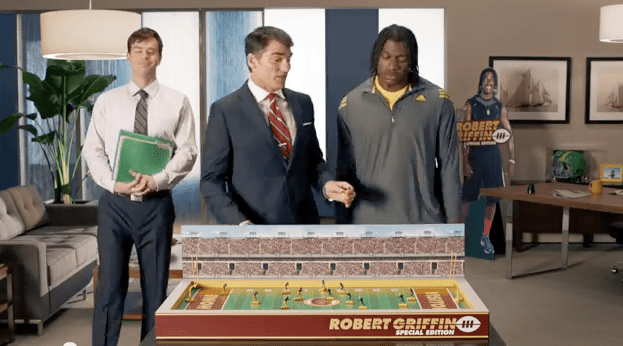
    It has to do with the attribution theory, studied in many communication and psychology classes. Viewers of Subway commercials see famous celebrity athletes supporting Subway and attribute their success to Subway and its healthy sandwich options. One of Subway’s newest commercials features the famous Washington Redskin’s quarterback, Robert Griffin III, better known as RG3. Throughout the commercial the narrator makes Comments such as, “RG3 trains hard and smart with low-fat protein-rich turkey breast” and “RG3 always scores with his fav, Subway turkey breast with spinach and tomatoes.” This creates an automatic correlation in the mind of consumers between the success of Robert Griffin III and his decision to eat at Subway.

    RG3

    As we continue to see RG3 and other athletes on Subway commercials, and hear about all of their many accomplishments, we will most likely continue to choose Subway as a top fast food restaurant. I mean, who else wants to eat at the same restaurant as Jarvis Jones, Mike Trout, and Carl Edwards? We do! This healthy promotion is one that has everyone giving Subway two thumbs up and a stamp of approval.

    -Caitlin Ford, Kaitlin Bateson, Parker Farfour, Alex Corrigan